


Who
Tim Smith, President and General Manager of Waterville Valley, New Hampshire
Recorded on
November 12, 2025
About Waterville Valley
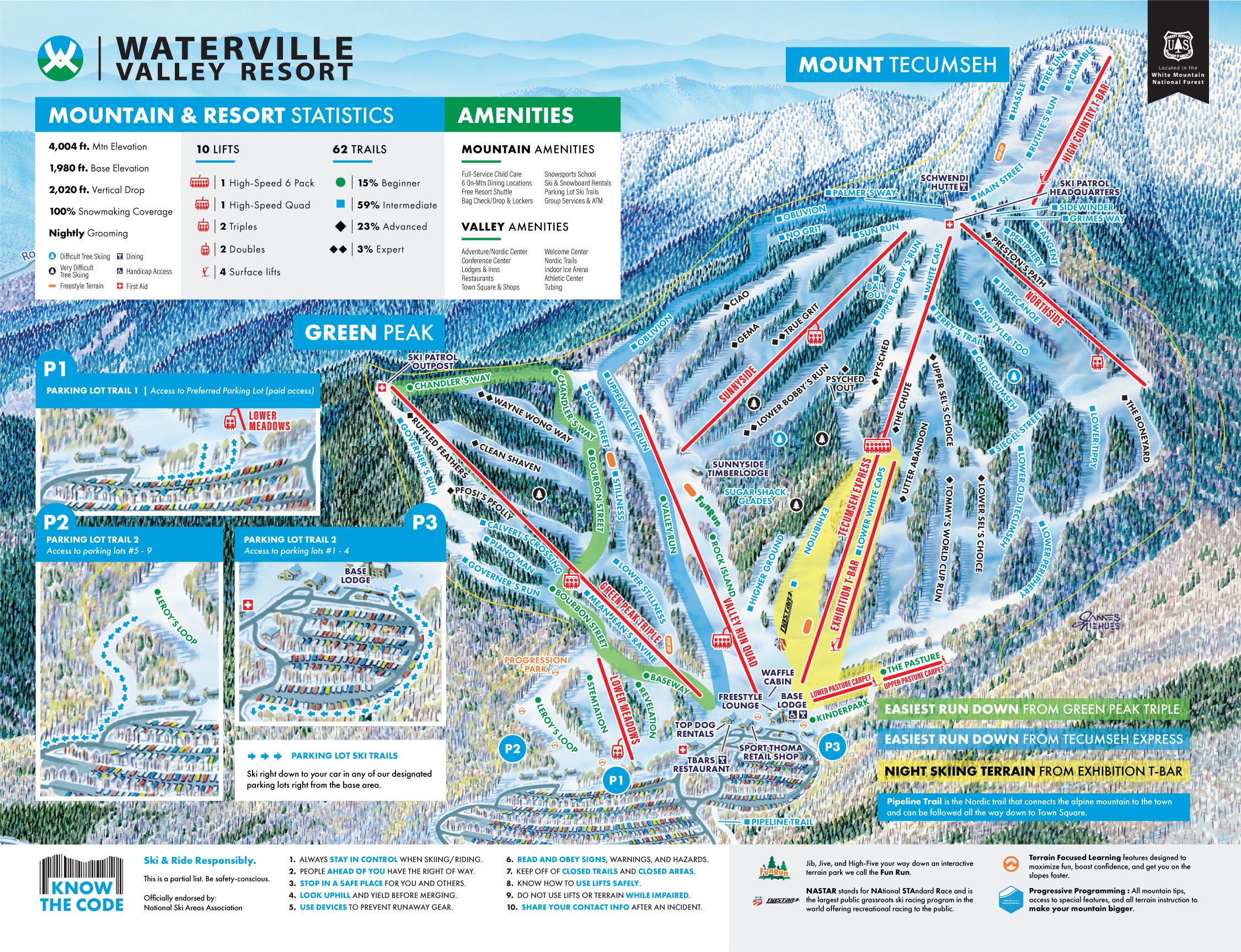
Click here for a mountain stats overview
Owned by: The Sununu Family
Located in: Waterville Valley, New Hampshire
Year founded: 1966
Pass affiliations:
Indy Pass, Indy+ Pass: 2 days, no blackouts
White Mountain Super Pass: unlimited, no blackouts
Indy Learn-to-Turn: 3 days, includes rentals, lesson, lift ticket; limited lift access
Ski New Hampshire Kids Passport: 1 day with holiday blackouts
Uphill New England: no lift access
Base elevation: 1,984 feet (highest in New Hampshire, 3rd in New England)
Summit elevation: 4,004 feet (2nd-highest in New Hampshire, 5th in New England)
Vertical drop: 2,020 feet (4th-highest in New Hampshire, 14th in New England)
Skiable acres: 265
Average annual snowfall: 148 inches
Trail count: 62 (14% novice, 64% intermediate, 22% advanced)
Lift count: 10 (1 six-pack, 1 high-speed quad, 2 triples, 2 doubles, 2 T-bars, 2 carpets)
Why I interviewed him
Well no one wants to hear this but we got to $300 lift tickets the same way we got to $80,000 pickup trucks. We’re Americans Goddamnit and we just can’t do stickshifts and we sure as shit ain’t standin’ up on our skis to ride back up the mountain. It’s pure agony you see. We need us a nine-pack chairlift with a bubble and a breakroom and a minibar and surround sound and Lazy-Boy seats and hell no we ain’t ridin’ it with eight strangers we’ll hold back and take a whole chair to our ownselves. And it needs to move fast, Son. Like embarrass-the-Concord fast because God help us we spend more than 90 seconds with our own thoughts.
I’m not aiming to get kicked out of America here, but if I may submit a few requests regarding our self-inflicted false price floors. I would like the option of purchasing a brand-new car with a manual transmission and windows rolled up and down with a hand-crank. I would like to keep pedaling my bicycle. I would like to cut the number of holidays with commercial mandates by 80 percent. I would prefer that we not set the air-conditioners to 60 when it’s 65 degrees outside. This doesn’t mean I want to get rid of all the air-conditioners but could we maybe take it easy on the frostbite-in-July overkill of it all?
My Heretic Wishlist for American Skiing includes but is not limited to: more surface lifts, especially to serve terrain parks, high-altitude exposed terrain, and expert pods; on-resort lodging that does not still require a commute-by-personal-vehicle to reach the lifts; and thoughtful terrain management that retains ungroomed sections for skiers who like things about skiing other than going fast.
Waterville Valley is doing all of these things. It is perhaps the only major American ski area in decades to replace a chairlift with a surface lift on a non-beginner terrain pod, and the only one to build two new T-bars this century. A planned gondola would connect Waterville Valley the town with Waterville Valley the ski area, correcting an only-in-America setup that separates these inseparable places by two miles of road. The glade network grows annually in both subtle and obvious ways.
This is not a ski area going in reverse. Waterville is modern and keeps modernizing. The four-year-old Tecumseh bubble six-pack, though bookended with T-bars, is one of the nicest chairlifts in America. Skiers still go groomer-kaboom on morning cord. Suburban office-park dads with interstate commutes and a habit of lecturing the Facebook Commons about the virtues of snow tires can still park their 42-wheel-drive Abrams-Caterpillar-F-15,000 Tanktruck in sub-parking lot 42Z and walk uphill to the lifts. But Waterville Valley is one of a handful of American ski areas, along with Killington and Deer Valley and Winter Park, that is embracing all of our luxe cultural excesses while pursuing the very un-American ambition of putting more skiers close to skiing.


No ski area is perfect. For all the cash saved on those T-bars, peak-day Waterville lift tickets still hit $145. The mountain’s season pass is the second-most expensive single-mountain season passes in New England – more than a top-line Epic Pass (an adult WV pass includes a free pass for a kid age 6 to 12, which is great if you have one of those). That’s bold pricing for the 22nd-largest ski area in New England, especially one that still spins three Stadeli chairlifts that predate the extinction of the dinosaurs. And two high-speed chairlifts is not a lot of high-speed chairlifts for a 2,000-vertical-foot ski area (though about half of New England’s 2,000-footers run just two or fewer detaches).
Yeah I know. Sick burn from someone who was waxing about surface lifts four paragraphs ago. I may have collected too many ski area Lego blocks in my mental bucket, and they don’t always click together back here on planet Earth. “More villages,” I say while dismissing Aspen as a subsidized simulacrum of itself. “Big fast lifts rule,” I say while setting off fire alarms as first-generation chairlifts disintegrate and the cost of their most basic replacements escalates. “No-grooming, all-glades makes the best ski area,” I say, while condemning resort operators for $356 lift tickets that dam the masses. “Vail is too expensive,” I say. “Vail is too cheap,” I also say. “Modernize our chairlifts,” I say while celebrating the joy of riding an antique Riblet double. I endorse ski areas splitting off from conglomerates and ski areas joining them. These narratives can feel contradictory at best and schizophrenic at worst.
But that tension is part of what draws me to lift-served ski areas, where two things central to my worldview – wild nature and human invention – merge. Or perhaps more accurately, collide. Both forces act at all times not only to extinguish one another, but themselves: above-freezing temps trash two feet of new snow; bad liftline management cancels out the capacity benefits of a $12 million lift upgrade. Making a ski area function, then, requires continual tweaking, of both the nuanced and look-at-us-press-release variety. A ski area is a business, sure, but that’s almost a coincidence. The act of building and running a ski area is foremost an art, architecture, and engineering project that requires a somewhat madcap conductor to succeed.
As with any artform, there is no one correct and final way to build a ski area. The variety is central to skiing’s appeal. But there are operator/artist attributes - flexibility, inventiveness, consistency tempered by openness to change - that contribute to the overall quality and cohesion of the individual ski area experience in the context of competing ski areas. In the current version of Waterville Valley, we find one of our best contemporary examples of a ski area evolving toward the best version of itself under the stewardship of owners and managers possessing exactly these traits.

What we talked about
The return of World Cup training and events to Waterville; drifting away from and back toward freeskiing culture; the best terrain parks in New England; why terrain parks are drifting away from mega-features; what happened to all the halfpipes?; and ramps?; no really no one wore helmets in the ‘90s; building terrain parks before institutional knowledge and the internet; the lost Hidden Valley, Wisconsin ski area; the rise of the high-speed ropetow; why Waterville replaced one T-bar and one Poma with a new T-bar (rather than a chairlift); why Waterville installed night skiing; the return of the Exhibition terrain park; self-installing the World Cup T-bar; Waterville’s ops blog; why the Tecumseh Express sixer needed new bubbles after just a couple of seasons; why bubbles cost so much and how Waterville manufactured a less expensive one; Tecumseh’s incredible wind resistance; MND lifts as an alternative to the two large U.S.-based lift manufacturers; a chairlift’s “infancy” and how different 2020s lift technology is from early detachable tech; how Waterville’s masterplan would reorient the mountain and skier traffic with an expansion and new lifts; Waterville’s declining skier visits and whether that’s a bad thing; how the resort’s 1994 bankruptcy changed Waterville’s trajectory; what stoked the Green Peak expansion; “we’ve been on a track to try to rebuild that energy we saw in the 1990s”; why Waterville turned away from discounting; “the right quantity of skiers on the right amount of surface”; building more terrain diversity; and a gondola connection from town to mountain.
Should someone tell them they’re running it backwards? Video by Stuart Winchester.
What I got wrong
I said that the “High Country double chair was still standing” – what I meant was that parts of it were still in place. The top terminal remains, sans bullwheel, and the base terminal and motor room remain as a patrol shack:


I said that Waterville hadn’t been known for terrain parks until recently, but Smith recalled that the ski area was more freestyle-centric from the ‘70s through the ‘90s, before pulling back during the first part of this century.
I said that 1,100 skiers per hour was “a little less than what a double chair would move,” thinking standard capacity for a double was 1,200 per hour. Smith says it is 900. Exact capacity varies from lift-to-lift, however. Lift Blog itemizes hourly capacities of between 800 and 1,200 for four of Smugglers’ Notch’s double chairs, between 1,000 and 1,200 for four of Mt. Spokane’s fleet of Riblet doubles, and 1,000 for Waterville’s Lower Meadows double. We all know, however, that the hourly capacity for a double chair is however many people are in line minus the number not paying attention minus singles who refuse to ride with anyone. So I don’t know maybe 50.
Podcast Notes
On other mentioned podcasts
World Cup competition returning to Sun Valley:
Heavenly backing out of mega-parks features:

Killington and the cost of bubbles:
Waterville part 1, from 2021:

On Partek and each lift being different
“The Industry Got What It Asked For” – Partek's Hagen Schulz on U.S. Skiing’s Lift Affordability Crisis

Hagen Schulz has been building chairlifts since 1981, first for the Borvig lifts company, run by his father, Gary Schulz, and then under the banner of Partek, a company that he founded in 1996. Over the past three decades, Partek has built 40 fixed-grip chairlifts at 29 U.S. ski areas in 14 states:
On Waterville’s ownership history
Founder Tom Corcoran owned Waterville Valley from 1966 until 1994, when he sold to American Skiing Company (ASC) antecedent S-K-I. The feds made ASC dispense with Waterville and Cranmore when they merged with LBO Enterprises in 1996. Booth Creek (more on them below), bought the ski area and held it until 2010, when they sold it to the Sununu family. This makes Waterville one of just a handful of ski areas to ever enter a multi-mountain pass portfolio and then exit to independence - though Killington and Ragged recently did exactly that, and Eldora may follow.
On Mt. Holiday, Michigan
This is just a little 200-footer, but it’s still around on the outskirts of Traverse City, Michigan:
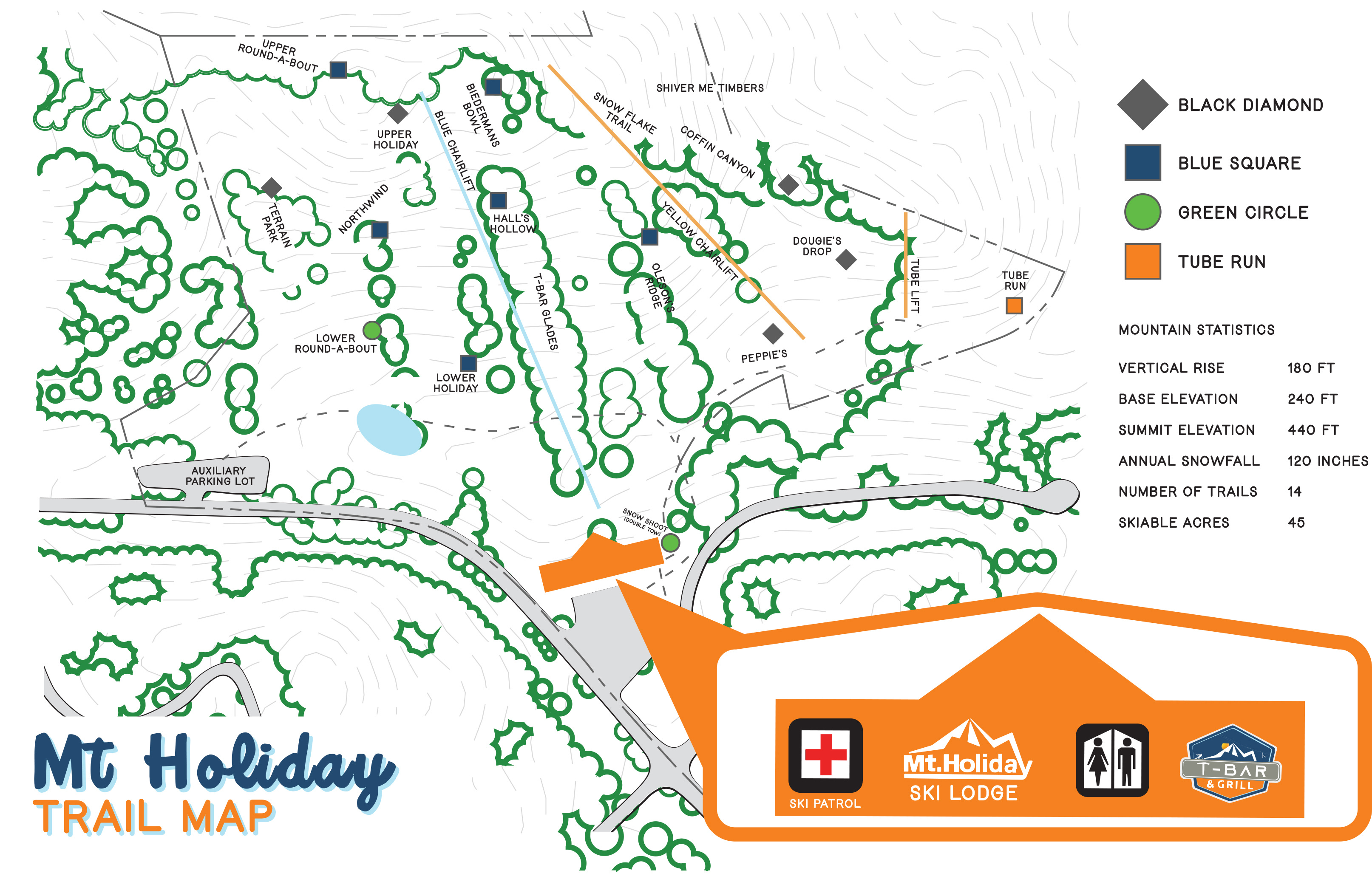
That trailmap doesn’t really communicate the ski area’s essence. A little better are these pics I took on a summertime swing-through a few years back:


I never skied there though, always preferring the far-larger Sugar Loaf, right down the road (which Smith and I also discussed):
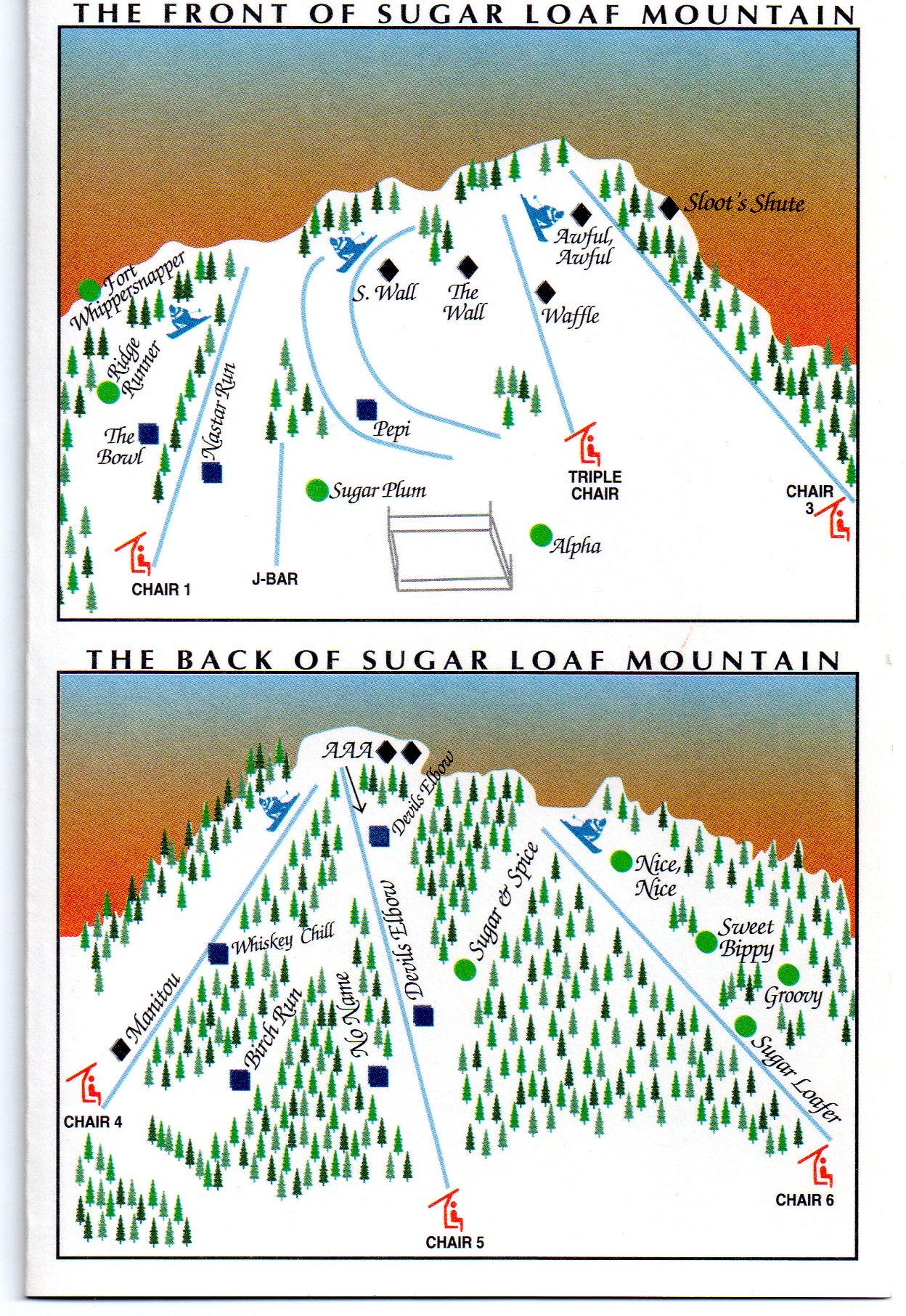
Until it was abandoned around 2000, this was one of the better ski areas in Michigan’s Lower Peninsula. After a succession of owners - one of whom stripped all the chairlifts off the bump - failed to bring skiing back, the Leelanau Conservancy recently took ownership of the property. Skiing will return as an officially sanctioned activity, though unfortunately without a lift or snowmaking. I would have at least liked to have seen a ropetow. Here’s their vision:
On midwestskier.com
Yes, Kids, the internet really did used to look like this:

On Hidden Valley, Wisconsin
Here’s a little ski hill that didn’t make it. Smith spent time at Hidden Valley, Wisconsin, which opened in 1956 and closed forever in 2013. The chairlift appears to have been moved to nearby, county-run Kewaunee Winter Park, where it awaits installation.
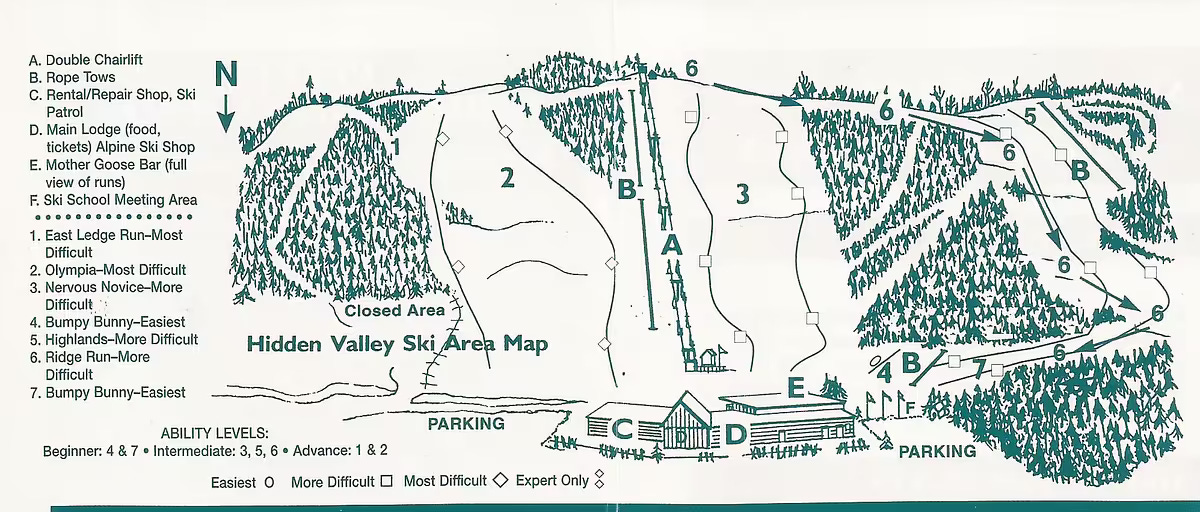
On high-speed ropetows
I am a huge fan of high-speed ropetows, which are a cheap and effective means to isolate users of terrain parks or other specialized, intensive-use zones from the broader ski area. Here’s one at Spirit Mountain, Minnesota in 2023 (video by Stuart Winchester):
On Waterville Valley’s masterplan
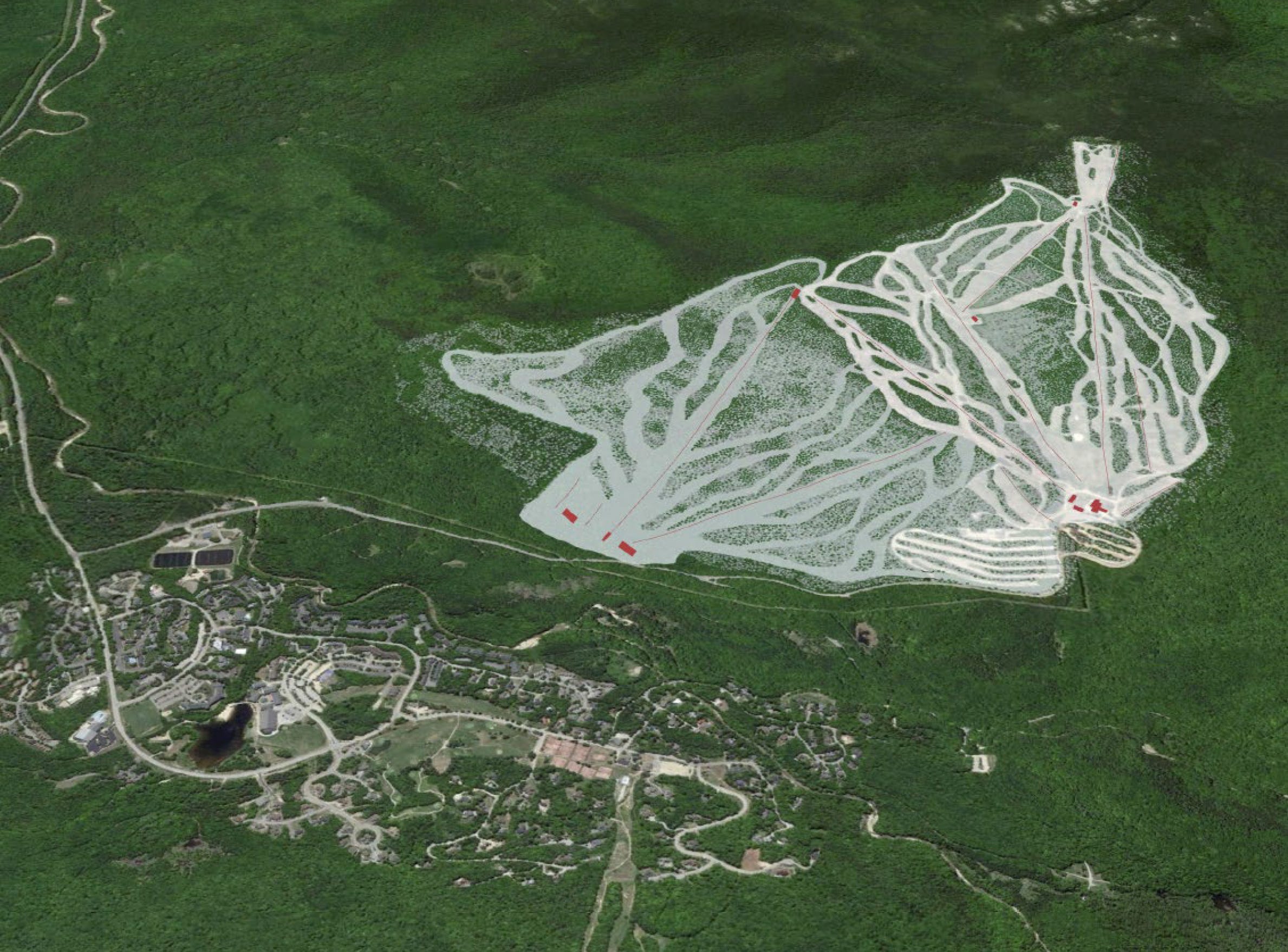
This is perhaps the best angle of how Waterville’s expansion would connect the legacy trail network to the town:
Here’s the Forest Service masterplan slide:
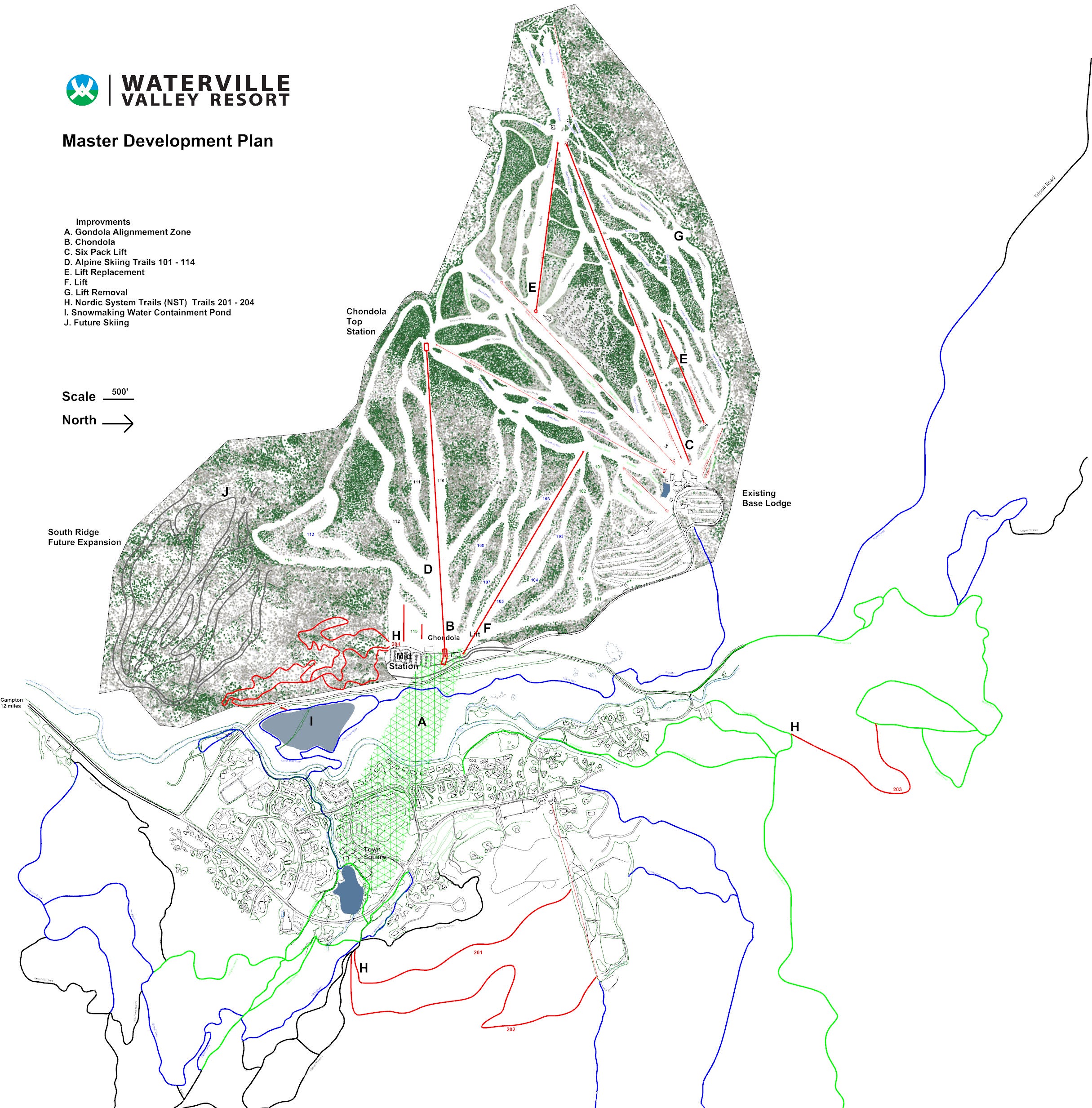
Neither of these images, however, show how the gondola would eventually connect down into town, which is the crucial element of transforming Waterville Valley from a ski-area-that-says-it’s-a-ski-resort into an actual ski resort. Here’s a look at that connection:
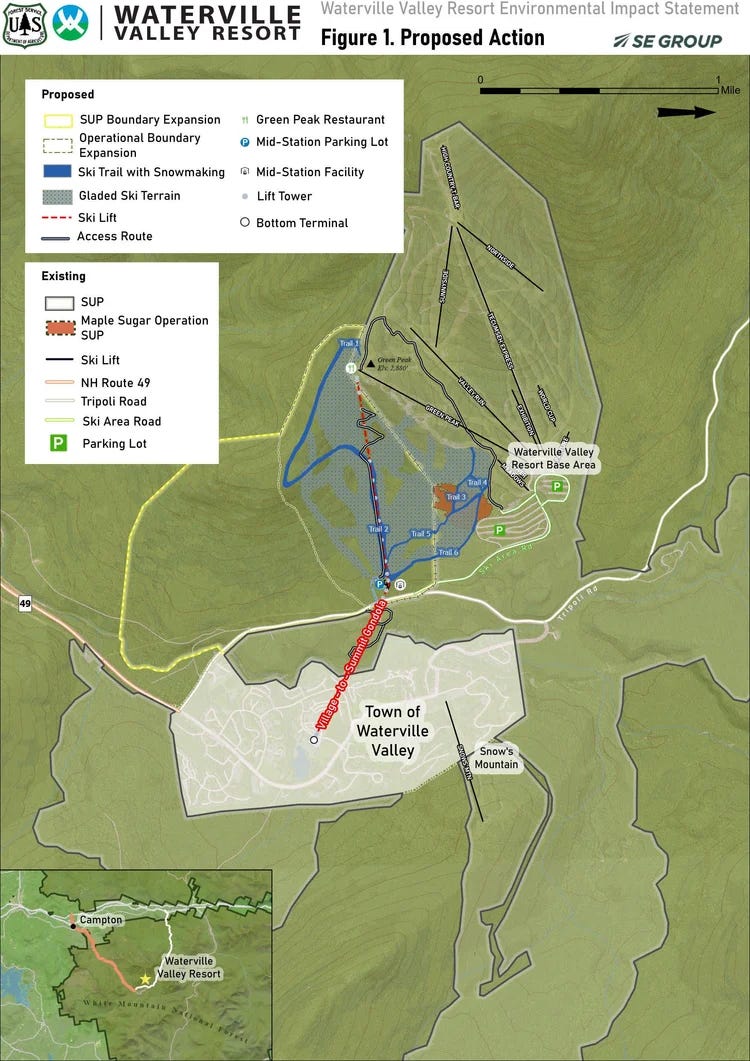
Waterville set up an excellent microsite detailing the hoped-for evolution.
On Booth Creek
At the mid-90s height of American Skiing Company dominance, a former Vail executive assembled a cross-country ski area portfolio with ambitions of creating a hub-and-spoke network:
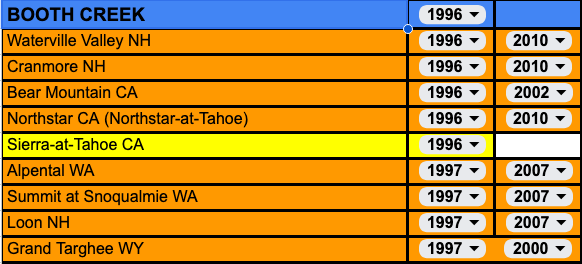
Booth Creek ultimately sold off most of its properties, but still own Sierra-at-Tahoe. Grand Targhee GM Geordie Gillett was involved in the whole saga and broke it down for us in 2024:

On Waterville going from one of the oldest lift fleets in New England to one of the most modern
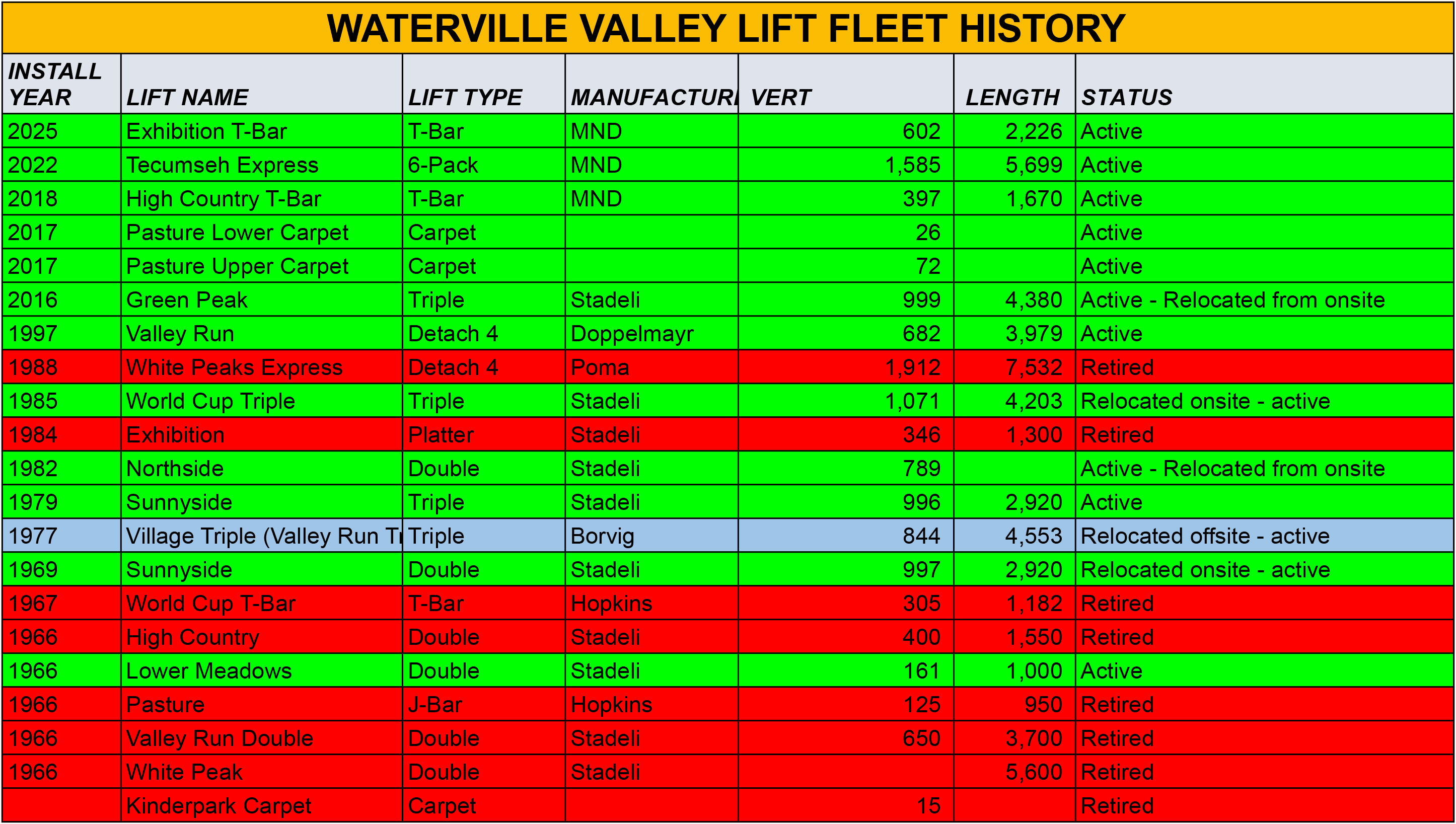
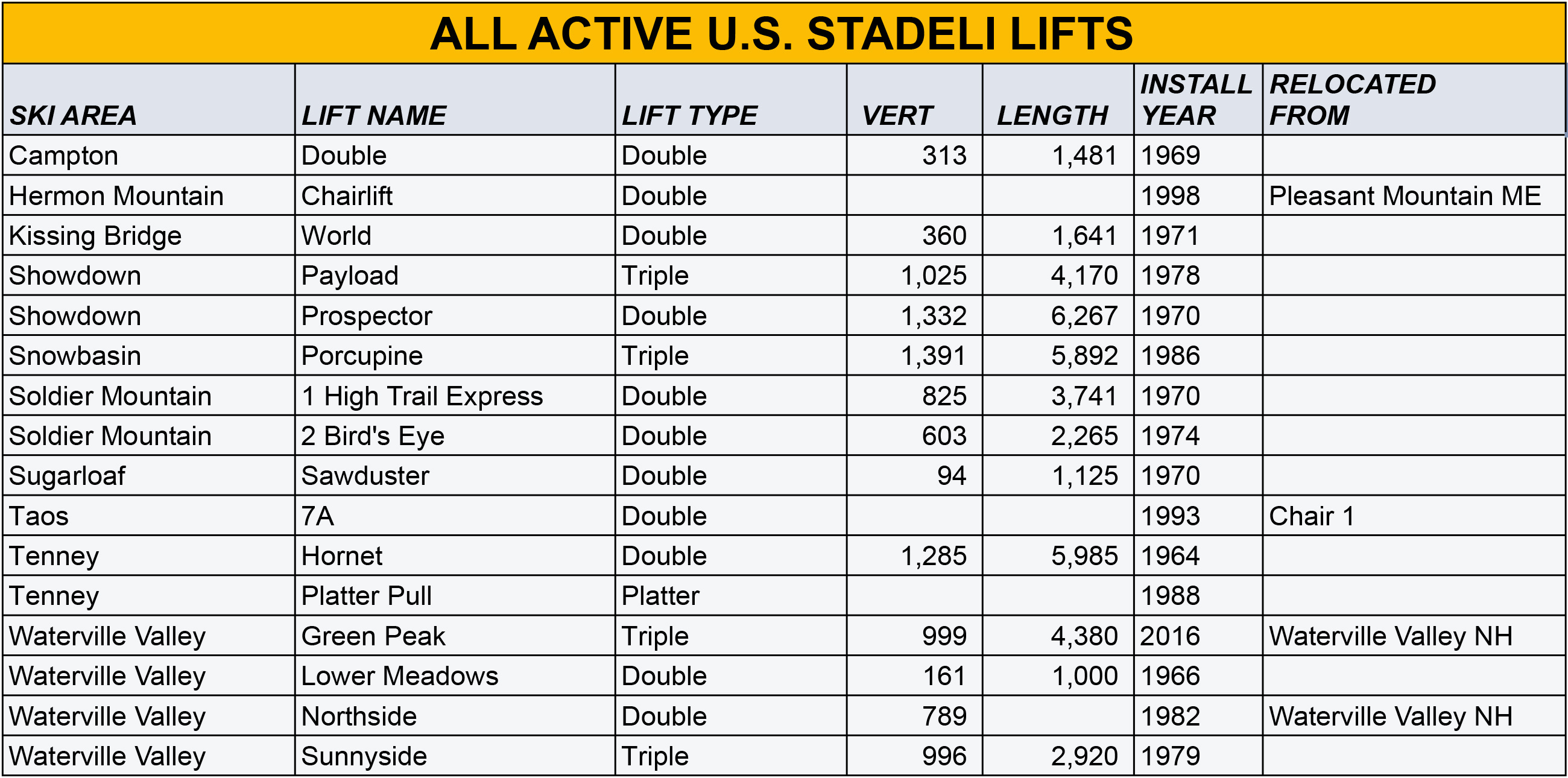
While Waterville runs some of the last Stadeli lifts in America (I count 16), the ski area has modernized extensively over the past decade:
On U.S. Forest Service ski areas in the East
Most (109) of the 119 active U.S. ski areas on United States Forest Service leases sit in the West; two are in the Midwest, and eight are in the East: Bromley, Mount Snow, and Sugarbush, Vermont; Waterville Valley, Loon, Attitash, and Wildcat, New Hampshire; and Timberline, West Virginia. None, as far as I know, sit entirely within the boundaries of a national forest, but even partial overlap triggers the requirement to submit an updated masterplan each decade.


