


Who
Susan Cross, Vice President of Operations at Aspen Skiing Company (and former Mountain Manager of Snowmass)
Recorded on
November 14, 2025 - which was well before I traveled to Snowmass and chased Cross around a bit in the pow. There she is tiny in the distance:
About Aspen Skiing Company
Aspen Skiing Company (Skico) is part of something called Aspen One. Don’t ask me what that is because even though they rolled it out two years ago I still have no idea what they’re talking about. All I know or care about is that they own four ski areas and here is what I know about them:
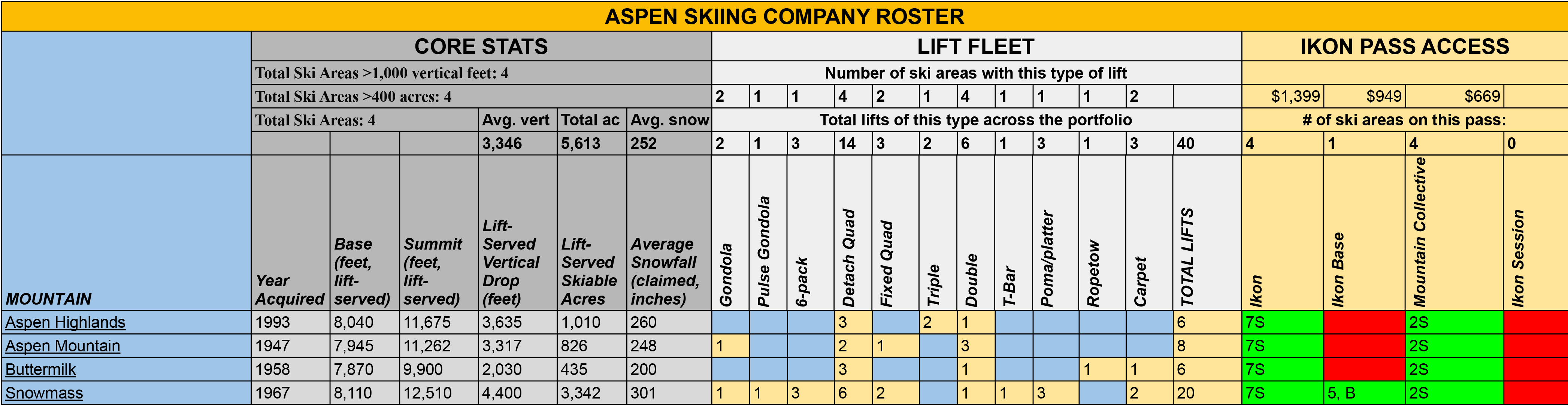
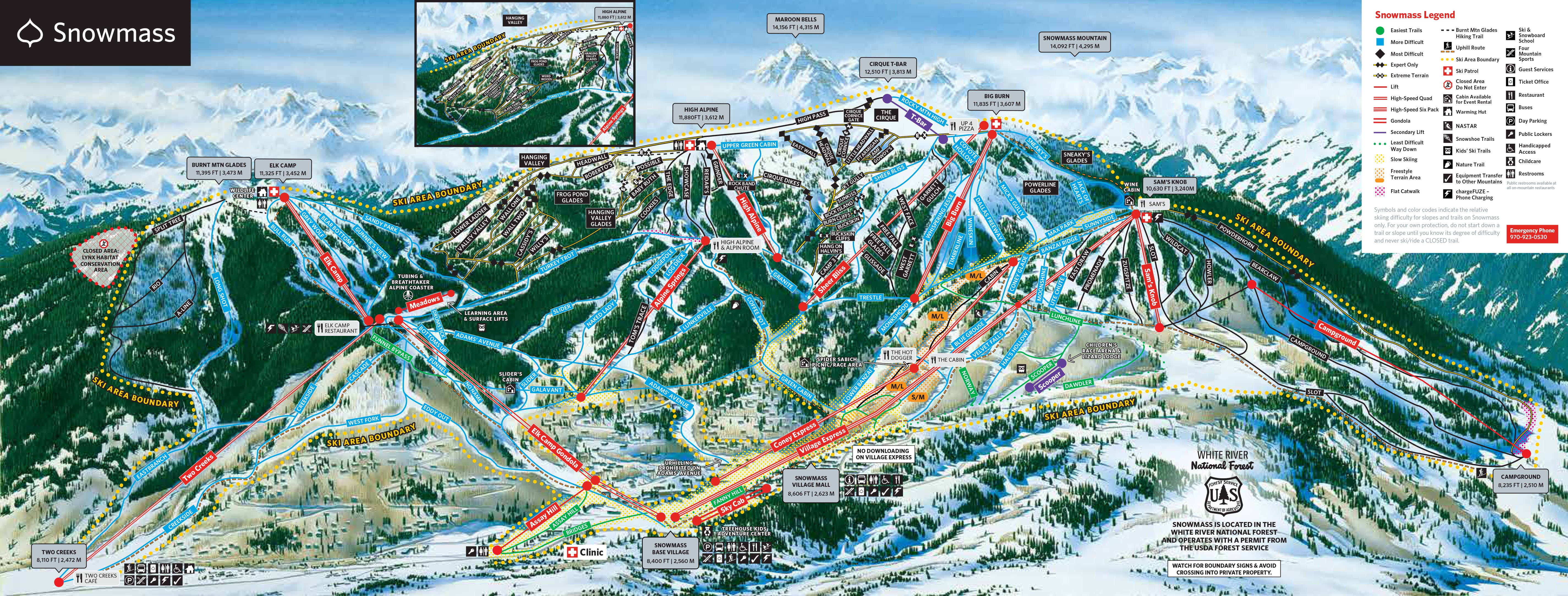
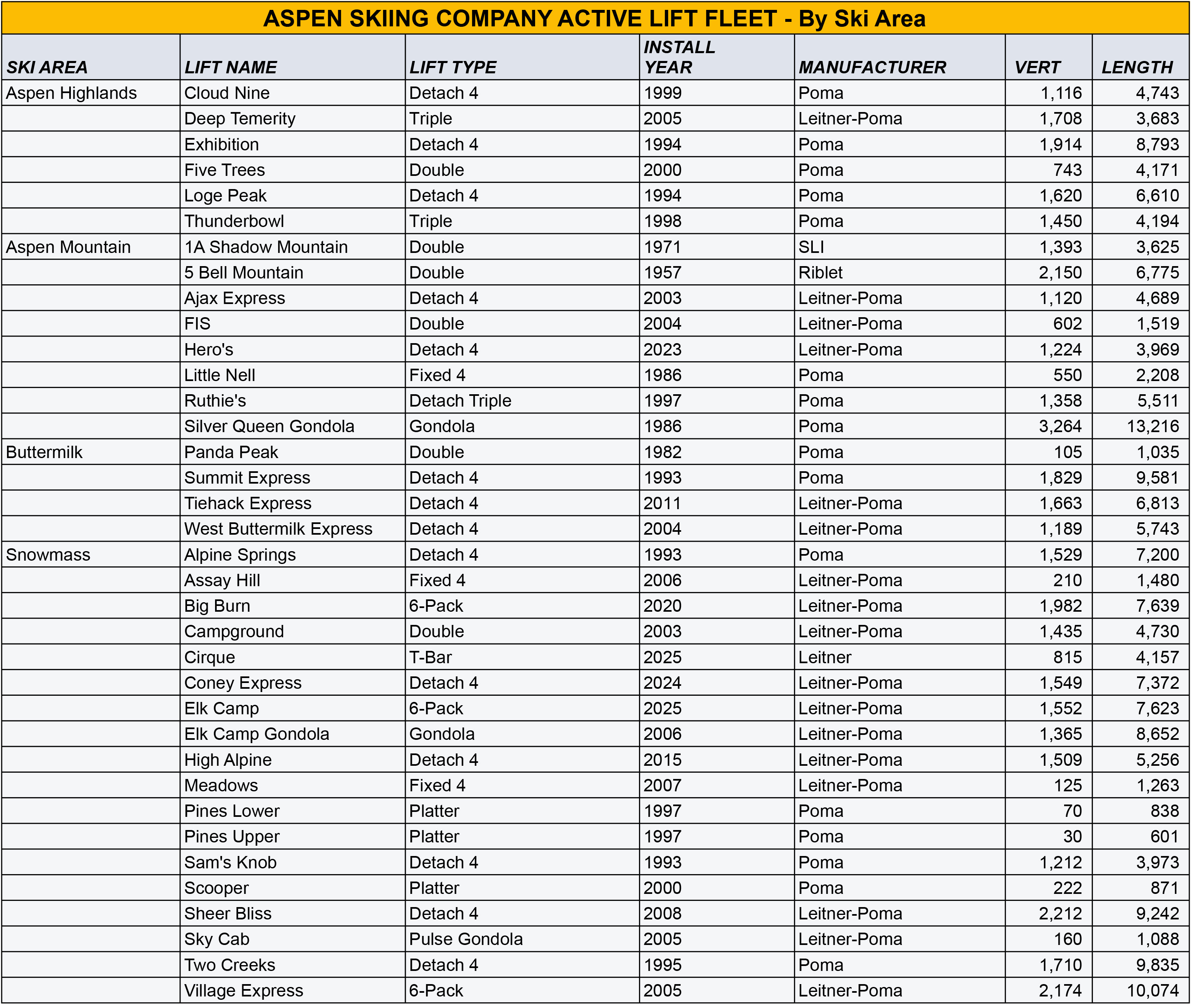
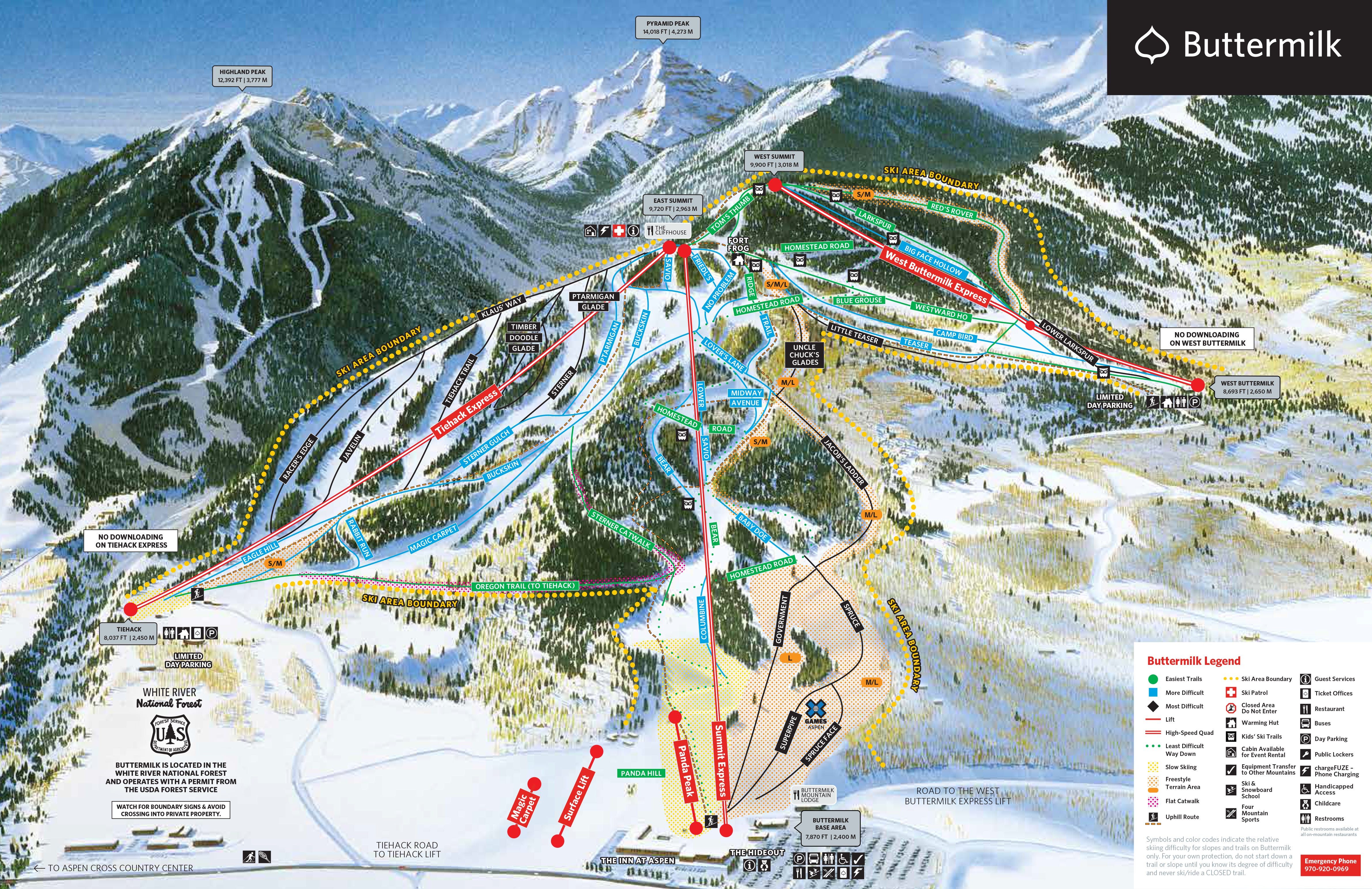
Don’t be fooled by the scale of the map above - at 3,342 acres, Snowmass is larger than Aspen Mountain, Buttermilk, and Aspen Highlands combined. The monster 4,400-foot vert means these lifts are massively shrunken to fit the map - Snowmass operates three of the 10 longest chairlifts in America, and seven chairlifts over one mile long:
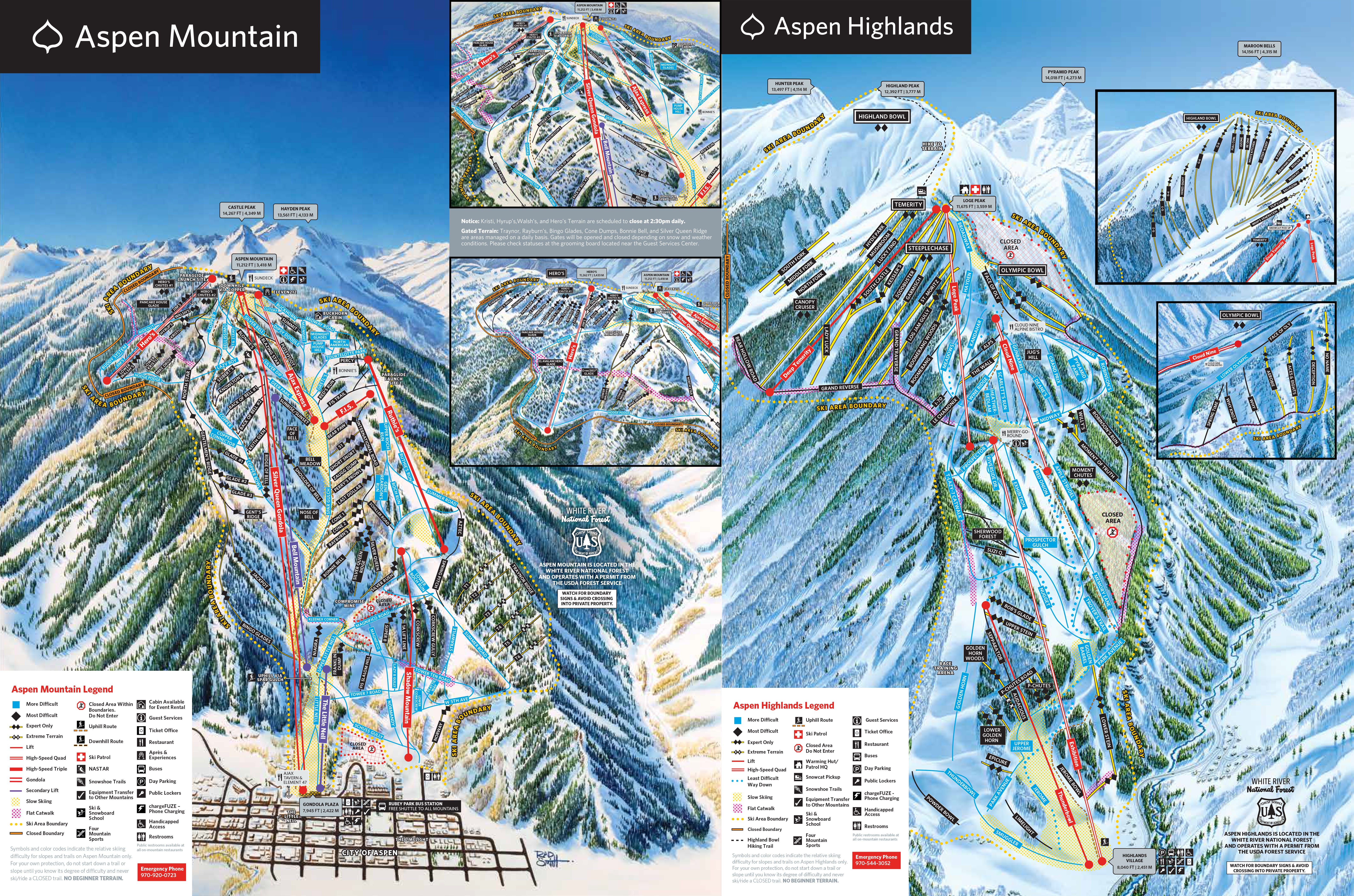
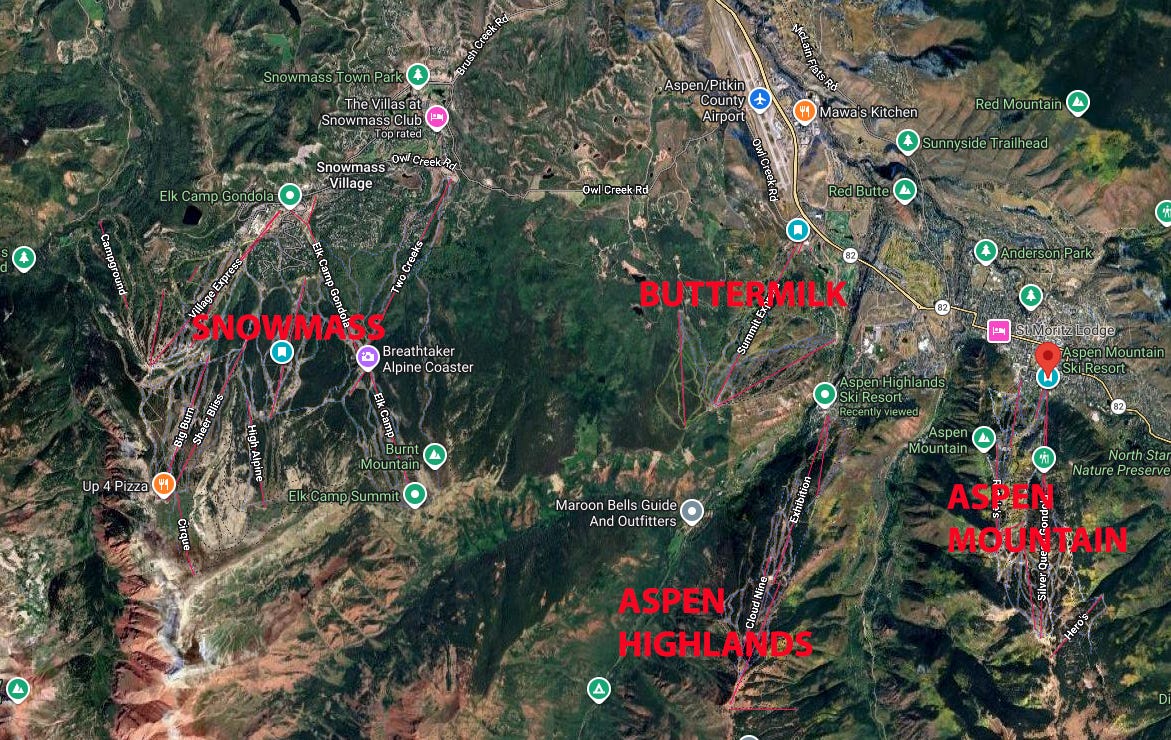
You can’t ski or ride a lift between the four mountains, but free shuttles connect them all. Aspen Mountain, Highlands, and Buttermilk are all bunched together near town, and Snowmass is a short drive (15 to 20 minutes if traffic is clear and dependent upon which base area you want to hit):
Why I interviewed her
American ski areas will often re-use chairlifts or snowcats that other operators have outgrown. Aspen Mountain re-used a whole town.
In 1879, Aspen the city didn’t exist, and by 1890 more than 5,000 people lived there. They came for silver, not snow. In less than a decade they laid out the Victorian street grid of brick and wood-framed buildings using hand tools and horses, with the Roaring Fork River as their supply road.
Aspen’s population collapsed in the economic depressions of the 1890s and didn’t rebound to 5,000 for 100 years. The 1940 Census counted 777 residents. That was 16 years before the first chairlift rose up Ajax, a perfect ski mountain above an intact but semi-abandoned town made pointless by history.
It was an amazing coincidence, really. Americans would never build a ski town on purpose. That’s where the parking lots go. But hey it all worked out: Aspen evolved into a ski town that offset its European walk-to-the-chairlifts sensibility with a hard-coded American refusal to expand the historic street grid in favor of protectionism and mansion-building. The contemporary result is one of the world’s most expensive real estate markets cosplaying as a quaint ski town, a lively and walkable mixed-use community of the sort that we idealize but refuse to build more of. Aspen’s population is now around 7,000, most of whom live there by benefit of longevity, subsidy, inheritance, or extreme wealth. The city’s median household income is just over $50,000. The median home price is $9.5 million. Anyone clinging to the illusion that Aspen is an actual ski town should consider that it took 25 years to approve and build the Hero’s chairlift. Imagine what the fellows who built this whole city in half a decade without the benefit of electricity or cement trucks or paved roads would make of that.
The illusory city, however, is a dynamic separate from the skiing. Aspen, despite its somewhat dated lift fleet, remains one of America’s best small ski mountains. But it is small, and, with no green terrain and barely any blues, the ski area lacks the substance and scale to draw tourists west of Summit County and Vail.
Sister mountain Snowmass does that. And while Snowmass did not benefit from an already-built town at its base, it did benefit from not having one, in that the mountain could evolve with a purpose and speed that Ajax, boxed in by geography and politics, never could. Snowmass has built 13 new aerial lifts this century, including the two-station, mountain-redefining Elk Camp Gondola; the Village Express six-pack, which is the fourth-longest chairlift in America; and, in just the past two years, a considerably lengthened Coney high-speed quad and a new six-pack to replace the Elk Camp chairlift.

I’ve focused on Aspen’s story a bit over the years (including this 2021 podcast with former Skico CEO Mike Kaplan), but probably not enough. The four Aspen mountains are some of the most important in American skiing, even if visitation doesn’t quite match their status as skiing word-association champion among non-skiers (more on that below). Aspen, a leader not just in skiing but in housing, the environment, and culture, carries narrative heft, and the company’s status as favored property of Alterra part-owner Henry Crown hints at deeper influence than Skico likely takes credit for.
Aspen, like Big Sky and Deer Valley and Sun Valley, is rapidly emerging as one of the new titans of American skiing, unleashing a modernization drive that should lead, as Cross says in our conversation, to an average of at least one new lift per year across the portfolio. Snowmass’ 2023 U.S. Forest Service masterplan envisions a fully modern mountain with snowmaking to the summit. Necessary and exciting as that all is, forthcoming updates to the dated masterplans at Aspen Highlands (2013) and Buttermilk (2008), could, Skico officials tell me, offer a complete rethinking of what Aspen-Snowmass is and how the ski areas orbit one another as a unit.
And they do need to rethink the whole package. Challenging Skico’s pre-eminence in the Circle of American Ski Gods are many obstacles, including but not limited to: an address that’s just a bit remote for Denver to bother with or tourists to comprehend; a rinky-dink airport that can’t land a paper plane; an only-come-if-you-have-nine-houses rap on the affordability matrix; a toxic combination of one of America’s most expensive season passes and most expensive walk-up lift tickets; and national pass partners who do a poor job making it clear that Aspen is not one ski area but four.
A lot to overcome, but I think they’ll figure it out. The skiing is too good not to.
What we talked about
“I thought I had found Heaven” upon arrival in Aspen; Aspen in the 1990s; $200 a month to live in Carbondale; “as soon as you go up on the lifts, the mountain hasn’t changed”; when Skico purchased formerly independent Aspen Highlands; Highlands pre-detachable lifts; four ski areas working (and not), as one ski resort; why there is “minimal sharing” of employees between the four mountains; why “two winter seasons, and then I was going back to Boston” didn’t quite work out; why “total guilt sets in” if Cross misses a day of skiing and how she “deliberately” makes “at least a couple of runs” happen every day of the winter and encourages everyone else to do the same; Long Shot in the morning; the four pods of Snowmass; why tourists tend to lock onto one section of the mountain; “a lot of people don’t realize their lift ticket is good for the four mountains”; “there’s plenty of room to spread out and have a blast” even at busy Snowmass; defining the four mountains without typecasting them; no seriously there are no green runs on Aspen Mountain; the new Elk Camp six-pack; why Elk Camp doesn’t terminate at the top of Burnt Mountain; why Elk Camp doesn’t have the fancy carriers that came with 2024’s new Coney Express lift; why Snowmass opted not to add bubbles to its six-packs; how Coney Express changed how skiers use Snowmass; why Coney is a quad rather than a six; why skiers can’t unload at the Coney Express mid-station (and couldn’t load last season); how Coney ended up with a mid-station and two bends along the liftline; the hazards of bending chairlifts and lessons learned from Alta’s Supreme debacle; why Snowmass replaced the Cirque Poma with a T-bar (and not a chairlift); which mountain purchased the old Poma; Aspen’s history of selling lifts and how the old Elk Camp wound up at Powderhorn ski area; where Skico had considered moving the Elk Camp quad; “we want everybody to stay in business”; why Snowmass didn’t sell or relocate the Coney Glade lift; prioritizing future chairlift upgrades; the debate over whether to replace Elk Camp or Alpine Springs first, and why Elk Camp won; “what we’re trying to do is at least one lift a year across the four mountains”; a photobomb from my cat; why the relatively new Village Express lift is a replacement candidate and where that lift could move; why we’re unlikely to see the proposed Burnt Mountain chairlift anytime soon; and the new megalift that could rise on Aspen Mountain this summer.

What I got wrong
I said that Breck had “T-bars serving their high peaks,” which is incorrect. In fact, Breck runs chairlifts close to the summits of Peak 8 (Imperial Superchair, the highest chairlift in North America), and Peak 6 (Kensho Superchair). I was thinking, however, of the Horseshoe T-Bar, an incredible high-alpine machine that I rode recently (it lands below Imperial Superchair on Peak 8).
I said that Maverick Mountain, Montana, was running a “1960-something” Riblet double. The lift dates to 1969, and is slated for replacement by Aspen Mountain’s old Gent’s Ridge fixed-grip quad, which Skico removed in 2024.
I referred to the Sheer Bliss chairlift as “Super Bliss,” which I think was fallout from over-exposure to Breck, where 12 of the chairlifts are named [SOMETHING] Superchair or some similar name.
Why you should ski Aspen-Snowmass
Why do we ski Colorado? In some ways, it’s a dumb question. We ski Colorado because everyone skis Colorado: the state’s resorts account for 20 to 25 percent of annual U.S. skier visits, inbounds skiable acreage, and detachable chairlifts. Colorado is so synonymous with skiing that the state basically is skiing from the point of view of the outside world, especially to non-skiers who, challenged to name a ski resort, would probably come up with Vail or Aspen.
But among well-traveled skiers, Colorado is Taylor Swift. Talented, yes, but a bit too obvious and sell-your-kidneys expensive. There’s a lot more music out there: Utah gets more snow, Idaho and Montana have fewer people, B.C.’s Powder Highway has both of those things. Europe is cheaper (well, everywhere is cheaper). Colorado is only home to 26 public, lift-served ski areas, and only two of the 10 largest in America. Only seven Colorado ski areas rank among the nation’s 50 snowiest by average annual snowfall. Getting there is a hassle. That awful airport. That stupid road. So many Texans. So many New Yorkers. Alternate, Man!
But we all go anyway. And here’s why: Colorado ski areas claim 14 of the 20 highest base areas in North America, and 16 of the 20 highest summits. What that means is that, unlike in Tahoe or Park City or Idaho, it never rains. Temperatures rarely top freezing. That means the snow that falls stays, and stays nice. Even in a mediocre Rocky Mountain winter – like this one – Colorado is able to deliver a consistent and predictable trail footprint in a way that no other U.S. ski state can match. Add in an abundance of approachable, intermediate-oriented ski terrain, and it’s clear why America’s two largest ski area operators center their multi-mountain pass empires in Colorado.
Which brings us back to the thing most skiers hate the most about Colorado skiing: other skiers. There are just so many of them. And they all planned the same vacation. For the same time.
But there is a back door. Around half of Colorado’s 12 to 14 million annual skier visits occur at just five ski areas: Vail Mountain, Breck, Keystone, Copper, and Steamboat – often but not always strictly in that order. Next comes Winter Park, then Beaver Creek. And all the way down at number eight for Colorado annual skier visits is Snowmass.
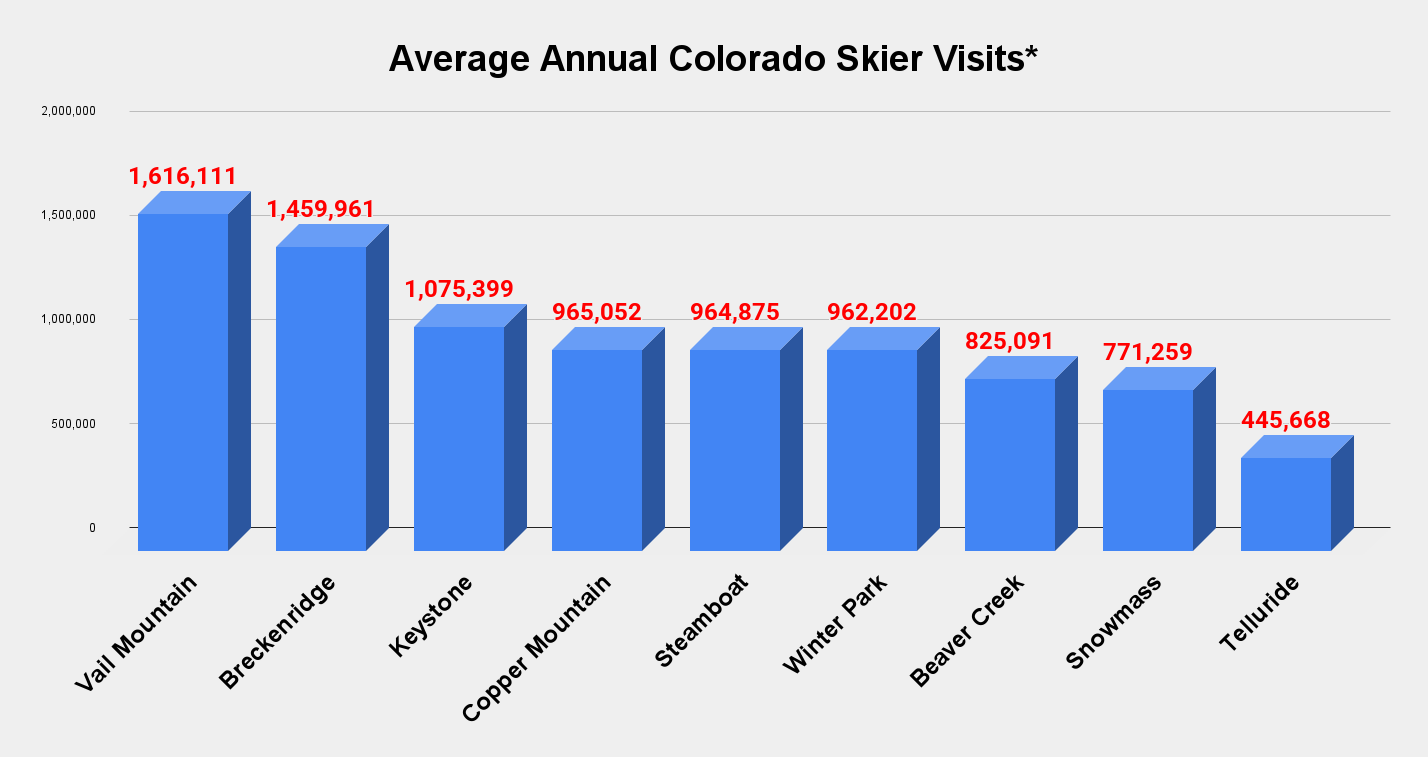
Snowmass’ 771,259 skier visits is still a lot of skier visits. But consider some additional stats: Snowmass is the third-largest ski area in Colorado and the 11th-largest in America. From a skier visits-to-skiable-acreage ratio, it comes in way below the state’s other 2,000-plus-acre ski areas (save Telluride, which is even more remote than Aspen):
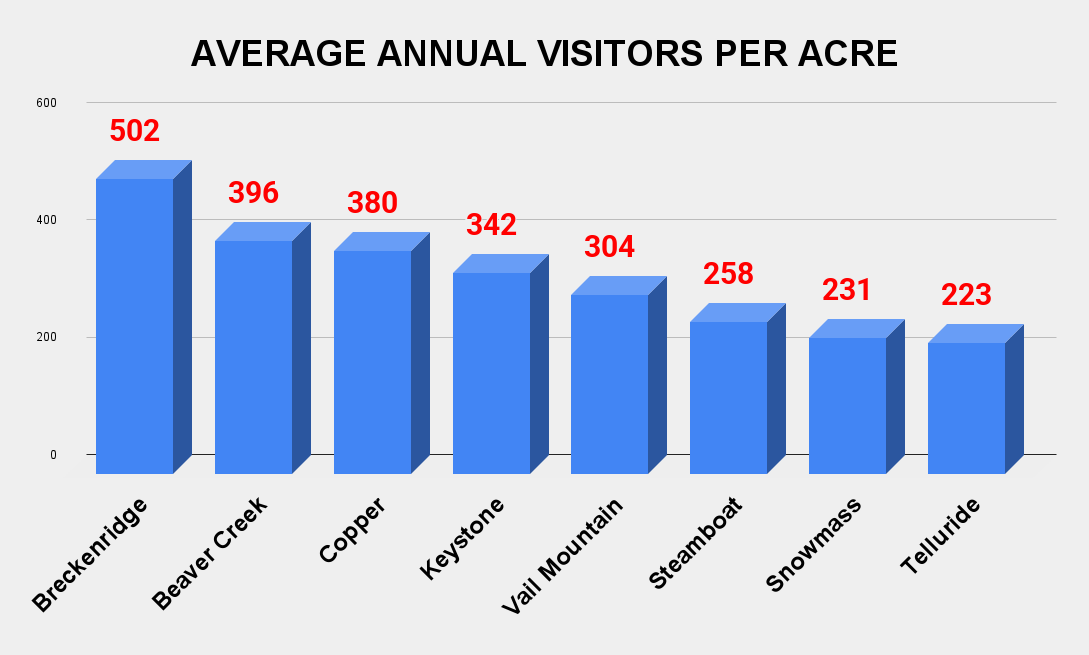
Why is that? The map explains it: Snowmass, and Aspen in general, lost the I-70 sweepstakes. They’re too far west, too far off the interstate (so is Steamboat, but at least they have a real airport).
Snowmass is worth the extra drive time. I-70 through Glenwood Canyon is slow-going but gorgeous, and the 40 miles of Colorado 82 after the interstate turnoff barely qualify as mountain driving – four lanes most of the way, no tight turns, some congestion but only if you’re arriving in the morning. A roundabout or two and there you are at Snowmass.
And here’s what that extra two hours of driving gets you: all the benefits of Colorado skiing absent most of its drawbacks. Goldilocks Mountain. Here you’ll find the fourth-highest lift-served summit in American skiing, the second-tallest vertical drop, and a dizzying, dazzling modern lift fleet spinning 20 lifts, including 9 detachables and a gondola. You’ll find glorious ever-cruisers, tree-dotted and infinite; long bumpers twisting off High Alpine; comically approachable green zones at the village and mid-mountain. If Campground double is open, you can sample Colorado skiing circa 1975, alone in the big empty lapping the long, slow lift. And since the Brobots hate Snowmass, the high-altitude Hanging Valley and Cirque Headwall expert zones are always empty.
That’s one of four mountains. Towering, no-greens-for-real Aspen Mountain and Aspen Highlands are as rugged and wicked as anything a Colorado chairlift can drop you onto. And Buttermilk is just delightful – 2,000 vertical feet of no-stress-with-the-9-year-old, with fast lifts back to the top all day long.
Podcast Notes
On Sugarbush and Mad River Glen
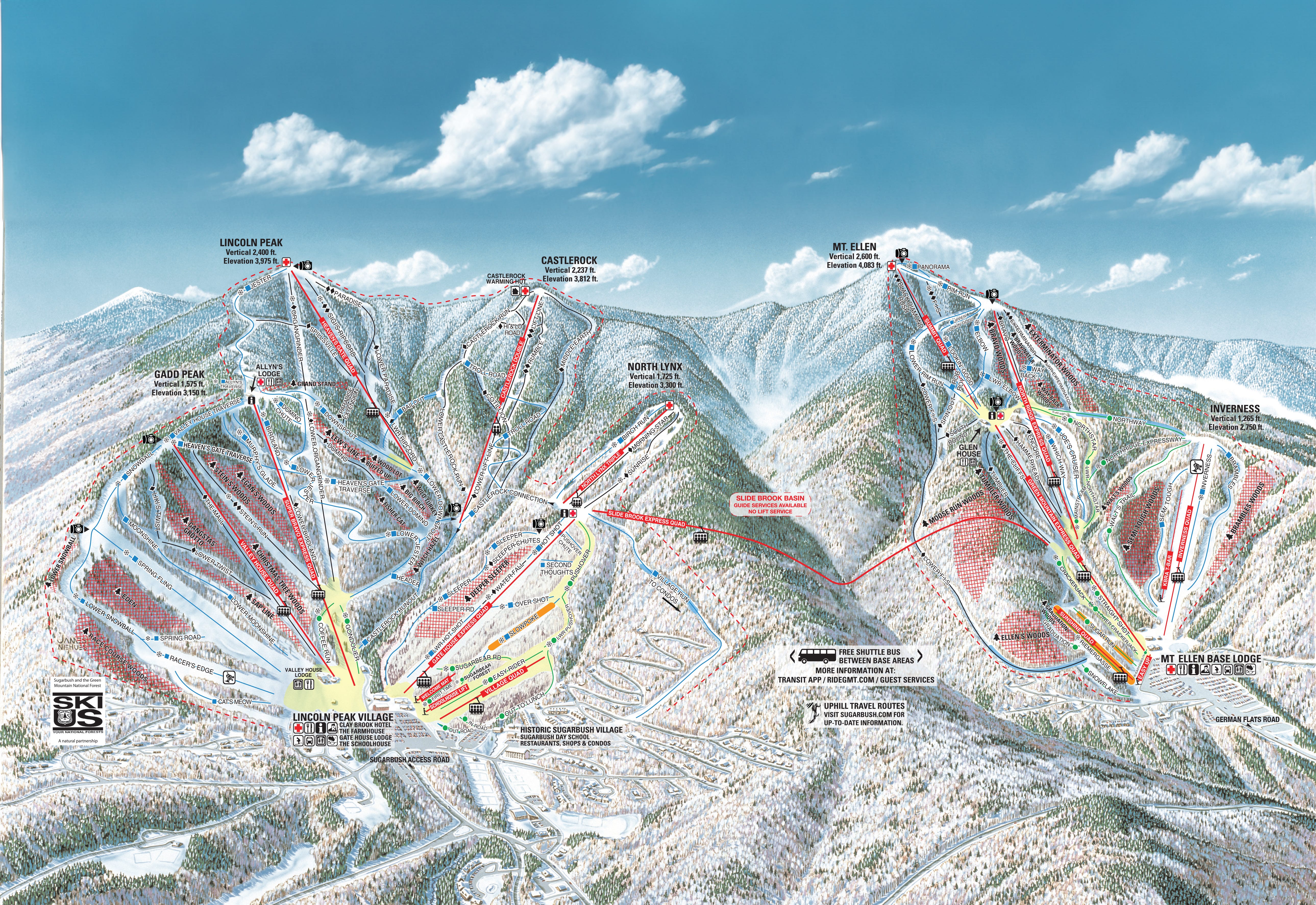
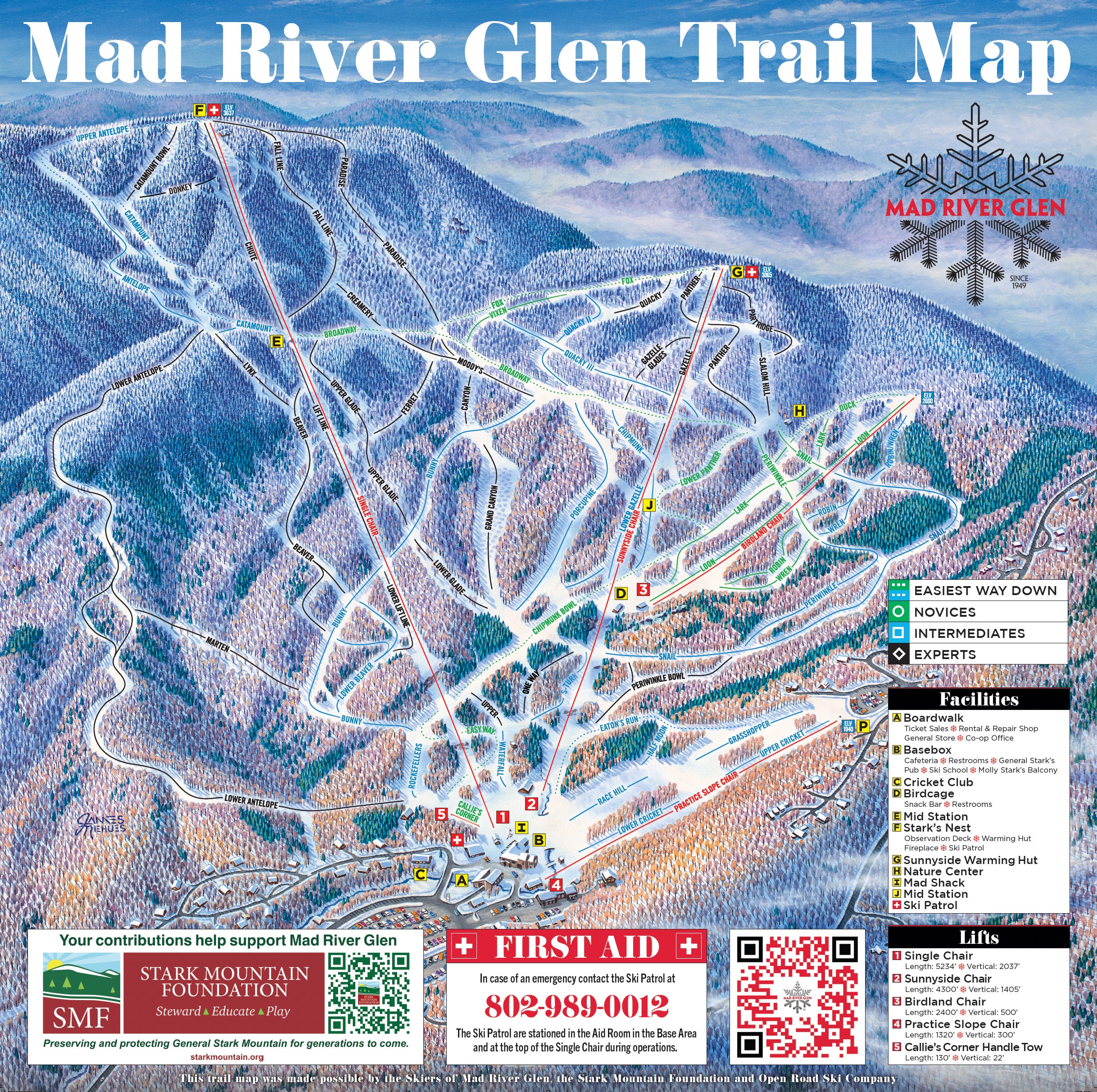
I always like to make this point for western partisans: there is eastern skiing that stacks up well against the average western ski experience. Most of it is in northern Vermont, and two of the best, terrain-wise, are Alterra-owned Sugarbush - home of the longest chairlift in the world - and co-op-owned Mad River Glen, which still spins the only single chair in the lower 48. Here’s Sugarbush:
Mad River Glen is right next door. Just keep going looker’s right off Mt. Ellen:
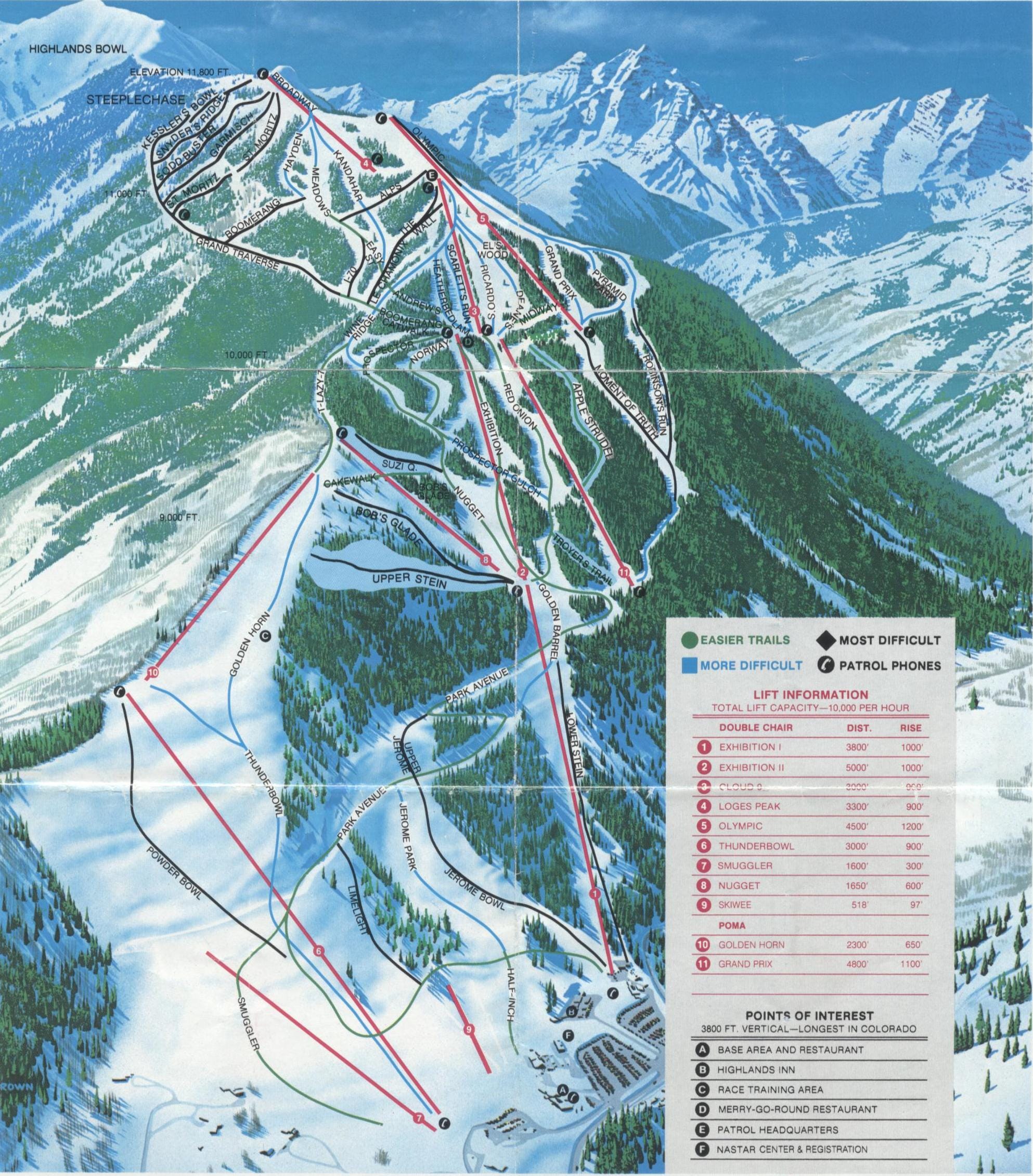
On pre-Skico Highlands
Whoa that’s a lot of lifts. And they’re almost all doubles and Pomas.
On Joe Hession
Hession is founder and CEO of Snow Partners, which owns Mountain Creek ski area, the Big Snow indoor ski ramp in New Jersey, Snow Cloud resort-management software, the Snow Triple Play Pass, and the Terrain Based Learning concept that you see in beginner areas all over America. He’s been on the pod a few times, and he’s a huge fan of Susan’s.
On Timberline’s wonky vert
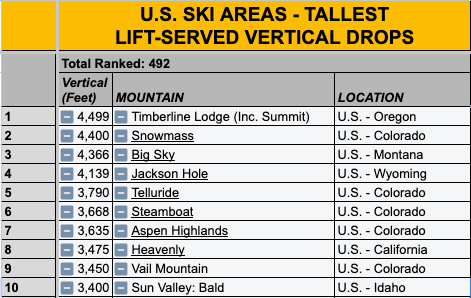
Measuring vertical drop is a somewhat hazardous game. Potential asterisks include the clandestine inclusion of hike-up terrain (Aspen Highlands), ski-down terrain with no return lift access (Sunlight), or both (Arapahoe Basin). Generally, I refer to lift-served vert, meaning what you can ski down and ride back up without walking. But even that gets tricky, as in the case of Timberline Lodge, Oregon, home to the tallest vertical drop in American lift-served skiing. We have to get mighty creative with the definition of “lift” however, since Timberline includes a 557-vertical-foot lift-served gap between the top of the Summit chairlift (4,290 feet) and the bottom of the Jeff Flood high-speed quad (4,847 feet). This is the result of two historically separate ski areas combining in 2018:
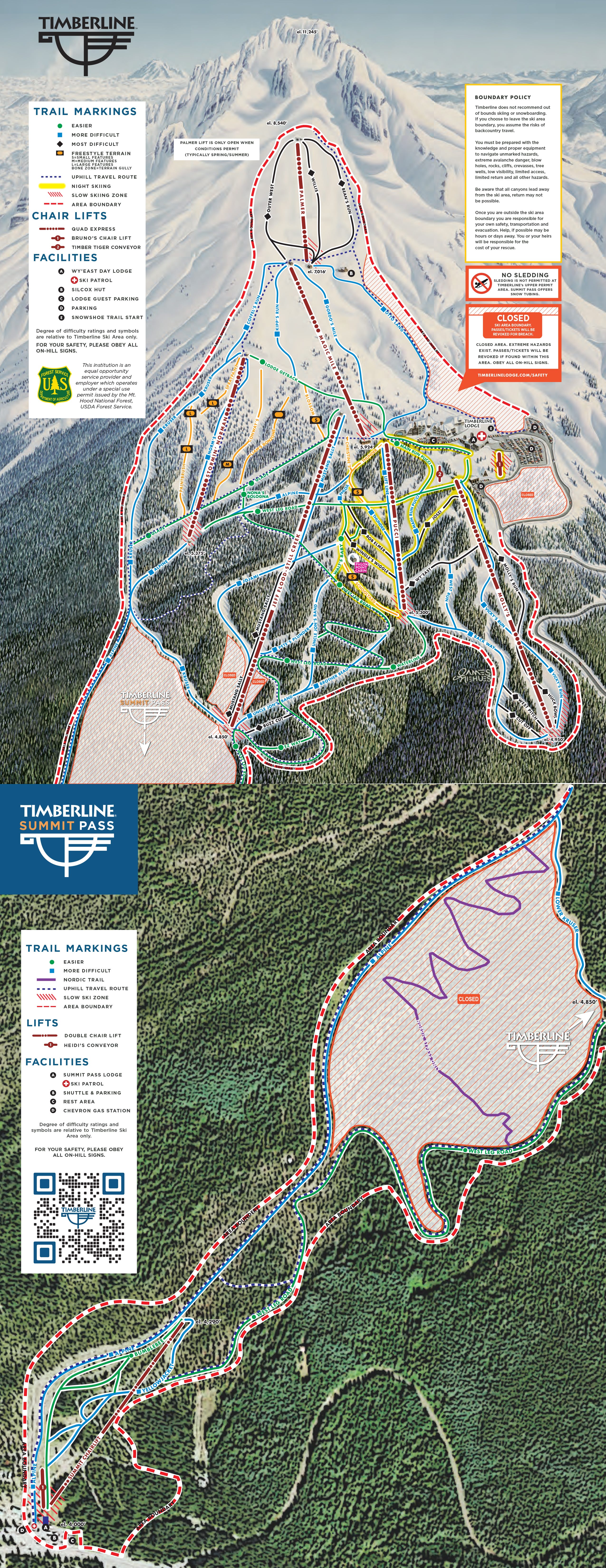
Timberline’s masterplan calls for a gondola from the base of Summit up to the top of Jeff Flood:
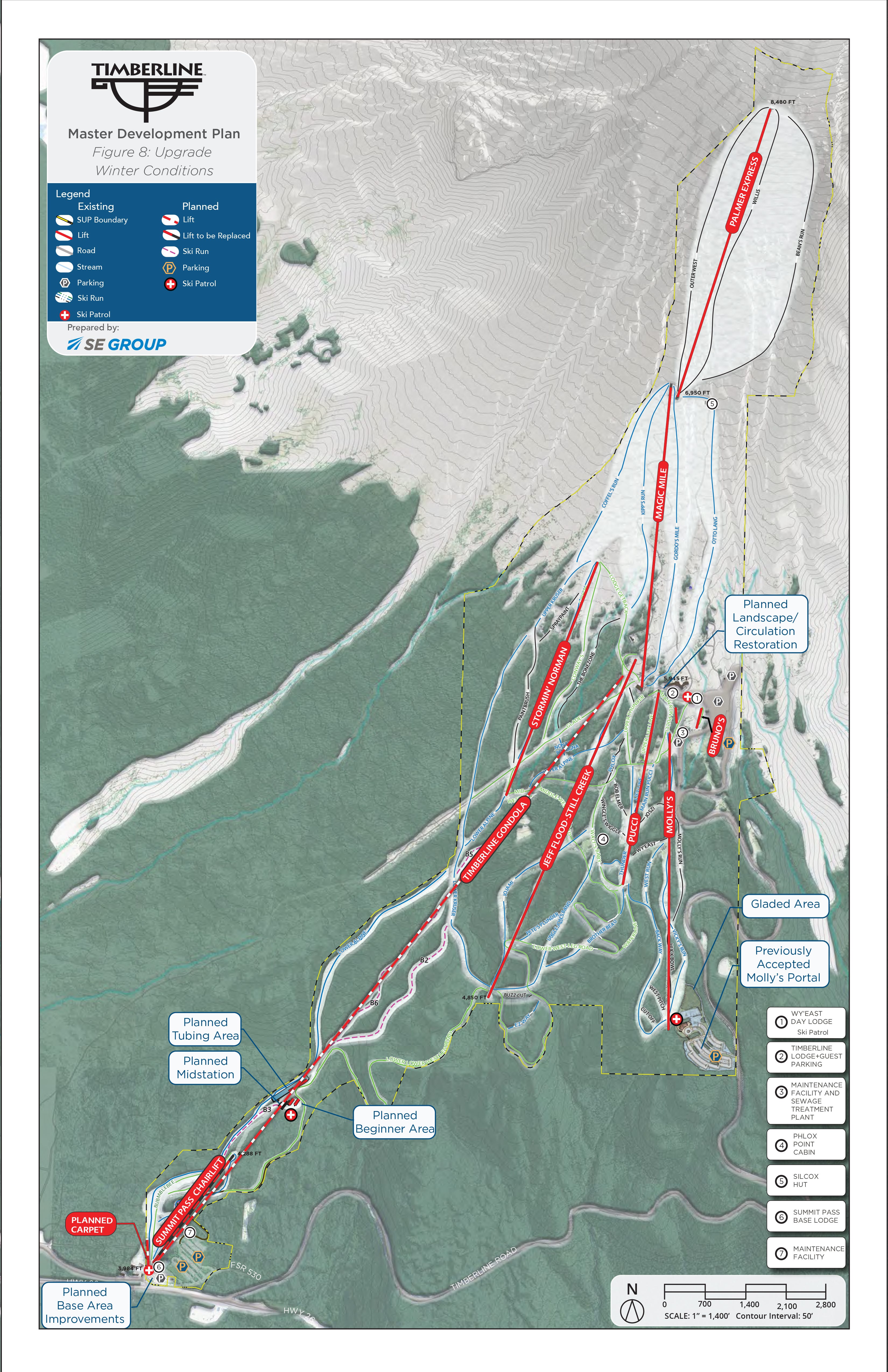
For now, skiers can ski all the way down, but have to ride back up to Timberline from the Summit base via shuttle. To further complicate the calculus here, the hyper-exposed Palmer high-speed summit quad rarely runs in winter, acting mostly as a summer workhorse for camp kids. When Palmer’s not running, a snowcat will sometimes shuttle skiers close to the unload point.
Anyway, that’s the fine print annotating our biggest lift-served vertical drop list:
On Big Sky’s new lifts and pod-sticking
Snowmass’ recent lift upgrade splurges are impressive, but Big Sky has built an incredible 12 aerial lifts in the past decade, 11 of them brand-new. These are some of the most sophisticated lifts in the world and include two six-packs, two eight-packs, a tram, and two gondolas. This reverse chronology of Big Sky’s active lifts doubles as a neat history of the mountain’s evolution from striver importing other resorts’ leftovers to one of the top ski areas on the continent:
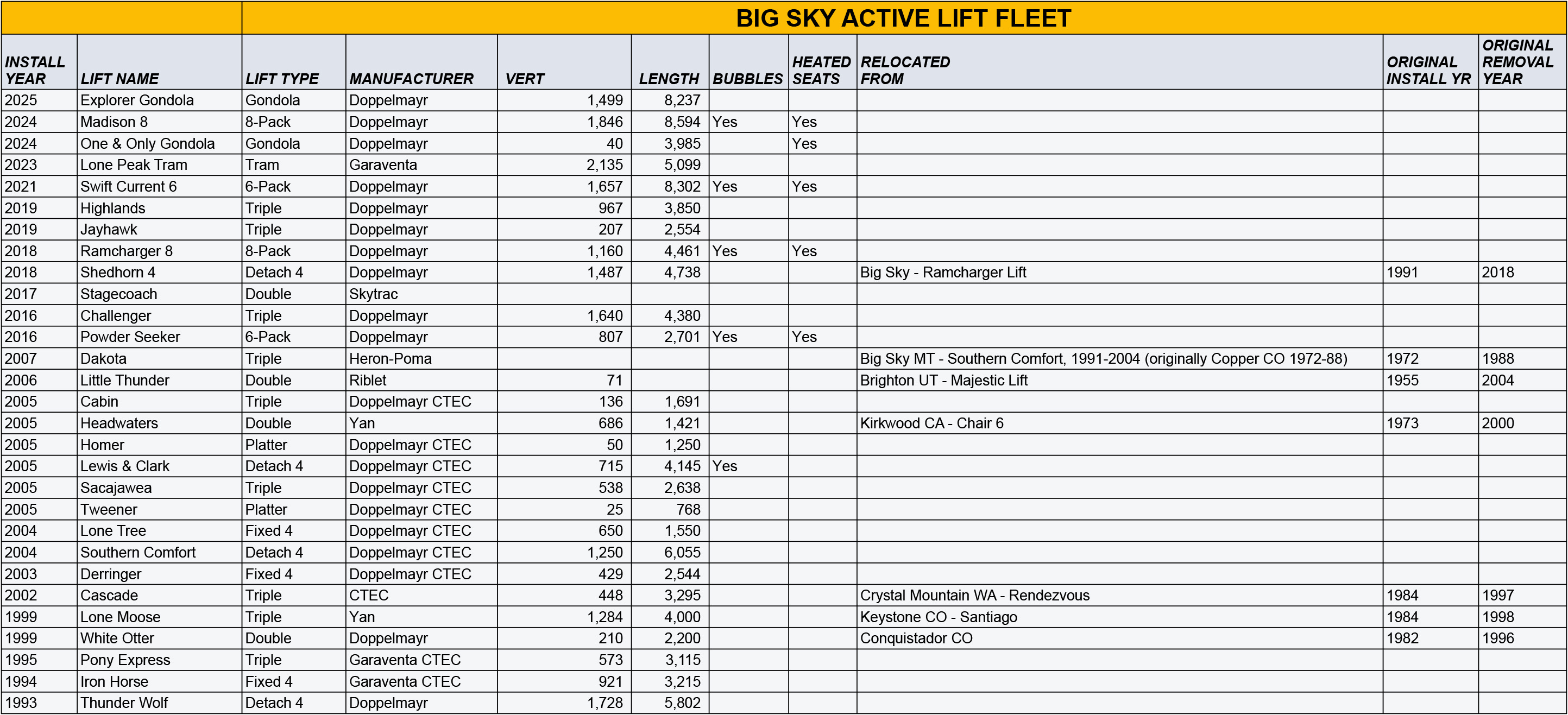
Big Sky still has some older chairs spinning along its margins, but plenty of tourists spend their entire vacation just lapping the out-of-base super lifts (according to on-the-ground staff). The only peer Big Sky has in the recent American lift upgrade game is Deer Valley, which has erected nearly a dozen aerial lifts in just the past two years to feed its mega-expansion.
On the Ikon Pass site being confusing as to mountain access
I just find the classification of four separate and distinct ski areas as one “destination” confusing, especially for skiers who aren’t familiar with the place:

On the new Elk Camp chairlift
The upside of taking nine years to distribute this podcast is that I was able to go ride Snowmass’ gorgeous new Elk Camp sixer:


On my Superstar lift discussion with Killington
On Aspen’s history of selling lifts
I somewhat overstated Aspen’s history of selling lifts to smaller mountains. It seemed like a lot, though these are the only ones I can find records of:

However, given Skico’s enormous number of retired Riblets (28, all but two of which were doubles), and the durability and ubiquity of these machines, I suspect that pieces – and perhaps wholes – of Aspen’s retired chairlifts are scattered in boneyards across the West.
On the small number of relocated detachable lifts
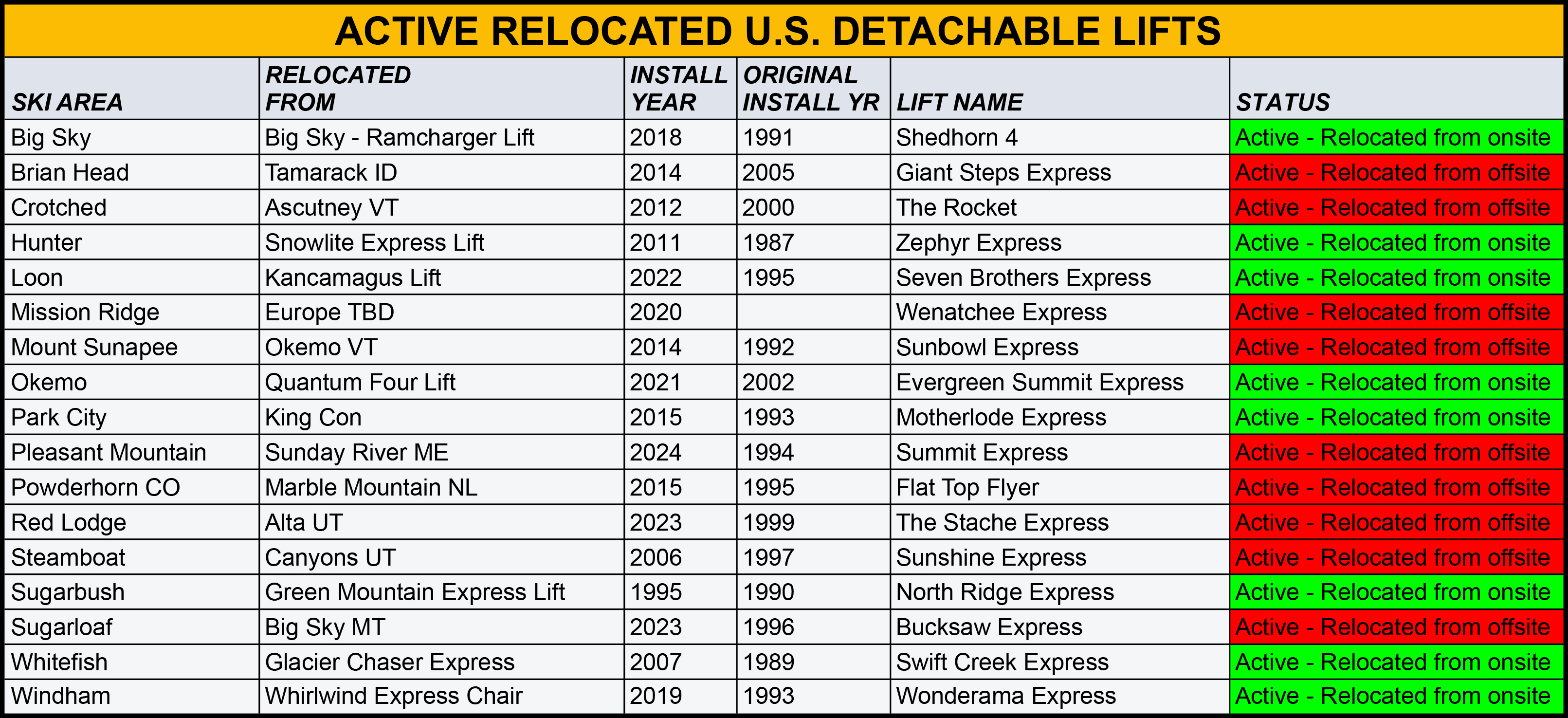
Given that the world’s first modern detachable chairlift debuted at Breckenridge 45 years ago, it’s astonishing how few have been relocated. Only 19 U.S. detaches that started life within the U.S. are now operating elsewhere in the country, and only nine moved to a different ski area:
On Powderhorn’s West End chair
The number of relocated detachables is set to increase to 10 next year, when Powderhorn, Colorado repurposes Snowmass’ old Elk Camp quad to replace this amazing, 7,000-foot-long double chair, a 1972 Heron-Poma machine:
Elk Camp is already sitting in a pile beside the load station (Powderhorn officials tell me the carriers are also onsite, but elsewhere):
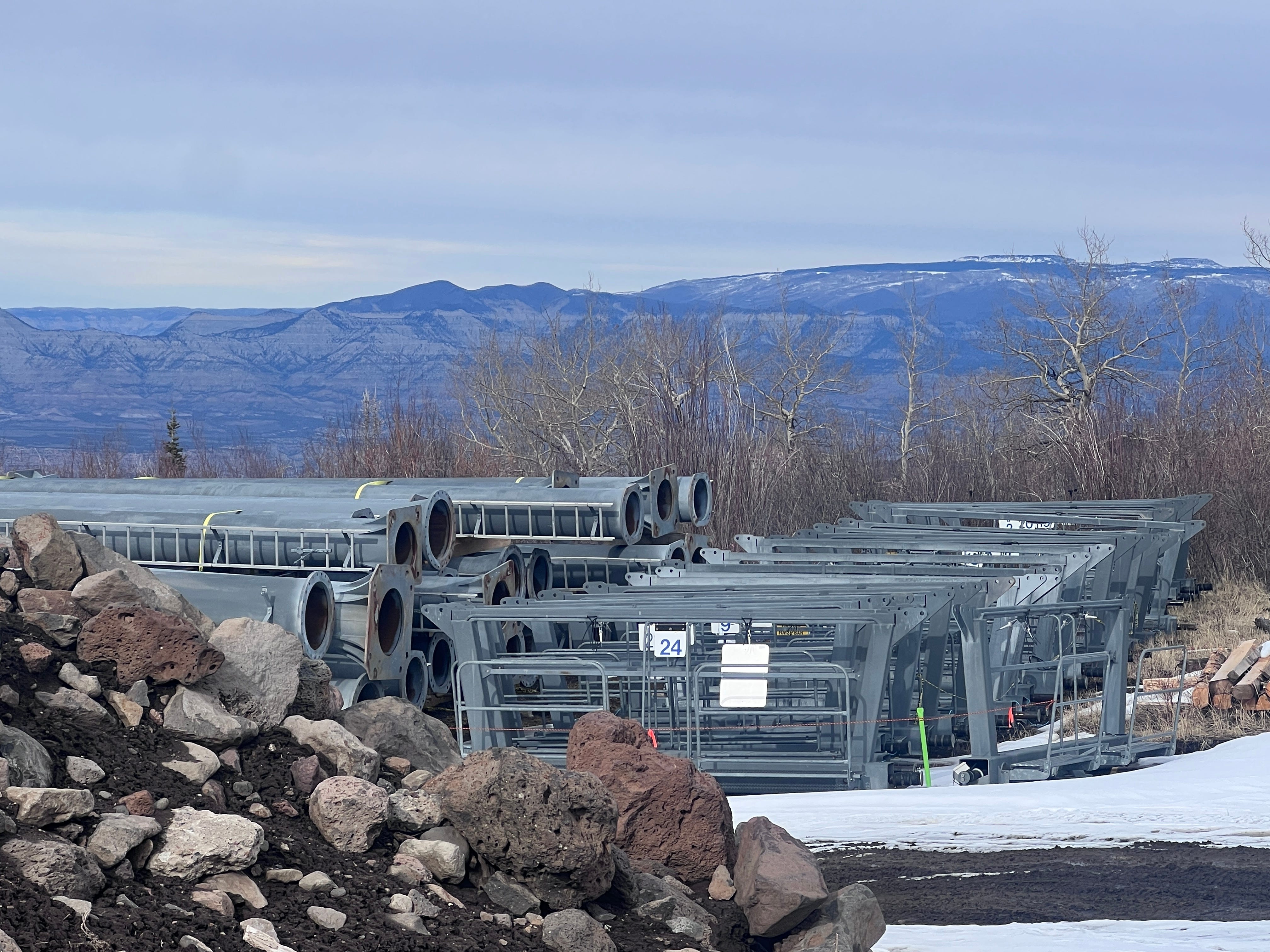
Powderhorn’s existing high-speed quad, the Flat Top Flyer, also came used, from Marble Mountain in Canada.
On Snowmass’ masterplan and the proposed Burnt Mountain lift
Snowmass’ most recent U.S. Forest Service masterplan, released in 2022, shows the approximate location of a future hypothetical Burnt Mountain chairlift (the left-most red dotted line below):
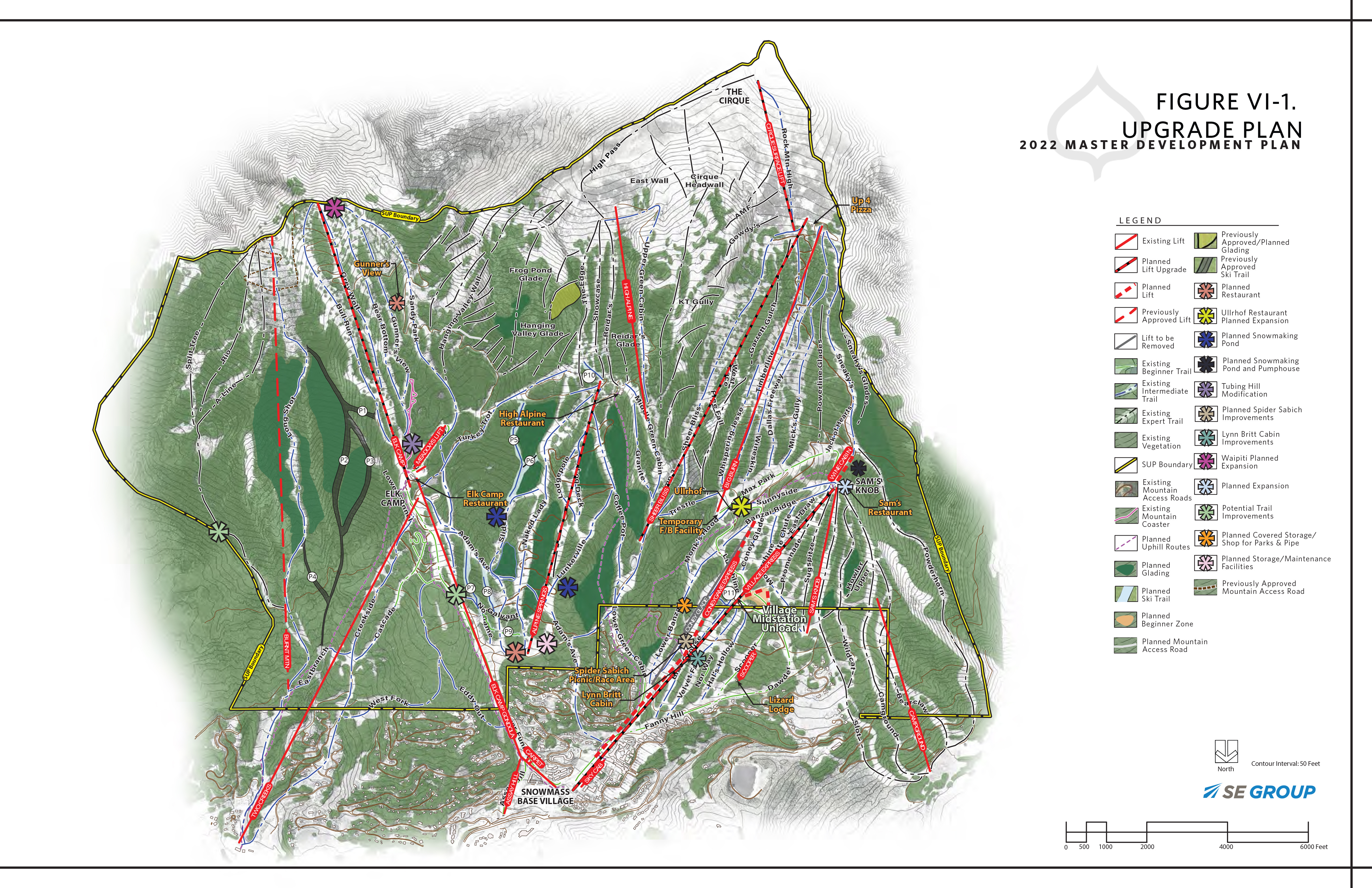
Unfortunately, Cross and the rest of Skico’s leadership seem fairly unenthusiastic about actually building this lift. Right now, skiers can hike from the top of Elk Camp chair to access this terrain.
On Aspen’s Nell-Bell Proposal
Oh man how freaking cool would it be to ride one chairlift from Aspen’s base to the top of Bell? Cross and I discuss Aspen Mountain’s Forest Service application to do exactly that, with a machine along roughly this line parallel to the gondola:
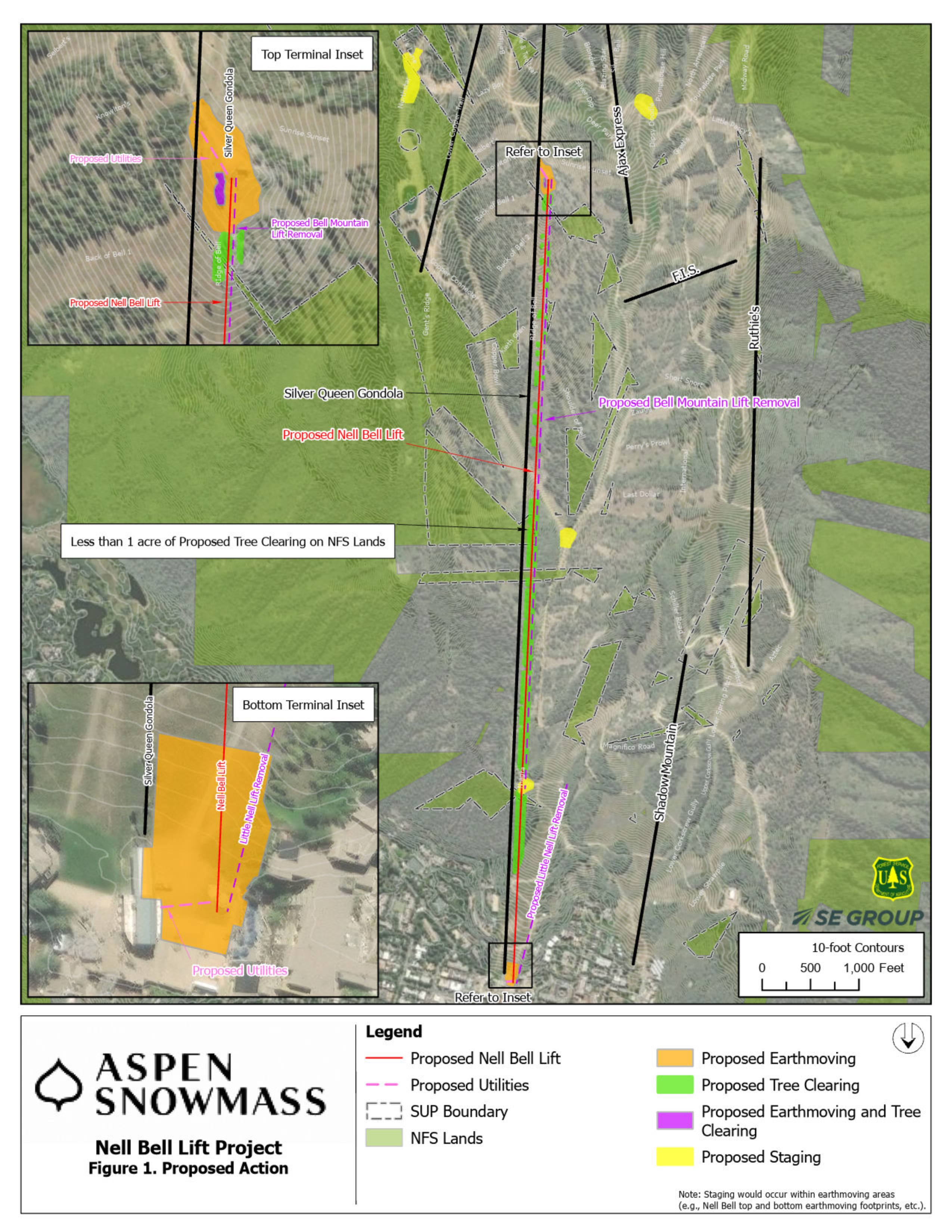
The new detachable would replace two rarely-used chairs: the Nell fixed-grip quad and the Bell Mountain double chair, which, incredibly, dates to 1957 (with heavy modifications in the 1980s), making it the fourth-oldest standing chairlift in the nation (after Mt. Spokane’s 1956 Vista Cruiser Riblet, Mad River Glen’s 1946 American Steel & Wire single chair, and Boyne Mountain’s Hemlock Riblet double, moved to Michigan in 1948 after starting life circa 1936 as America’s first chairlift – a single standing at Sun Valley).
I lucked out with a gondola wind hold when I was in Aspen a few weeks back, meaning Nell was spinning:
Sadly, Bell was idle, but I skied the liftline and loaded up on photos:


On the original Lift 1 at Aspen
Behold Lift 1 on Aspen Mountain, a 1946 American Steel & Wire single chair that rose 2,574 vertical feet along an 8,480-foot line in something like 35 or 40 minutes. Details on this lift’s origin story and history vary, but commenters on Lift Blog suggest that towers from this lift ended up as part of Sunlight’s Segundo double following its removal from Ajax in 1971. That Franken-lift, which also contained parts from Aspen’s Lift 3 – which dated to 1954 and may have been a Poma or American Steel & Wire machine, but lived its 52-year Sunlight tenure as a Riblet – came down last summer to make way for a new-used triple – A-Basin’s old Lenawee chair.
On the Hero’s expansion
At just 826 acres, Aspen Mountain is the most famous small ski area in the West. The reason, in part, for this notoriety: a quirky, lively treasure chest of a ski area that rockets straight up, hiding odd little terrain pockets in its fingers and folds. The 153-acre Hero’s terrain, a byzantine scramble of high-altitude tree skiing opened just two years ago, fits into this Rocky Mountain minefield like a thousand-dollar bill in a millionaire’s wallet. An obscene boost to an already near-perfect ski mountain, so good it’s hard to believe the ski area existed so long without it.
Here’s a mellow section of Hero’s:
And a less-mellow one (adding to the challenge, this terrain is at 11,000 feet):


