


Who
John Kelly, CEO of Taos Ski Valley, New Mexico
Recorded on
November 13, 2025
About Taos Ski Valley
Click here for a mountain stats overview
Owned by: Louis Bacon (since December 2013)
Located in: Taos Ski Valley, New Mexico
Year founded: 1955
Pass affiliations:
Ikon Pass – 7 days, no blackouts
Ikon Base Pass – 5 days, holiday blackouts
Ikon Session Pass – 1-4 days, holiday blackouts
Mountain Collective – 2 days, no blackouts
Ski New Mexico True Pass – 2 days, holiday blackouts
Base elevation: 9,350 feet
Summit elevation: 12,450 feet lift-served, 12,481 hike-to
Vertical drop: 3,100 feet lift-served, 3,131 hike-to.
Skiable acres: 1,294 (some hike-to)
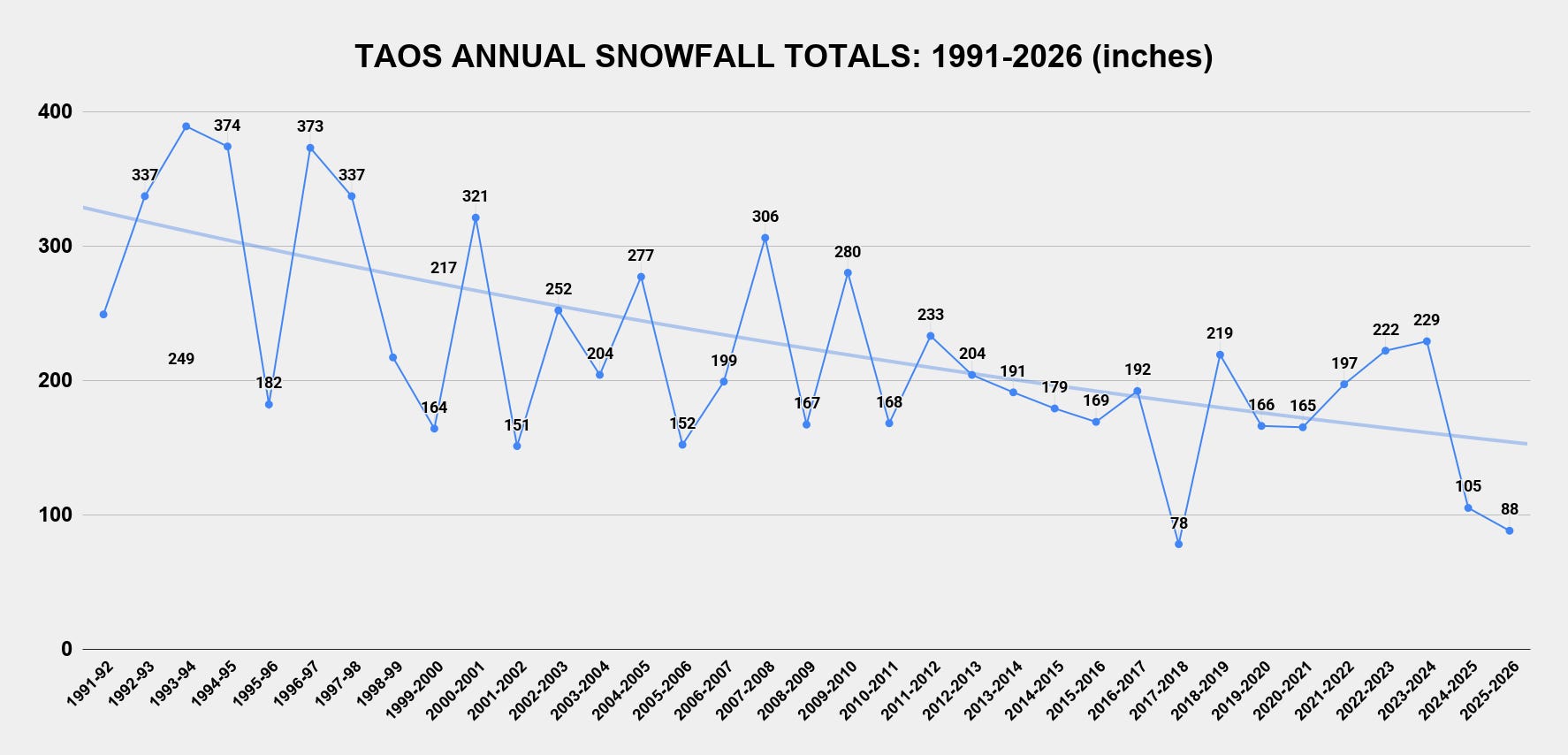
Average annual snowfall: 300 inches claimed on website; calculated 36-year average using data sourced from Taos’ 2010 master development plan, Ski New Mexico tallies, and media reports is 233 inches. The 10-year average falls to 166 inches. Here’s the year-by-year breakdown:
Trail count: 110 (24% beginner, 25% intermediate, 51% expert)
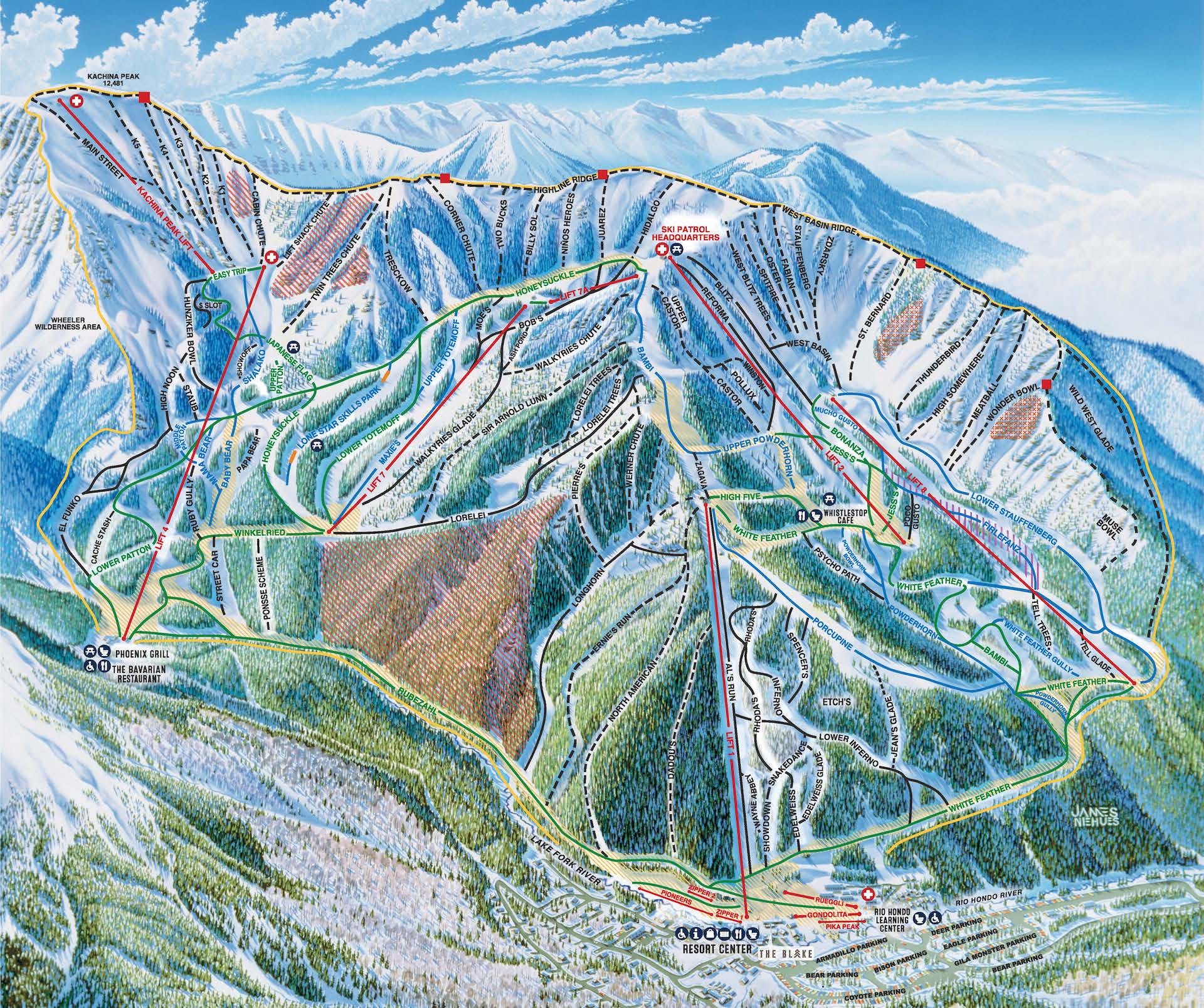
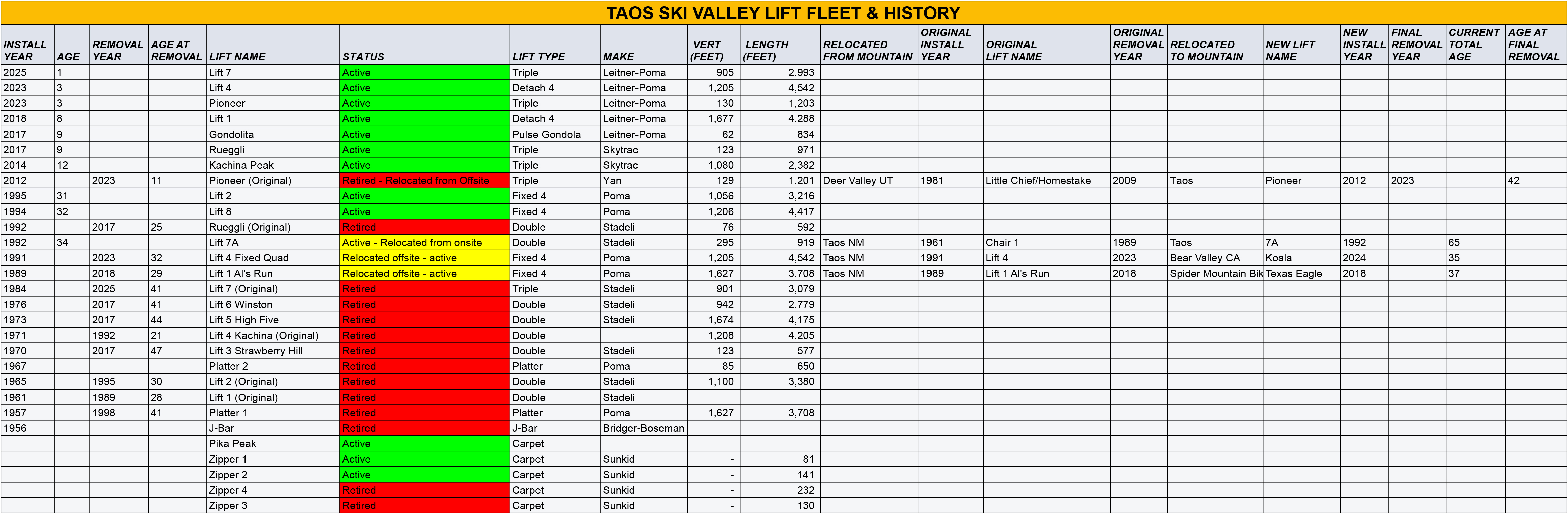
Lift count: 13 (1 pulse gondola, 2 high-speed quads, 2 fixed-grip quads, 4 triples, 1 double, 3 carpets)
Why I interviewed him
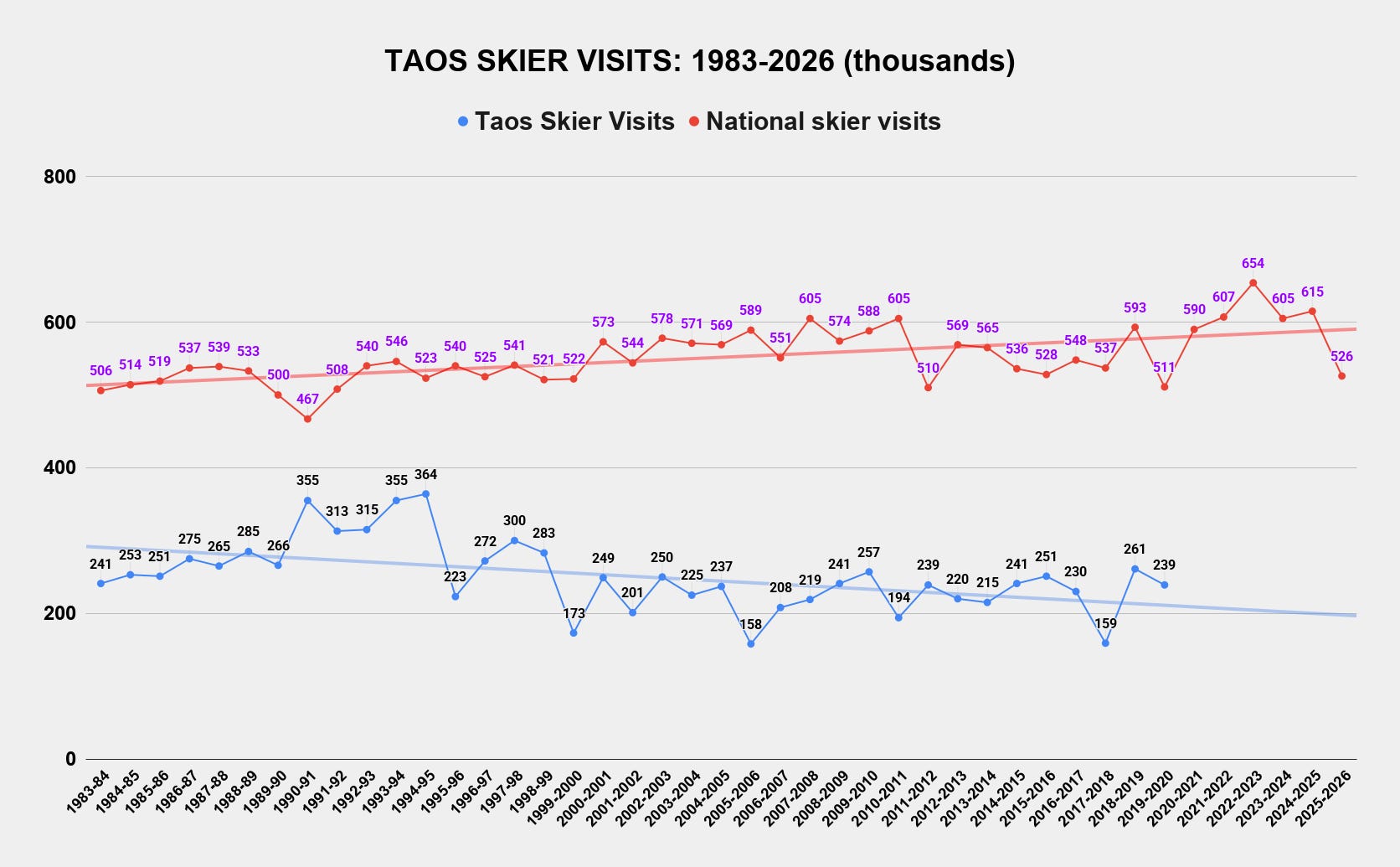
Let’s start with a superficially troubling number: Taos’ long, steady decline in average annual skier visits:
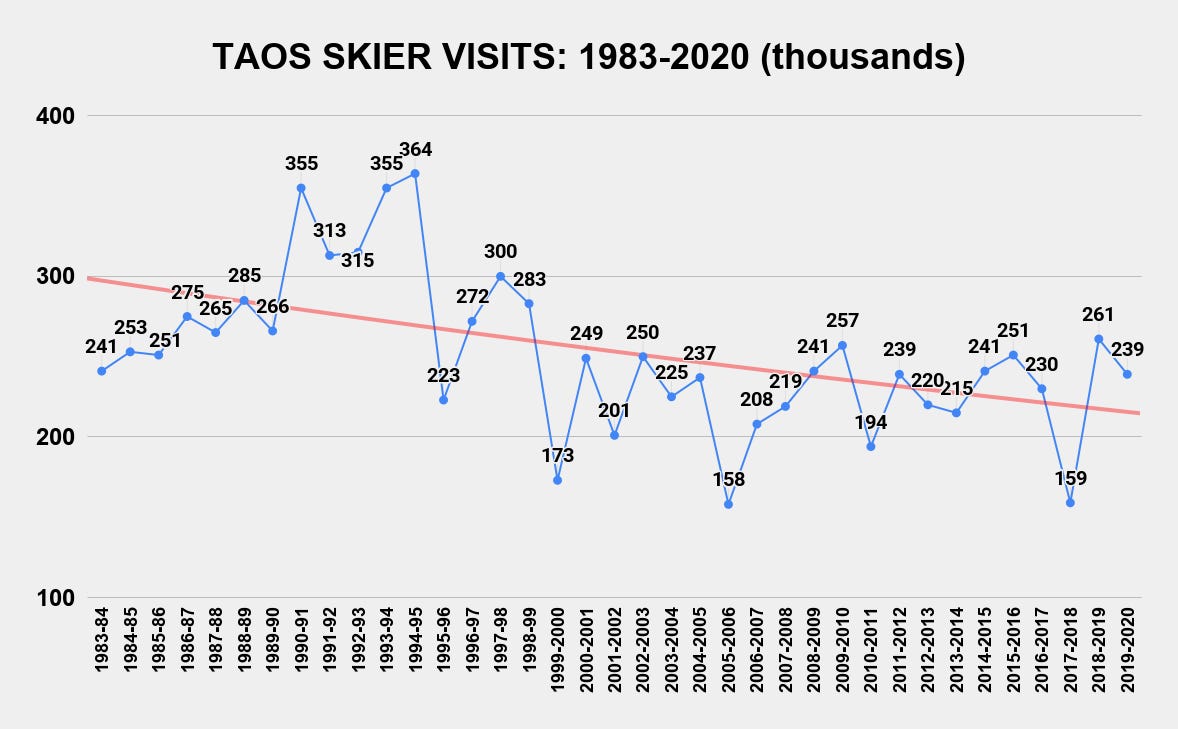
That doesn’t look so good, especially when laid alongside the long-term increase in national skier visits:
Taos not only declined in the context of national skier visits, but also among its peers. In winter 1983-84, Taos drew more skiers (241,000) than Telluride (132,460), Big Sky (136,000), Jackson Hole (177,000), Whitefish (I’m lacking an estimate for that winter, but the ski area then known as “Big Mountain” logged 209,000 skiers in 1980-81 and 170,581 in 1985-86). Taos (dark blue line below), continued to out-duel this group through about the mid-90s before falling off a cliff:
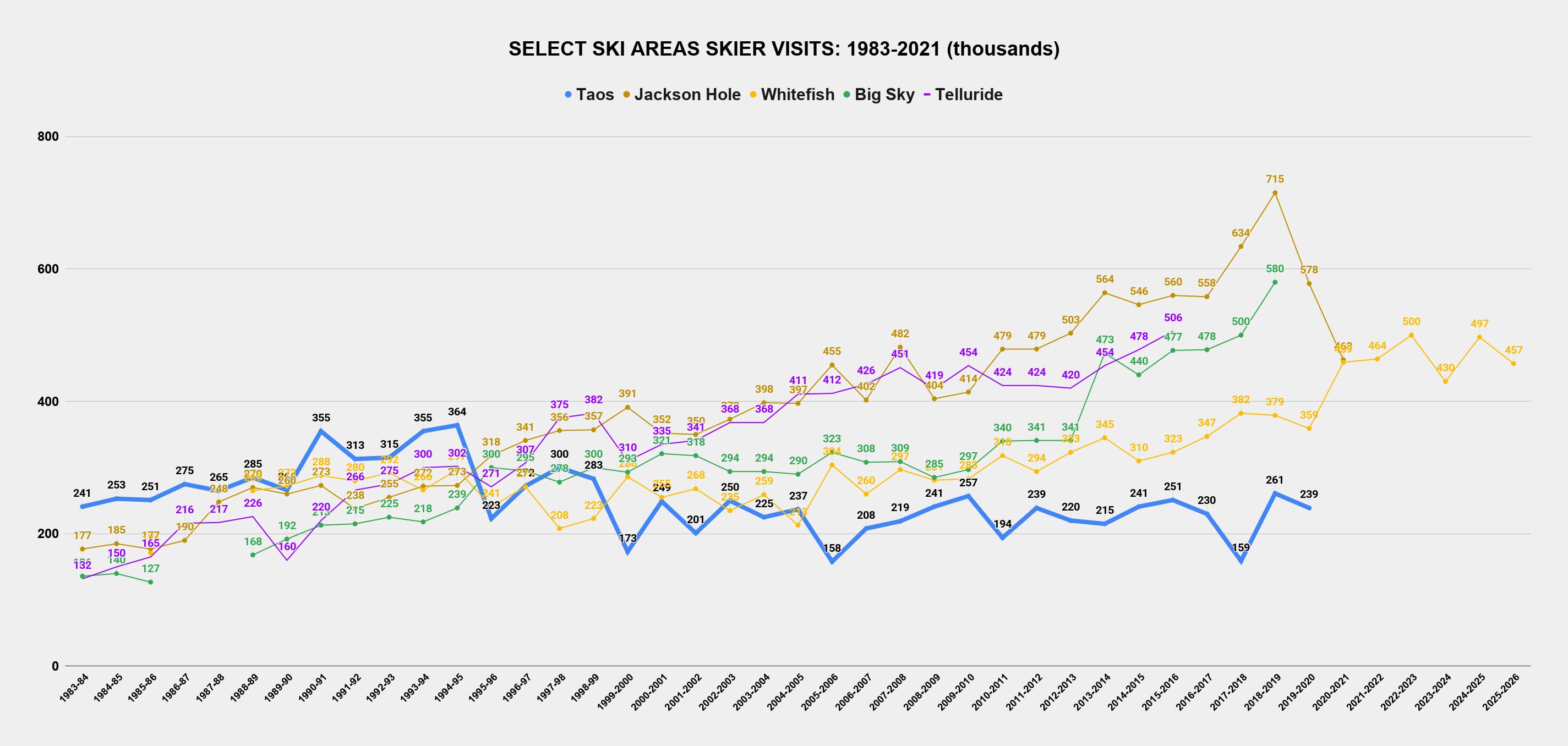
So what happened? 1995 Taos, a freeride mecca before freeride was cool, should have been perfectly suited to flourish in a cultural moment when skiers began demanding more interesting terrain than the groomed superhighways that had become the industry’s default setting. Sure, Taos was remote and a bit harder to access than, say, Keystone or Park City, but so were Jackson and Whitefish and Big Sky and Telluride. A partial explanation: Taos stopped modernizing. After replacing the Lift 2 double with a fixed-grip quad in 1994, Taos didn’t install another new chairlift for 19 years. The first detachable didn’t arrive until 2018. The resort banned snowboards until 2008. Meanwhile, Big Sky laced a tram to the summit of Lone Peak in 1995 and started pushing detachable quads up the mountain; the first high-speed quads arrived at Telluride in 1986 and Whitefish in 1989.
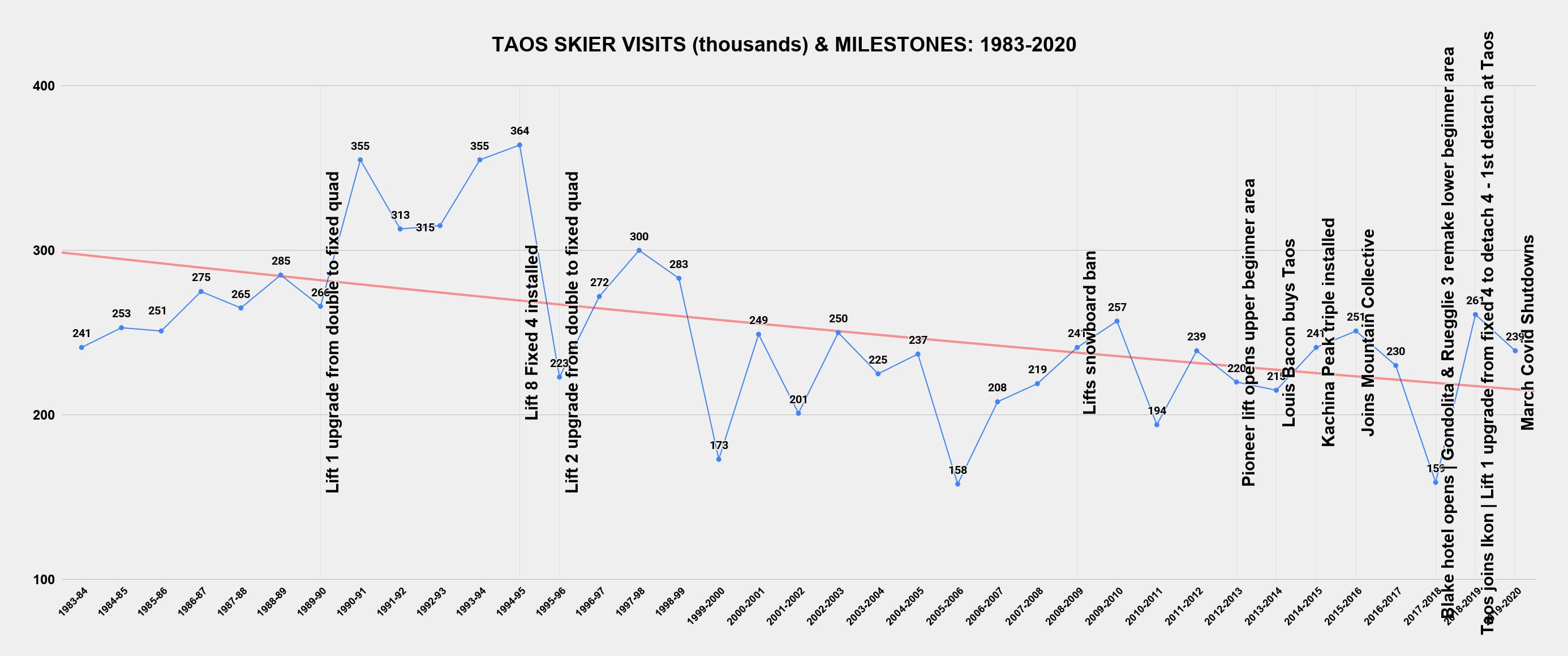
It’s not a perfect narrative – while Jackson Hole rolled out its short Sublette detach in the mid-90s, the mountain didn’t install an upper-mountain high-speed chairlift until Casper in 2012. Skier visits went up and up and up all that time, probably due in large part to aggressive improvements at the Jackson Hole airport.
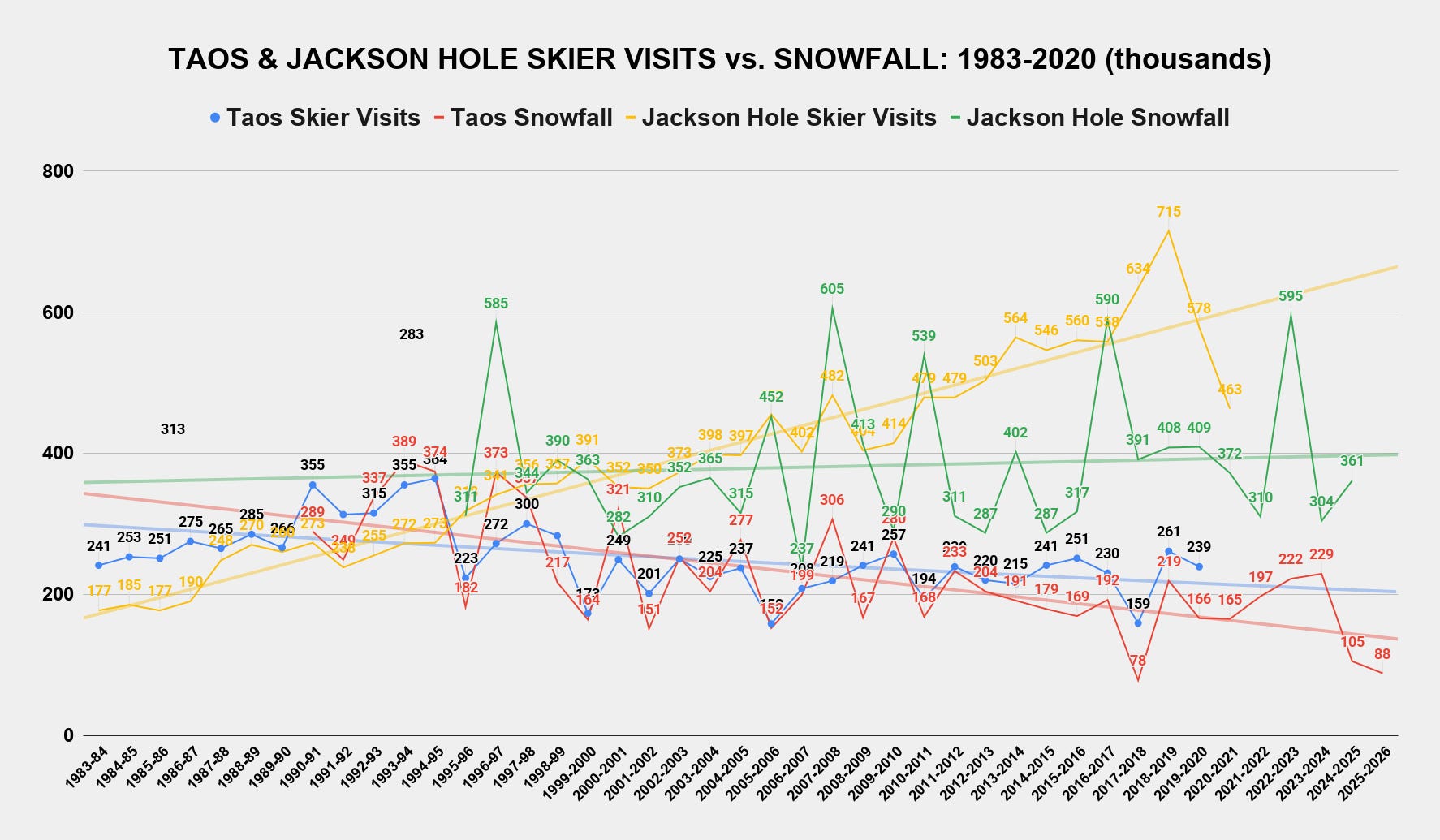
Maybe, though, it’s as simple as this: banger snow years descended upon Taos – and New Mexico in general – from the late ‘80s through mid-‘90s. It’s little surprise that attendance ups-and-downs largely mirror snowfall patterns:
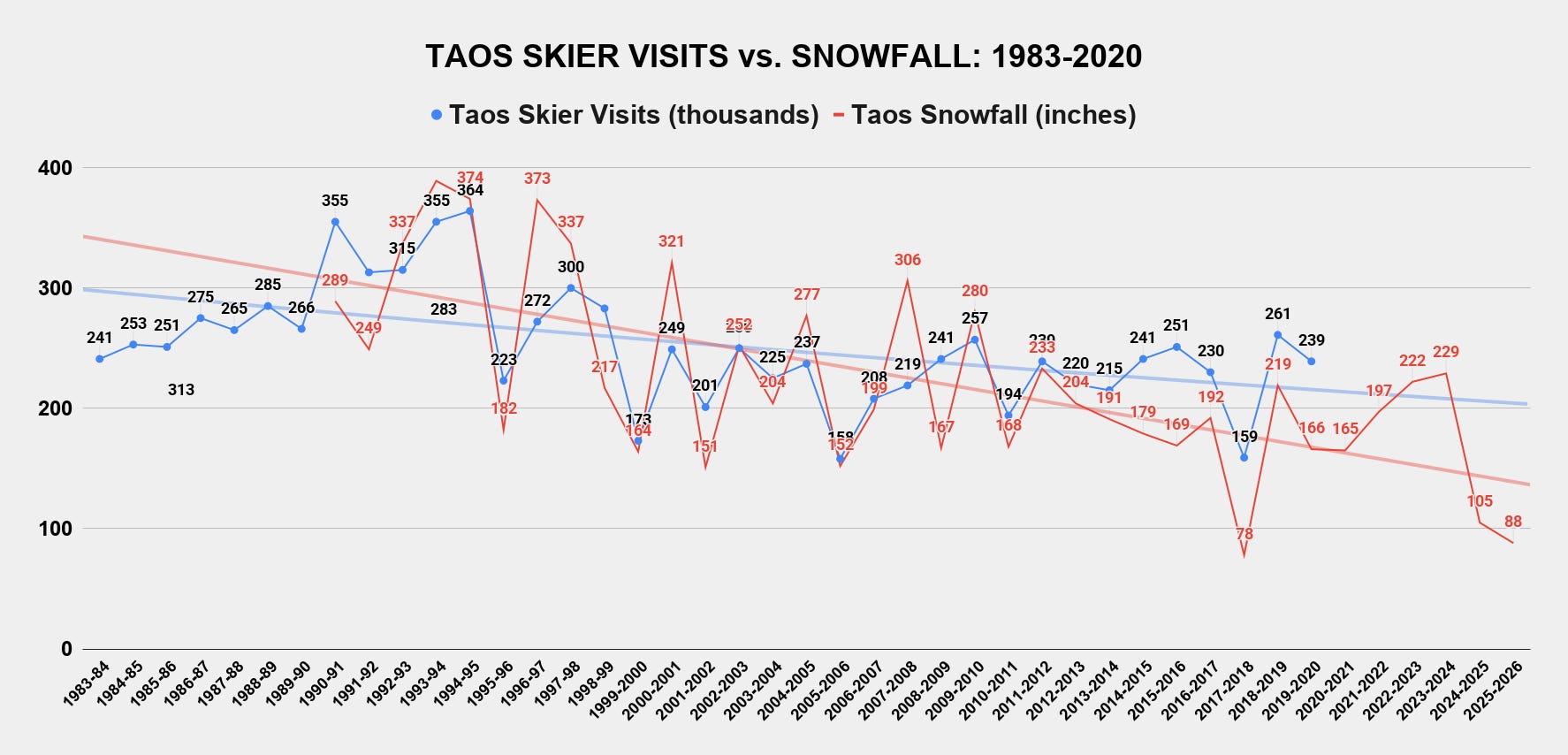
But, as the corresponding trendlines show, Taos’ skier visits have not declined at the same rate as the mountain’s average annual snowfall. And while Jackson’s long-term average snowfall has remained relatively constant, attendance has crept steadily upward. Attendance spiked at both mountains when the 2018-19 season brought both plentiful snow and the introduction of the Ikon Pass:
Unfortunately, Taos stopped reporting skier visits after the Covid-shortened 2019-20 season, so we have less concrete insight into whether the mountain’s recent investments in a reconfigured beginner area and a second detachable on the backside have insulated it from two historically poor snow years. This is why it’s nice to have basic visitation data, and why I’m pushing the ski industry to again publicize annual attendance for ski areas occupying public lands (since going live with a chart of 2,406 years of skier visit data for 97 ski areas with 10 or more years of attendance available, I’m up to 2,822 years across 108 ski areas, and I have a total of 3,802 years of data across 184 active U.S. ski areas for which I could find at least one year of attendance).
We do know this: Taos doesn’t want to return to the world of 300,000-plus skier visits. Somewhere between 250,000 and 275,000 is the “right number for the experience we want Taos to have,” Kelly tells us on the pod. Meaning: fewer skiers spread via a modern lift network is a better business than 364,000 skiers funneling onto double chairs. This flips the busiest-equals-best narrative that made skier-visit counts a 20th-century bragging point. I’ve heard the same logic articulated by the leaders of Killington, Waterville Valley, and other ski areas that have created a better business even with fewer skiers on their mountains. Jackson Hole, too, halted its relentless upward surge – that 2020-21 dip was deliberate, as the mountain exited Ikon Base and implemented a reservation system.
This approach makes sense to me. With U.S. skier visits surging (until this year) and an Ikon or Epic pass in every pocket, no one wants to brag about being busy anymore. Space is the new volume. Social media can still transform one bad liftline into an eternal meme, but at least most skiers on the ground will have a better day most of the time than they probably would have 30 years ago.
What doesn’t make sense to me is why, in a less-is-more era, ski area operators have suddenly decided that skier visits should be guarded like Fort Knox. If fewer skiers is a good thing and a stated goal, why hide the numbers? The resorts ought to just say “Hey we’ve deliberately reduced our annual skier count from 300,000 to 250,000 [or whatever] to create a better mountain for you.” Instead, this secrecy around volume just looks cagey - if national skier visit numbers are up, then why should skiers just believe ski areas when they say “trust us, it’s better now,” and offer no data to support it? Perception is reality, and today’s skiing zeitgeist, as channeled by social media, tells us that American skiers perceive busier mountains today than they did a decade ago.
But I’m getting off track. Since Louis Bacon bought Taos in 2013, he’s funded an almost-complete renovation of what had become America’s most decrepit destination ski resort. I don’t think any mountain operating on U.S. Forest Service lands has more completely remade itself in the past decade (rapidly changing Big Sky, Deer Valley, and Powder Mountain operate on private property). Glimmering new but reset to 1970s volume, Taos is beautifully positioned to tap a skiing public that’s burned-out on Colorado and Utah crowds but accustomed to modern lifts and snowmaking.
What we talked about
Taos as a family ski mountain; last winter’s Chair 7 upgrade and custom terminals; owner Louis Bacon’s mission to “improve everything without changing a thing”; why Taos changed from Skytrac to parent company Leitner-Poma for its newer lifts; Taos’ great base-area reorganization; the story behind the Free Tacos run; a green run from the top of every lift other than the fierce Kachina triple; Taos’ massive evolution since 2015; whether the mountain is committed to long-term independence; the founding Blake family’s legacy and presence at Taos today; executing rapid development on Forest Service land; [VIDEO BONUS: Cat photobombing]; running Taos with the context of having worked at also-independent Telluride; becoming a skier growing up in Nashville, Tennessee; Telluride’s evolution from semi-affordable to gigantic housing puzzle; employee housing at Taos; the logic behind the proposed base-to-base gondola and navigating local opposition; thoughts on the evolution of lifts 2 and 8; preserving parts of the hike-to ski experience; Taos’ evolution after the Kachina Peak lift; lift 7A; the Minnesotas glades from the masterplan; avalanche mitigation; old-school boot-packing; parking lot evolutions; an ideal annual skier visit number and why that number is below historic highs; and getting to Taos.


What I got wrong
When we discuss the wood-paneled terminals on Taos’ new Lift 7, I ask if they’re thematically related to the “wood RFID gates.” This is a reference to an earlier conversation that I cut, about Taos finally installing RFID for the 2025-26 ski season (the gates carry a wood theme).
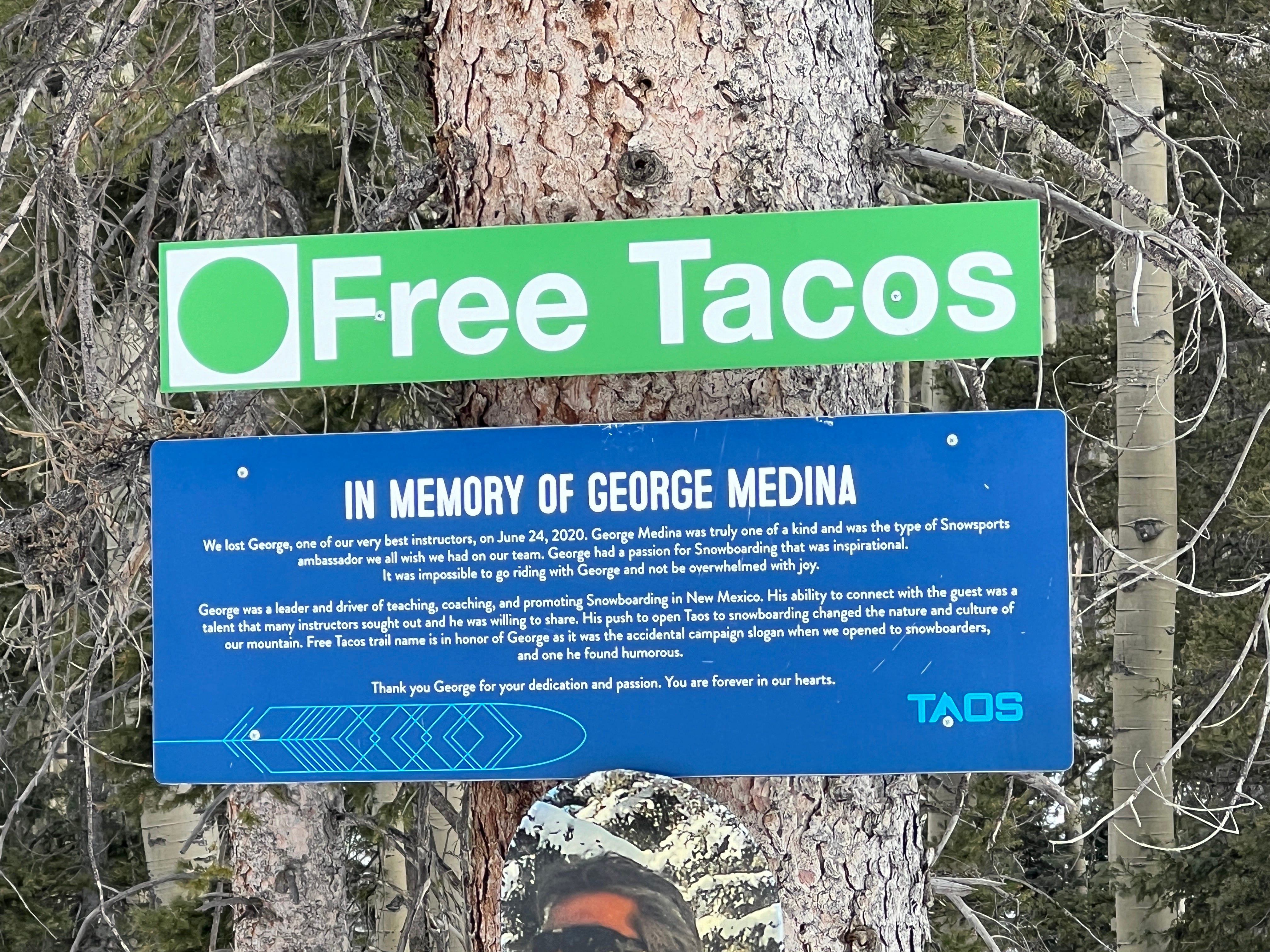
I said that the trees skier’s left of the Pioneer chair were not a named run, but they in fact are, and “Free Tacos” has a pretty awesome story behind it.
I accidentally asked Kelly to, “lay out the housing landscape for Telluride” but meant to say “Taos.” I didn’t catch this in real time, but Kelly – who spent several years at Telluride before moving to Taos in 2015 – caught it and course-corrected.
Questions I wished I’d asked
Taos’ 2010 USFS masterplan proposed a 7,045-foot-long, 2,363-vertical-foot detach quad that would have run parallel to Lift 1 to the top of Lift 2:
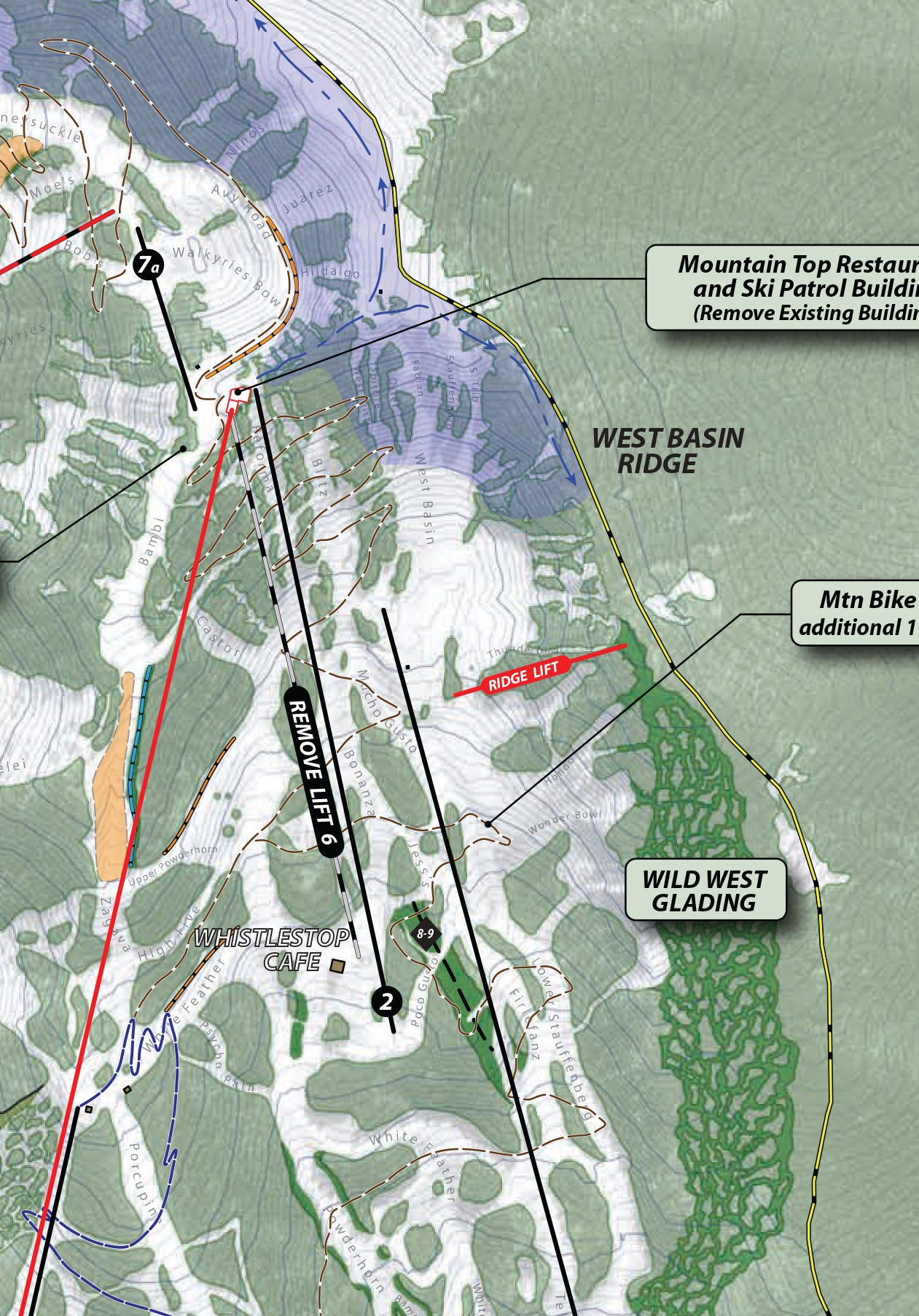
We did, however, discuss the proposed 545-vertical-foot, 991-foot-long Ridge Lift off of Lift 8, and why Taos nixed that machine from its latest MDP:
Why you should (or shouldn’t) ski Taos
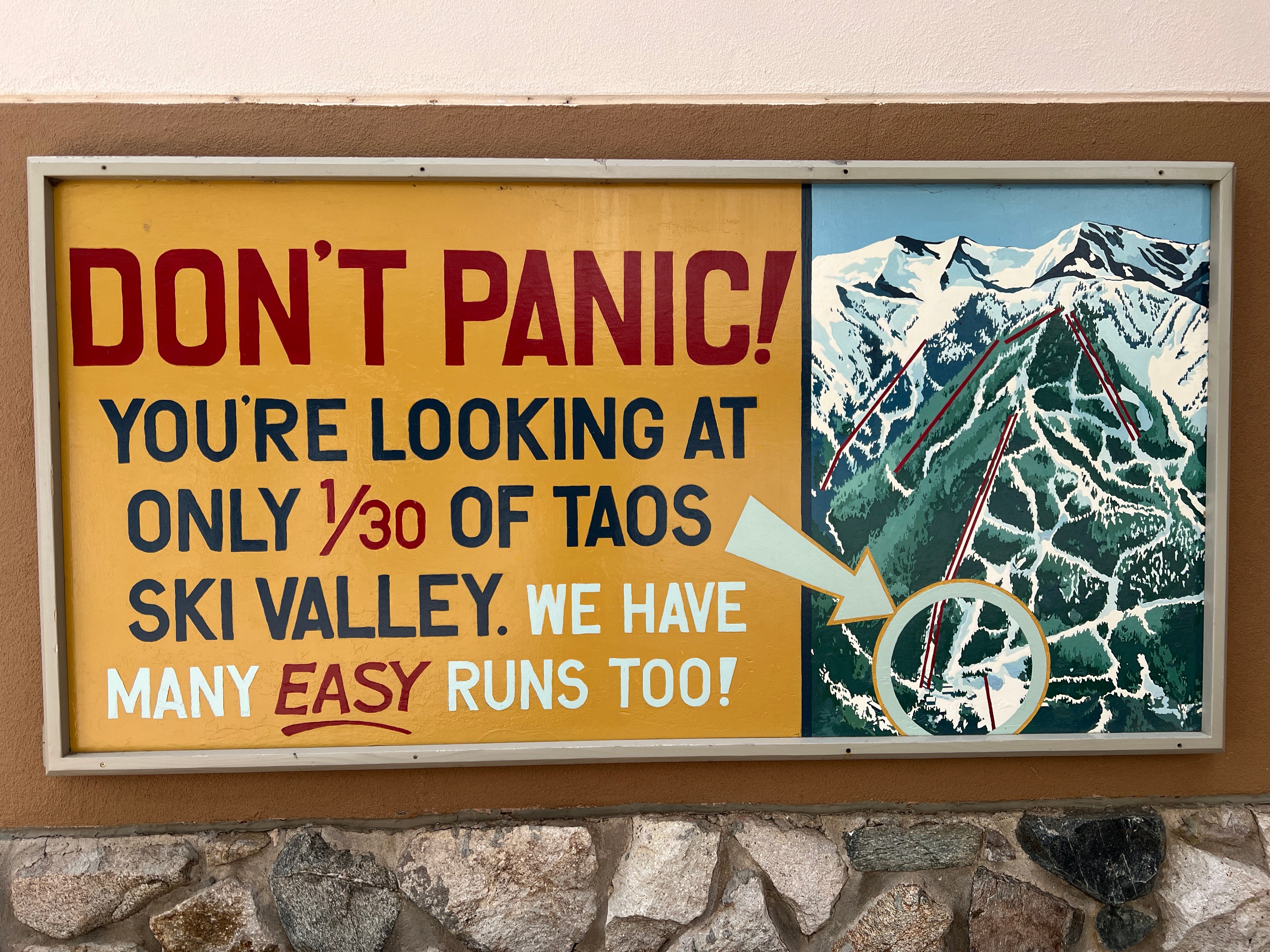
Taos, like Jackson Hole or Snowbird or Palisades Tahoe, has a toughguy reputation. The place ripples with hike-to chutes and glades. To calm visitors shocked by the vertical bump run rocketing skyward beneath Chair 1, Taos to erected this base-area sign decades ago:
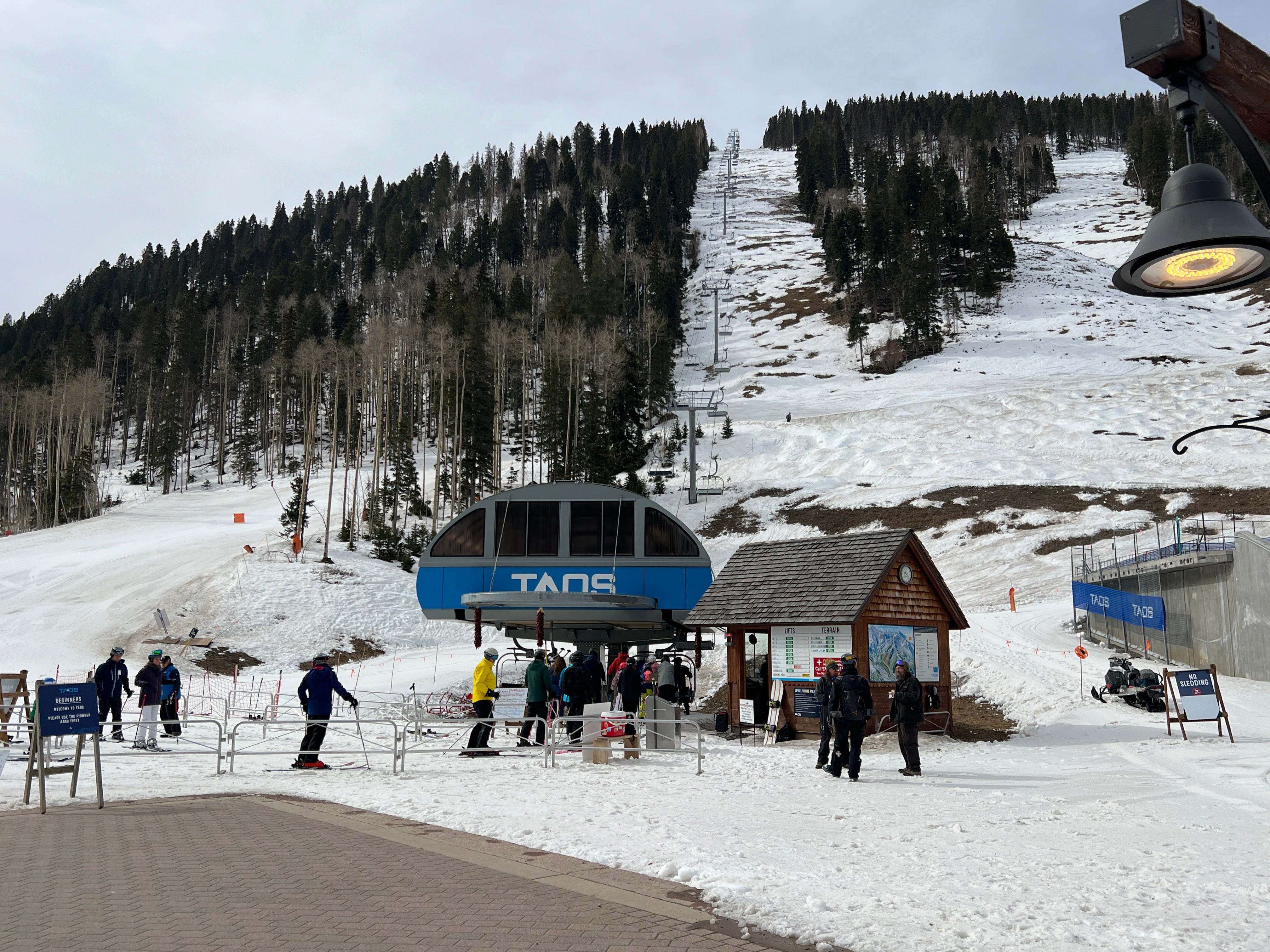
The sign refers to the infamous Al’s Run, which typically ripples with moguls, but was closed on my last visit, in March 2025 (Lift 1 was open):
Taos certainly has plenty of nasty. The terrain ripping off the Kachina Peak triple is among the steepest inbounds terrain I’m aware of in America.


But what shocked me about the place was how approachable it was for my then-8-year-old son, a solid but very intermediate skier. Every chair other than Kachina offers a top-to-bottom green – and some mostly mellow blues – making Taos one of the better family mountains in America.
A lot of the solid-black terrain sits above the lifts, and requires a short, easy hike. If you’ve ever humped up Catherine’s at Alta or Spanky’s Ladder on Blackcomb, the ascent off of Lift 2 over to Highline Ridge or West Basin Ridge isn’t much longer, and it flattens out considerably after the short incline. Unlike East Wall at A-Basin or Highlands Bowl at Aspen Highlands, this is hike-up terrain that’s approachable for people who (like me), live at sea level and only like going up the mountain on machines. The runs are steep, and solo missions are discouraged, but the easy-in and proximity to lifts means a strong skier could reasonably expect to tuck a half-dozen hike-up laps into an afternoon. Here I am huffing and puffing right off Chair 2:
Dang those trees are steep even right off the jump. Crunch crunch crunch:
Go up a bit higher, and things get Lord of The Rings pretty fast:
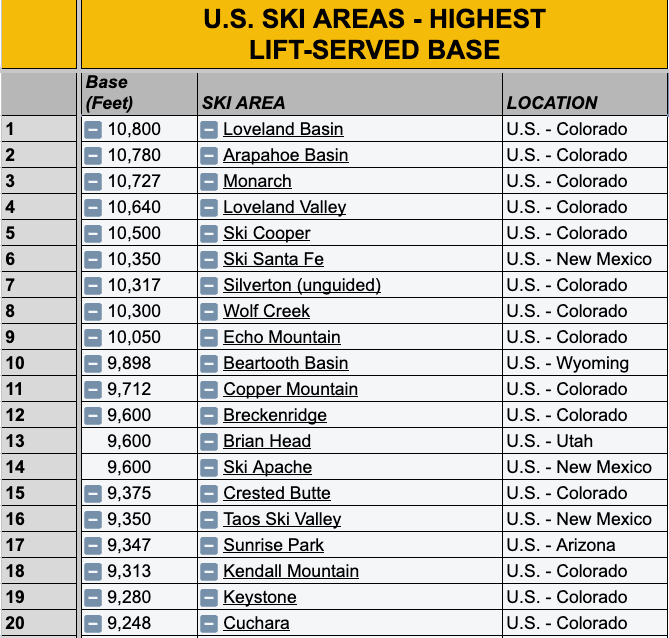
Taos’ only real buyer-beware statistic is its insane base elevation of 9,350 feet, which makes everything, especially sleep, a bit more challenging. That altitude is actually a bit lower than the bases at Copper (9,712) or Breck (9,600). I start to have trouble functioning around 8,000 feet, which is the Vail (8,120), Snowmass (8,110), Snowbird (7,760), and Mammoth (7,953) range. So maybe see how you do at one of those burners before leveling up above 9,000 feet. Or at least arrive knowing that Taos will try punching you in the face. Hydrate and lay off the beer bongs for a day or two. You’ll be fine.
Podcast Notes
On Stadeli lifts
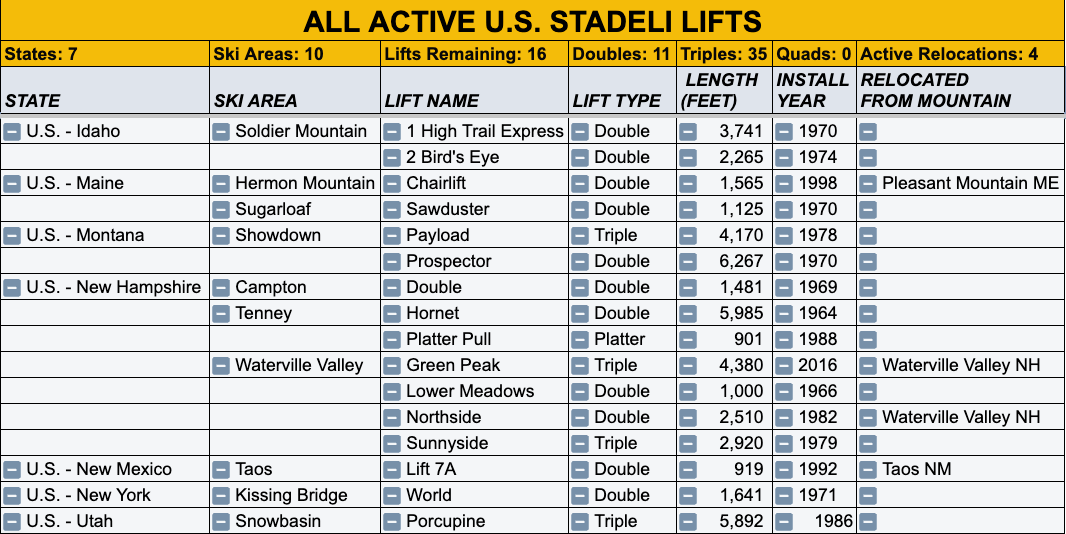
We’ve got 16 of these guys left across 10 U.S. ski areas, including Lift 7A at Taos:
On the character of old chairlifts
I wrote last year that U.S. ski lifts’ overall design aesthetic has deteriorated with the decline in number of manufacturers and a tacit emphasis on technology over beauty.
RIP: Last Original Chairlifts Demolished at Alpental, Big Sky, Sunlight, Meadows

It’s some kind of topographic miracle, this sprawling ski complex an hour east of Seattle: 2,000 acres, 428 inches, 25 lifts, soaring views, door-to-door interstate connection. Michigan-based Boyne Resorts has run The Summit at Snoqualmie since 2007 and itemizes the center as one of the company’s 10 ski areas, its second largest after Big Sky. The on-th…
And I love old Riblets and Halls and Yans, but sentimentalism that locks skiing in a time capsule ultimately stalls long-term growth and invites disaster-by-disintegration. Rather than fight to live in a museum, I’ve adopted a quest mentality to ride as many of these dinosaurs as I can before they go extinct:
Five Classic Chairlifts to Ride While You Still Can

Sit around waiting and you miss them. Gone in just the past five years: Big Sky’s tin-can tram, original Pali at A-Basin, Saddleback’s Rangeley double, Bonanza at 49 North, Argentine at Keystone, Chair 5 and Rip’s Ride at Breck, Sundance’s wild up-and-over
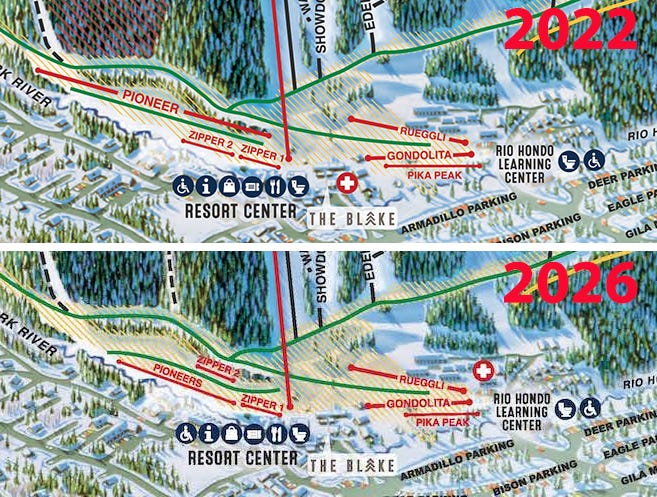
On Taos’ base-area fliparound
On Taos’ current masterplan
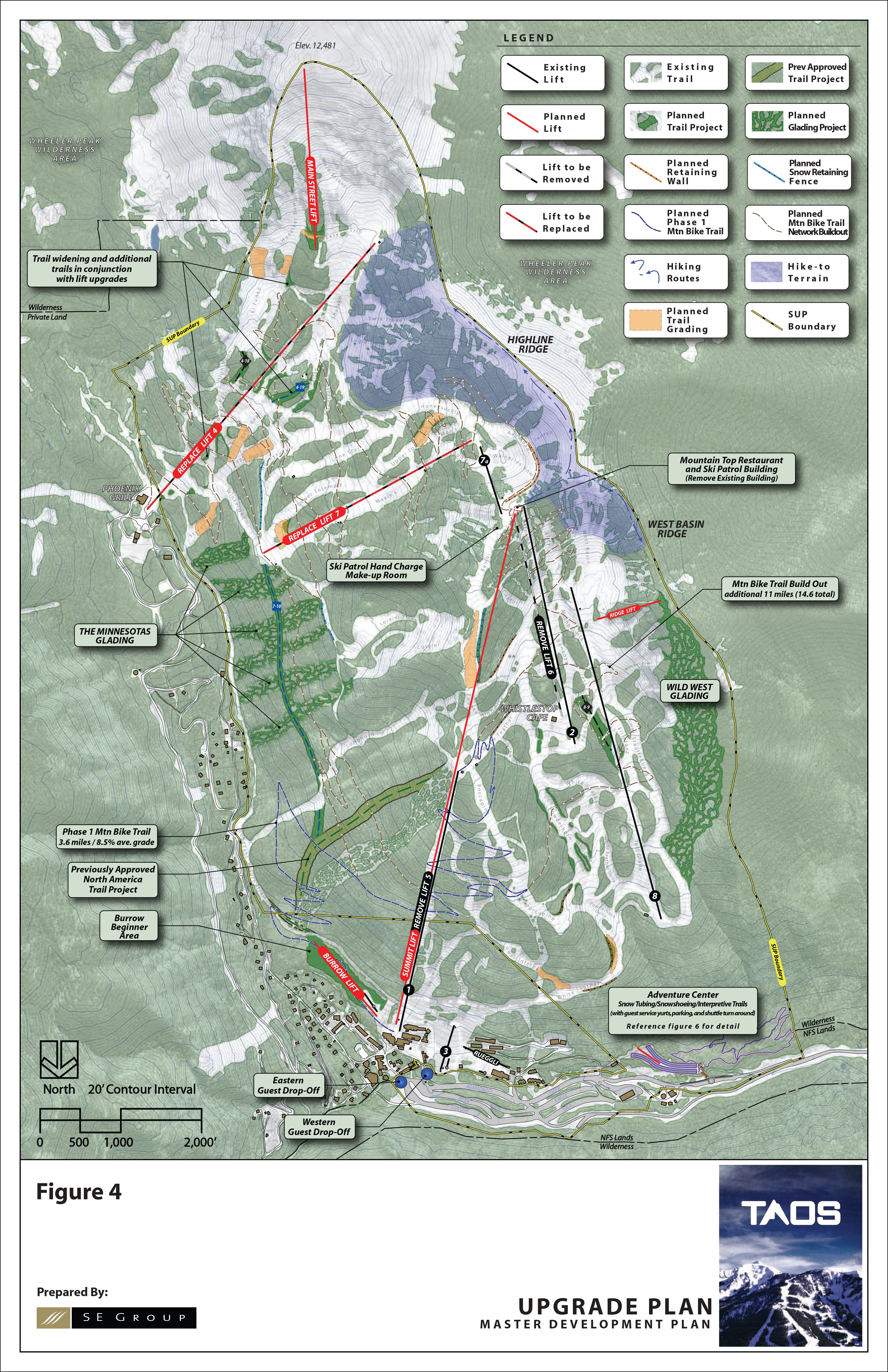
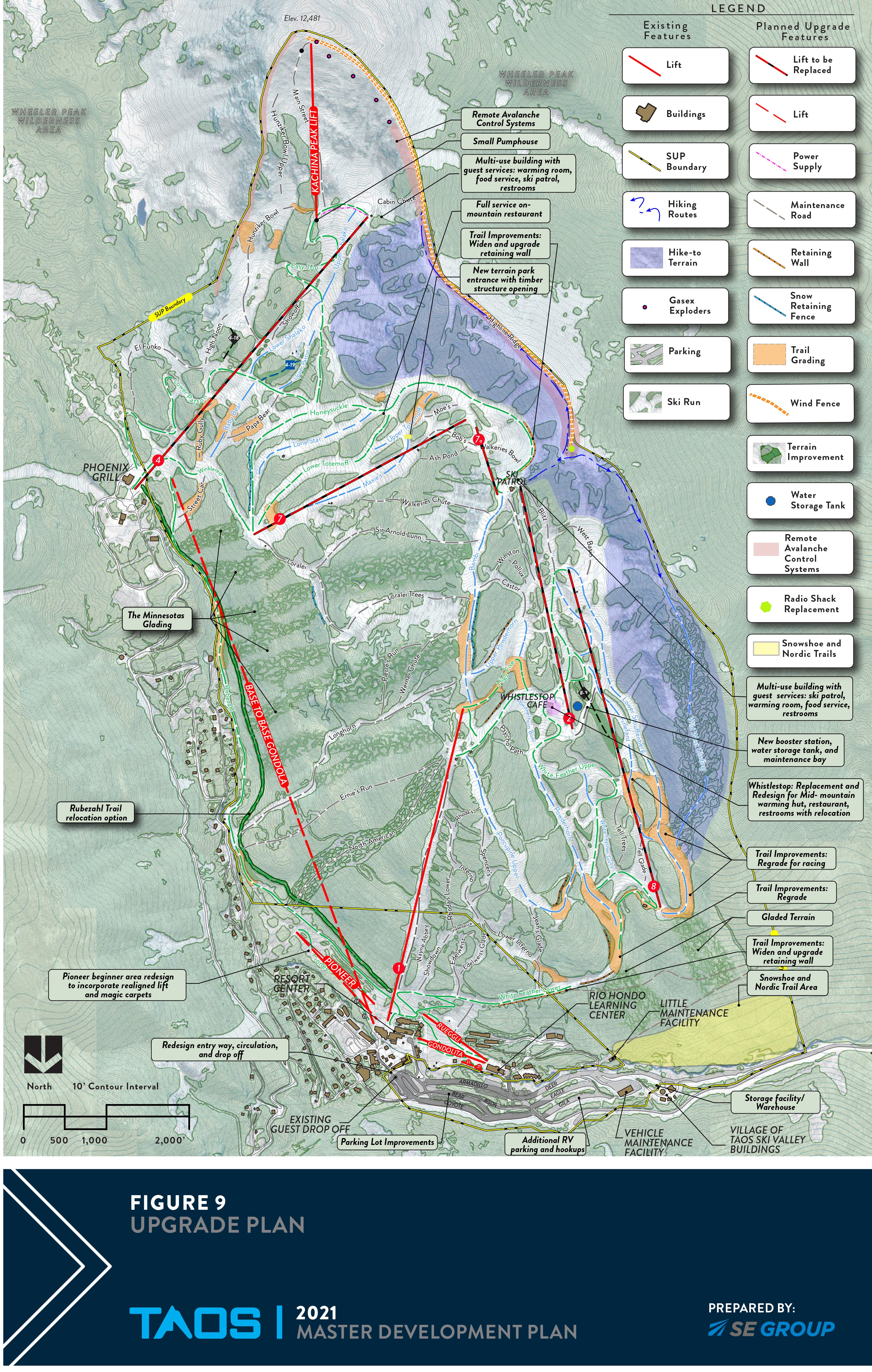
Here’s the conceptual overview of Taos’ 2021 U.S. Forest Service master development plan:
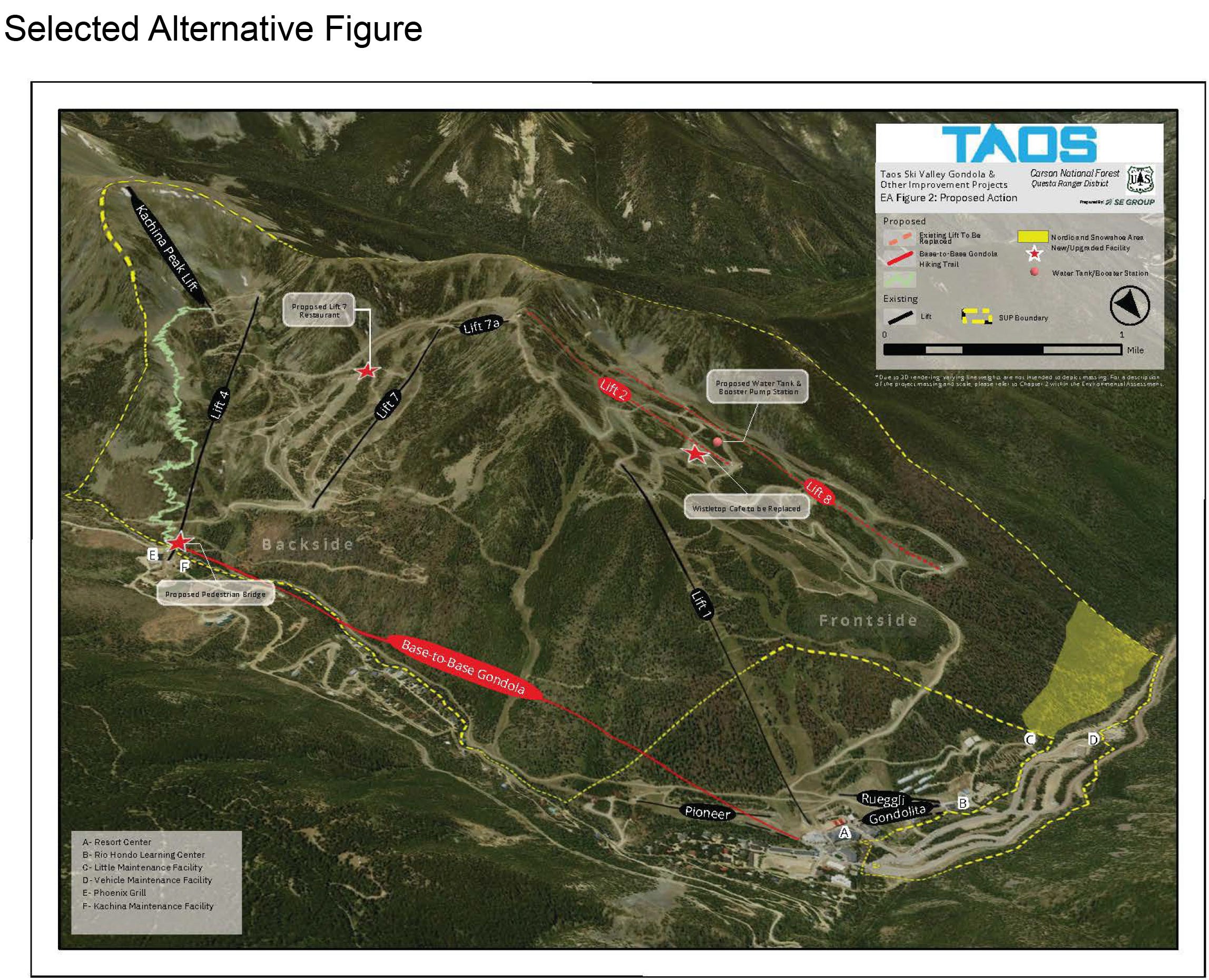
The major unrealized part of this is the base-to-base gondola - here’s the most recent plan for that lift:
On “class A avalanche mountains” with more than 200 slidepaths
Kelly mentioned that Taos’ more than 200 slidepaths earn it the designation of a Class A avalanche mountain. I of course went looking for a list of U.S. ski areas so classified, and of course did not find one. In a rare exercise in self-restraint, however, I also did not create one. A quick Google search suggests that that such a list would include Alta, Kirkwood, and Stevens Pass alongside Taos. I would also assume that Alpine Meadows, Palisades, Mammoth, Snowbird, Big Sky, Silverton, and Crested Butte are among the most avy prone. That is not a complete list or an attempt at one so please don’t write that I “forgot about” some particularly avalanche-prone mountain that I’m not trying very hard to remember.
On The Storm’s first Taos podcast
Podcast #53: Taos Ski Valley CEO David Norden

The Storm Skiing Podcast is sponsored by Mountain Gazette - Listen to the podcast for discount codes on subscriptions and merch.


