


Who
Brian Bensch, founder of Snow Schoolers
Date recorded
September 24, 2026
About Snow Schoolers
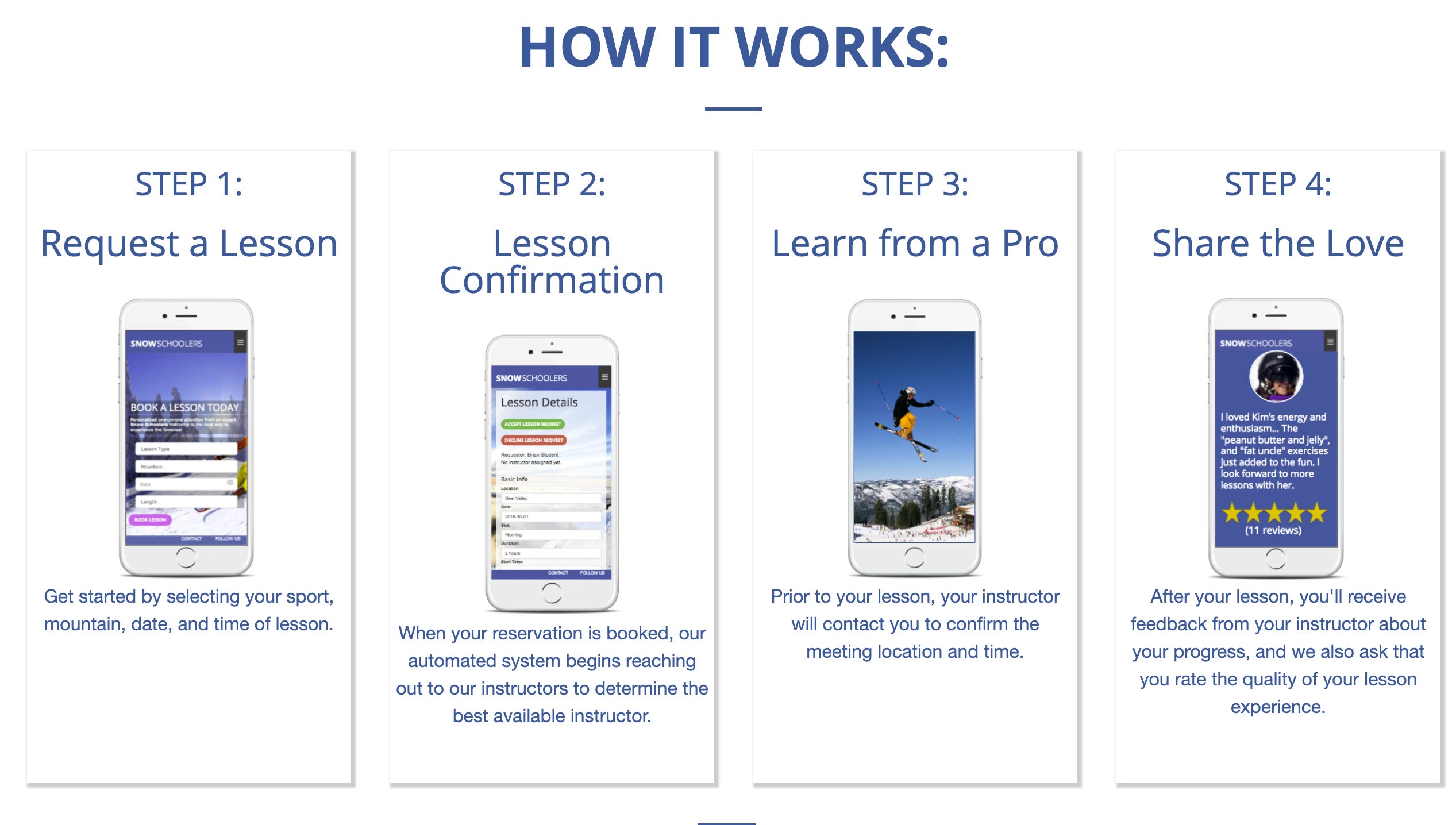
Snow Schoolers, per its website, is an “independent ski school program” that teaches lessons “at any mountain where we’ve established a revenue-sharing partnership with the ski area.” Skiers sign up for lessons on their Pet Rectangles, like this:
Why I interviewed him
That sounds pretty neat, right? Let me go see if Snow Schoolers teaches at my favorite mountain. Snow Schoolers probably does not teach at your favorite mountain. Unless your favorite mountain is 222-vertical-foot Granlibakken, which is about five feet away from 6,000-acre Palisades Tahoe, or 100 vertical-foot Frisco Adventure Park, tucked off highway 9, after 1.5 million-ish skiers exit I-70 on their way to nearby Breckenridge.
That is not an indictment of small ski areas, which I love, or Snow Schoolers’ business model, which I also love. Rather, it’s my way of saying that the only way to sign up for ski school at Palisades Tahoe or Breckenridge is through Palisades Tahoe or Breckenridge. With the strange, grandfathered-in exception of the strange, cobbled-together ski bazaar that is Summit at Snoqualmie in Washington, all major American ski areas (so far as I know) operate with a monopoly over ski school operations on their property. In ways subtle and aggressive, they police and ban rogue instructors who would offer discounted lessons on resort property.
There are probably ways to break this system, either through the courts or legislative amendment of the Forest Service leases that 125 U.S. ski areas operate on. Such change sounds radical only in an American context - most European ski areas already operate with multiple independent competing ski schools onsite.
Over the past 20 years, technology has challenged monopolies across American commerce. Sports and concert tickets and taxi rides offer two prime examples of power shifting from one central operator to many operators, with benefits and drawbacks for the consumer.
Perhaps we will get there with ski school. For now, I see a more practical path for an asset-light, app-based, independent ski school like Snow Schoolers - as the costs of labor, utilities, infrastructure, and insurance pile up, perhaps outsourcing the operation of a ski school is more practical for many smaller, independent ski areas than establishing and maintaining one of their own. That is what you get at Granlibakken and Frisco: Snow Schoolers pays the ski areas a share of each lesson, essentially as rent for the right to operate a ski school on their property. And Granlibakken and Friso don’t have to worry about hiring instructors and organizing lessons. There are probably 100 under-resourced ski areas in America where this model could work tomorrow. Brian and I discuss why Snow Schoolers works where it does, and why the model has been slow to spread.
Transcripts
There are two transcripts. Both are generated by robots. Both are helpful and defective in their own unique ways. I do not proofread either of them.
Transcript 1: Click the “transcript” button at the top of this article. You can only see this transcript on a computer. Because I don’t know why exactly but everything is getting better and dumber all at once it seems. Anyway, this is the transcript that the robots create when I upload the podcast to the internet. The cool thing about it is that you can click on any block of text and the audio will teleport there instantly. The uncool thing about this transcript is that it does not indicate who is talking at any given moment.
Transcript 2: You can read this below. This is the transcript that Zoom creates as we record the podcast. The cool thing about this transcript is that it indicates who is talking at any given moment. The uncool thing about this transcript is that the timestamps do not match the audio. Also, you cannot click on this text to move to the associated point in the audio.
Zoom
Stuart Winchester: My guest today founded Snowschoolers in 2014 with the mission to make skiing and riding affordable and accessible for average Americans.
00:16:06.000 --> 00:16:11.000
Stuart Winchester: and to pay snow sports pros a sustainable living wage.
00:16:11.000 --> 00:16:19.000
Stuart Winchester: Today, Snowschoolers operates at Grand Lebakken in Lake Tahoe, and Frisco Adventure Park in Colorado, two small ski areas.
00:16:19.000 --> 00:16:36.000
Stuart Winchester: Last year, Snow Schoolers hosted approximately 6,000 students. He is a good friend of the Storm. He is Brian Bench. Brian, welcome to the Storm. You reached out to me very shortly after I launched in 2019 or 20, and we’ve been talking for years, and you’ve helped me out a lot.
00:16:36.000 --> 00:16:38.000
Stuart Winchester: With the…
00:16:38.000 --> 00:16:45.000
Stuart Winchester: digital side of things, which I’m not so good at, so it’s awesome to finally get you on and talk some snow schoolers. How you doing today?
00:16:44.000 --> 00:16:48.000
Brian Bensch: Doing lovely. Can’t complain. Always busy, never bored.
00:16:46.000 --> 00:16:52.000
Stuart Winchester: And that is… yeah, that is a picture out your window of Tahoe, right?
00:16:51.000 --> 00:17:00.000
Brian Bensch: Yes, that is a, it’s called Maggie’s Peak, but that’s looking at the little lake just next to Emerald Bay.
00:16:55.000 --> 00:16:57.000
Stuart Winchester: Mmhm.
00:17:00.000 --> 00:17:05.000
Stuart Winchester: Okay, which would be sort of north side of the lake, so you’d be looking…
00:17:02.000 --> 00:17:03.000
Brian Bensch: Oh.
00:17:03.000 --> 00:17:08.000
Brian Bensch: South Tahoe, kind of on the other side of the corner, like, across from Heavenly.
00:17:08.000 --> 00:17:18.000
Stuart Winchester: Oh, south, right? I was… I was backwards. So… so on the… up the left side, there would be Homewood, and then up the right side would be Heavenly and Diamond Peak, and at the top is, like.
00:17:09.000 --> 00:17:10.000
Brian Bensch: Yeah.
00:17:13.000 --> 00:17:15.000
Brian Bensch: Correct.
00:17:18.000 --> 00:17:19.000
Brian Bensch: Mostly correct.
00:17:18.000 --> 00:17:26.000
Stuart Winchester: Or North Star? North Star, Northwood. Okay, alright, uh, before I hurt myself, let’s just get into this. So, so Brian.
00:17:24.000 --> 00:17:28.000
Brian Bensch: Well, we’ll get you out to Tahoe soon enough, and then your Tahoe geography will get.
00:17:26.000 --> 00:17:31.000
Stuart Winchester: It’s been a minute. So…
00:17:32.000 --> 00:17:40.000
Stuart Winchester: What is broken about American ski schools, and how did you try to fix it with snow schoolers?
00:17:39.000 --> 00:17:45.000
Brian Bensch: Yeah. So I would say similar to, you know.
00:17:45.000 --> 00:17:49.000
Brian Bensch: The the general diatribe about, you know.
00:17:49.000 --> 00:17:55.000
Brian Bensch: The ski industry being kind of broken with lift tickets too expensive and climate change is gonna end the world.
00:17:55.000 --> 00:18:07.000
Brian Bensch: Not everything is broken, but particularly the most front and center in your face resorts that you know everyone hears about, and you know, makes the quote unquote mainstream news has been broken for a while.
00:18:07.000 --> 00:18:15.000
Brian Bensch: And, you know, the gist is, if you roll up to, you know, a Tier 1 destination resort.
00:18:15.000 --> 00:18:16.000
Brian Bensch: Brooke, uh…
00:18:16.000 --> 00:18:32.000
Brian Bensch: Not only is lift ticket price what it is, but if you are looking for a group lesson, you’re looking at a couple 100 bucks. And if you’re looking for a private lesson, you’re lucky if you can find anything that is under 1000 today. When we started Snow Schoolers, I remember telling people like, you know, a private lesson is $700 or $800.
00:18:32.000 --> 00:18:35.000
Brian Bensch: Well, now it’s roughly double that.
00:18:35.000 --> 00:18:51.000
Brian Bensch: And I started teaching skiing back in college at the Dartmouth Skiway shout out to Mark and the team there, and you know I thought it was the best job ever making 12 bucks an hour in college, but it is still a minimum wage hourly job.
00:18:51.000 --> 00:18:55.000
Brian Bensch: Despite the high margins that resorts take.
00:18:54.000 --> 00:18:59.000
Stuart Winchester: Okay, wait, wait, let’s, let’s pause right there. So over a thousand a day for a lesson.
00:18:59.000 --> 00:19:07.000
Stuart Winchester: patrollers are making… I think at the Tier 1 resorts, they’re probably making more than minimum wage. I think it’s probably more in… at least in the 20s.
00:19:07.000 --> 00:19:10.000
Brian Bensch: Yeah, the, the, go ahead.
00:19:07.000 --> 00:19:09.000
Stuart Winchester: Plus tips, but, but.
00:19:09.000 --> 00:19:19.000
Stuart Winchester: Still, right, so you figure it’s $1,200 a day for a lesson, and the instructor’s getting, you know, $150 of that, or something. What… why…
00:19:19.000 --> 00:19:23.000
Stuart Winchester: Why does that model even exist? Like, who would even do that?
00:19:24.000 --> 00:19:25.000
Brian Bensch: Out.
00:19:26.000 --> 00:19:28.000
Brian Bensch: Because…
00:19:26.000 --> 00:19:31.000
Stuart Winchester: Like, who would work for that? Like, when you, right? Like, why not just give your own lessons?
00:19:28.000 --> 00:19:29.000
Brian Bensch: Yeah.
00:19:29.000 --> 00:19:44.000
Brian Bensch: Yeah, well, and there’s two sides… two sides of the mark, and I, uh… outside of my passions for skiing, I consider myself sort of a marketplace, you know, guru of sorts. And, you know, on the supply side, or, like, the staffing side.
00:19:31.000 --> 00:19:33.000
Stuart Winchester: Yeah, thank you.
00:19:47.000 --> 00:19:52.000
Brian Bensch: could ever imagine, and there’s a reason why people love to teach skiing.
00:19:53.000 --> 00:19:55.000
Brian Bensch: One of the, I would say.
00:19:54.000 --> 00:20:03.000
Stuart Winchester: Hey, Brian, I’m sorry, you froze there for probably about, like, 5 seconds. Um, I don’t know if you’re on a hard line, or you have good Wi-Fi, or…
00:19:58.000 --> 00:20:00.000
Brian Bensch: Okay.
00:20:03.000 --> 00:20:11.000
Brian Bensch: It’s Tahoe Wi-Fi. But it’s generally fine, unless it goes out and flickers, but…
00:20:03.000 --> 00:20:05.000
Stuart Winchester: Is it?
00:20:05.000 --> 00:20:07.000
Stuart Winchester: It’s Tahoe Wi-Fi.
00:20:07.000 --> 00:20:09.000
Stuart Winchester: Yeah.
00:20:11.000 --> 00:20:13.000
Stuart Winchester: you…
00:20:12.000 --> 00:20:19.000
Brian Bensch: I can close a couple tabs, that might help. Or we can just… I don’t want you to… I know editing is tough.
00:20:15.000 --> 00:20:17.000
Stuart Winchester: Yeah, I think so.
00:20:19.000 --> 00:20:22.000
Stuart Winchester: No, no, no, you, you, uh, can you plug in, possibly?
00:20:22.000 --> 00:20:25.000
Brian Bensch: I don’t have an Ethernet.
00:20:23.000 --> 00:20:31.000
Stuart Winchester: You know, okay, alright. Um, yeah, let’s just, yeah, try to close some stuff, and we’ll keep going, and at worst case, you can, uh, go off screen.
00:20:28.000 --> 00:20:29.000
Brian Bensch: Yep.
00:20:31.000 --> 00:20:32.000
Brian Bensch: Sure.
00:20:33.000 --> 00:20:38.000
Brian Bensch: To pick back up the… the kind of…
00:20:38.000 --> 00:20:54.000
Brian Bensch: Why is it, you know, possible for a lesson to cost $1,200 and the instructor only keeps 20% of that? There’s two components to it. The first is that, you know, historically there was a glut of ski instructors going back into the 60s, 70s, 80s.
00:20:54.000 --> 00:21:10.000
Brian Bensch: Uh, you know, the, the quintessential ski bum, uh, is and was a great job, particularly for people that, you know, get the addiction that I know we both have. Um, and so, you know, lessons didn’t used to be this expensive, um, just like lift tickets didn’t used to be this expensive.
00:21:10.000 --> 00:21:29.000
Brian Bensch: Um, and so just like being a lifty, being a ski instructor was, you know, maybe a slight step above, you know, requires more training, but it has always been the sort of an entry-level hourly position. Um, and it’s certainly not the federal minimum wage at most resorts. Uh, when Vail came out, uh, post-COVID with the $20 an hour kind of cross-board raise.
00:21:29.000 --> 00:21:41.000
Brian Bensch: Uh, that was great for the industry, not just, you know, Vail Resorts staff. Um, and… but the prevailing wage for, you know, first-year ski instructor is certainly in that $20 an hour range today.
00:21:41.000 --> 00:21:45.000
Brian Bensch: And, you know, we try to do things differently.
00:21:44.000 --> 00:21:49.000
Stuart Winchester: Right, but okay, so, but fundamentally to get at the…
00:21:49.000 --> 00:21:55.000
Stuart Winchester: at this dynamic. I’m a ski instructor. Let’s say I’m a great ski instructor, right? And everybody loves me.
00:21:55.000 --> 00:21:57.000
Stuart Winchester: And I… I can see that…
00:21:57.000 --> 00:22:07.000
Stuart Winchester: you know, Northstar is charging $1,000 for a lesson, and they’re paying me $25 an hour. I don’t know what Northstar pays, so feel free to correct me, Northstar, but…
00:22:07.000 --> 00:22:10.000
Stuart Winchester: Why don’t I as an instructor?
00:22:10.000 --> 00:22:25.000
Stuart Winchester: just say, well, I’m just gonna go on Facebook and advertise my services, and say, meet me at the Lyft at Northstar, and I’ll give you a lesson for $200 for the day, because then I’m making more, and… and we’re just… and the consumer’s getting a better deal.
00:22:25.000 --> 00:22:34.000
Stuart Winchester: And then we established this one-on-one relationship. Why doesn’t that marketplace exist? Why do ski areas exist?
00:22:34.000 --> 00:22:42.000
Stuart Winchester: How are they able to do this weird market dynamic, which sounds fundamentally unfair to the instructor?
00:22:42.000 --> 00:22:57.000
Brian Bensch: Yeah. Well, that question is certainly more or less exactly what I pondered 10 years ago. And how I got into this fun little project called Snowschoolers.
00:22:57.000 --> 00:23:03.000
Brian Bensch: was the realization that, oh my god, like, why does this exist? Um, and, you know, and…
00:23:03.000 --> 00:23:08.000
Brian Bensch: 10 years ago, Uber and Airbnb had just become kind of a mainstream thing.
00:23:08.000 --> 00:23:10.000
Brian Bensch: Um, and so I was like, oh.
00:23:10.000 --> 00:23:28.000
Brian Bensch: I wonder if we could just connect instructors to students directly and have a little marketplace for ski school. At the time, I knew nothing about, you know, special use permits from the Forest Service and the ski industry broadly. You know, I’d grown up skiing, but I was just a lay consumer skier. The reality is, and very similar to.
00:23:28.000 --> 00:23:36.000
Brian Bensch: you know a lot of the work you’ve done this summer going into Forest Service kind of history. The special use permit system.
00:23:36.000 --> 00:23:54.000
Brian Bensch: effectively grants the resort, at least on Federal lands, where the special use permit exists, a micro monopoly over all business activity at their mountain. And it doesn’t have to be that way. If you do go over to Europe, it is a much more laissez-faire free market.
00:23:54.000 --> 00:24:07.000
Brian Bensch: Um, and most major resorts in Europe have at least four to six, you know, uh, ski schools that operate and compete, and, you know, the average lesson prices are roughly a third, and instructors keep, you know, 50 to 60% of lessons.
00:24:07.000 --> 00:24:19.000
Brian Bensch: And so it doesn’t have to be the way it is. But at at the core it is. It is because resorts have the legal right to be the only ski school of record. And.
00:24:17.000 --> 00:24:30.000
Stuart Winchester: Right, so just to get ahead of the people who like to point out details, so North Star was a weird example for me to use because it’s on private land, it’s not on Forest Service land. However, it’s owned by Vail Resorts, and I think what you’re saying is.
00:24:30.000 --> 00:24:44.000
Stuart Winchester: even though not every U.S. skier is on U.S. Forest Service land, 125 of them are, it… the fact that that encompasses the majority of our ski terrain has normalized the culture of one mountain, one ski school. Is that fair?
00:24:44.000 --> 00:25:01.000
Brian Bensch: Correct. And there is maybe a dirty little secret of capitalism that monopolies are great businesses. So Northstar does not want six other ski schools competing and driving the price down because ski school is very, very lucrative to the at least traditional big resort ski model.
00:24:44.000 --> 00:24:46.000
Stuart Winchester: Okay.
00:24:49.000 --> 00:24:50.000
Stuart Winchester: Mmhm.
00:25:02.000 --> 00:25:09.000
Stuart Winchester: So, disruptor Brian comes out and says, alright guys, get out of the way, I am gonna change the world with.
00:25:09.000 --> 00:25:19.000
Stuart Winchester: snow schoolers and my Uber for skiing app, which I know you don’t want to call it anymore, but nonetheless, since you brought up the analogy, let’s go back to 2014.
00:25:19.000 --> 00:25:22.000
Stuart Winchester: Take us into it. What did you do and what happened?
00:25:22.000 --> 00:25:32.000
Brian Bensch: Yeah. In short, I would say, did a little bit of experimenting with that idea. And, you know, by the end of the first season.
00:25:32.000 --> 00:25:43.000
Brian Bensch: Learned pretty quickly that the ski resort management does not like the idea. And if you want to be able to ski at places that you love to ski.
00:25:43.000 --> 00:25:55.000
Brian Bensch: it’s probably a good idea to not, uh, not poke the bear too much, so to speak. Um, and so, uh, that first kind of pilot program very much led me into the, uh.
00:25:55.000 --> 00:26:14.000
Brian Bensch: and and this it was always a snooze. This has been a side project of mine for a while. It’s a I would call it a thriving small business. That 1st year I I pretended it was a startup, or I called it a startup, but never took funding and you know that 1st pilot program helped me realize that the only way, if I was going to turn this into real business.
00:26:06.000 --> 00:26:07.000
Stuart Winchester: Okay.
00:26:14.000 --> 00:26:27.000
Brian Bensch: was to find a way that was mutually beneficial for both resorts and instructors, uh, and obviously the students. Um, and that led me to, you know, how can I create a revenue share model.
00:26:27.000 --> 00:26:41.000
Brian Bensch: Uh, where by bringing more new skiers to the mountain, everyone benefits. Um, the resort gets to share the revenue, uh, the student gets a cheaper lesson, and the instructor gets higher pay. Um, and, uh…
00:26:41.000 --> 00:26:54.000
Brian Bensch: you know, by the time 2016 rolled around I was ready to quit my corporate job and give it a role, and so moved to Tahoe. And you know, without the.
00:26:54.000 --> 00:27:04.000
Brian Bensch: A gentleman named Brian Schilling out in Homewood. Without him taking sort of a chance on me, snow schoolers would not exist. But Homewood was coming off.
00:27:04.000 --> 00:27:22.000
Brian Bensch: we’ll say a typical bad snow year, and had to let go a lot of their ski school staff the year prior, because I think they were open for, like, 40 days that season, and hiring was a huge priority. Like, they were rebuilding a ski school from scratch, and the reality was the pitch that resonated with Homewood.
00:27:22.000 --> 00:27:37.000
Brian Bensch: was much less about, can we, like, you know, offer more affordable lessons and increase gear visits that way, but we need, like, we don’t know how to hire instructors, we need a bunch of instructors, and this Uber model of.
00:27:37.000 --> 00:27:52.000
Brian Bensch: uh, pseudo-freelance instructors was attractive to them. Um, and, you know, I told them that, like, I had put up a couple ads and had, you know, 20 people apply within a few weeks, and they’re like, ah, that’s interesting. Um, and so that led to our first season, uh, which I would say was.
00:27:52.000 --> 00:28:06.000
Brian Bensch: uh, not a hands-down success at Homewood, um, but I skied nearly 100 days, and it ended up being, uh, Tahoe’s second best winter of at least my young adulthood, um, and, you know, you know, no regrets at all.
00:28:06.000 --> 00:28:17.000
Stuart Winchester: Yeah, I mean, Homo’s a serious mountain. I mean, right on the lake, it’s dramatic, it has pretty nice chair lifts. But that didn’t end up being the future, right?
00:28:18.000 --> 00:28:23.000
Stuart Winchester: How did Homewood break down, and how did you…
00:28:23.000 --> 00:28:25.000
Stuart Winchester: reassemble…
00:28:25.000 --> 00:28:35.000
Stuart Winchester: like, sort of rethink the business, uh, on a different scale, and I mean both, like, going smaller to get bigger, if that makes sense.
00:28:35.000 --> 00:28:44.000
Brian Bensch: Yeah. So the core hypothesis of snow schoolers was always kind of twofold. If you make lessons.
00:28:46.000 --> 00:28:52.000
Brian Bensch: more interest or demand and potential customers when lessons are affordable.
00:28:52.000 --> 00:29:09.000
Brian Bensch: I think the same thing is true of lift tickets, and that’s why, you know, the places that are still offering $700 lift tickets are thriving. But affordable lessons drives an outsized increase in, you know, lesson visits. And if you pay instructors well, there’s no shortage of instructors you can find if you’re willing to pay them well.
00:29:09.000 --> 00:29:25.000
Brian Bensch: What we didn’t get right in that 1st year at Homewood was the affordable lesson side of things. We were able to teach lessons at Homewood, but we were offering the normal prices from the year before, which were more or less, I would say, 10% below what Squaw Valley Alpine Meadows up the road was charging.
00:29:25.000 --> 00:29:41.000
Brian Bensch: Um, and we were not… yeah, we taught a total of, I think, 50 lessons that season, um, which was, you know, better than zero, but certainly not enough to get me too, too excited. Um, and the kind of going smaller to get bigger.
00:29:42.000 --> 00:29:45.000
Brian Bensch: Uh, it was a function of, uh…
00:29:45.000 --> 00:29:57.000
Brian Bensch: my my tiny little hill in the woods called Grand Lebakken, that, as someone who’d grown up skiing Tahoe, I had literally never heard of. I think I’d probably skied in Tahoe 500 days at that point.
00:29:57.000 --> 00:29:59.000
Brian Bensch: Um, but, uh…
00:29:57.000 --> 00:30:02.000
Stuart Winchester: And it’s right by Palisades, right? It’s, like, right across the street, basically.
00:30:01.000 --> 00:30:17.000
Brian Bensch: Not quite across the street. It is two minutes from the lake, but you can’t see the lake from Grand Labaquin. So it’s literally like tucked in the way, tucked kind of behind a hill. It is between Alpine Meadows and Homewood, if you look at the map. And it’s roughly like 10 minutes from both of them.
00:30:04.000 --> 00:30:05.000
Stuart Winchester: Yeah.
00:30:06.000 --> 00:30:08.000
Stuart Winchester: Right.
00:30:08.000 --> 00:30:09.000
Stuart Winchester: Mmhm.
00:30:16.000 --> 00:30:18.000
Stuart Winchester: Mmhm.
00:30:17.000 --> 00:30:23.000
Brian Bensch: Um, and as I was winding down that first season with Homewood, I challenged myself, um.
00:30:23.000 --> 00:30:39.000
Brian Bensch: And, you know, tried to put it on social media, but no one really cared to do a March Madness Sweet 16 circuit, because there, at the time, were 16 unique mountains in Tahoe, and Grand Lebakken was one of the last stops on that circuit, and I forget who told me it existed.
00:30:33.000 --> 00:30:34.000
Stuart Winchester: Mmhm.
00:30:39.000 --> 00:30:44.000
Brian Bensch: Um, but, you know, Grand Lubakken is not a ski resort. Grand Lubakken is a ski.
00:30:47.000 --> 00:30:51.000
Brian Bensch: Kind of known for its lodging and accommodations business.
00:30:49.000 --> 00:30:54.000
Stuart Winchester: Hey, Brian, you, uh, you just froze again, but you said Grand Lebakken is a ski…
00:30:53.000 --> 00:30:55.000
Brian Bensch: Yeah.
00:30:54.000 --> 00:30:57.000
Stuart Winchester: So just start over from Grand Lebakken is a ski.
00:30:56.000 --> 00:31:13.000
Brian Bensch: Sure. Grand Labaca is not a ski resort. It is a ski hill or a ski area, as Stuart likes to say. It is two surface lifts. It is roughly 20 acres from the bottom of the hill of Grand Labaca. You can see the entire hill, the entire mountain. What you see is what you get.
00:31:13.000 --> 00:31:30.000
Brian Bensch: It is not, I would say, exclusively for beginners. The Poma that goes to the top, and it’s, I think, roughly 225 feet. I would put it at a solid, you know, a Jackson Hole blue. It is at least a 25 to 30 degree slope.
00:31:30.000 --> 00:31:46.000
Brian Bensch: and I have seen 12 year olds straight line it and almost die. So it is. It is certainly like there’s enough terrain that you could do ski race like training on it, and we do a little bit of that in the winter on weekdays. But it is a ski hill.
00:31:46.000 --> 00:31:57.000
Brian Bensch: Um, not at all, sort of, no bells and whistles, no high-speed quads, um, just a bunny lift, uh, rope toe, and a, you know, slightly more advanced poma that goes to the top.
00:31:57.000 --> 00:32:09.000
Brian Bensch: And, uh, spent a good afternoon with, uh, the Parson family back in spring 2017, and I was like, this price is pretty cool, this is cute, and told them about my ideas for ski school.
00:32:07.000 --> 00:32:09.000
Stuart Winchester: And who are they?
00:32:09.000 --> 00:32:25.000
Brian Bensch: Chris Parson and Ron Parson. Ron is Chris’s father, and has owned the mountain for quite a while, and what Grand Lombachman is known for is, it is more of an accommodations center. It’s a lodge and conference center.
00:32:18.000 --> 00:32:20.000
Stuart Winchester: Mmhm.
00:32:25.000 --> 00:32:42.000
Brian Bensch: Uh, with roughly, I think, 150-ish units. Um, and the ski hill is an amenity, uh, along with their pool, along with their spa, along with, like, you know, their, you know, uh, dining areas and so forth. Um, and they’ve operated the ski area and sled hill, um, for…
00:32:28.000 --> 00:32:29.000
Stuart Winchester: Mmhm.
00:32:42.000 --> 00:32:55.000
Brian Bensch: I think Ron is — the Parson family is going on maybe 30 years. I hope to convince him that he should come on the pod at some point. But he is —.
00:32:46.000 --> 00:32:47.000
Stuart Winchester: Mmhm.
00:32:55.000 --> 00:33:12.000
Brian Bensch: Their family, you know, is the quintessential mom and pop ski hill ski area sort of operators. When I met them, ski school was run mostly with Chris, who had sort of two group lesson slots a day and a piece of paper for people to sign up in the morning.
00:33:12.000 --> 00:33:28.000
Brian Bensch: And they were like, you know, we could probably be more organized with this. And I was like, yeah, I think I can help you a little bit. And then the season ended and I went home, had made no money. So, you know, my day job has been in marketing.
00:33:28.000 --> 00:33:40.000
Brian Bensch: for big and small tech companies for a while. Um, and so I went and had to get a big boy tech job again to, you know, pay for rent. Um, and my Tahoe ski lease was up for the season. So, I went back home.
00:33:38.000 --> 00:33:39.000
Stuart Winchester: Mmhm.
00:33:40.000 --> 00:33:47.000
Brian Bensch: you know, wasn’t sure if Snow Solutions was going to continue, kind of just assumed it was a one-year thing, and, you know.
00:33:47.000 --> 00:34:03.000
Brian Bensch: you know, hadn’t talked a ton with Homewood, but I knew, like we weren’t gonna you know the business wasn’t great. But fast forward October 1st roughly, this time of year the Gm. Gives me a call out of the blue, and I pick up. I’m now at my new day job, and I just play it cool. And I’m like, Oh, yeah.
00:34:03.000 --> 00:34:19.000
Brian Bensch: Yeah, no, we’ll run your ski school this winter. Grant Lebakken did, yeah. So the GM of Grant Lebakken picked up and said, hey, you know, we love meeting you in the spring, and you know, winter’s around the corner. Let’s talk about, you know, what needs to be done for you guys to run ski school for us this year.
00:34:06.000 --> 00:34:08.000
Stuart Winchester: Grand Labaquin?
00:34:08.000 --> 00:34:10.000
Stuart Winchester: Okay, okay.
00:34:10.000 --> 00:34:11.000
Stuart Winchester: Yeah, thank you.
00:34:13.000 --> 00:34:14.000
Stuart Winchester: Mmhm.
00:34:18.000 --> 00:34:20.000
Stuart Winchester: Mm-hmm. Right.
00:34:19.000 --> 00:34:23.000
Brian Bensch: Um, and I remember going home that night being like, huh.
00:34:23.000 --> 00:34:33.000
Brian Bensch: This is not going to be easy because I’m working 40 to 50 hours a week now at my new job. But skiing in this space is what I love to do.
00:34:24.000 --> 00:34:25.000
Stuart Winchester: Yeah.
00:34:33.000 --> 00:34:51.000
Brian Bensch: You know, at one point, a quote on the website was the Confucius quote, “If you find a job you love, you’ll never work another day.” And, you know, I said, yes, you know, porque no las dos, let’s do both. Didn’t tell my employer at the time.
00:34:48.000 --> 00:34:49.000
Stuart Winchester: Mmhm.
00:34:51.000 --> 00:35:06.000
Brian Bensch: Because, you know, don’t want to give them reason to question how much time you’re putting in. But basically worked, you know, spent many nights, and I was a bad developer at the time. So everything snow schoolers is kind of built in-house from a code perspective.
00:34:53.000 --> 00:34:55.000
Stuart Winchester: Been there?
00:35:01.000 --> 00:35:03.000
Stuart Winchester: Mmhm.
00:35:06.000 --> 00:35:23.000
Brian Bensch: And, you know, I just, every evening from 6 p.m. to midnight, I’d be plugging away to build the Grand Le Bacon kind of new system that we built that first year. And it worked. You know, year two, we taught.
00:35:23.000 --> 00:35:38.000
Brian Bensch: I think 300 plus lessons, and we did five times more revenue than year one at Homewood. And again, I was, you know, I only taught probably 2% of lessons because I had my full-time job. Christmas was a fun disaster where.
00:35:38.000 --> 00:35:47.000
Brian Bensch: all of a sudden, we were sold out every single day, and I was like, uh, I guess I need to figure out how to stop selling lessons, uh, because I hadn’t really built that into the model the first year, because we were never sold out.
00:35:46.000 --> 00:35:48.000
Stuart Winchester: Ah, okay, okay.
00:35:48.000 --> 00:35:56.000
Brian Bensch: But, you know, we made it work and lots of families had amazing, you know, first experiences learning to slide on snow.
00:35:55.000 --> 00:36:06.000
Stuart Winchester: So let me zoom out and just tell you why I think this makes sense from my point of view, and then you can color that in with with how Graham Lebakken actually achieved it. I look at…
00:36:07.000 --> 00:36:13.000
Stuart Winchester: something like the Icon Pass, and they have a partnership with Jackson Hole.
00:36:13.000 --> 00:36:22.000
Stuart Winchester: but Altera doesn’t have to own or operate Jackson Hole, and if a lift breaks, it’s not Altera’s problem, but they get the benefit of Jackson Hole.
00:36:22.000 --> 00:36:25.000
Stuart Winchester: on their IconPass. Uh…
00:36:25.000 --> 00:36:36.000
Stuart Winchester: this model that Grand Lebakken has, there used to be hundreds of ski areas like this, just attached to resorts all across. In this part of the country, there were a ton of them, in the Catskills and the Poconos, and…
00:36:36.000 --> 00:36:38.000
Brian Bensch: Okay.
00:36:36.000 --> 00:36:42.000
Stuart Winchester: most of them, I mean, they frankly weren’t super interesting hills, but they…
00:36:42.000 --> 00:37:02.000
Stuart Winchester: Those resorts found that as God running a ski hill became more complex, it wasn’t worth keeping all those pieces and parts as an amenity. So in the case of, of Grand Le Bacon, I, I imagine, you know, you have a couple Pomas, so your market is probably like people who wanted to come to Tahoe in the winter, but aren’t necessarily skiers, but maybe want to try it.
00:37:02.000 --> 00:37:18.000
Stuart Winchester: Right? Because no one’s like, hmm, should I go to Palisades or Grand Lebakken today, right? Like it’s, it’s a very unique place. So, but Grand Lebakken, I mean, if they’re going to have a hill, that means they also have to have, you know, a rental shop and they have to have a ski school and instructors. This basically.
00:37:07.000 --> 00:37:08.000
Brian Bensch: Yeah.
00:37:18.000 --> 00:37:21.000
Stuart Winchester: Takes the whole ski school, all that labor.
00:37:21.000 --> 00:37:23.000
Stuart Winchester: all the infrastructure.
00:37:23.000 --> 00:37:25.000
Stuart Winchester: out of it, and I’d imagine you just…
00:37:25.000 --> 00:37:41.000
Stuart Winchester: Pay, you know, you just write them a check like a lease, basically like a forest service lease where a skier operates and they, they pay based on what they make to the government. So it, it seems to me like ski areas would love that. And I, and I could think of 100 small ski areas in the country where that would work. That’s how I’m understanding this is that.
00:37:41.000 --> 00:37:44.000
Stuart Winchester: Is that fair? And…
00:37:43.000 --> 00:37:47.000
Brian Bensch: Yeah, I I would say you more or less hit the nail on the head.
00:37:46.000 --> 00:37:47.000
Stuart Winchester: Yeah.
00:37:48.000 --> 00:38:03.000
Brian Bensch: The and and the models the operating model that we’ve sort of developed, that we are sort of most in favor of is, we do ski school. We take full responsibility for ski school and nothing else.
00:38:03.000 --> 00:38:14.000
Brian Bensch: we’ve we’ve we’re not obligated, or we don’t have to stick with that model entirely. And at our Frisco location, Colorado. We also do all of rentals.
00:38:14.000 --> 00:38:20.000
Brian Bensch: And but ski school is what sort of what we love, what we care about.
00:38:20.000 --> 00:38:34.000
Brian Bensch: And you know, in in other past smaller partnerships we’ve done. We were responsible for even more of operations, grooming and parking and snow removal is.
00:38:33.000 --> 00:38:34.000
Stuart Winchester: Mmhm.
00:38:34.000 --> 00:38:40.000
Brian Bensch: like very underappreciated. How time consuming, expensive those can be.
00:38:39.000 --> 00:38:40.000
Stuart Winchester: Mmhm.
00:38:40.000 --> 00:38:50.000
Brian Bensch: And so I I am very thankful that Gran Lebakken and our partners at Frisco take responsibility for for grooming, and particularly grooming snowmaking.
00:38:50.000 --> 00:39:00.000
Brian Bensch: um, and sort of the general operations, uh, lift operations and so forth, are… are never gonna be our sweet spot. Um, and we would happily run the, like.
00:38:56.000 --> 00:38:57.000
Stuart Winchester: Mmhm.
00:39:00.000 --> 00:39:06.000
Brian Bensch: like ski school is often the biggest human part of the organization, because you have a bunch of instructors.
00:39:06.000 --> 00:39:22.000
Brian Bensch: Uh, and you have to, like, you know, herding cats doesn’t happen without effort. Um, and scheduling does not happen, uh, without good software, and a human to supervise the software. Um, and so, yeah, that’s been our sweet spot. Um, I likewise, uh, think that there are at least.
00:39:10.000 --> 00:39:11.000
Stuart Winchester: Mmhm.
00:39:15.000 --> 00:39:16.000
Stuart Winchester: Mmhm.
00:39:22.000 --> 00:39:35.000
Brian Bensch: a few dozen, if not hundreds, of other small ski areas, whether they’re surface lift only, or just small with, like, a single fixed grip lift, that, um, that want to do a better ski school program, and we would love to talk to them.
00:39:35.000 --> 00:39:53.000
Stuart Winchester: So, so Grand Labakin you’ve been with ever since, so I’m assuming they’ve been pretty happy with it. Let’s jump across the country to another really weird ski area that probably people don’t know exists, that we’ve been talking about, which is Frisco, which is… you pass by it on the way to Breckenridge, but you won’t even see it. It’s so small, like.
00:39:53.000 --> 00:40:09.000
Stuart Winchester: You have to drive around this weird road and it’s, you know, underneath a hill. And I’ve not skied there, but I stopped by after they were closed, uh, a couple years ago. So, so that is not attached to a resort. That’s, I think, a city park. So you have a completely different demo there.
00:40:09.000 --> 00:40:19.000
Stuart Winchester: So who is Frisco trying to serve, and how did you meet that need? And it seems like you’ve had a long-term relationship with them as well.
00:40:18.000 --> 00:40:29.000
Brian Bensch: Yes. So we’re now going to our fifth season with the town of Frisco. And so, yes, it is a municipally managed ski area and tubing park.
00:40:29.000 --> 00:40:42.000
Brian Bensch: You can’t miss the tubing element when you’re driving from getting off I-70 and heading to Breckenridge, but very few people will know that there’s beginner ski and snowboarding there as well. I’ve been to Colorado a good handful of times.
00:40:42.000 --> 00:40:48.000
Brian Bensch: definitely drove by it once and didn’t know they were skiing there. And you know a mutual acquaintance.
00:40:44.000 --> 00:40:45.000
Stuart Winchester: Yeah.
00:40:48.000 --> 00:41:01.000
Brian Bensch: post-COVID, when I was talking about, you know what, you know, the world’s going remote, maybe I can just, you know, expand snow schoolers without me physically being there all the time. Um, and I was like, huh, have you heard of Frisco? I was like, no, what.
00:40:57.000 --> 00:40:58.000
Stuart Winchester: Yeah. Okay.
00:41:01.000 --> 00:41:07.000
Brian Bensch: And, you know, that was probably two months before our first successful season with Frisco.
00:41:07.000 --> 00:41:22.000
Brian Bensch: Um, the audience they’re serving, to your question, is not nearly as local as you might expect for being, like, a town-run hill. Uh, we certainly have some local programs, but their audience is Summit County visitors.
00:41:14.000 --> 00:41:15.000
Stuart Winchester: Hmm.
00:41:22.000 --> 00:41:35.000
Brian Bensch: Who primarily are either not skiers yet, not skiers and swimmers yet, or are brand new and want to get their sort of their ski legs on because someone invited them on a trip to Breck or trip to Copper.
00:41:35.000 --> 00:41:52.000
Brian Bensch: and they’re like, well, I’ve never skied before. You know a lifting. It’s expensive, less expensive. B like, can I get my legs like, you know, get my footing somewhere, and we are smack dab in the middle of, you know, 4 major resorts. In addition to Copper Breck, you’ve got a base and and.
00:41:51.000 --> 00:41:52.000
Stuart Winchester: Mmhm.
00:41:52.000 --> 00:41:59.000
Brian Bensch: and Keystone around the corner, and we are the affordable alternative for Summit County visitors.
00:41:59.000 --> 00:42:03.000
Stuart Winchester: It’s expensive for a rope tail, by the way, it’s like $40 for a lift ticket.
00:41:59.000 --> 00:42:01.000
Brian Bensch: Um, and the town…
00:42:03.000 --> 00:42:07.000
Brian Bensch: Sure. Expenses is very relative. That is fair.
00:42:06.000 --> 00:42:07.000
Stuart Winchester: Yeah.
00:42:07.000 --> 00:42:08.000
Stuart Winchester: Yeah, okay.
00:42:08.000 --> 00:42:10.000
Stuart Winchester: Uh, okay, so, so…
00:42:10.000 --> 00:42:21.000
Stuart Winchester: you established… that’s funny, that’s not at all what I expected. I thought it would be, like, bust loads of kids, but I guess they probably have deals with Breckenridge or something. So you’ve had success.
00:42:21.000 --> 00:42:35.000
Stuart Winchester: at Frisco and at Grand Labaca, and you’ve had a couple others that you’ve been in and out of other than Homewood. Tell us about those, and what did work, and ultimately what didn’t work about them.
00:42:35.000 --> 00:42:46.000
Brian Bensch: Yeah. Let’s go with — let’s stick with the Colorado trend first, and then we’ll come back to Tahoe. There’s an awesome little mountain.
00:42:46.000 --> 00:43:01.000
Brian Bensch: that, I think you know, and and didn’t. As you think about your the last ski resorts to open or ski areas to open. I actually think Hoedown Hill is the most recently opened new ski area in the country. It’s about an hour north of Denver.
00:43:01.000 --> 00:43:06.000
Brian Bensch: in Windsor, Colorado, and we worked with them for their 1st 2 seasons.
00:43:06.000 --> 00:43:15.000
Brian Bensch: Um, and we did not work with them last year. Um, still in touch with them, um, but they are a brand new ski area that is, I would say, a…
00:43:15.000 --> 00:43:18.000
Brian Bensch: a privately…
00:43:18.000 --> 00:43:26.000
Brian Bensch: run like you. You could say there’s similarities to the Grand Lebakken business model, but on a whole other level of, I would say.
00:43:26.000 --> 00:43:40.000
Brian Bensch: affluence and like target demo. The Hoedown Hill facility is attached to the Raindance National Golf Course, which I’m not a golfer, but I hear it’s a tier one destination golf course.
00:43:40.000 --> 00:43:49.000
Brian Bensch: They want to build, you know, 4 seasons esque hotel there, and it is a we’ll say a bourgeois experience that they’re going for with some, you know.
00:43:49.000 --> 00:44:06.000
Brian Bensch: you know, a good culture vibe there. And I think so long as the management team remains committed, it will continue to grow. They are at the IndyPass, so shout out there, like, it’s worth a quick visit if you’re flying into Denver with your IndyPass.
00:44:00.000 --> 00:44:01.000
Stuart Winchester: Yep.
00:44:05.000 --> 00:44:07.000
Stuart Winchester: Yeah.
00:44:06.000 --> 00:44:10.000
Brian Bensch: Um, and in our first two seasons there, um.
00:44:10.000 --> 00:44:12.000
Brian Bensch: We did, we did.
00:44:12.000 --> 00:44:19.000
Brian Bensch: we did okay. But we weren’t able to draw the numbers that we saw in Summit County, or anywhere close to them.
00:44:18.000 --> 00:44:20.000
Stuart Winchester: Hmm. Okay.
00:44:19.000 --> 00:44:22.000
Brian Bensch: And my conclusion.
00:44:22.000 --> 00:44:26.000
Brian Bensch: or one of my conclusions is that.
00:44:26.000 --> 00:44:39.000
Brian Bensch: It is much, much harder to influence the macro kind of tide of skier movements than it is to siphon off.
00:44:39.000 --> 00:44:55.000
Brian Bensch: not to capture demand in an underserved market in Northern Colorado. You know, it’s great that they have Hodown Hill, but there weren’t a thousand people looking for affordable lessons in Northern Colorado before Hodown Hill existed.
00:44:44.000 --> 00:44:45.000
Stuart Winchester: Mmhm.
00:44:53.000 --> 00:44:55.000
Stuart Winchester: Hmm. Okay.
00:44:55.000 --> 00:45:11.000
Brian Bensch: Uh, whereas there’s, you know, thousands of Summit County visitors who want more affordable lessons and just don’t take lessons today. Um, and so, like, it was… and same thing in Tahoe. Uh, it was much easier, like, we open up for business and, like, we don’t have to do much marketing for.
00:45:02.000 --> 00:45:04.000
Stuart Winchester: You know.
00:45:11.000 --> 00:45:25.000
Brian Bensch: for the wave of customers to come in, whereas every customer we earned in, uh, in Windsor and Fort Collins area, sort of, we had to hustle to get. There weren’t people, like, already looking for affordable skiing there, because it’s… it’s a suburb of Denver.
00:45:19.000 --> 00:45:21.000
Stuart Winchester: Yeah, that’s true.
00:45:25.000 --> 00:45:28.000
Stuart Winchester: That’s so interesting because I.
00:45:28.000 --> 00:45:39.000
Stuart Winchester: wrote up, and I talked to the folks at Hood on Hill, and they were opening it. And the way I thought… the way they pitched it to me was more of making skiing accessible for locals at an entry level.
00:45:39.000 --> 00:45:49.000
Stuart Winchester: Uh, they didn’t… I mean, I understood that it was attached to this other resort, but my understanding is it was kind of a low-cost thing for the community. I think one mistake they made, and…
00:45:49.000 --> 00:45:53.000
Stuart Winchester: Maybe you don’t want to criticize them, but I think having four carpets.
00:45:53.000 --> 00:46:02.000
Stuart Winchester: I think they should have had at least one rope tower or T-bar, like, something to serve the terrain park that wasn’t so slow. I think that would have gotten them more…
00:46:02.000 --> 00:46:04.000
Stuart Winchester: Energy on site.
00:46:04.000 --> 00:46:18.000
Stuart Winchester: And… and had a multiplier effect. I just didn’t… I didn’t like the four carpets model. I liked the model of putting a ski area there, because otherwise the closest place is, what, like Eldora, and a lift ticket’s 180 bucks?
00:46:18.000 --> 00:46:30.000
Stuart Winchester: Uh, so… so there wasn’t… or you go up to Echo, I guess, but that’s a pain to get to. So… so I… I don’t know, that… that was my… that’s my impression of Hoedown so far, is it was, like, a good idea with bad execution.
00:46:22.000 --> 00:46:24.000
Brian Bensch: Yeah.
00:46:31.000 --> 00:46:35.000
Brian Bensch: I I think that there’s some fairness to that.
00:46:35.000 --> 00:46:48.000
Brian Bensch: They did a great job with the terrain park, given the resources available. And yes, like, a rope tower right next to the park is always, like, I think, a good idea. And it’s something that the town of Frisco invested in, I think.
00:46:37.000 --> 00:46:38.000
Stuart Winchester: Mmhm.
00:46:43.000 --> 00:46:44.000
Stuart Winchester: Yeah. Okay.
00:46:48.000 --> 00:47:05.000
Brian Bensch: 3 years ago, maybe 2 years ago, and it has been wildly popular. And you know, rope toes, you know you don’t need to convince me. But I’m I’m with you on the rope toes are the most affordable, accessible way for a ski area to like increase uphill uphill capacity.
00:47:05.000 --> 00:47:06.000
Stuart Winchester: Yeah.
00:47:05.000 --> 00:47:17.000
Brian Bensch: Um, I think the biggest challenge for Hoedown was… and you’d call this bad luck, um, I would say bad luck more than bad execution, but it is at, you know, 6,000 feet, and uh…
00:47:17.000 --> 00:47:24.000
Brian Bensch: Natural snowfall in an hour north of Denver is not the most plentiful.
00:47:23.000 --> 00:47:25.000
Stuart Winchester: Yeah. Okay.
00:47:24.000 --> 00:47:28.000
Brian Bensch: And they invested heavily in snowmaking, but you can’t fight temps.
00:47:28.000 --> 00:47:40.000
Brian Bensch: And so, in both of our first two seasons at Hoedown, we opened between January 2nd and January 7th, but we missed Christmas both of those years, and it’s really hard to, sort of.
00:47:40.000 --> 00:47:57.000
Brian Bensch: generate momentum for a ski area when you miss Christmas. Um, and, you know, Mother Nature is the biggest determiner of that. Uh, I’m not positive, but I don’t think they got open for Christmas last year, and last year was obviously the worst of the three past seasons. So, um, hoping Mother Nature cooperates better for them this year.
00:47:43.000 --> 00:47:44.000
Stuart Winchester: Yeah, thank you.
00:47:53.000 --> 00:47:55.000
Stuart Winchester: Mmhm.
00:47:57.000 --> 00:48:00.000
Stuart Winchester: All right, Brian, so you can keep hunting rope toes.
00:48:00.000 --> 00:48:16.000
Stuart Winchester: You know, I was having this debate with someone yesterday. A lot of the stats you hear when you point back in time, oh, there was 1,200 ski areas and now there’s only 500. It’s like, well, a lot of them were little rope toes. Like, most of the lost ski areas in Colorado were just little rope toes that existed. The reason they went away…
00:48:16.000 --> 00:48:22.000
Stuart Winchester: Uh, is, is not because there, there was some catastrophe in, uh.
00:48:22.000 --> 00:48:34.000
Stuart Winchester: anywhere other than the fact that there just was better ski areas built, and they’re kind of boring. Like, when you just… you get over that pretty quick. Like, 100 vertical foot, wide open run, with a rope tow, unless it has some park features.
00:48:29.000 --> 00:48:31.000
Brian Bensch: Yeah.
00:48:34.000 --> 00:48:47.000
Stuart Winchester: you’re gonna get over it. And almost all of them, they still exist. And I’ve been to a lot of them across America, and they’re mostly in New England and Midwest, and kind of sprinkled throughout the West, especially in the Pacific Northwest. They’re almost all…
00:48:47.000 --> 00:48:56.000
Stuart Winchester: None of them are actual businesses, almost. Like, they’re almost all subsidized, they’re a city park, they’re owned by a school, they’re attached to a resort.
00:48:56.000 --> 00:49:01.000
Stuart Winchester: My point is, this is not a growth area long term.
00:49:01.000 --> 00:49:02.000
Stuart Winchester: And…
00:49:02.000 --> 00:49:17.000
Stuart Winchester: you know, the big ski areas mostly do have really good beginner centers, and they’re getting better all the time, right? You see places like Jackson and Big Sky building mid-mountain beginner centers to put people more up in the alpine experience and away from.
00:49:17.000 --> 00:49:22.000
Stuart Winchester: the chaos of the base. So what I’m getting at here is.
00:49:22.000 --> 00:49:24.000
Stuart Winchester: Eventually…
00:49:25.000 --> 00:49:28.000
Stuart Winchester: It seems like you have to get…
00:49:28.000 --> 00:49:41.000
Stuart Winchester: into a ski area where there’s somewhere else to go after the beginner hill’s done, right? Or else you’re just gonna be teaching pizza French fry forever, and… and I don’t think that even the most passionate ski instructor wants to do that, so…
00:49:42.000 --> 00:49:49.000
Stuart Winchester: And it’s funny, because you started at Homewood, and it’s like, how do you get back to Homewood is almost the question I’m asking.
00:49:49.000 --> 00:49:51.000
Stuart Winchester: But I…
00:49:51.000 --> 00:50:02.000
Stuart Winchester: How do you… First of all, do you agree with that or am I totally missing the point? And second, if you do want to eventually get into bigger operations, what…
00:50:02.000 --> 00:50:07.000
Stuart Winchester: What are the obstacles to doing so other than the obvious permitting issue we just talked about?
00:50:07.000 --> 00:50:20.000
Brian Bensch: Yeah, so I would say I 80% agree with you. The 20% carve out would be that Grand Lavaca is still a business and Ron runs it like a business.
00:50:12.000 --> 00:50:13.000
Stuart Winchester: Mmhm.
00:50:16.000 --> 00:50:18.000
Stuart Winchester: Mmhm.
00:50:20.000 --> 00:50:27.000
Brian Bensch: And the town of Frisco, even if it’s town-operated, is a business that, like, reports its P&L, and they’re both, like, pretty thriving.
00:50:27.000 --> 00:50:33.000
Brian Bensch: medium sized businesses. Snow schoolers is a small business. They’re they’re certainly, you know, 5 to 10 x bigger.
00:50:33.000 --> 00:50:42.000
Brian Bensch: And and I think that just like, you know, grade school education is a business.
00:50:40.000 --> 00:50:41.000
Stuart Winchester: Mmhm.
00:50:42.000 --> 00:50:46.000
Brian Bensch: There is a steady stream of families.
00:50:46.000 --> 00:50:47.000
Stuart Winchester: Mmhm.
00:50:46.000 --> 00:51:01.000
Brian Bensch: You know, kids that, you know, will hopefully have the opportunity to learn to ski. And, you know, I think there’s a world for, you know, bump hills, so to speak, to remain thriving in existence without having, you know.
00:51:01.000 --> 00:51:13.000
Brian Bensch: the Jackson Hole Palisades terrain to keep people forever. As far as you know, snow schoolers and kind of the the lesson ecosystem.
00:51:04.000 --> 00:51:06.000
Stuart Winchester: Mmhm.
00:51:06.000 --> 00:51:07.000
Stuart Winchester: Right.
00:51:14.000 --> 00:51:22.000
Brian Bensch: I would say vehemently believe there is an underserved market for intermediate and advanced lessons.
00:51:21.000 --> 00:51:22.000
Stuart Winchester: Mmhm.
00:51:22.000 --> 00:51:37.000
Brian Bensch: at, you know, quote-unquote, real resorts. Um, I’d somewhat be lying if I said I had the answer, uh, to how to break into that, because I probably would have done so already, uh, even if this is my part-time endeavor. Um, but the… in a similar manner to.
00:51:28.000 --> 00:51:29.000
Stuart Winchester: Yeah, thank you.
00:51:38.000 --> 00:51:44.000
Brian Bensch: Uh, you know, how to… you know, we’ve… we struggled to create demand at Hoedown Hill. Hoedown Hill? Um…
00:51:42.000 --> 00:51:43.000
Stuart Winchester: Mmhm.
00:51:44.000 --> 00:51:59.000
Brian Bensch: It is a completely new endeavor to create demand for that, you know, lifelong skier who skis, you know, 5 to 15 days a year, or maybe even like 10 to 50 days a year, and doesn’t think that they need a lesson.
00:51:59.000 --> 00:52:01.000
Brian Bensch: Um, that is a much sort of.
00:52:01.000 --> 00:52:14.000
Brian Bensch: harder marketing challenge. But I can guarantee you, unless they are in the top 1% of like wealth. They’re not going to pay $1,000. And so that’s the like. How do you? How do you like? Come up with the right product?
00:52:14.000 --> 00:52:15.000
Stuart Winchester: Right.
00:52:14.000 --> 00:52:26.000
Brian Bensch: And, you know, when I talk to people on chairlifts, you know, fun skiing, I’ll often ask, like, you know, hey, when’s the last time you took a lesson now? Yeah, when I was a kid. What would you be willing to pay?
00:52:26.000 --> 00:52:42.000
Brian Bensch: Uh, you know, to get 20% better at your skiing riding today. It’s like, yeah, maybe 50 bucks, maybe 40 bucks, 60 bucks, like, you know. Uh, and there’s no mountain that offers that, particularly for, like, the one or two hour segment. Um, and, you know.
00:52:42.000 --> 00:52:49.000
Brian Bensch: I think there’s a lot of experimentation that the bigger mountains could do with ski school to serve that sort of.
00:52:46.000 --> 00:52:48.000
Stuart Winchester: Mmhm.
00:52:49.000 --> 00:52:52.000
Brian Bensch: Latent market, or latent demand, uh…
00:52:52.000 --> 00:52:55.000
Brian Bensch: I’d love to help, but I’d be lying if I think that.
00:52:55.000 --> 00:52:58.000
Brian Bensch: Ask a 3rd party to do it for them.
00:52:57.000 --> 00:52:59.000
Stuart Winchester: Yeah. Okay.
00:52:58.000 --> 00:53:13.000
Brian Bensch: And but you know, in the the only thing I think that I am a believer of Einstein’s definition of insanity, and and if you do the same thing over over and over again, and expect different results like that’s insane.
00:53:13.000 --> 00:53:28.000
Brian Bensch: Um, and I’d love to see more experimentation with, like, you know, better serving sort of lessons for people that already know how to ski. Um, because that’s what… that’s what got me addicted. Uh, becoming an instructor made me realize how much more.
00:53:21.000 --> 00:53:23.000
Stuart Winchester: Yeah, I’m.
00:53:25.000 --> 00:53:26.000
Stuart Winchester: Yeah. Okay.
00:53:28.000 --> 00:53:37.000
Brian Bensch: fun I could have and how much more like I still I want to learn to be a better skier this year uh and like everyone that sort of.
00:53:33.000 --> 00:53:34.000
Stuart Winchester: Yeah, I think so.
00:53:37.000 --> 00:53:47.000
Brian Bensch: really gets sort of addicted to ski instruction. They do it because, like there, it’s a lifelong pursuit of learning to like, get better. And most.
00:53:47.000 --> 00:53:50.000
Brian Bensch: lace gears like don’t have that sort of.
00:53:50.000 --> 00:53:54.000
Brian Bensch: have that spark that I’d love to spread.
00:53:51.000 --> 00:53:52.000
Stuart Winchester: Yeah, thank you.
00:53:53.000 --> 00:54:08.000
Stuart Winchester: Yeah, I guess the cynic in me thinks you’re never gonna get the robots to ski. Like, there’s too much ego in American skiing, especially among the sort of core demographic of males. But what I… I think what I meant more was, like, okay.
00:54:08.000 --> 00:54:24.000
Stuart Winchester: Uh, Grand Le Bacon’s kind of a novelty, and I get that it’s a business, uh, that’s attached to it. I, how about like Tahoe Donner, right? So it’s, it’s, it’s not a big resort. It’s, you know, right next to Sugar Bowl. It’s got 500 vertical feet, like five double.
00:54:24.000 --> 00:54:31.000
Stuart Winchester: Maybe they don’t need the hassle of running a ski school, and the…
00:54:31.000 --> 00:54:41.000
Stuart Winchester: they have locals, right? Because that’s a mountain with interesting terrain, even though it’s short vert, where parents would want to go and, like, put their kids in ski school while they go off and ski, even if you don’t.
00:54:41.000 --> 00:54:57.000
Stuart Winchester: get the parents. Is there… do you see opportunity in that? Because there’s… there’s lots of hills like that, which are not, you know, down the Frisco level, but, you know, if you want to go Summit County, so you have Frisco, and you have, like, Keystone Basin.
00:54:57.000 --> 00:55:07.000
Stuart Winchester: uh, Breck, but then you also have Granby Ranch, and you have Ski Cooper, and it’s like, okay, may… or you have Echo Mountain, maybe those places are sort of the logical next.
00:55:07.000 --> 00:55:18.000
Stuart Winchester: I don’t even know if it’s possible to get the really big ones, but, you know, do you see any growth in that? Just tiering up, not to destinations necessarily, but sort of like.
00:55:18.000 --> 00:55:21.000
Stuart Winchester: ski areas that families actually want to ski a whole season at.
00:55:21.000 --> 00:55:23.000
Brian Bensch: Yeah, um…
00:55:23.000 --> 00:55:28.000
Brian Bensch: A few things to come back to your earlier question. Not all of ski school is broken.
00:55:27.000 --> 00:55:28.000
Stuart Winchester: Mmhm.
00:55:28.000 --> 00:55:30.000
Brian Bensch: I visited Granby Ranch.
00:55:30.000 --> 00:55:37.000
Brian Bensch: last spring, I believe? Maybe it was 2 springs ago. Um, and I’ve been to Tahoe Donner many a times. Both of those, uh…
00:55:32.000 --> 00:55:34.000
Stuart Winchester: Mmhm.
00:55:35.000 --> 00:55:36.000
Stuart Winchester: Mmhm.
00:55:37.000 --> 00:55:42.000
Brian Bensch: mountains have pretty phenomenal ski schools. Like, they don’t need our help.
00:55:42.000 --> 00:55:50.000
Brian Bensch: You know, maybe, you know, maybe there’s some cool software things that we’re doing that they could, you know, borrow and replicate, but they are thriving.
00:55:50.000 --> 00:56:00.000
Brian Bensch: learning area programs. And I think there’s a like for for the listeners that have, you know, you know.
00:56:00.000 --> 00:56:03.000
Brian Bensch: young kids that are thinking about when to start in ski school.
00:56:03.000 --> 00:56:22.000
Brian Bensch: That, I would say, tier of mountain is today, like, if it’s not on your radar, it should be, because the affordability, like, they’re not gouging people nearly as much as the Tier 1 Icon Epic Resorts are, and every time I’ve visited them, on a weekend at least.
00:56:22.000 --> 00:56:30.000
Brian Bensch: Yeah, their fault. They’re thriving. And so I don’t think that at least the class of the Tahoe Donners and Granbys of the world. I don’t think they’re broken.
00:56:30.000 --> 00:56:38.000
Brian Bensch: Other than, you know, yeah, more staff, like, how do you keep scaling? But they are thriving pretty well from what I’ve seen.
00:56:34.000 --> 00:56:36.000
Stuart Winchester: Yeah, I’m.
00:56:37.000 --> 00:56:50.000
Stuart Winchester: I could still see some operator… you know, I was talking to the guy who revitalized Steeplechase, and he was saying, you know, we don’t have a ski school, and I think I may have even connected you guys, but it’s like, you sort of have a ski school in a box you could offer them.
00:56:50.000 --> 00:56:51.000
Brian Bensch: Yeah.
00:56:50.000 --> 00:56:57.000
Stuart Winchester: Alright, one more ski school question, and then you can make fun of my charts. Um, so… so, Summit at Snoqualmie.
00:56:57.000 --> 00:57:11.000
Stuart Winchester: and I’m sure you know this, for some reason, because of, like, it’s grandfathered in, because it used to be, like, 92 different ski areas, and now it’s… it’s one. They have competing ski schools there. It’s one of the few… might be the only place in America.
00:57:11.000 --> 00:57:16.000
Stuart Winchester: Uh, that I’m aware of, at least the only major, you know, it’s owned by Boeing. And I’ve asked Boe.
00:57:16.000 --> 00:57:25.000
Stuart Winchester: I don’t know, we don’t really want to have that war. You know, it works. But but what do you think of Summit at Snoqualmie?
00:57:25.000 --> 00:57:27.000
Stuart Winchester: And is it just?
00:57:27.000 --> 00:57:40.000
Stuart Winchester: a fringe case, and it doesn’t tell us anything useful about how we could maybe change American ski school structure. Any thoughts on that? That’s right outside of Seattle, by the way, for folks who don’t know.
00:57:39.000 --> 00:57:40.000
Brian Bensch: Yeah, yeah, uh…
00:57:40.000 --> 00:57:43.000
Brian Bensch: Now, fun, fun fact.
00:57:43.000 --> 00:57:45.000
Brian Bensch: You know, in my 1st year of.
00:57:45.000 --> 00:57:52.000
Brian Bensch: researching this space and figuring out what I was gonna do. Uh, the Pacific Northwest, and Snoqualmie in particular, was sort of.
00:57:52.000 --> 00:58:08.000
Brian Bensch: Number one, I’m like, I need to get up there and figure out, like, what they’re doing, why, how they made it work, and how do we do that in Tahoe? That was my, like, year one thesis. I finally got up there just before the world shut down with COVID.
00:58:01.000 --> 00:58:03.000
Stuart Winchester: Yes.
00:58:08.000 --> 00:58:11.000
Brian Bensch: Knocked on doors, had some good conversations.
00:58:11.000 --> 00:58:23.000
Brian Bensch: And and you’re correct like there are at least 6 or 7, maybe even more independent ski schools. They all have their own little lodge building. They’re all primarily seasonal programs.
00:58:23.000 --> 00:58:33.000
Brian Bensch: And they do. They still do a good deal of the sort of transportation coordination. You know that whole market is, you know, Seattle and Seattle suburbs, you know, coming up.
00:58:33.000 --> 00:58:36.000
Stuart Winchester: Right off the interstate. Yeah.
00:58:33.000 --> 00:58:45.000
Brian Bensch: to the mountains right off the interstate. It’s it’s as sort of like convenient as you could imagine. And more or less the answer I got was, we’ve done it this way.
00:58:39.000 --> 00:58:40.000
Stuart Winchester: Mmhm.
00:58:45.000 --> 00:58:48.000
Brian Bensch: Uh, but we’re not looking to make it more this way.
00:58:49.000 --> 00:58:51.000
Brian Bensch: And you know they.
00:58:50.000 --> 00:58:52.000
Stuart Winchester: That was the answer from Boyne or from the ski schools?
00:58:52.000 --> 00:59:08.000
Brian Bensch: Uh, it was… I would say both. There was a, uh, like, the first party unoperated, like, Snoqualmie Ski School manager, like, told me that. And there was a person who coordinated, basically, was the Boyne representative for the seven other independents.
00:59:07.000 --> 00:59:09.000
Stuart Winchester: Mmhm.
00:59:08.000 --> 00:59:11.000
Brian Bensch: And it was like, yeah, we’re not, you know, we’re not inviting new people.
00:59:11.000 --> 00:59:18.000
Stuart Winchester: Yeah, and in case anyone from the ski schools at Summit is listening to this, don’t run to Guy Lawrence or Steven Kirchner and be like.
00:59:11.000 --> 00:59:13.000
Brian Bensch: Um, okay.
00:59:18.000 --> 00:59:33.000
Stuart Winchester: Stu Winchester said that you said this. I’m paraphrasing, and that’s my take, is that they don’t want that war. What they said was probably something like, our ski schools do a great job, and we’re so happy to work with them. So don’t run that back to them. This is just my take on it.
00:59:22.000 --> 00:59:23.000
Brian Bensch: Yeah.
00:59:30.000 --> 00:59:31.000
Brian Bensch: Yep.
00:59:33.000 --> 00:59:37.000
Stuart Winchester: Uh, that they don’t want to fight you, and I think they’re smart not to.
00:59:36.000 --> 00:59:43.000
Brian Bensch: Yeah. The thing I would probably acknowledge is when a…
00:59:43.000 --> 00:59:47.000
Brian Bensch: Sierra is running a…
00:59:49.000 --> 00:59:54.000
Brian Bensch: a well executed, operationally efficient ski school.
00:59:53.000 --> 00:59:54.000
Stuart Winchester: Mmhm.
00:59:54.000 --> 01:00:00.000
Brian Bensch: They don’t necessarily need third parties to come in and, like, try to do it better.
01:00:00.000 --> 01:00:02.000
Brian Bensch: Okay.
01:00:02.000 --> 01:00:06.000
Brian Bensch: However, there is a short term sort of.
01:00:06.000 --> 01:00:09.000
Brian Bensch: financially motivated incentive.
01:00:09.000 --> 01:00:15.000
Brian Bensch: to run a, I would say, less at scale, more profitable ski area over time.
01:00:15.000 --> 01:00:19.000
Brian Bensch: And you know that is sort of.
01:00:19.000 --> 01:00:22.000
Brian Bensch: what I would attribute to, like, you know, the…
01:00:23.000 --> 01:00:37.000
Brian Bensch: the non-snow summit at Snoqualmie Mountains that have one ski school and their list prices are $279 for group lesson or $1,299 for private lesson.
01:00:37.000 --> 01:00:50.000
Brian Bensch: they’ve decided that it’s better for their business to, you know, maximize, like, short-term financials over long-term bringing skiers in the market. Um, and the history of Snoqualmie was, you know.
01:00:50.000 --> 01:01:05.000
Brian Bensch: Because it was like this, and because the ski schools were busing kids, you know, from school to the mountain afternoon, and, like, handling the very messy logistics and operations, that, like, they saw that as valuable and let them keep doing that.
01:01:05.000 --> 01:01:12.000
Brian Bensch: But from a business perspective, it’s just more profitable, at least in the short term, to teach fewer lessons at higher margin.
01:01:13.000 --> 01:01:17.000
Stuart Winchester: So to end on this thought on ski lessons.
01:01:17.000 --> 01:01:27.000
Stuart Winchester: I think they’re… it’s like… it’s a little bit like Lyft tickets, where the retail price is scary, but there’s a lot of hacks. And I’m not saying there’s hacks at, like.
01:01:27.000 --> 01:01:40.000
Stuart Winchester: Big Sky, but, but what I always tell folks with kids is find a seasonal program. And my seasonal program at Mount Peter, you know, 250 vertical foot ski area, an hour and 15 minutes away from New York City.
01:01:40.000 --> 01:01:55.000
Stuart Winchester: Uh, 3 little chairlifts, family-run, great little place. It’s $650 for my son. It… that includes 7 weekends, uh, you know, 3… so, it’s 7 different weekends, and you choose a time, and it’s…
01:01:55.000 --> 01:02:10.000
Stuart Winchester: 3 hours on Sunday. Okay, so it’s, it’s a total of 21 hours of instruction, if we go to all 7, which we never seem to make it to. But they’re with the same group every, every week, they’re with the same instructor every week, they get a lot of peer pressure from the other kids, positive peer pressure because they’re having fun.
01:02:10.000 --> 01:02:26.000
Stuart Winchester: So that’s the hack I always tell people about, is like, don’t wait until you go on vacation to Banff and get your kids a lesson. Like, get them a seasonal rental of gear, right? It’s like 150 bucks around here, and they don’t really do it in some parts of the country, but in the Northwest they do.
01:02:26.000 --> 01:02:37.000
Stuart Winchester: Uh, and then you… you get them in a seasonal program with a… a season pass place at Mt. Peter’s $400, and then the CC program’s $650. Still… still, like, not… not nothing.
01:02:37.000 --> 01:02:43.000
Stuart Winchester: Uh, but if you’re a middle-class person with a middle-class income, and you want skiing to be part of your life.
01:02:43.000 --> 01:02:58.000
Stuart Winchester: I think that, you know, $1,200 is a fair investment in your child per winter to make that happen. And that’s, again, like, one day of one lesson at a major resort. So that’s sort of my hack, and it’s not even really a hack, it’s just…
01:02:58.000 --> 01:03:09.000
Stuart Winchester: kind of things that I found. So, so do you have any tips for people looking to get more affordable lessons, uh, either, you know, at any, at any.
01:03:09.000 --> 01:03:11.000
Stuart Winchester: Age or stage?
01:03:11.000 --> 01:03:13.000
Brian Bensch: Yeah, uh…
01:03:13.000 --> 01:03:15.000
Brian Bensch: A love that.
01:03:15.000 --> 01:03:23.000
Brian Bensch: Love the hacker. Seasonal programs are great. The downside of seasonal programs is, you know.
01:03:23.000 --> 01:03:33.000
Brian Bensch: Similar to the downside of, uh, season passes in general, and it… a season pass is never going to be that attractive to your first-time skier.
01:03:27.000 --> 01:03:28.000
Stuart Winchester: Mmhm.
01:03:33.000 --> 01:03:48.000
Brian Bensch: Like, you know, being asked to, like, spend any, you know, approaching $500 to $1,000 amount for a thing that you want to try for the first time is just, like, a big ask. And so, even, you know, seasonal programs are great. Once you’ve.
01:03:44.000 --> 01:03:45.000
Stuart Winchester: Mmhm.
01:03:48.000 --> 01:04:01.000
Brian Bensch: had your successful first day or so, day or two. Um, and uh… and we gotta get people over the hump. So, you know, the ski industry, I do believe, has a top-of-funnel problem.
01:04:01.000 --> 01:04:17.000
Brian Bensch: Um, and I, I, I hope that the Vail Resorts and Alteras of the world are, are sort of slowly but surely waking up to that. Um, but as far as, like, you know, if you’re thinking about, you know, how to introduce your, your son or daughter to skiing for the first time.
01:04:17.000 --> 01:04:20.000
Brian Bensch: Um, my… I would say…
01:04:20.000 --> 01:04:28.000
Brian Bensch: I don’t know, biggest unknown hack, so to speak, would be to take the lesson with them.
01:04:28.000 --> 01:04:43.000
Brian Bensch: Like sign up for a group lesson where they’ll, where they’ll let adults and kids together. And your job is to learn as much from the instructor about how to teach your son or daughter as as your son or daughter learns so that you can continue with them.
01:04:44.000 --> 01:04:55.000
Brian Bensch: Um, and, and most people, like, think you’re doing this, like, you hopefully already know how to ski yourself, but, like, learning to, to be your own instructor for, for your son or daughter is.
01:04:55.000 --> 01:05:11.000
Brian Bensch: the most affordable hack out there. And we’ve done an occasional mommy and me program with snow schoolers that very much serves that market or that intent.
01:04:56.000 --> 01:04:58.000
Stuart Winchester: Mmhm.
01:05:11.000 --> 01:05:15.000
Brian Bensch: And maybe you might learn that you want to take lessons yourself for real later.
01:05:14.000 --> 01:05:25.000
Stuart Winchester: Yeah. You know, another thing that I just thought of, and my brother-in-law does this a lot, he has three kids, and uh, you know, he’ll often have other friends with kids skiing with him.
01:05:25.000 --> 01:05:32.000
Stuart Winchester: in a… a private lesson for a day is super expensive, right, at a big place like Steamboat, but it starts to make sense.
01:05:32.000 --> 01:05:38.000
Stuart Winchester: when you realize it doesn’t have to be one-to-one. Like, if you get an instructor, it can be…
01:05:38.000 --> 01:05:45.000
Stuart Winchester: for your whole group of 5 people, or whatever. I’m not saying that’s cheap for a day, but you do cut the line, and you go around, and you…
01:05:45.000 --> 01:06:01.000
Stuart Winchester: And, you know, they give you tips, and they know the mountain, and they know where to go, and uh, you know, I skied with them one day, and they’re like, oh, Stewie, you go down this mogul run and meet us on this cat track, we’re gonna go, like, go all around. And I thought that was kind of neat, too, if…
01:05:56.000 --> 01:05:57.000
Brian Bensch: Yeah.
01:06:01.000 --> 01:06:02.000
Stuart Winchester: you know…
01:06:02.000 --> 01:06:13.000
Stuart Winchester: So it’s not like if you have 5 people, it’s $5,000 for a day. Like, if it’s $1,000 for 5 people, you know, as a splurge, it starts to make a little more sense when I realize that.
01:06:05.000 --> 01:06:07.000
Brian Bensch: Totally.
01:06:12.000 --> 01:06:19.000
Brian Bensch: Yeah, and and that is that is true almost anywhere. And you know, when.
01:06:15.000 --> 01:06:16.000
Stuart Winchester: Yeah.
01:06:19.000 --> 01:06:28.000
Brian Bensch: When we talk about our ratio of private lessons to group lessons, and we are well over 90% private lessons, we call this, like, private.
01:06:28.000 --> 01:06:40.000
Brian Bensch: including, like, the brothers, the mom, dad, etc. And, you know, a family lesson makes the economics work much better than, you know, an actual individual one-to-one lesson.
01:06:40.000 --> 01:06:43.000
Stuart Winchester: Do you have another meeting right now, or do you have a minute to make fun of my chart.
01:06:43.000 --> 01:06:45.000
Brian Bensch: Uh, let’s do it. Um…
01:06:44.000 --> 01:06:47.000
Stuart Winchester: Alright, so… so, as everyone knows.
01:06:47.000 --> 01:06:52.000
Stuart Winchester: Uh, I do big dumb charts, and uh… about…
01:06:52.000 --> 01:07:01.000
Stuart Winchester: once a day, I get an email from someone who’s like, hey, why don’t you do this thing to fix them? And I think they’re mostly missing the point, because what I’m…
01:07:01.000 --> 01:07:06.000
Stuart Winchester: Like, I didn’t have to make this public. It’s a piece of junk worksheet that I made public.
01:07:06.000 --> 01:07:23.000
Stuart Winchester: Just because you could see the chart, right? Just because I was like, why not have this information? So, so what I’m trying to do is just get all this information about ski areas in one place where I don’t have to click through a million pages, where it’s not buried under somebody’s, it’s all just right here. Like anything I need.
01:07:23.000 --> 01:07:27.000
Stuart Winchester: and then I make little breakout tables, so, like, for example.
01:07:27.000 --> 01:07:30.000
Stuart Winchester: Uh, if I want to see, like, early bird pass prices.
01:07:30.000 --> 01:07:47.000
Stuart Winchester: for different ski areas. You know, once I learned how to make pivot tables, which any, like, 2-year-old can do, you know, now I can just break this out, and I can just look at them all in order, and I can just do it like this. Inevitably, people, like, they focus too much on what it looks like, and not on the fact that this is exactly what I.
01:07:47.000 --> 01:08:05.000
Stuart Winchester: wanted to build. Now, I wish it would, uh, that I could make it, you know, it’d be nice to make it look better at some point, and it would be nice to be able to make charts easier, and to be able to sort information on demand easier. But that’s sort of my position, and that’s why I’m always.
01:08:05.000 --> 01:08:09.000
Stuart Winchester: Pretty dismissive about, like, all the chart geniuses out there.
01:08:09.000 --> 01:08:23.000
Stuart Winchester: But we’ve had a working relationship for a long time. I respect your opinion. I’m not saying they’re perfect, I’m just saying that it’s gonna take a pretty big boulder to knock me off my position here, so…
01:08:23.000 --> 01:08:27.000
Stuart Winchester: So talk to me, Brian, and talk to the audience more importantly.
01:08:24.000 --> 01:08:39.000
Brian Bensch: All I’ll say is that it’s a blessing and a curse that I think my first shout out in the Storm Ski Journal was when you said someone taught me that pivot tables existed. And I think that was me.
01:08:39.000 --> 01:08:54.000
Brian Bensch: Because you mangling sort of static spreadsheets hand by hand was was an even more painful experience to watch. But the fact that you’ve assembled this data is a hundred percent.
01:08:49.000 --> 01:08:50.000
Stuart Winchester: Mmhm.
01:08:54.000 --> 01:09:11.000
Brian Bensch: a gift to the industry. So thank you. And I’ll more or less say that like data visualization used to be something that people, you know, spend a semester in college studying, or a few years in a white collar job to get good at data visualization.
01:08:56.000 --> 01:08:57.000
Stuart Winchester: Mmhm.
01:08:57.000 --> 01:08:58.000
Stuart Winchester: Sure.
01:09:07.000 --> 01:09:09.000
Stuart Winchester: Mmhm.
01:09:11.000 --> 01:09:12.000
Stuart Winchester: Mmhm.
01:09:11.000 --> 01:09:16.000
Brian Bensch: And as much as AI is controversial these days.
01:09:16.000 --> 01:09:21.000
Brian Bensch: We’re going to teach you how to take your…
01:09:21.000 --> 01:09:33.000
Brian Bensch: current outputs and just make it easier for, uh, us on our mobile devices, uh, to look at and get the gist. But the underlying data you put together is incredible. And, you know, uh…
01:09:22.000 --> 01:09:23.000
Stuart Winchester: Mmhm.
01:09:28.000 --> 01:09:29.000
Stuart Winchester: Yep.
01:09:33.000 --> 01:09:38.000
Brian Bensch: And I guarantee you, whether it’s Claude or Gbt or or anything else.
01:09:38.000 --> 01:09:40.000
Brian Bensch: We’ll…
01:09:40.000 --> 01:09:47.000
Brian Bensch: You’re going to be able to create beautiful charts that are still based on the big dumb pivot table that should never go away.
01:09:46.000 --> 01:09:54.000
Stuart Winchester: The, the, the actual, uh, you know, I, I jest, uh, with cockiness, but, um, I, I do…
01:09:54.000 --> 01:09:59.000
Stuart Winchester: really realize that this is a rough draft of what I hope to get to, and.
01:09:59.000 --> 01:10:04.000
Stuart Winchester: Uh, it was Joel from OpenSnow who captured this sentiment best. He’s like.
01:10:04.000 --> 01:10:11.000
Stuart Winchester: you know, I move very slowly, but I’m always moving forward. And so we’ve seen what he’s built with OpenSnow.
01:10:08.000 --> 01:10:09.000
Brian Bensch: Yeah.
01:10:11.000 --> 01:10:20.000
Stuart Winchester: Uh, and, you know, I’m building something with the storm, and I’m not saying it’s gonna be at the scale of… of open snow, but… but I am saying that I’m always…
01:10:20.000 --> 01:10:35.000
Stuart Winchester: Aware of the faults and trying to make it better so I do appreciate your insights on a bunch of other things and I think we’ll get to a better place with this eventually.


