


Who
John Merriman, President and General Manager of Mount Bachelor, Oregon
Date Recorded
Oct. 28, 2026
About Mount Bachelor
Owned by: Powdr, which also owns:
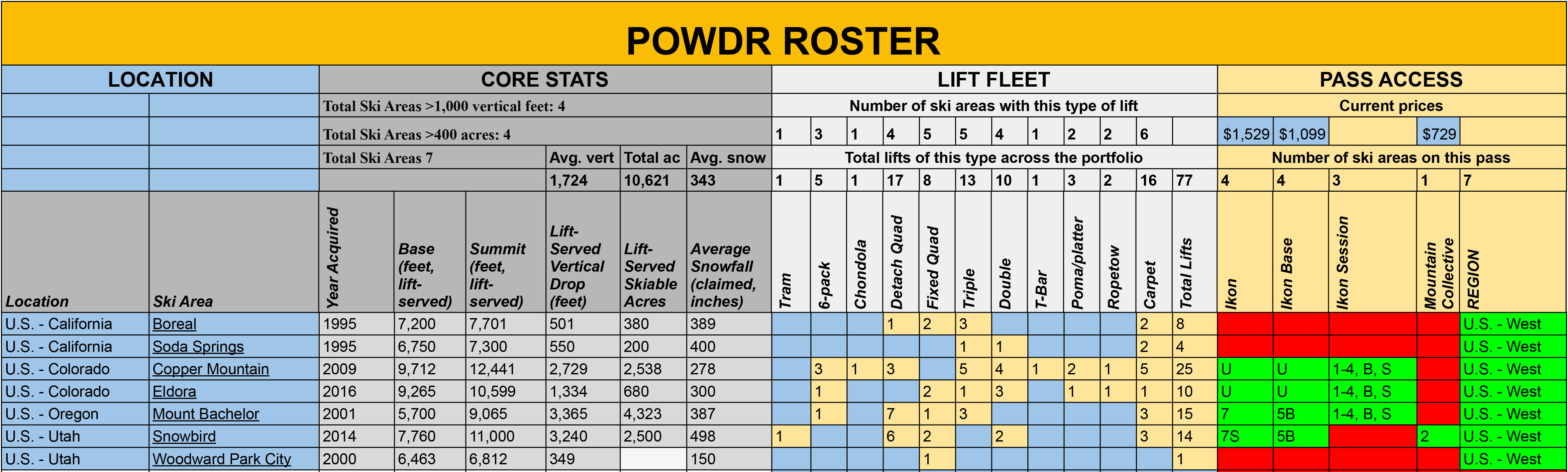
Year founded: 1958
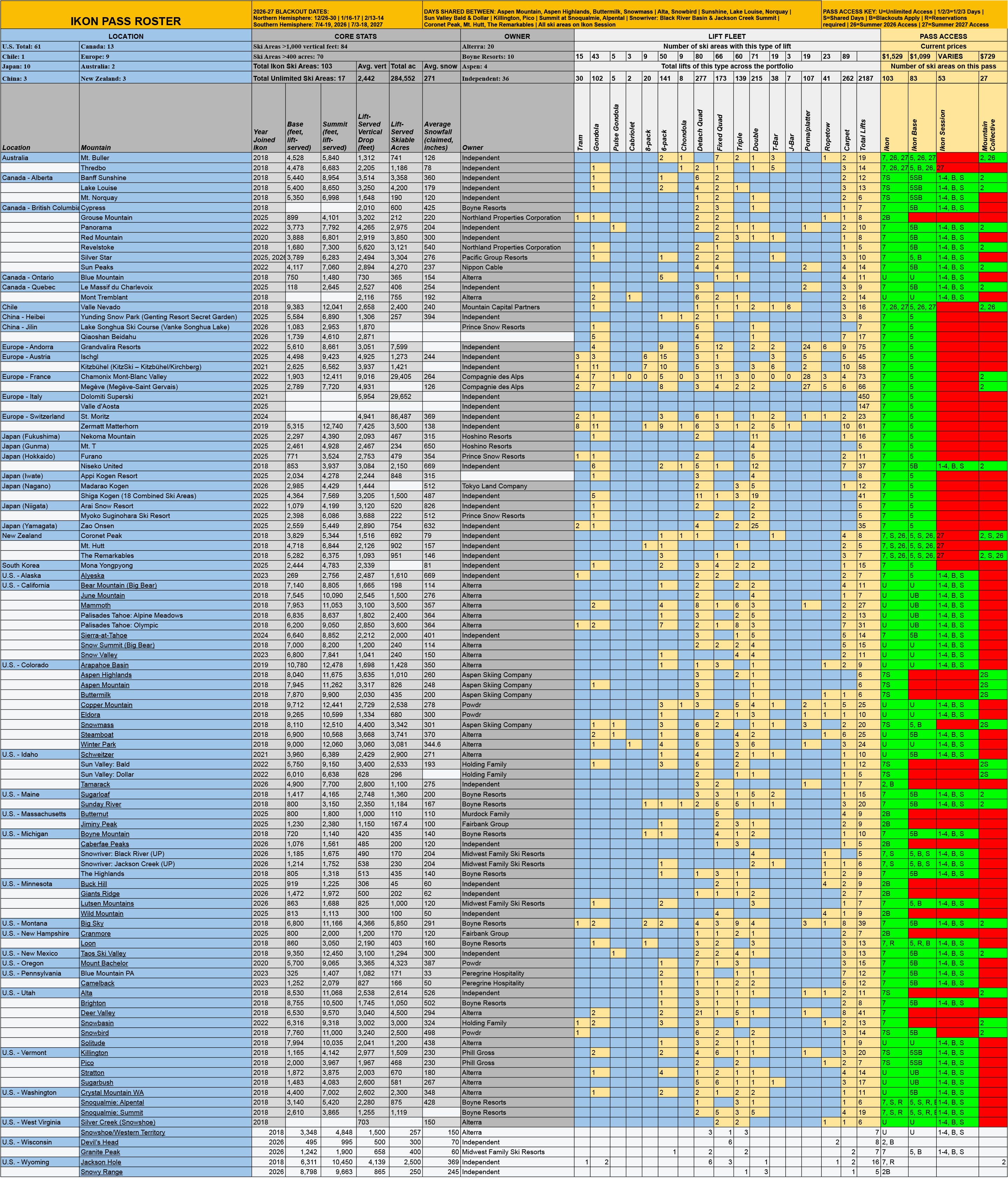
Pass affiliations:
Ikon Pass: 7 days, no blackouts
Ikon Base Pass: 5 days, holiday blackouts
Base elevation: 5,703 feet (bottom of Northwest Express chairlift)
Summit elevation: 8,957 feet (top of Summit Express chairlift), can hike to 9,065 feet
Vertical drop: 3,254 feet lift-served | 3,362 feet hike-to
Skiable acres: 4,323
Average annual snowfall: 410 inches
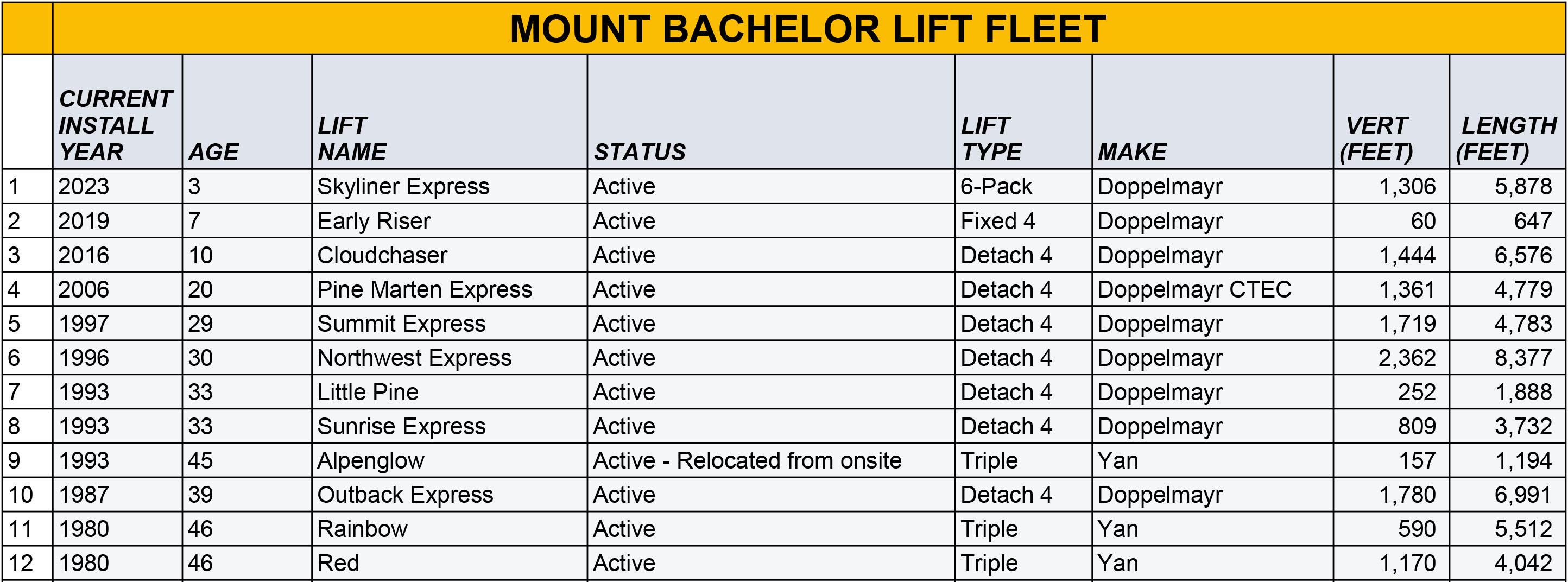
Lift count: 15 (1 six-pack, 7 high-speed quads, 1 fixed-grip quad, 3 triples, 3 carpets)
Why I interviewed him
First, the volcano thing never stops thrilling me. As I wrote when I hosted Mount Hood Meadows GM Greg Pack on the pod last year:
Volcanoes are weird. Oh look, an exploding mountain. Because that seems reasonable. Volcanoes sound like something imagined, like dragons or teleportation or dinosaurs*. “So let me get this straight,” I imagine some puzzled Appalachian miner, circa 1852, responding to the fellow across the fire as he tells of his adventures in the Oregon Territory, “you expect me to believe that out thataways they got themselves mountains that just blow their roofs off whenever they feel like it, and shoot off fire and rocks and gas for 50 mile or more, and no one never knows when it’s a’comin’? You must think I’m dumber’n that there tree stump.”
Turns out volcanoes are real. How humanity survived past day one I have no idea. But here we are, skiing on volcanoes instead of tossing our virgins from the rim as a way of asking the nice mountain to please not explode (seriously how did anyone make it out of the past alive?).
And one of the volcanoes we can ski on is Mount Hood. This actually seems more unbelievable to me than the concept of a vengeful nuclear mountain. PNW Nature Bros shield every blade of grass like they’re guarding Fort Knox. When, in 2014, federal scientists proposed installing four monitoring stations on Hood, which the U.S. Geological Survey ranks as the sixth-highest threat to erupt out of America’s 161 active volcanoes, these morons stalled the process for six years. “I think it is so important to have places like that where we can just step back, out of respect and humility, and appreciate nature for what it is,” a Wilderness Watch official told The New York Times. Personally I think it’s so important to install basic monitoring infrastructure so that thousands of people are not incinerated in a predictable volcanic eruption. While “Japan, Iceland and Chile smother their high-threat volcanoes in scientific instruments,” The Times wrote, American Granola Bros say things like, “This is more proof that the Forest Service has abandoned any pretense of administering wilderness as per the letter or spirit of the Wilderness Act.” And Hood and the nation’s other volcanoes cackle madly. “These idiots are dumber than the human-sacrifice people,” they say just before belching up an ash cloud that could take down a 747. When officials finally installed these instrument clusters on Hood in 2020, they occupied three boxes that look to be approximately the size of a convenience-store ice freezer, which feels like an acceptable trade-off to mass death and airplanes falling out of the sky.
It’s weird because for most of human history, humans just kind of did whatever they wanted to. That’s how we have castles on mountain peaks all over Europe and railroad tracks across continents and the towering city of Manhattan where a forest used to be. Ever heard of The Great Black Swamp? It once covered three million acres in Northwest Ohio and was more than 120 miles wide. It’s gone. Gone. Humans drained it in the 1800s for farmland.
Mount Bachelor ski resort, opened in 1958 as Bachelor Butte, is probably one of the last instances we’ll ever see in America of a built human experience laid over nature’s grandeur. It’s too bad. Humans build amazing things. Done correctly, they complement nature aesthetically and functionally, bringing the animal most capable of destroying the world closer to where they can appreciate its specialness. Our current posture mostly allows us to build in the least desirable places - flatlands accessible only by car, typically on a city’s edge. That we could foster more appreciation for the natural world by allowing more people to live closer to - or even within - it is a sentiment completely absent from the national discussions on how to build the millions of housing units America needs.
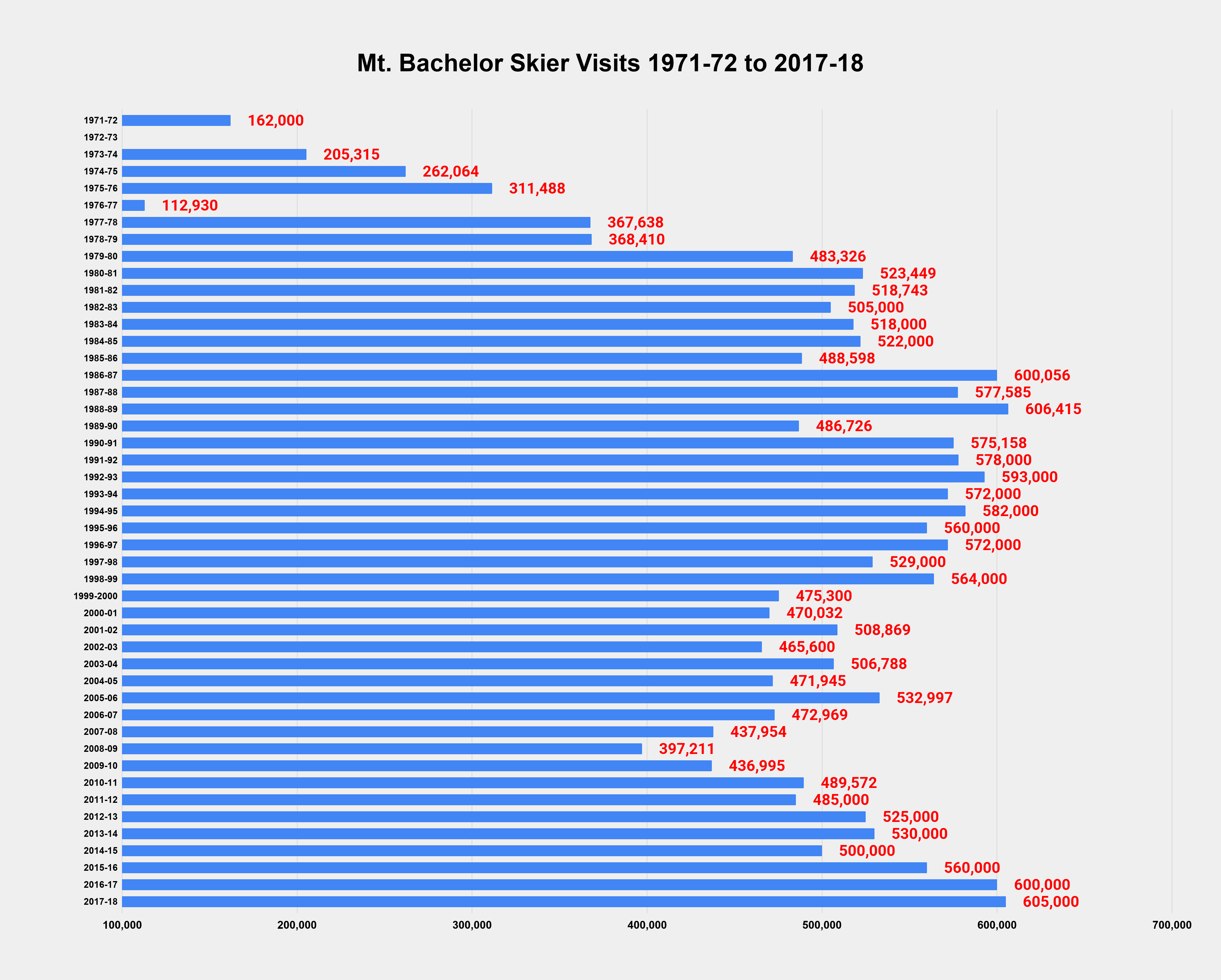
What do I mean by this? Build more ski resorts on volcanoes? No. But consider this: Mount Bachelor is a 21-mile drive from Bend, where the majority of the mountain’s skier visits originate. And Bachelor gets A LOT of skier visits:
There is no place to stay on the mountain, unless you snag one of 40 RV spots. Everyone else must arrive, every single day, in one of the approximately 4,880 personal vehicles or five buses that the ski area can accommodate on its 44-ish acres of parking lots.
Merriman makes it clear that Bachelor’s new Forest Service masterplan will not include any plans for onsite lodging. “I just don’t really think it fits our culture very well,” he said. And he’s correct: the predominant ethos in the Pacific Northwest has for decades been to separate the natural places that people most want to visit from the places where they are allowed to live.
This may have made sense in Bachelor’s early days of fewer than 100,000 annual skier visits. It doesn’t make sense anymore. Check out this peak-day visitation chart from Bachelor’s 2013 Environmental Impact Statement (EIS):
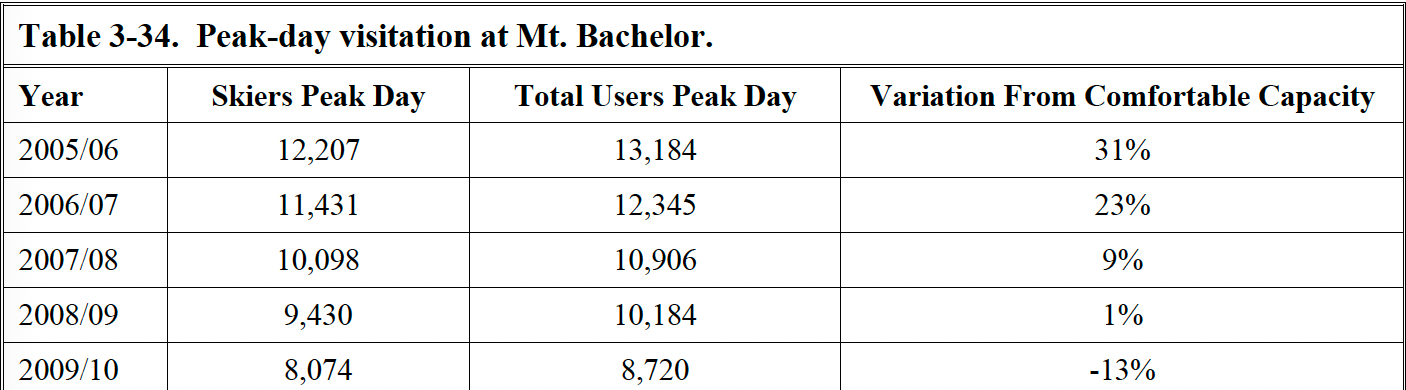
Here’s how that translates to traffic:
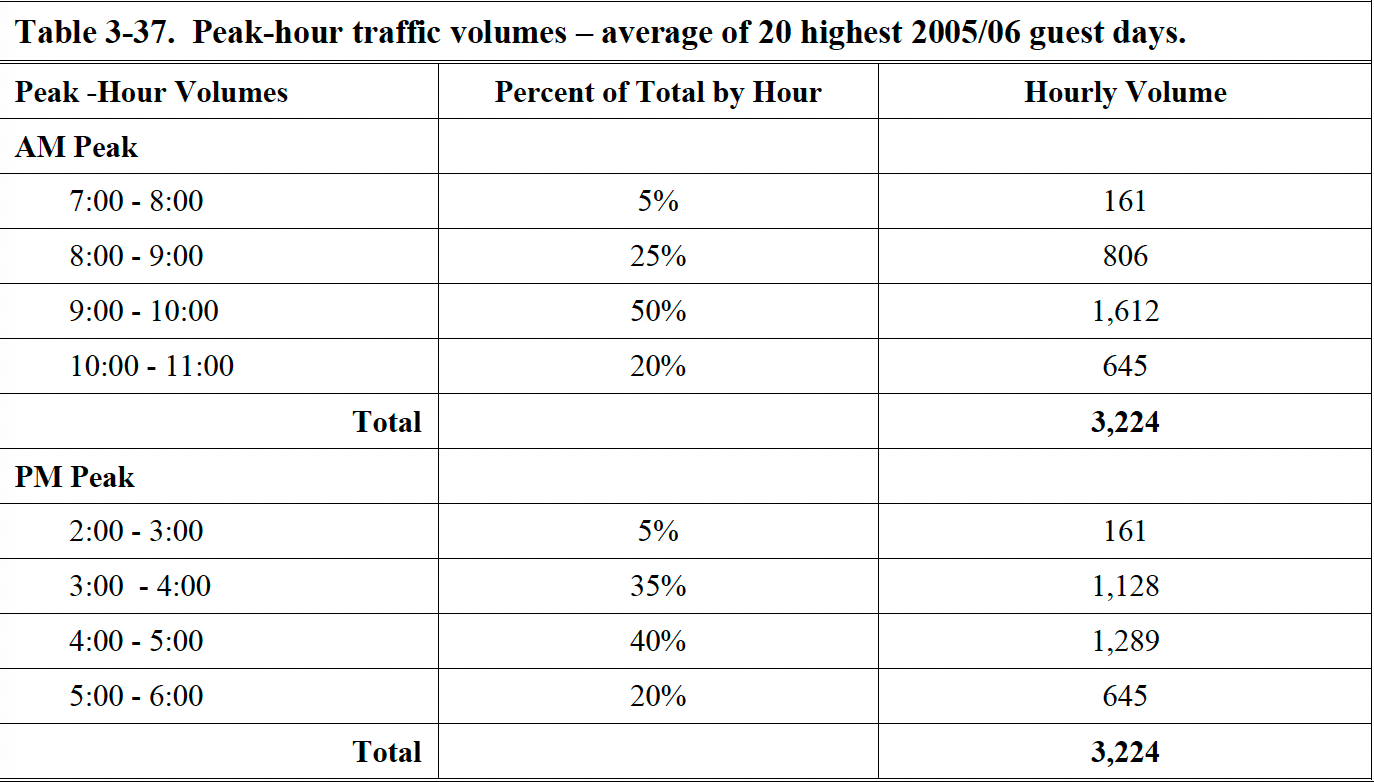
As big as those numbers are, Bachelor aspired for more skier visits. The solution? More parking. From that same 2013 EIS: “Under the Proposed Action, Mt. Bachelor would expand parking, increasing the comfortable parking capacity from 10,050 guests to 13,120.” The pink below shows where Bachelor planned to build parking lots:
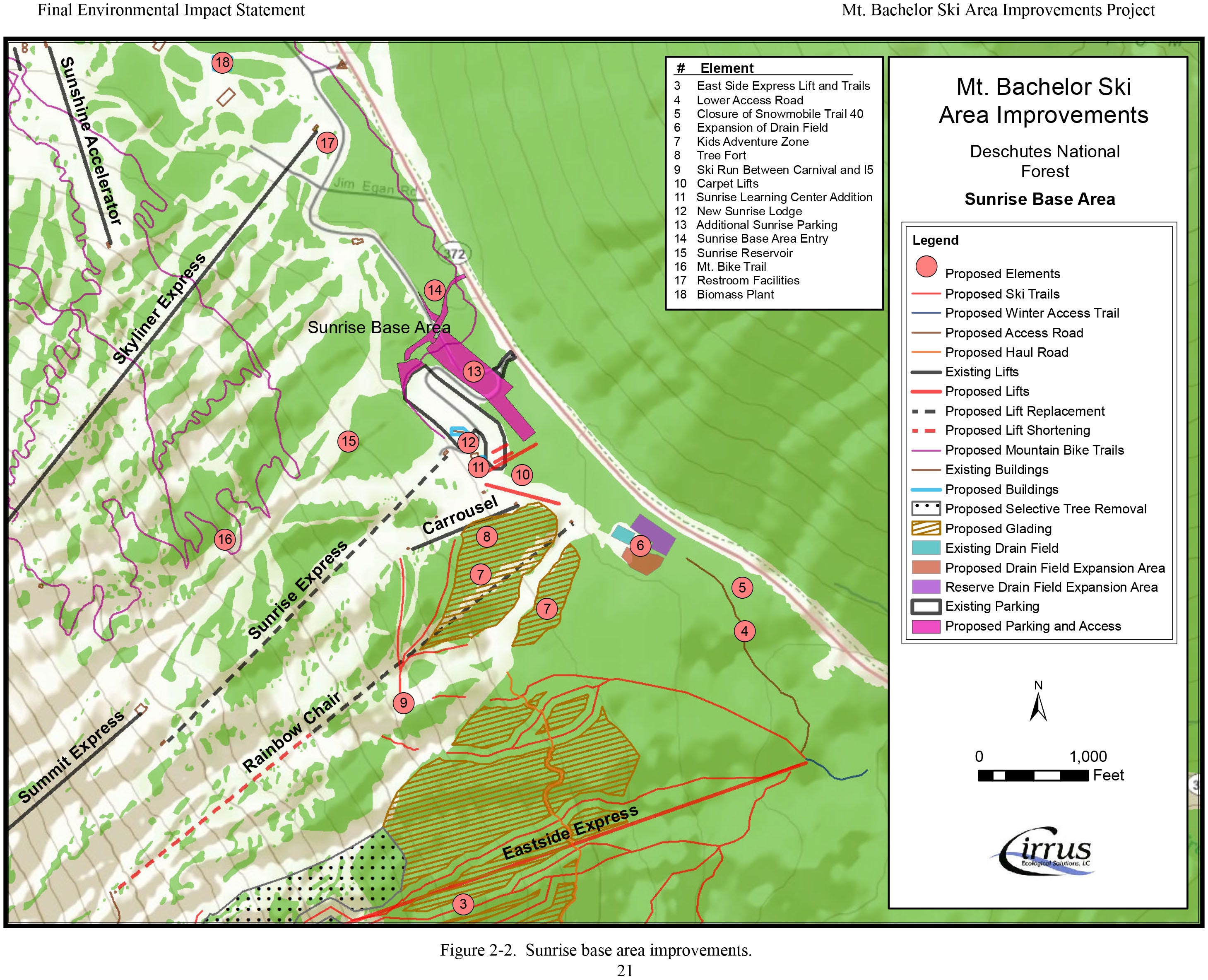
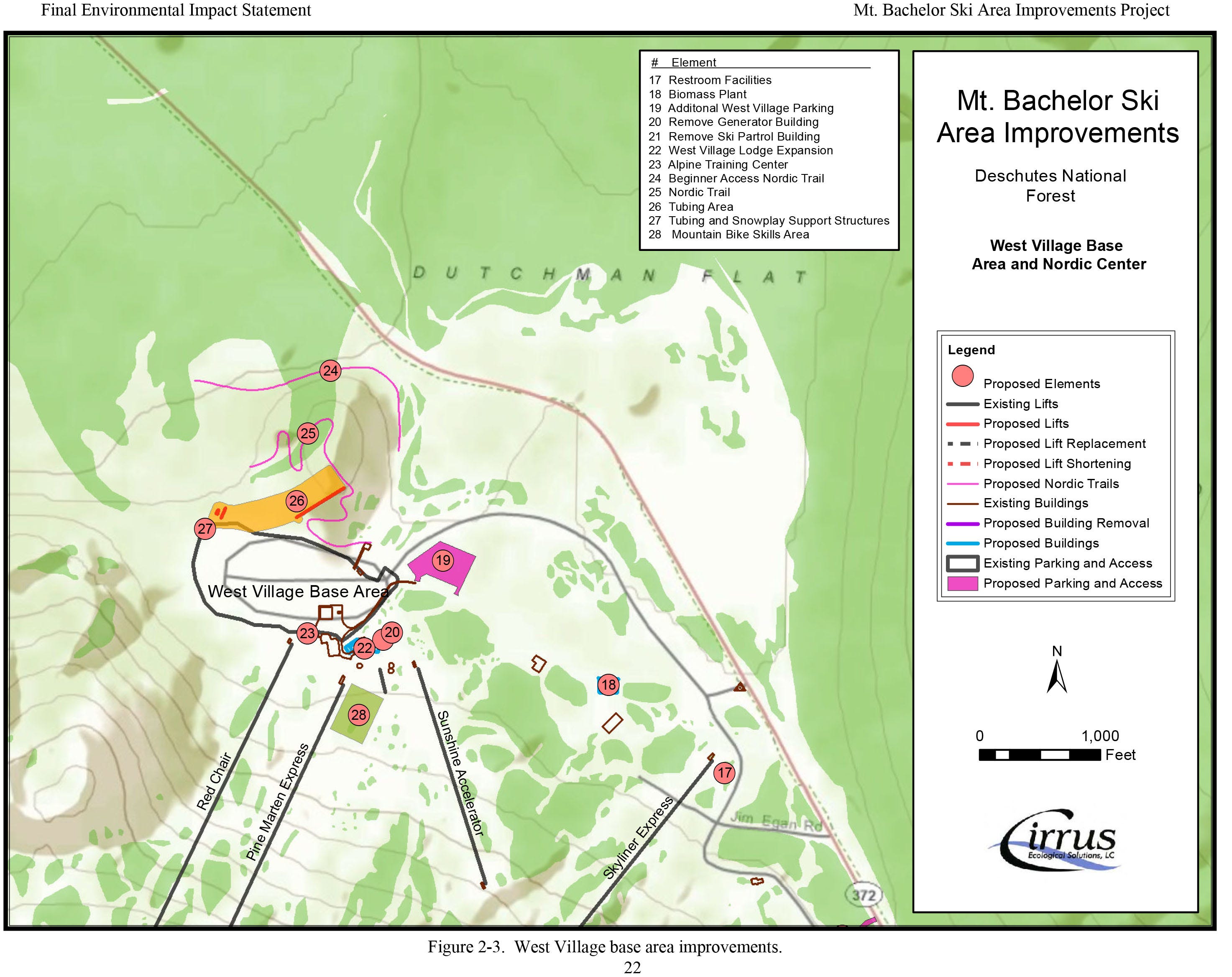
But imagine this: what if Bachelor, the U.S. Forest Service, and any relevant local authorities jointly developed 44 acres of the flat scrubland surrounding Mt. Bachelor into a dense, walkable, low-rise village accented with a wilderness motif that blended with the natural environment?
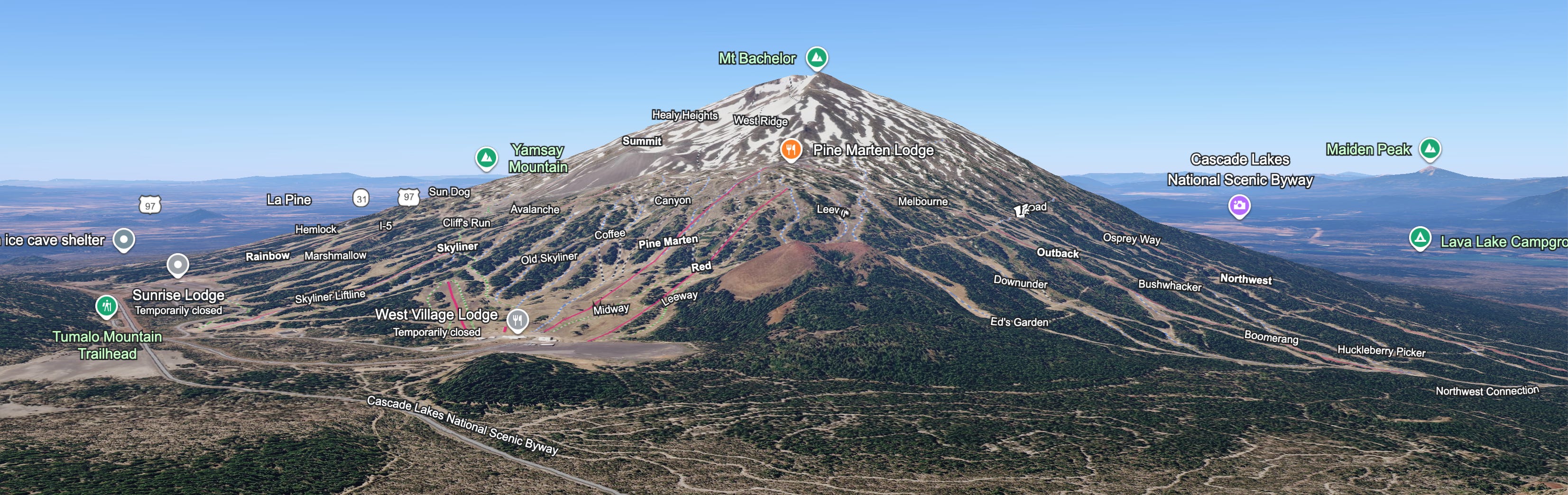
Humans have built beautiful places to live in the mountains for centuries. Consider the mountainside cities of Italy:


Or, just down the road from Bachelor, Timberline Lodge on Mt. Hood:
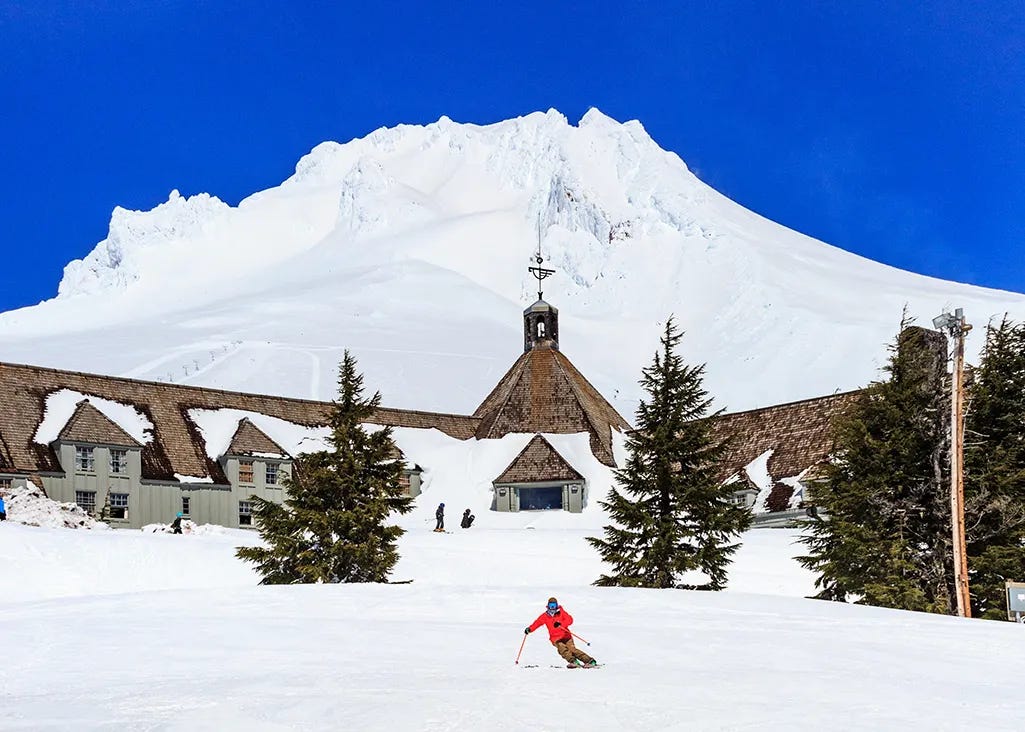
If ski resorts enabled more people to live where they actually want to be, then they could collectively do more than any other industry to model a car-lite mode of living that is alien to most Americans.
What I’m talking about here is place-building of the sort that humans did for the 100,000 years before the car showed up: a pedestrian-first community with plazas and parks and schools and grocery stores and pharmacies and barbershops and restaurants. I don’t mean a kitschy row of souvenir shops with condos owned by absentees who show up two weeks per year and Air B&B the rest, and I don’t mean employee housing built and subsidized by the ski areas. I mean establishing a community - let’s call it “Bachelor Butte” - and incorporating it; setting a street grid and baseline rules of building design, height, and size; establishing a government authorized to form a police force and firefighting unit and school system; banning through-traffic and stowing most cars in underground garages; and setting a hefty enough tax for unoccupied units that more residents than not are incentivized to live there year-round.
I realize this vision is unpopular. I also realize that any such development would likely carry a hefty market-rate pricetag for resident entry, making it a redoubt for rich folks to live beside a national treasure. But what if… mountainside residences are unaffordable because we build so few of them? What if Americans stopped reflexively opposing mountainside development and instead encouraged the development of dense communities, as our neighbors in British Columbia have so successfully done? Right now, B.C. developers are building, from raw wilderness, a community below Cypress Mountain that will eventually be home to 7,000 people, with 3,700 homes of all sizes, vibrant pedestrian areas and eight neighborhood parks:
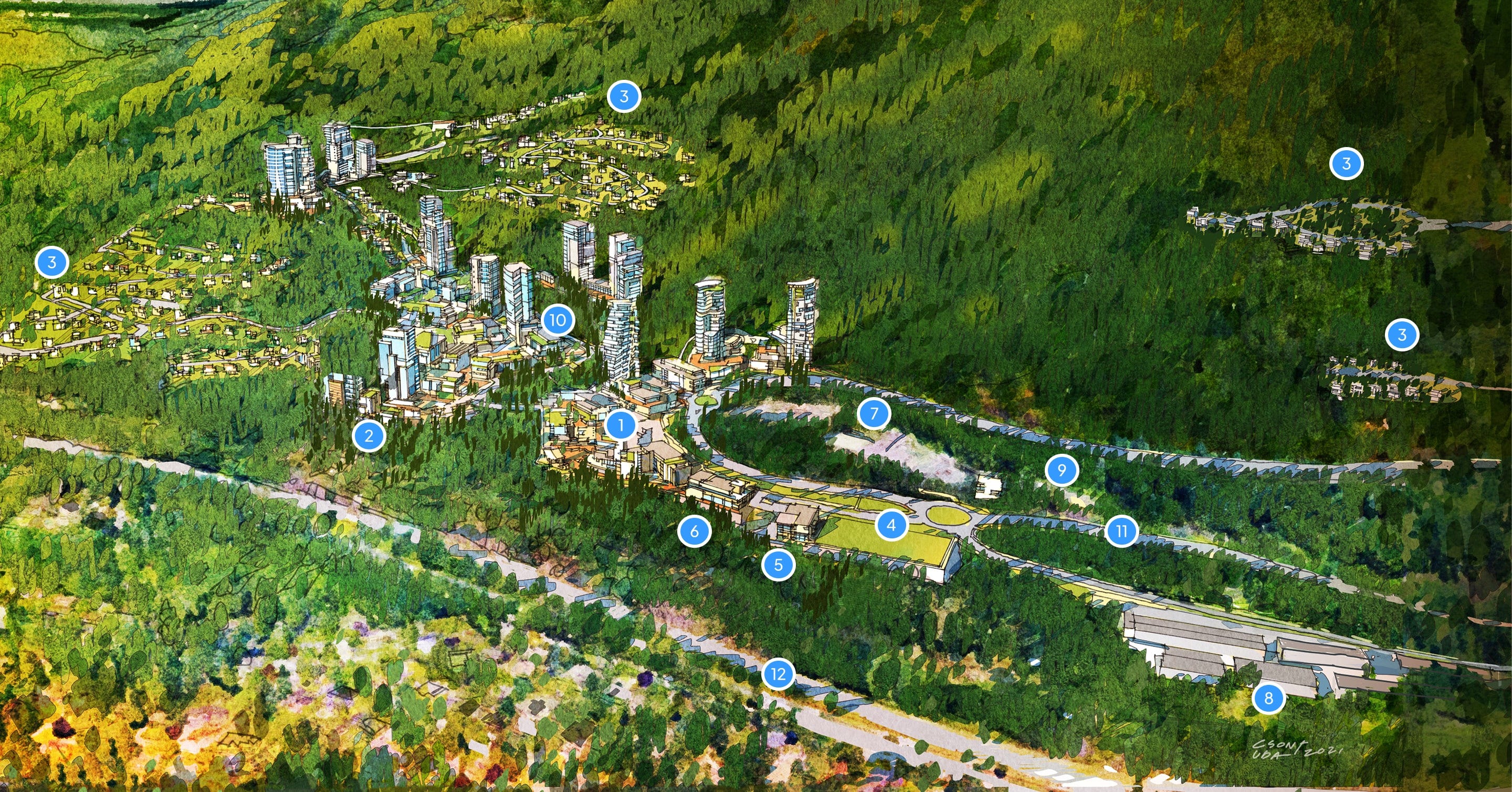
While this new community sits below Cypress ski area, a gondola may one day ferry skiers from the town square up to the mountain. Transit will likewise connect residents to Vancouver.
Americans have good reasons to oppose new development. Pretty much everything we’ve built in this country since World War II has de-centered the human experience, making our built environment a hazardous and ugly mishmosh of parking lots, lowrise buildings, and highways as uncrossable by a pedestrian as the Mississippi River. The American soul sees, in any new proposal, more of this discombobulated cartoon world, and they don’t want that transposed onto our most beautiful places.
Neither do I. But the world is filled with gorgeous, intimate places built with great care to complement - even enhance - nature’s brilliance. Humans love these places. Bachelor - and so many other American places - could reclaim from the richest among us the exclusive right to live immersed in nature simply by building more places adjacent to it.
This probably sounds extreme. “Stu you just don’t get it, we like that 44 acres of land are set aside for the temporary storage of personal vehicles so that we can enjoy nature and not look at a bunch of buildings.” You’re right - I don’t get it. Bachelor is the seventh-largest ski area in America, and it is the only one in the top 20 with no onsite beds. Given the preponderance of villages in the European Alps, that likely makes Mt. Bachelor the largest ski area in the world without lodging. Should that be a point of pride for a region that so staunchly defends the environment for development? Or could Bachelor’s remoteness be flipped into an opportunity to reduce, in any way possible, the car-dependance that defines its recreational use today?
OK that was kind of a tangent. I didn’t get into this much with Merriman, and I didn’t press him on it. It’s not the resort president’s job to champion literal community building at the base of his ski area. But it could be the owner’s job - meaning Powdr, which leases the land from the U.S. Forest Service. Or it could be up to the people of Bend, who may decide, some day, that sending a half-million or more people to the local ski area annually by car is in fact rather senseless when some good number of them could actually be enticed to live at the base of the mountain.
Damn it I tried to escape the tangent and it lassoed me right back in. How about this:
Bachelor is great I love it everyone go there hurray!
Transcripts
There are two transcripts. Both are generated by robots. Both are helpful and defective in their own unique ways. I do not proofread either of them.
Transcript 1: Click the “transcript” button at the top of this article. You can only see this transcript on a computer. Because I don’t know why exactly but everything is getting better and dumber all at once it seems. Anyway, this is the transcript that the robots create when I upload the podcast to the internet. The cool thing about it is that you can click on any block of text and the audio will teleport there instantly. The uncool thing about this transcript is that it does not indicate who is talking at any given moment.
Transcript 2: You can read this below. This is the transcript that Zoom creates as we record the podcast. The cool thing about this transcript is that it indicates who is talking at any given moment. The uncool thing about this transcript is that the timestamps do not match the audio. Also, you cannot click on this text to move to the associated point in the audio.
Zoom
Stuart Winchester: My guest today is entering his fourth season as president and general manager of Mount Bachelor, Oregon.
00:17:55.000 --> 00:18:15.000
Stuart Winchester: The Mount Bachelor ski area is the largest in the Pacific Northwest, and one of the largest in the United States, with 4,323 acres served by 15 lifts. The mountain averages 410 inches of snow annually. Bachelor is one of seven U.S. ski areas owned by Park City-based Powder.
00:18:15.000 --> 00:18:30.000
Stuart Winchester: Prior to joining the team at Bachelor, he worked at sister resort Copper Mountain for seven years as vice president of finance. John Merriman is my guest. John, welcome to the storm. So glad we could make this one happen finally. How was your summer and how are your winter preparations going?
00:18:29.000 --> 00:18:47.000
John Merriman: Thanks, Stuart. Psyched to be here. Summer was great. I mean, from a personal standpoint, I had a little bit of a biking incident, broke my arm. So that created some challenge personally. But from a mountain standpoint, it was great. Weather was actually pretty good here.
00:18:38.000 --> 00:18:40.000
Stuart Winchester: Oh no.
00:18:47.000 --> 00:19:03.000
John Merriman: in Bend. Uh, we had some… some fires, as… as we’ll typically get, uh, in the summers, but, uh, you know, thankfully not a huge impact from those, so summer was great. We had our… we’re having our biggest construction season.
00:19:03.000 --> 00:19:05.000
John Merriman: Um, in recent memory.
00:19:04.000 --> 00:19:05.000
Stuart Winchester: Yeah.
00:19:05.000 --> 00:19:12.000
John Merriman: Um, here, we’ve got a lot, um, that we’re working on, um, for winter prep.
00:19:12.000 --> 00:19:17.000
Stuart Winchester: So, what was the bike accident? Was it at Bachelor, or was it just on the road?
00:19:15.000 --> 00:19:27.000
John Merriman: No, it was, uh, I ride my e-bike up to the mountain quite a bit, um, and I happened to just hit some bad pavement when I reached for a water bottle. Off I went.
00:19:19.000 --> 00:19:20.000
Stuart Winchester: Here.
00:19:27.000 --> 00:19:31.000
Stuart Winchester: Oh, gosh. Where’d you get hurt at?
00:19:27.000 --> 00:19:29.000
John Merriman: Yeah.
00:19:30.000 --> 00:19:35.000
John Merriman: Yeah, it was this whole area here. Boat soup.
00:19:34.000 --> 00:19:36.000
Stuart Winchester: Okay, okay.
00:19:36.000 --> 00:19:41.000
Stuart Winchester: Yeah, oh my gosh. Did they take care of you, though? Put it back together?
00:19:37.000 --> 00:19:38.000
John Merriman: Yep.
00:19:38.000 --> 00:19:43.000
John Merriman: Oh, yeah. Yeah, thankfully we have good surgeons here, so…
00:19:42.000 --> 00:19:57.000
Stuart Winchester: Yeah, it’s amazing when I broke my leg to look at the x-ray, and my leg, my tib-fib are in pieces, and they just put it back together, put a plate in, and I’m skiing like normal. It’s pretty amazing what they can do with that kind of stuff.
00:19:49.000 --> 00:19:50.000
John Merriman: Yep.
00:19:56.000 --> 00:20:00.000
John Merriman: It’s incredible. It’s incredible. Yeah.
00:19:57.000 --> 00:19:59.000
Stuart Winchester: All right.
00:19:59.000 --> 00:20:00.000
Stuart Winchester: Yeah.
00:20:00.000 --> 00:20:17.000
Stuart Winchester: Alright, John, let’s start with the Northwest Chairlift, and just to set this up for the listeners and viewers, this is a 96 Doppelmayr, so 30 years old. It’s 8,377 feet long, that makes it the 18th longest high-speed quad in America.
00:20:01.000 --> 00:20:02.000
John Merriman: Sure.
00:20:08.000 --> 00:20:09.000
John Merriman: Right.
00:20:16.000 --> 00:20:18.000
John Merriman: At one point, it was first.
00:20:17.000 --> 00:20:35.000
Stuart Winchester: And it is 2,365 vert. It is the 4th tallest chairlift and the 3rd tallest high-speed quad in the USA. Uh, the highest… the tallest high-speed is… is Sun Valley Challenger, followed by, uh, Snowbasin, John Paul, and, uh, Snowbird Peruvian. So, if… if anyone’s wondering what that list is.
00:20:35.000 --> 00:20:38.000
Stuart Winchester: And, uh, so, so, John.
00:20:38.000 --> 00:20:47.000
Stuart Winchester: You’re not replacing it, but you’re replacing a lot of pieces on it. So break this down for us. What are you doing with Northwest?
00:20:38.000 --> 00:20:40.000
John Merriman: Right.
00:20:47.000 --> 00:20:52.000
Stuart Winchester: chairlift, and why was it time for this major upgrade?
00:20:50.000 --> 00:21:05.000
John Merriman: Yeah, so, uh, glad you asked. We, uh… Northwest is our most popular lift, especially on powder days. Um, you know, it is all advanced terrain. Um, essentially, it’s… it’s bowls into tree skiing.
00:21:05.000 --> 00:21:21.000
John Merriman: Um, it’s got, you know, decent pitch to it, and like you mentioned, it’s one of the longest lifts going. I believe when it was put in, uh, it was either the, uh, biggest or one of the biggest, uh, back in the 90s. So, essentially.
00:21:17.000 --> 00:21:19.000
Stuart Winchester: Mmhm.
00:21:21.000 --> 00:21:26.000
John Merriman: We have been having fits with that lift, honestly. Um, it…
00:21:26.000 --> 00:21:40.000
John Merriman: over time, you know, the motor degrades. Over time, um, it doesn’t have the power that it once had when it was initially, uh, put in place. So, um…
00:21:38.000 --> 00:21:40.000
Stuart Winchester: Mmhm.
00:21:41.000 --> 00:21:49.000
John Merriman: We looked at it as… it’s just becoming somewhat unreliable. Um, you know, it had had…
00:21:49.000 --> 00:22:05.000
John Merriman: times when it wouldn’t be able to run at full capacity just because of power draw, uh, which was a big part of it. So it was kind of a two-pronged thing. The first thing we had to do was upgrade the power down to the lift, which we did. Um, we did that last season.
00:22:05.000 --> 00:22:21.000
John Merriman: Um, and then the second thing we did is this season, you know, Doppelmeyer kind of, they, they come in, and they do full specs on it, you know, they have to individually engineer each of these, so what they do is you leave the, you leave the towers in place.
00:22:21.000 --> 00:22:25.000
John Merriman: You leave the chairs in place, you leave the rope.
00:22:25.000 --> 00:22:40.000
John Merriman: And then you essentially replace all of the guts of the lift, and we did this for a couple of different reasons. Number one, um, is we have some wildlife restrictions with the Forest Service that we have to adhere to in this area. It’s spotted owl habitat.
00:22:41.000 --> 00:22:52.000
John Merriman: So, you know, the general rule is no work after October 1st in that area, and as you can imagine, trying to install a lift from October 1st to the time we open is not going to happen.
00:22:52.000 --> 00:23:10.000
John Merriman: So, now, that can be alleviated, but that takes years to get approval on that, typically. So, we kind of put our heads together with Doppelmayr, and we’re like, well, what else can we do? And they’re like, well, we’ve done some of these, what we call, modernizations. And so, we looked into that.
00:22:52.000 --> 00:22:54.000
Stuart Winchester: Right. Okay.
00:23:10.000 --> 00:23:25.000
John Merriman: And essentially what that does is it replaces, uh, the electric motor, it replaces the, uh, the APU and the EPU, all of the drives and controls. We recently replaced our Skyliner lift.
00:23:23.000 --> 00:23:24.000
Stuart Winchester: Mmhm.
00:23:25.000 --> 00:23:27.000
John Merriman: Uh, 3 summers ago.
00:23:27.000 --> 00:23:35.000
John Merriman: and essentially, we’re gonna have all of the same components, um, as our Skyliner lift. So it’s… it’s almost… it’s like…
00:23:35.000 --> 00:23:52.000
John Merriman: a brand new lift without having to replace everything, and some of the more expensive things that you have to do, as you know, is to fly towers, you know, and all of that type of thing. And the big benefit to us that I like is that we’re having full parking down at the bottom now.
00:23:52.000 --> 00:24:08.000
John Merriman: So essentially, we can take all the chairs off of the lift during a storm cycle, and then we run it on night drive. So essentially, we do that with our Summit lift now, but essentially what that will do is it runs the rope without chairs on it at, like, a half a meter per second.
00:23:53.000 --> 00:23:54.000
Stuart Winchester: Mm-hmm, okay.
00:24:08.000 --> 00:24:29.000
John Merriman: And what that’ll do is, in some of the big storms that we get, it alleviates some of the ice getting on there. So if that can continue to run, then when we go to start it up after the storm, it’s a heck of a lot easier. Sometimes it takes us, you know, a full day to recover from a storm over there, just because of all the ice you gotta get off the lift, and you gotta dig it out, and all of that stuff.
00:24:29.000 --> 00:24:37.000
John Merriman: We’re still gonna have to dig it out, but ideally, we have a lot less ice clearing that we have to do, and we get it open for people on powder days a lot earlier.
00:24:38.000 --> 00:24:54.000
Stuart Winchester: I mean, that’s got to be a heck of a big garage. I don’t know if this has changed. Liftblog, and by the way, for anyone watching on stormskiing.com or YouTube at Storm Ski Journal, I was going through Liftblog’s pictures of the Northwest Trail Lift, which I was not able to ride when I was there.
00:24:54.000 --> 00:25:05.000
Stuart Winchester: only Outback. So… so Lyft blog lists 176 chairs for Northwest. I’m not sure if that changed over the years, but…
00:25:02.000 --> 00:25:04.000
John Merriman: That’s about right.
00:25:05.000 --> 00:25:10.000
Stuart Winchester: Okay, so are all of them are going to be able to fit in this garage?
00:25:08.000 --> 00:25:17.000
John Merriman: Well, it’s not a build… we have a small building to do work on it… on them. They’re actually going to be outside, just under an enclosure.
00:25:13.000 --> 00:25:14.000
Stuart Winchester: Okay.
00:25:17.000 --> 00:25:26.000
John Merriman: So they’re gonna be protected from the weather still, but it’s not… it’s not a complete building. That… you’re right, that would have to be enormous, uh, for people to do that.
00:25:17.000 --> 00:25:18.000
Stuart Winchester: Hmm. Okay.
00:25:20.000 --> 00:25:21.000
Stuart Winchester: Right.
00:25:24.000 --> 00:25:26.000
Stuart Winchester: So you…
00:25:26.000 --> 00:25:36.000
Stuart Winchester: So you mentioned Skyliner, and yeah, that’s a beautiful lift. I was also flipping through pictures of Lift Blog with the 6, and I was able to ride that lift. It’s really nice.
00:25:30.000 --> 00:25:32.000
John Merriman: Right.
00:25:34.000 --> 00:25:37.000
John Merriman: Yeah, you and I wrote that one. Yep.
00:25:36.000 --> 00:25:39.000
Stuart Winchester: Yeah, yeah, so just…
00:25:39.000 --> 00:25:41.000
Stuart Winchester: Zooming out a little bit here.
00:25:40.000 --> 00:25:41.000
John Merriman: Mm-hmm.
00:25:41.000 --> 00:25:44.000
Stuart Winchester: That lift was…
00:25:44.000 --> 00:26:00.000
Stuart Winchester: A, it replaced a 1989 Doppelmayr high speed quad with a six pack. So that was obviously probably a very expensive project. The price tags I get are, you know, 12, 15 million for a lift of, of that size and length.
00:25:48.000 --> 00:25:50.000
John Merriman: Right.
00:25:50.000 --> 00:25:51.000
John Merriman: Right.
00:25:55.000 --> 00:25:56.000
John Merriman: Yep.
00:25:57.000 --> 00:25:58.000
John Merriman: Sure.
00:26:00.000 --> 00:26:07.000
Stuart Winchester: So, take us through the thought process internally, as you said, okay, Skyliner’s done.
00:26:06.000 --> 00:26:07.000
John Merriman: Yep.
00:26:07.000 --> 00:26:23.000
Stuart Winchester: And Northwest has to be next. Do we replace it or do we just upgrade it? And ultimately, why did you decide on upgrade? I know you mentioned some things with, with, uh, environmental stuff, but just take us through the thought process of, of, of, of modernizing instead of replacing.
00:26:16.000 --> 00:26:18.000
John Merriman: Yep.
00:26:22.000 --> 00:26:39.000
John Merriman: Yep. Now, replacing was an attractive option. It really was, because, you know, if we were to replace it, we probably would have done a six-pack there, too, just because six-packs have the weight. And, you know, we, especially early season, we tend to have a bit of wind.
00:26:32.000 --> 00:26:33.000
Stuart Winchester: Okay.
00:26:39.000 --> 00:27:00.000
John Merriman: Um, and Skyliner has been excellent in the wind, and just because of the weight, uh, primarily. So, I don’t think we necessarily need the volume out there, uh, because it still is advanced terrain, you know, a limited amount of guests are able to ski over there. It certainly gets busy on powder days.
00:26:40.000 --> 00:26:41.000
Stuart Winchester: Mm-hmm.
00:26:44.000 --> 00:26:46.000
Stuart Winchester: Yeah, yeah, yeah.
00:26:48.000 --> 00:26:49.000
Stuart Winchester: Yeah, yeah, yeah.
00:27:00.000 --> 00:27:06.000
John Merriman: You know, but nothing usually longer than a 15-minute lift line or so. Um…
00:27:01.000 --> 00:27:02.000
Stuart Winchester: Down.
00:27:06.000 --> 00:27:19.000
John Merriman: But it really came down to cost, Stuart. Um, and it was, you know, a six-pack out there, you’re talking quite a bit bigger number than what you had quoted earlier. You know, it’s 15 plus.
00:27:19.000 --> 00:27:27.000
John Merriman: million, probably, for a six-pack out there, being that size. Whereas, you can do a modernization for a fraction of that.
00:27:28.000 --> 00:27:31.000
Stuart Winchester: How much of a fraction? Can you give us a ballpark?
00:27:29.000 --> 00:27:34.000
John Merriman: Yeah, I mean, I would say anywhere from a third to a half.
00:27:34.000 --> 00:27:46.000
Stuart Winchester: Yeah, and that’s really smart, and I’ve seen a lot of ski areas begin to do this. The Fairbank Group, for example, did that at both Bromley and Cranmore out in New England.
00:27:46.000 --> 00:27:48.000
Stuart Winchester: Is that…
00:27:48.000 --> 00:28:05.000
Stuart Winchester: Are you kind of, kind of wait and see how well it works out, or is that your, is that maybe setting the template for what you’ll do with Outback and Little Pine and some of these, well, I imagine the Yons will go when they go, but, but some of these older high speed quads.
00:28:00.000 --> 00:28:02.000
John Merriman: Yeah, thank you.
00:28:05.000 --> 00:28:10.000
Stuart Winchester: Would you rather modernize or replace or is this going to be a case by case?
00:28:08.000 --> 00:28:22.000
John Merriman: You know, it depends. We are actually modernizing Little Pine right now, too. We’ve been as public about that, uh, but, you know, we are modernizing that one now, too, and that lift is the exact same model as Summit.
00:28:12.000 --> 00:28:14.000
Stuart Winchester: Oh, no way, okay.
00:28:15.000 --> 00:28:16.000
Stuart Winchester: Okay.
00:28:22.000 --> 00:28:35.000
John Merriman: And so the reason that we’re doing Little Pine is because we want to see exactly how that’s going to work, because we really would like to modernize Summit, um, at some point in the near future.
00:28:22.000 --> 00:28:23.000
Stuart Winchester: Okay.
00:28:28.000 --> 00:28:29.000
Stuart Winchester: Okay.
00:28:35.000 --> 00:28:51.000
John Merriman: Because that would be a much more economical way to do that lift, because, you know, obviously that lift is… has buildings top and bottom, and it is… the terrain up there is, you know, like the surface of the moon. Um, it is extremely difficult to work in.
00:28:40.000 --> 00:28:41.000
Stuart Winchester: Yeah. Okay.
00:28:51.000 --> 00:29:06.000
John Merriman: Um, and is certainly subject to the elements. So, like, a lift like Summit, we would love to be able to modernize, so we’re testing that out on Little Pine. Now, a lift like Outback is actually too old. So, those… that…
00:28:59.000 --> 00:29:01.000
Stuart Winchester: Yeah.
00:29:05.000 --> 00:29:08.000
Stuart Winchester: Oh, at 87, yeah.
00:29:06.000 --> 00:29:21.000
John Merriman: Yep, that lift is actually too old, and Doppelmeyer’s not even able to modernize something like that. So, when we do replace Outback, that will either be with a brand new lift, or reusing one of our other lifts that we replace.
00:29:12.000 --> 00:29:13.000
Stuart Winchester: Right.
00:29:22.000 --> 00:29:40.000
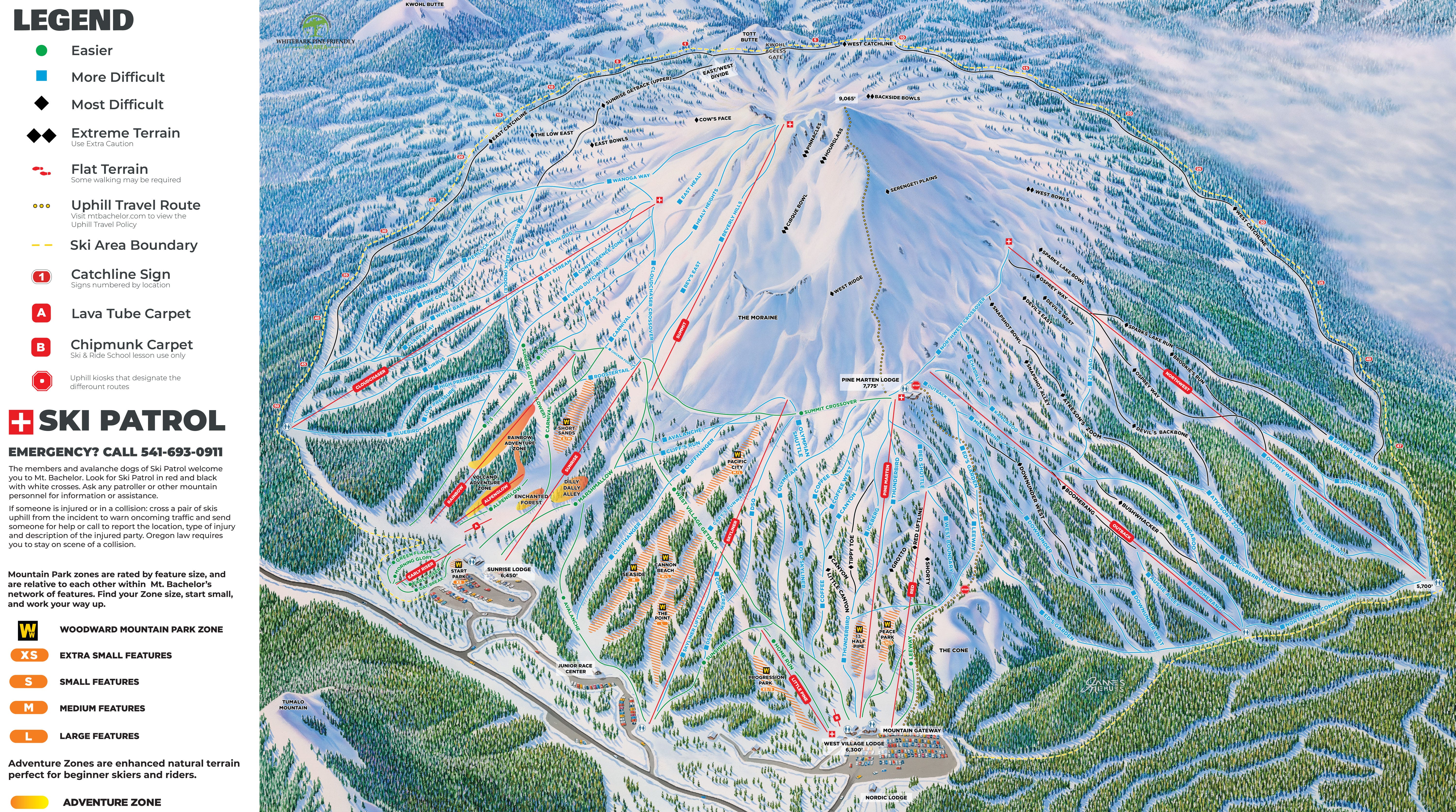
Stuart Winchester: Okay, yeah, let’s… I just want to bring up the trail map here for folks who may not be as familiar with the mountain, so if you’re watching on YouTube or StormSkiing.com, so this… it’s a little small, but this is Northwest, this is what John and I were mainly focused on, and there’s… LiftBlog has this awesome picture that kind of shows you the scale of it, just going all the way out into the wilder.
00:29:23.000 --> 00:29:25.000
John Merriman: Sure.
00:29:37.000 --> 00:29:38.000
John Merriman: Right.
00:29:39.000 --> 00:29:40.000
John Merriman: Yep.
00:29:40.000 --> 00:29:44.000
Stuart Winchester: Uh, in the summer, and that crazy dude probably hiked that. Um…
00:29:44.000 --> 00:29:58.000
Stuart Winchester: And then Outback is next, and Outback is an 87 Doppelmeyer, and so that’s one of those older ones. And then you have Skyliner, Pine Martin. Pine Martin is…
00:29:49.000 --> 00:29:50.000
John Merriman: Right.
00:29:55.000 --> 00:29:56.000
John Merriman: Yep.
00:29:58.000 --> 00:30:06.000
Stuart Winchester: let’s see, oh, that’s a newer one. Uh, and then you have Summit over here. So what are you doing with… with Little Pine, which is right here out of the main base lodge?
00:29:59.000 --> 00:30:00.000
John Merriman: Yep.
00:30:04.000 --> 00:30:05.000
John Merriman: Yep.
00:30:05.000 --> 00:30:22.000
John Merriman: Yeah, so Little Pine is a nice little beginner lift that we have out here in West Village. So we’re essentially doing the same thing. We are replacing the electric motor, the APU, the EPU, and all of the drives and components. So again, that will mirror, kind of, what.
00:30:13.000 --> 00:30:14.000
Stuart Winchester: Mmhm.
00:30:22.000 --> 00:30:33.000
John Merriman: what our experience has been with Skyliner, which has been a really effective lift for us. So, our team is already really used to using those drives and controls, and so, you know, it should be seamless.
00:30:34.000 --> 00:30:37.000
Stuart Winchester: So, just looking at…
00:30:37.000 --> 00:30:41.000
Stuart Winchester: the rest of the Lyft fleet. So…
00:30:41.000 --> 00:30:44.000
Stuart Winchester: The team decided to do Northwest.
00:30:43.000 --> 00:30:44.000
John Merriman: Yep.
00:30:44.000 --> 00:30:54.000
Stuart Winchester: for Outback, and I guess you are doing Little Pine and Sunrise, which is also a 93 Doppelmeyer high-speed quad. You know.
00:30:50.000 --> 00:30:51.000
John Merriman: Yep.
00:30:54.000 --> 00:30:57.000
Stuart Winchester: Was it just the particular…
00:30:57.000 --> 00:31:04.000
Stuart Winchester: Because I would imagine this one probably runs less than the others, because it’s so far over, and it opens later in the season. Maybe I’m wrong about that.
00:31:04.000 --> 00:31:13.000
Stuart Winchester: But what was it? Was it just the power issues that made you have to concentrate on that one first, even though it’s a 96 and a little newer than some of these?
00:31:08.000 --> 00:31:09.000
John Merriman: Yeah.
00:31:11.000 --> 00:31:15.000
John Merriman: Yeah, it was honestly our least reliable lift.
00:31:15.000 --> 00:31:19.000
John Merriman: Um, you know, when we run…
00:31:19.000 --> 00:31:39.000
John Merriman: stats on that. It was, you know, it certainly had, um, some maintenance issues. Um, it had a lot of, like, as I mentioned, some power issues, you know, it was underpowered out there. And, uh, so, you know, we put a lot into getting, um, additional power out there, new lines.
00:31:33.000 --> 00:31:34.000
Stuart Winchester: Mmhm.
00:31:39.000 --> 00:31:43.000
John Merriman: With the modernization and we think it’s going to run great.
00:31:44.000 --> 00:31:49.000
Stuart Winchester: That’s amazing. So I want to talk a little more about the power issue, because that’s been…
00:31:49.000 --> 00:31:58.000
Stuart Winchester: Man, that’s been dogging you guys for years and years, and I’m not sure if I heard this right, but it sounded like earlier you said that.
00:31:58.000 --> 00:32:04.000
Stuart Winchester: the power supply was initially good to Northwest, and then it wasn’t, so just take us through.
00:32:04.000 --> 00:32:10.000
Stuart Winchester: Resort-wide, the power upgrades that you’ve had to make, and the resources it took to pull that off.
00:32:05.000 --> 00:32:07.000
John Merriman: Yeah.
00:32:08.000 --> 00:32:26.000
John Merriman: Yeah, sure. It actually is a huge project for us. We actually have a power line that runs up to Mount Bachelor that we own and manage. We’re in the process of turning that back over to the utility company.
00:32:19.000 --> 00:32:21.000
Stuart Winchester: Mmhm.
00:32:26.000 --> 00:32:41.000
John Merriman: And in order to do that, uh, we have to upgrade the line. So we have to upgrade the poles and upgrade the line coming out, which would be nice because, you know, we’ll get the upgraded power coming out, and then we’ll also get some fiber optics and stuff like that, which would be really nice for us.
00:32:41.000 --> 00:32:44.000
John Merriman: Um, and…
00:32:44.000 --> 00:32:55.000
John Merriman: You know, that’s a multi-year project, as you can imagine, you know, that goes 12 miles through the forest, and so, you know, a lot of approvals, um, through there, which we’re working through. It’s currently, um…
00:32:50.000 --> 00:32:52.000
Stuart Winchester: Jeez.
00:32:55.000 --> 00:33:11.000
John Merriman: in submission to the Forest Service. I’m expecting to begin work on that, um, in the summer, um, as far as the… the big project. We’ve been doing lots of things internally here. Um, in the meantime, we’ve been replacing a lot of our backup power.
00:33:08.000 --> 00:33:09.000
Stuart Winchester: Yeah.
00:33:11.000 --> 00:33:32.000
John Merriman: Um, and then, um, as I mentioned, we ran a new line to Northwest. Now, the issue that I was, I was pointing out before wasn’t necessarily, uh, a power issue. What, what happens is, you know, the motors over time become a little bit weaker, a little bit weaker, you know, as with any, anything else.
00:33:32.000 --> 00:33:37.000
John Merriman: When something’s designed to be… to pull a lift that big.
00:33:37.000 --> 00:33:53.000
John Merriman: Right? Um, if it just degrades a little bit, all of a sudden, it’s gonna be pulling… it needs to pull more, right? And so, when it’s trying to pull more resources, sometimes there isn’t a lot of resources to pull from. And so, you know, it was… it was causing…
00:33:53.000 --> 00:34:06.000
John Merriman: some power blips on the resort if we were fully loading it on some big days. And so, you know, by replacing the power line and modernizing the lift, we won’t see those issues.
00:33:59.000 --> 00:34:00.000
Stuart Winchester: Oh, wow.
00:34:06.000 --> 00:34:12.000
Stuart Winchester: So do you think the power issue will be fixed in time for this season or what’s the timeline? What’s that?
00:34:09.000 --> 00:34:23.000
John Merriman: Oh, absolutely. Absolutely. I mean, we shouldn’t notice any issue with Northwest. I mean, what we’ve got going forward, essentially, will just be setting us up for the future. You know, we feel good about where we’re at right now.
00:34:24.000 --> 00:34:39.000
Stuart Winchester: Right, so when you… it doesn’t sound that old when you… in the world of chairless, but who’s driving a 1996 car around, right? So it’s an older motor, and when you take it out, is the new one more powerful, more efficient, both? What’s the difference?
00:34:30.000 --> 00:34:31.000
John Merriman: Right.
00:34:37.000 --> 00:34:46.000
John Merriman: It’s much more efficient, yes. Much more efficient, and yes, yeah, more powerful. Um, but, you know, it’s, it’s all…
00:34:39.000 --> 00:34:40.000
Stuart Winchester: Yeah. Yeah.
00:34:46.000 --> 00:35:03.000
John Merriman: It’ll be able to run at higher speeds than what we were able to run the last one before as well. I mean we’re we’re constantly having to lower the speed due to wind and those kind of things that will always exist. But you know on on nice clear days we should be able to run it at a nice high speed too.
00:34:58.000 --> 00:34:59.000
Stuart Winchester: Mmhm.
00:35:04.000 --> 00:35:19.000
Stuart Winchester: All right, John, just a couple more lift questions here. I’m gonna bring the trail map back up. So you have, like I said, three yon triples still running, uh, the red lift, the rainbow lift, and what’s the other one? Is it early? Is it early? Uh, Alpenglow.
00:35:06.000 --> 00:35:07.000
John Merriman: Sure.
00:35:12.000 --> 00:35:14.000
John Merriman: Yep.
00:35:18.000 --> 00:35:20.000
John Merriman: Help him look.
00:35:19.000 --> 00:35:28.000
Stuart Winchester: Okay, and this… so this one was moved over from Sunrise. So in the… in the MDP that I read, which was from 2012 or 13, called for shortening red.
00:35:21.000 --> 00:35:22.000
John Merriman: Right.
00:35:25.000 --> 00:35:26.000
John Merriman: Yep.
00:35:27.000 --> 00:35:28.000
John Merriman: Yep.
00:35:28.000 --> 00:35:43.000
Stuart Winchester: uh, shortening rainbow, moving this high-speed quad over here, putting the Sunrise high-speed quad, for those listening, over on the rainbow line, on a shorter line, and then putting a six-pack for Sunrise. I think, if I have any of that wrong, just correct me, but.
00:35:43.000 --> 00:35:50.000
Stuart Winchester: Looking at those lifts and that overall plan, is that still the plan or do you have something else in mind?
00:35:49.000 --> 00:36:07.000
John Merriman: No, we’re actually working on the MVP now, and we’re getting closer to having that put together, but I think that has changed. I mean, the rainbow lift has been shortened, so that has already happened. That happened when we put in the Cloud Chaser lift in 2016.
00:35:58.000 --> 00:35:59.000
Stuart Winchester: Okay.
00:36:02.000 --> 00:36:03.000
Stuart Winchester: Mmhm.
00:36:03.000 --> 00:36:05.000
Stuart Winchester: Oh, it did, okay.
00:36:07.000 --> 00:36:24.000
John Merriman: Um, but I think the idea for the future would be to put a high speed at Rainbow and take it back up to where it was before, so take it up a little bit higher. Uh, we feel like that gives you kind of a… another way out of the Sunrise base area as…
00:36:07.000 --> 00:36:08.000
Stuart Winchester: Okay.
00:36:17.000 --> 00:36:18.000
Stuart Winchester: Mmhm.
00:36:18.000 --> 00:36:20.000
Stuart Winchester: Okay.
00:36:24.000 --> 00:36:37.000
John Merriman: as capacity becomes more… more constrained over there over time. You know, and I think a six-pack makes sense at sunrise, sometime down the road, you know, that’s in our plan. Um…
00:36:29.000 --> 00:36:30.000
Stuart Winchester: Mmhm.
00:36:37.000 --> 00:36:49.000
John Merriman: Red, uh, probably won’t exist in its current stage in the future, because Pine… the idea would be to move the base of Pine Martin over to where Red is, and perhaps do a chandelier.
00:36:42.000 --> 00:36:44.000
Stuart Winchester: Mmhm.
00:36:48.000 --> 00:36:49.000
Stuart Winchester: Okay.
00:36:49.000 --> 00:37:06.000
John Merriman: there, because we have this beautiful building, Pine Martin Lodge there, you can see on the map, is just a gorgeous building. And, you know, we want to use that as much as we possibly can, and having some gondola cabins to allow that, especially in the summer, uh, would be great for us.
00:36:50.000 --> 00:36:51.000
Stuart Winchester: Ah, cool.
00:36:56.000 --> 00:36:57.000
Stuart Winchester: Mmhm.
00:37:05.000 --> 00:37:06.000
Stuart Winchester: Mm-hmm.
00:37:06.000 --> 00:37:10.000
John Merriman: So I think, you know, a six-pack…
00:37:10.000 --> 00:37:23.000
John Merriman: uh… with gondola combo, I think similar to what Copper does, or what Beaver Creek does, I think would be a really good solution for us there, because a lot of people like to lap pine, too, so you wouldn’t want to do a full gondola.
00:37:16.000 --> 00:37:18.000
Stuart Winchester: Yeah, thank you.
00:37:23.000 --> 00:37:28.000
John Merriman: But I kind of like having the flexibility there. Um…
00:37:23.000 --> 00:37:25.000
Stuart Winchester: Mmhm.
00:37:26.000 --> 00:37:28.000
Stuart Winchester: Mmhm.
00:37:28.000 --> 00:37:37.000
John Merriman: And, uh, yeah, that would probably… the Pine Martin replacement is probably what would be next on our docket once the funds become available.
00:37:37.000 --> 00:37:47.000
John Merriman: Um, and what I would love to do, and I don’t know if this is going to be possible or not, but what I would love to do is take the existing pine and replace Outback with that.
00:37:37.000 --> 00:37:39.000
Stuart Winchester: Mmhm.
00:37:47.000 --> 00:37:52.000
John Merriman: And, and perhaps just modernize pine, um, in place at Outback.
00:37:48.000 --> 00:37:50.000
Stuart Winchester: Oh, okay.
00:37:53.000 --> 00:38:03.000
John Merriman: But we’re still in the beginning stages on that, on researching if that’s possible, so that may not be possible, but, you know, uh…
00:37:54.000 --> 00:37:56.000
Stuart Winchester: Little Pine?
00:37:56.000 --> 00:37:57.000
Stuart Winchester: Okay.
00:37:57.000 --> 00:37:58.000
Stuart Winchester: Yeah, I’m.
00:37:59.000 --> 00:38:01.000
Stuart Winchester: Mmhm.
00:38:03.000 --> 00:38:12.000
John Merriman: It may be, and if it is, that would probably be the most economical way to go that would really still be very effective for us.
00:38:09.000 --> 00:38:11.000
Stuart Winchester: Mmhm.
00:38:13.000 --> 00:38:18.000
Stuart Winchester: And then when you… when you get to Outback, would that be a 6?
00:38:16.000 --> 00:38:22.000
John Merriman: That would be a 4, because you would be just taking the existing Pine 4 and putting that over there.
00:38:21.000 --> 00:38:24.000
Stuart Winchester: Yeah. I see. Okay.
00:38:22.000 --> 00:38:26.000
John Merriman: And and then replacing pine with the with the chandelier.
00:38:26.000 --> 00:38:32.000
Stuart Winchester: when I was skiing around, I don’t remember if you made this comment, or if it was just someone I was skiing with.
00:38:32.000 --> 00:38:40.000
Stuart Winchester: that it would make sense to have gondola cars on here at some point, but I don’t know if… is that ever been a consideration?
00:38:39.000 --> 00:38:49.000
John Merriman: Not really. I’m not sure the wind would be too kind to the gondola cabins up there. Um, it would be great, um…
00:38:44.000 --> 00:38:45.000
Stuart Winchester: Okay.
00:38:49.000 --> 00:38:54.000
John Merriman: That lift is such a unicorn. I mean…
00:38:54.000 --> 00:39:02.000
John Merriman: you know, when they put this in, and… well, I think they originally put it in in the 80s, and then they replaced it in the late 90s, but um…
00:39:02.000 --> 00:39:15.000
John Merriman: I wish I was here for that, because it is such an adventure, um, out in that terrain, and you know, I mean, the options for us is either do something in place with the buildings that already exist.
00:39:08.000 --> 00:39:09.000
Stuart Winchester: Right.
00:39:15.000 --> 00:39:30.000
John Merriman: or build something next to it, because that’s probably a 2-year lift replacement if you have to replace all the buildings as well. Um, and, you know, it’s our signature. It’s… it’s the way that we can do 360-degree skiing. So… so, um, you know, it’s… it’s…
00:39:15.000 --> 00:39:16.000
Stuart Winchester: Mmhm.
00:39:20.000 --> 00:39:21.000
Stuart Winchester: Okay.
00:39:30.000 --> 00:39:36.000
John Merriman: Even though it’s the lift that’s open the least amount of time, it’s probably one of our most important lifts.
00:39:37.000 --> 00:39:49.000
Stuart Winchester: So, I’m looking here, I pulled up Google Earth, I pulled up Mount Bachelor on Google Earth, and… because I want to show the… everyone who’s watching, and communicates to everyone who’s listening, that when you look at the trail map.
00:39:38.000 --> 00:39:40.000
John Merriman: Yep.
00:39:49.000 --> 00:40:02.000
Stuart Winchester: there’s really not a lot of… there’s nothing on the back side. Google Earth gives you a better sense of, you know, there’s actually lifts on it, looks like about 60% of the mountain. Just take us through this, John. I mean, first of all.
00:39:57.000 --> 00:39:58.000
John Merriman: Yep.
00:40:02.000 --> 00:40:15.000
Stuart Winchester: I can’t imagine what would happen if someone tried to build a mountain on a volcano today. I can’t believe this and the Mount Hood ski areas exist, because we just never, ever get through environmental approvals. But as far as the backside goes, has it always been…
00:40:07.000 --> 00:40:08.000
John Merriman: Right.
00:40:15.000 --> 00:40:26.000
Stuart Winchester: just understood that there won’t be lifts back there. Is that part of your restrictions or lease, or does it just not make sense because of weather? Just take us through why all the lifts are on this side of the mountain.
00:40:18.000 --> 00:40:20.000
John Merriman: Well…
00:40:24.000 --> 00:40:25.000
John Merriman: Yep.
00:40:25.000 --> 00:40:31.000
John Merriman: I mean, you know, it’s a niche thing to get lifts out there, because, you know, I mean, it’s…
00:40:26.000 --> 00:40:29.000
Stuart Winchester: The northwest, the northeast.
00:40:31.000 --> 00:40:46.000
John Merriman: You know, it’s typically open, you know, call it 75 days a year on estimate. You know, I don’t know… I have about the number, so it’s around 75 days.
00:40:39.000 --> 00:40:41.000
Stuart Winchester: Mm-hmm.
00:40:46.000 --> 00:40:51.000
John Merriman: Um, but, like, if you’re where you’re at right now.
00:40:47.000 --> 00:40:48.000
Stuart Winchester: Mmhm.
00:40:51.000 --> 00:41:07.000
John Merriman: is not a bad opportunity to have a lift just west of Northwest. Um, we’re considering it in our MDP now, I’m not sure if it’ll end up in there or not, um, because, you know, we’ve… obviously, we’ve got to get public comment and… and, um…
00:40:51.000 --> 00:40:52.000
Stuart Winchester: Mmhm.
00:40:56.000 --> 00:40:57.000
Stuart Winchester: Okay.
00:41:02.000 --> 00:41:03.000
Stuart Winchester: Mmhm.
00:41:07.000 --> 00:41:23.000
John Merriman: you know, other… other opinions on that, too. But, um, I think a lift out there where it says West Bowls would be a pretty fun lift to have, to be able to lap. Because right now, in order to do, like, a 360 lap, the most efficient way.
00:41:15.000 --> 00:41:16.000
Stuart Winchester: Mmhm.
00:41:18.000 --> 00:41:20.000
Stuart Winchester: Mmhm.
00:41:23.000 --> 00:41:41.000
John Merriman: is to go up Summit, go down the backside, go over towards Northwest, and kind of come all the way around, and then you gotta come back up to Northwest, get all the way back over to the base of Summit, and then come back up. It’s about a 45-minute lap if you’re hustling.
00:41:27.000 --> 00:41:29.000
Stuart Winchester: Mmhm.
00:41:41.000 --> 00:41:43.000
Stuart Winchester: Mm-hmm. Right.
00:41:41.000 --> 00:41:50.000
John Merriman: Um, which, you know, could be even longer than that. But if we put a lift out there in the West Bowls, it would be something that you might be able to just lap.
00:41:50.000 --> 00:41:58.000
John Merriman: And just hang out there until it’s time to go, and when it’s time to go, you just pop down to Northwest, um, and get out.
00:41:50.000 --> 00:41:51.000
Stuart Winchester: Okay.
00:41:58.000 --> 00:42:07.000
Stuart Winchester: Most of the lifts other than Summit seem to end right around Treeline. Is that just because above that they start to get really wind affected?
00:42:06.000 --> 00:42:10.000
John Merriman: Exactly, exactly, especially on that west side.
00:42:07.000 --> 00:42:09.000
Stuart Winchester: Okay.
00:42:10.000 --> 00:42:25.000
Stuart Winchester: Yeah, and looking at this on Google Earth, it’s amazing how steep the backside is, so it’s probably best if that’s left for the experts on good days. Okay, John, I want to talk about another huge project.
00:42:16.000 --> 00:42:17.000
John Merriman: Yep.
00:42:25.000 --> 00:42:27.000
Stuart Winchester: That you’ve been working on and.
00:42:27.000 --> 00:42:37.000
Stuart Winchester: It’s the, this wood burning furnace deal. So. So tell us about this. Tell us what’s going on and why you’re doing this.
00:42:30.000 --> 00:42:31.000
John Merriman: Good.
00:42:35.000 --> 00:42:42.000
John Merriman: Yeah, we’re really excited about it, and we’re, you know, we’re very thankful that we got a lot of help on this project, you know, we’re.
00:42:42.000 --> 00:42:57.000
John Merriman: we got some grants from… from the, uh, the Forest Service along with, um, the state, uh, and the county, uh, on this, and essentially what it… what… the way that I describe it in kind of simpleton terms.
00:42:51.000 --> 00:42:53.000
Stuart Winchester: Mmhm.
00:42:57.000 --> 00:43:16.000
John Merriman: is it’s like the world’s biggest Traeger grill. So, essentially, um, you know, we live in a big forested area, in an area that’s susceptible to forest fires, you know, in this… in our county, in our state here. Um, and essentially, what this is gonna do is it’s gonna allow us to use the slash.
00:43:00.000 --> 00:43:01.000
Stuart Winchester: Okay.
00:43:16.000 --> 00:43:28.000
John Merriman: um, from some of the cleanup work that the Forest Service is doing, and then we load that into our building, and essentially, it will then feed into a boiler.
00:43:28.000 --> 00:43:44.000
John Merriman: So, it burns the wood chips, feeds into the boiler, and then the boiler sends hot water out into the resort. So, essentially, that’s going to be heat and hot water for the majority of our buildings once it’s fully complete. And it’s going to save 90% of our propane use.
00:43:29.000 --> 00:43:30.000
Stuart Winchester: Mmhm.
00:43:44.000 --> 00:44:00.000
John Merriman: So, it’s a really great way to use the available resources that we have for heat and hot water, and it’s pretty much unlimited resources. We have a contractor right in town here who’s prepared.
00:43:45.000 --> 00:43:47.000
Stuart Winchester: It’s amazing.
00:44:00.000 --> 00:44:08.000
John Merriman: Um, to deliver wood chips, when this thing’s fully operational, it’s gonna take at least one tractor-trailer truck full of wood chips a week.
00:44:08.000 --> 00:44:29.000
John Merriman: I mean, this thing, the scale of it’s enormous and we’re really excited for it. We got it fired up the other day. It is operational. We have a grand opening for it here in a couple of weeks that we’re really excited for. And again, we’re just really thankful that we did it with, you know, partnership with the Forest Service, the state and the county.
00:44:30.000 --> 00:44:47.000
Stuart Winchester: This is a pretty old map that I have up here, but I’m curious how accurate this is from 2012, I think, where the biomass plant would be over here, right by Skyliner. And then these are the utility corridors that it sends. Is that pretty much the map you ended up following?
00:44:38.000 --> 00:44:39.000
John Merriman: Yep.
00:44:42.000 --> 00:44:44.000
John Merriman: Correct.
00:44:45.000 --> 00:44:47.000
John Merriman: Yep. Yep.
00:44:47.000 --> 00:45:01.000
Stuart Winchester: So, what I really love about this project, I had the general manager of Pajarito in New Mexico on recently, and Pajarito has never been able to live up to its potential because they didn’t have a good snowmaking system, but they partnered with.
00:45:01.000 --> 00:45:06.000
Stuart Winchester: Some government agencies and ran a snowmaking pipe.
00:45:06.000 --> 00:45:20.000
Stuart Winchester: 2 miles up from the city, and… and it’s gonna help, and they put, you know, taps along the way to help with forest fire mitigation, and then they’ll also have a bigger pond that can be helped, that can be dipped for forest fire mitigation.
00:45:08.000 --> 00:45:10.000
John Merriman: Mmhm.
00:45:14.000 --> 00:45:15.000
John Merriman: Oh, that’s great.
00:45:20.000 --> 00:45:31.000
Stuart Winchester: I noticed this was also a partnership. U.S. Forest Service, uh, Department of Energy from Oregon, Deschutes County, uh, Republic Services. There’s more, Wisewood Energy.
00:45:22.000 --> 00:45:23.000
John Merriman: Right.
00:45:30.000 --> 00:45:31.000
John Merriman: Right.
00:45:31.000 --> 00:45:33.000
Stuart Winchester: But I’m curious.
00:45:33.000 --> 00:45:37.000
Stuart Winchester: Because I’m starting to see ski areas…
00:45:37.000 --> 00:45:40.000
Stuart Winchester: Because they’re, in many cases, because they’re all in rural areas.
00:45:40.000 --> 00:45:44.000
Stuart Winchester: become sort of these outposts for…
00:45:44.000 --> 00:45:51.000
Stuart Winchester: helping to mitigate wildfires in a lot of different ways. And typically, it’s with these snowmaking systems.
00:45:50.000 --> 00:45:51.000
John Merriman: Mmhm.
00:45:51.000 --> 00:46:00.000
Stuart Winchester: This is another one, because, you know, this wood would have just been burned. Now you’re taking it in. Just talk a little bit about the partnership and, uh…
00:45:55.000 --> 00:45:56.000
John Merriman: Right.
00:46:00.000 --> 00:46:08.000
Stuart Winchester: Did they help pay for it? Because this is something that benefits so many different agencies and parties?
00:46:02.000 --> 00:46:03.000
John Merriman: Yeah.
00:46:06.000 --> 00:46:17.000
John Merriman: Yeah, so they did help pay for it, uh, which was great, because, you know, the other big benefit to this is when it burns, it doesn’t just go up in the atmosphere, it goes through a bunch of different filters.
00:46:17.000 --> 00:46:40.000
John Merriman: Um, and I’m sure there’s much fancier words that the engineers use, but, um, you know, they essentially go through these filters so that by the time it gets into the atmosphere, there’s almost no smoke. It’s almost just like vapor, um, that goes into the atmosphere. So not only, you know, it saves us from having to burn a bunch of slash piles in the Forest Service, which means, you know, obviously that carbon just goes right into the atmosphere.
00:46:18.000 --> 00:46:19.000
Stuart Winchester: Hmm. Okay.
00:46:31.000 --> 00:46:32.000
Stuart Winchester: Mmhm.
00:46:40.000 --> 00:46:43.000
John Merriman: Here it’s being alleviated before it gets up there.
00:46:43.000 --> 00:46:45.000
John Merriman: So…
00:46:44.000 --> 00:46:58.000
Stuart Winchester: Yeah. Yeah, what a cool project, and I know you’ve been planning on that one for a long time, and it’s not the one that skiers would typically get so excited about, but it sounds like it’ll make a big difference for Bachelor. Let’s talk about…
00:46:52.000 --> 00:46:53.000
John Merriman: Done.
00:46:58.000 --> 00:47:03.000
Stuart Winchester: tickets and passes here, John. I really like Powder’s.
00:46:58.000 --> 00:47:00.000
John Merriman: Sure.
00:47:04.000 --> 00:47:22.000
Stuart Winchester: I don’t know if it’s a policy, but at Copper, at Snowbird, at Bachelor, when you buy an adult pass, you get a free kid’s pass. So talk to us about that and what the age is, because I think Copper is 17, Snowbird might be the same.
00:47:22.000 --> 00:47:27.000
Stuart Winchester: So yeah, just take us through it and why the number is the number.
00:47:24.000 --> 00:47:26.000
John Merriman: Sure.
00:47:26.000 --> 00:47:46.000
John Merriman: Sure, so we kicked this off, uh, two seasons ago, um, with Kids Ski Free. It’s something that, um, I really became fond of, uh, when I was at Copper. It’s, you know, something we had done at Copper for a while before that, and when I started at Copper, we were at 12 years old, and then, you know, we moved it to 15, and.
00:47:46.000 --> 00:48:03.000
John Merriman: And now I think they’ve moved it to 17. But, um, it’s really, uh, allows access onto the mountain. That’s the big part for us, right? I mean, we have Bend nearby, you know, we’re lucky enough to have, you know, 100,000, uh, population city here.
00:48:03.000 --> 00:48:18.000
John Merriman: Um, there are a lot of kids, and there are a lot of people who might not otherwise be able to ski. Um, because, you know, our sport is an expensive sport. There’s, you know, no question about it. But, if we can make it just a little bit more accessible for youth.
00:48:18.000 --> 00:48:33.000
John Merriman: to get onto our mountain, we’re gonna do it. And that was kind of a big, you know, when we pitched it to Powder, you know, obviously we’ve had experience at Powder doing it at Copper and Snowbird, so, you know, we didn’t get a lot of pushback on that.
00:48:33.000 --> 00:48:53.000
John Merriman: Um, and then, you know what? You end up selling… you know, I think we ended up, the first year, we sold a thousand more kids passes than what we normally would have. And, you know, that’s a thousand more kids on the mountain that wouldn’t have been there otherwise. And it’s changed the complete dynamic of our resort, Stuart. It’s made it much more family-friendly, which I love.
00:48:53.000 --> 00:49:09.000
John Merriman: You know, I love having kids running around here, you know, it’s… you know, we’re an adventure sport, but, you know, it’s fun. And it’s fun to have kids around, you know, we have a mascot now, and we have lots of kids’ activities and events that we do along with it.
00:49:09.000 --> 00:49:14.000
John Merriman: And, uh, really have kind of created that kids’ culture up here on the mountain.
00:49:14.000 --> 00:49:24.000
Stuart Winchester: So, you mentioned Bend, and Bend is great, and everyone loves Bend. There’s nowhere to stay on the mountain, which is unusual for a resort of your size.
00:49:23.000 --> 00:49:24.000
John Merriman: Right.
00:49:24.000 --> 00:49:26.000
Stuart Winchester: Uh, I’m curious.
00:49:26.000 --> 00:49:33.000
Stuart Winchester: how the Icon Pass may have drawn more destination folks. My sense of Bachelor…
00:49:30.000 --> 00:49:31.000
John Merriman: Yep.
00:49:33.000 --> 00:49:35.000
Stuart Winchester: Before, is that it was a very…
00:49:35.000 --> 00:49:46.000
Stuart Winchester: very popular regional destination, but not something that people would necessarily fly out to. And Bachelor joined the Icon Pass in 2020, and I appreciate that you were at Copper at that time.
00:49:45.000 --> 00:49:46.000
John Merriman: Yep.
00:49:46.000 --> 00:49:53.000
Stuart Winchester: But just from the institutional knowledge that you have, how has ICON, if it has, has it changed?
00:49:53.000 --> 00:49:59.000
Stuart Winchester: volume or profile of the… of the skiers? Are you getting more skiers, and are they coming from farther away?
00:49:58.000 --> 00:50:15.000
John Merriman: Yeah, absolutely. Um, it really is… has helped our destination business quite a bit. I mean, we’re still a locals mountain. You know, the… 75% of our skiers are still local. Um, you know, and… and obviously at other times during the year, it’s even more than that, but…
00:50:06.000 --> 00:50:07.000
Stuart Winchester: Yeah.
00:50:15.000 --> 00:50:32.000
John Merriman: But the Icon has been huge for us, because what we find is that the Icon guests love to travel, and they don’t mind spending for good experiences. So, with that light, you know, over the summer, we took over a lodge here in town.
00:50:21.000 --> 00:50:22.000
Stuart Winchester: Yes.
00:50:32.000 --> 00:50:48.000
John Merriman: So, uh, one of the… one of the closest lodges to the mountain, it used to be a Loge property, L-O-G-E, but, you know, we rebranded it the Trailhead Lodge, and we now operate it, and it’s… it’s 79 rooms, we’re gonna use 30 rooms of it for, um…
00:50:42.000 --> 00:50:43.000
Stuart Winchester: Yeah. Okay.
00:50:48.000 --> 00:51:05.000
John Merriman: for employee housing over the winter, um, but then the rest are gonna be for public, and we’re just really excited to be able to offer now ICON guests, like, full packaging. So, you know, or, you know, other destination guests as well, you know, we’ll have plenty of stay-and-scape.
00:51:05.000 --> 00:51:21.000
John Merriman: stay and ski packages, um, and those kind of things together, too. You know, and we still do quite a bit of partnership with hotels in town, uh, because, you know, there’s various levels, you know, anywhere from a one-star to a five-star, and we want to make sure that we’ve got all of our bases covered.
00:51:07.000 --> 00:51:08.000
Stuart Winchester: Yes.
00:51:21.000 --> 00:51:38.000
John Merriman: And since we’ll probably never have lodging up here on the mountain, you know, it’s great to have people be able to experience Bend, you know, at our cool Trailhead Lodge motel, which, you know, really is right on the bike trails, and it’s just a gorgeous location, you know, it’s close to the river.
00:51:38.000 --> 00:51:43.000
John Merriman: and, uh, give people that full Bend experience, and then… and then be able to come rip Bachelor.
00:51:44.000 --> 00:52:01.000
Stuart Winchester: So why is it that you don’t think you’ll ever have lodging at the mountain? I mean, most ski areas that do that, I mean, obviously that’s private land at the bottom, and usually they acquired it from the Forest Service. Is it just because your land is all Forest Service, or is there another reason for not building out a base?
00:51:52.000 --> 00:51:53.000
John Merriman: Yep.
00:52:01.000 --> 00:52:16.000
Stuart Winchester: Killington, which was a Powder property, is… it was in the process, when Powder sold it, of planning a gigantic village, so I know it’s not a company philosophy against it, necessarily, but just talk us through that, and I think there may have been a lodge there at one point that burned down, maybe? Okay.
00:52:03.000 --> 00:52:04.000
John Merriman: Mm-hmm.
00:52:10.000 --> 00:52:11.000
John Merriman: No.
00:52:13.000 --> 00:52:15.000
John Merriman: There was.
00:52:15.000 --> 00:52:32.000
John Merriman: There was. Actually, the main lodge, where we have our cafeteria and we have a bar there, that actually used to have lodging, I think back in the 1960s. But I don’t believe that lasted long. It’s not really a Forest Service issue.
00:52:22.000 --> 00:52:23.000
Stuart Winchester: Mm-hmm.
00:52:25.000 --> 00:52:26.000
Stuart Winchester: Mm-hmm.
00:52:32.000 --> 00:52:51.000
John Merriman: Um, you know, I mean, if we put it in our MDP and, you know, the Forest Service is okay with it, and public is generally okay with it, we could do it. I just don’t think it fits our culture very well. I mean, I think, you know, we are unique in the industry here in that we are 20 miles away from Bend.
00:52:43.000 --> 00:52:45.000
Stuart Winchester: Mmhm.
00:52:51.000 --> 00:53:06.000
John Merriman: And Bend is a big town, it’s not like a little ski town, you know, it’s 110,000 people, it’s 200,000 people in the greater, you know, central Oregon area, and there is a ton of lodging in town, and we have the unique.
00:52:52.000 --> 00:52:53.000
Stuart Winchester: Mmhm.
00:53:06.000 --> 00:53:23.000
John Merriman: unique situation where Bend is actually busier in the summer than it is in the winter. And so there’s plenty of available rooms in Bend in the winter, and you can actually get a pretty reasonably priced ski trip coming out to Bachelor.
00:53:23.000 --> 00:53:38.000
John Merriman: Uh, which I think is great. And, you know, and then the other thing is just… it… it would take the right developer to do something like that, because you… then it creates all different kinds of other things that you have to worry about, too, is, like, what are the people gonna do at night?
00:53:38.000 --> 00:53:51.000
John Merriman: Um, if they’re lodging up here, you know, what restaurants do we have available for dinner? And it kind of adds a whole complexity to it, when I would rather just keep Bachelor pure.
00:53:51.000 --> 00:54:06.000
John Merriman: and then have the lodging, you know, 15-20 minutes away. You know, we have good bus service, we have, you know, great ways to get to and from, and so, you know, I don’t worry about that. There’s, you know, two good roads coming up to the mountain. So, um…
00:53:51.000 --> 00:53:53.000
Stuart Winchester: Mmhm.
00:54:06.000 --> 00:54:15.000
John Merriman: you know, the accessibility’s really, really good as it is, and people… people should enjoy Central Oregon as well. It’s beautiful, year-round.
00:54:15.000 --> 00:54:26.000
Stuart Winchester: So one of the benefits I always think of these multi-mountain companies is that good ideas can travel. So you brought something really cool over from Sister Resort Copper when you came over to Bachelor. And why don’t we walk off on this today?
00:56:23.000 --> 00:56:25.000
John Merriman: Mm-hmm.
00:56:32.000 --> 00:56:37.000
Stuart Winchester: Tell us about your $99 Thursdays and the sort of.
00:56:34.000 --> 00:56:35.000
John Merriman: Yeah.
00:56:37.000 --> 00:56:42.000
Stuart Winchester: When those are and why you do it and what it’s for.
00:56:40.000 --> 00:57:00.000
John Merriman: Yeah, thank you. So, essentially, again, this is about accessibility. And, you know, it’s about getting people who wouldn’t normally be able to get out on the mountain on the mountain, I think is the number one reason why we do this. So, essentially, we have a $99 ticket, uh, for just about every Thursday. Um, I think it starts right after Christmas.
00:57:00.000 --> 00:57:17.000
John Merriman: Um, and goes, uh, through April, and essentially every week, uh, we have a non-profit that’s represented, and so they’ll come up and put a tent up, um, over either by the lifts or in the lodge, so people can get information on what that non-profit is all about. It’s always about.
00:57:17.000 --> 00:57:24.000
John Merriman: You know, with the nonprofits that we partner with, it’s always either community, um, or environmental.
00:57:24.000 --> 00:57:42.000
John Merriman: So, you know, it’s something that people typically will care about, and then we’ll… we do donate 5% from all ticket sales for that day to that non-profit, and then in addition to whatever else they can get for donations while they’re out here that day. I think it’s a really good way for us to engage in the community. It’s a really good way.
00:57:42.000 --> 00:57:59.000
John Merriman: for people to understand what some of the nonprofits are doing and to get involved. And then, you know, the additional benefit is that, you know, people who are able to ski on a Thursday can do it, you know, for a fairly inexpensive price.
00:58:00.000 --> 00:58:13.000
Stuart Winchester: Really, really cool deal there, John. And the way that Copper was set up, I think, is that you have to buy it in advance online, because if you show up, you’re gonna get the hit with the window price. Is it the same at Bachelor? Buy it ahead online?
00:58:10.000 --> 00:58:12.000
John Merriman: Yeah.
00:58:12.000 --> 00:58:23.000
John Merriman: It’s the same. I mean, we try to encourage everyone to buy their tickets online. I mean, it’s significantly discounted off of window rate if you just go online and buy.
00:58:17.000 --> 00:58:18.000
Stuart Winchester: Okay.
00:58:23.000 --> 00:58:24.000
John Merriman: Yep.
00:58:23.000 --> 00:58:38.000
Stuart Winchester: Yeah. All right. Good stuff, John. Lots happening at Batchelor. Thanks so much for catching us up. Let’s have you on again when you get that master plan you referred to, Don, because that’s one of my favorite things to go over. There’s all kinds of little gold nuggets hidden in those.
00:58:26.000 --> 00:58:27.000
John Merriman: Great.
00:58:33.000 --> 00:58:34.000
John Merriman: Absolutely.
00:58:38.000 --> 00:58:46.000
Stuart Winchester: I need to come out when… when I can ski 360 off the summit, so… so hopefully I’ll see you soon, and thank you so much for coming on the show today when you’re so busy.
00:58:41.000 --> 00:58:43.000
John Merriman: Okay.
00:58:45.000 --> 00:58:48.000
John Merriman: All right. Thanks for having me, Stuart. Appreciate it.


