

Welcome to the Storm’s short-form, news-focused podcast. Don’t worry, I will still write newsletters too (I blasted out this post on Smuggs joining Indy Pass this morning). To browse a podcast transcript, click the “transcript” button above - click on any block of text and the audio will jump to that point in the conversation. Paid subscribers can leave a comment in the article below, or by joining The Storm’s chat (also below). I’ll respond to some comments in the next episode.

The Zoom transcript (click “transcript” above for the Substack transcript, which will zoom to any point in the video when you click on the associated text block; timestamps below DO NOT MATCH THE VIDEO)
00:01:40.000 --> 00:01:56.000
Stuart Winchester: Welcome to Storm. It is September 9th, 2026 on a Wednesday. I’ve got a really great show for you today. We are going to visit with Loon President and General Manager, Brian Norton, who has been on the show before.
00:01:56.000 --> 00:02:04.000
Stuart Winchester: But we are going to have him on to talk about the Blackridge expansion that Loon announced last week.
00:02:04.000 --> 00:02:10.000
Stuart Winchester: There’s actually a couple of expansion items in the news today, and I want to hit on those first before we get to Brian.
00:02:10.000 --> 00:02:27.000
Stuart Winchester: Altera today confirmed a couple of things we already knew in their 2026 to 27 capital plan. So unlike Vale who tends to release all their lifts and expansions and projects at once, Vale or Altera lets them leak out.
00:02:27.000 --> 00:02:41.000
Stuart Winchester: and then officially announces them sometime later. So, we had a pretty good idea these were coming. The first one will be up at Mont Tremblant, and Tremblant is…
00:02:41.000 --> 00:02:44.000
Stuart Winchester: If you’ve been there, it’s…
00:02:44.000 --> 00:02:55.000
Stuart Winchester: an IntraWest legacy, so it has one of these really nice walkable villages of the sort that I’m always pushing for, and it has really great ski terrain. Busiest… it’s…
00:02:55.000 --> 00:03:11.000
Stuart Winchester: Traditionally, Intrawest had the three busiest ski areas in Canada. They had, uh, Whistler was number one, obviously. Number two was Tremblant, and number three, surprisingly, was Blue Mountain, Ontario, which we covered on in the podcast.
00:03:11.000 --> 00:03:14.000
Stuart Winchester: Pretty recently, but I want to…
00:03:14.000 --> 00:03:19.000
Stuart Winchester: show you something here. So this is why it’s cool to watch, because you can see…
00:03:19.000 --> 00:03:31.000
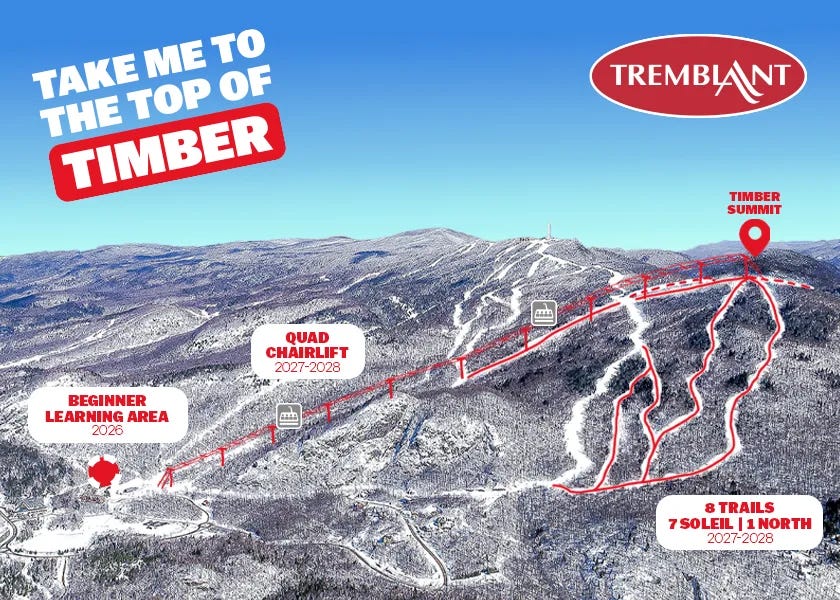
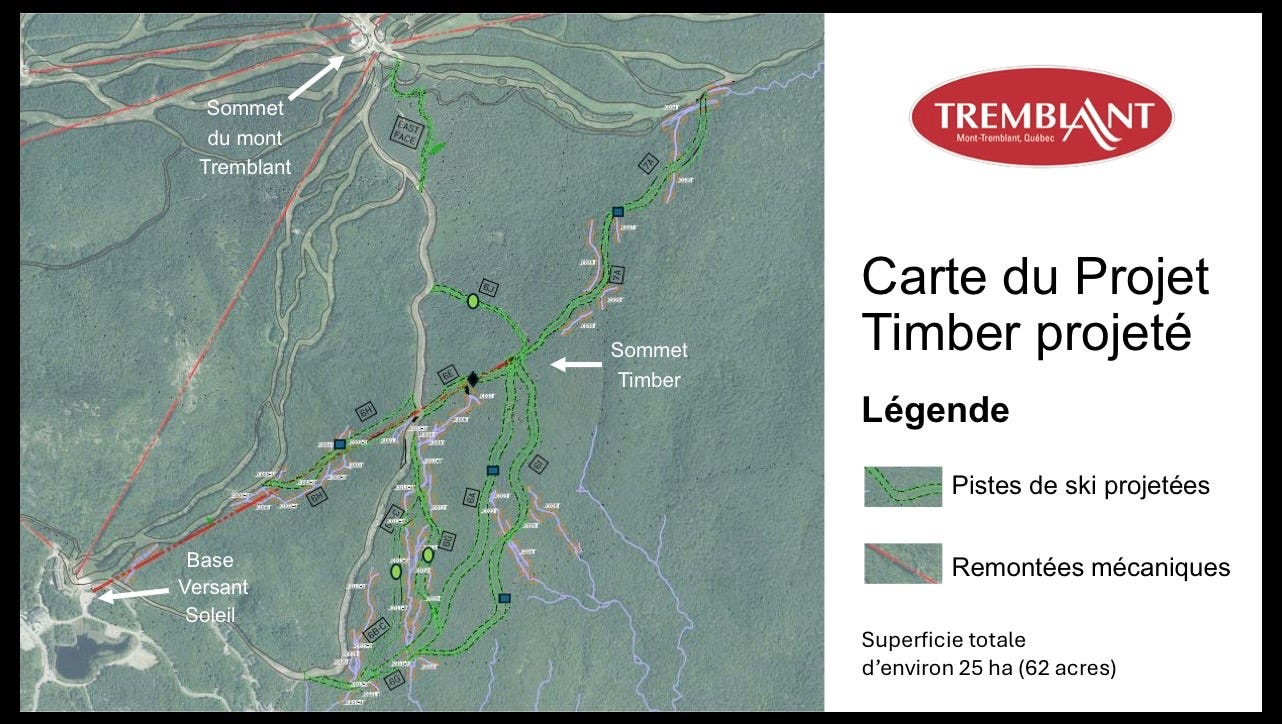
Stuart Winchester: some of these things on YouTube or Substack if you’re watching the podcast. So this is Tremblant’s timber expansion that they’re gonna open for 27 to 28. They’re gonna have a new.
00:03:31.000 --> 00:03:46.000
Stuart Winchester: quad, high-speed quad, coming up to the Timber Summit with 8 new trails over here. Uh, and that’s gonna be… let’s see, they gave an acreage on that, 62 acres. So sometimes it’s hard when you see these things, especially if you don’t know the mountain.
00:03:46.000 --> 00:03:57.000
Stuart Winchester: to really know where it fits in. So this one, here’s from the top, you can see the new trails, the timber trails, coming down here off of the new.
00:03:57.000 --> 00:04:09.000
Stuart Winchester: high-speed quad that’ll come out of the Versant-Soleil base. And then here is the existing, if you’re watching, here’s the existing lift that comes up to the current Tremblant Summit.
00:04:09.000 --> 00:04:19.000
Stuart Winchester: And you can see that right here. So the new expansion will go bloop right up here, and we’ll have some new trails over there. And then Altera also announced.
00:04:19.000 --> 00:04:32.000
Stuart Winchester: or not really announced, but reconfirmed, that will be when the Club Med is open, so that all-inclusive experience will be there for Tremblant. So, nice expansion coming for Tremblant. Obviously.
00:04:32.000 --> 00:04:42.000
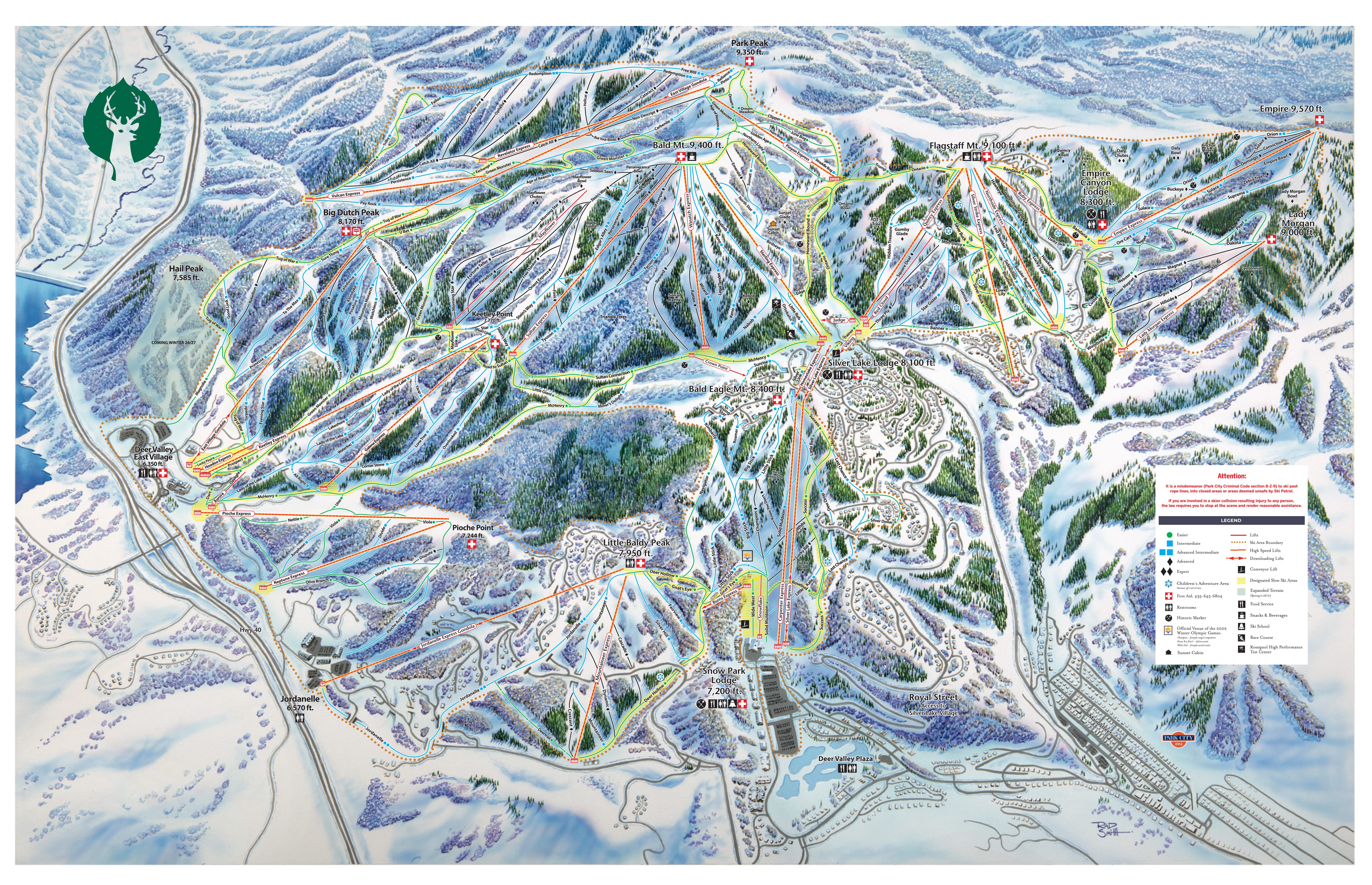
Stuart Winchester: Altera has had a big expansion ongoing at Deer Valley for years and years. So, Deer Valley, prior to 2023.
00:04:42.000 --> 00:04:46.000
Stuart Winchester: was really just Bald Mountain.
00:04:46.000 --> 00:05:02.000
Stuart Winchester: On over to Empire. Uh, and then here’s the front side, and then this little baldy peak was here. But over the past three seasons, they’ve really blown the place out and added thousands and thousands of acres. Uh, Deer Valley, believe it or not, is now the…
00:05:02.000 --> 00:05:18.000
Stuart Winchester: Sixth largest ski area in America. And, and they’re opening 200 more acres this year. Hale Peak will be another high speed quad. I don’t have a vertical on Hale Peak, but they did confirm today that Hale Peak will be.
00:05:18.000 --> 00:05:29.000
Stuart Winchester: 200 acres, so Deer Valley will now total 4,500 acres. It looks, it sounds pretty big, but right next door to it is Park City, which.
00:05:29.000 --> 00:05:45.000
Stuart Winchester: Combined with the historic canyons is 7,300 acres. That’s the largest ski area in the United States. So those are a couple of the expansions that we have coming up. We’ll talk about another one in a little bit with Loon. And the reason I wanna talk about expansions with you.
00:05:45.000 --> 00:05:47.000
Stuart Winchester: Is… is I… I…
00:05:48.000 --> 00:05:58.000
Stuart Winchester: I write about this over and over again, but sometimes when I write an article, it fritters off into the wilderness, and I’m not able to…
00:05:58.000 --> 00:06:12.000
Stuart Winchester: it doesn’t have the staying power necessarily where people might find it sometime later. So I want to revisit some of these points that I made in the past about expansions and how important they are. So I wrote this article a few years ago.
00:06:12.000 --> 00:06:14.000
Stuart Winchester: And…
00:06:16.000 --> 00:06:18.000
Stuart Winchester: I was looking at…
00:06:18.000 --> 00:06:34.000
Stuart Winchester: So everyone always gets hung up on this active ski ski areas number. And the NSA has tracked this for years and years. And here’s the numbers you can see on the screen if you’re watching in 1991 to 92 season.
00:06:34.000 --> 00:06:46.000
Stuart Winchester: The United States had 546 active ski areas. As of 2023 to 24, it had 486. The number for this season was right around 490.
00:06:46.000 --> 00:06:49.000
Stuart Winchester: So, oftentimes.
00:06:49.000 --> 00:07:04.000
Stuart Winchester: We will see articles usually written by folks who are not ski media, just general media, and they’ll write about this number and they’ll find this statistic and they’ll point to the declining number of ski areas and say, skiing is dying. Climate change is killing skiing.
00:07:05.000 --> 00:07:17.000
Stuart Winchester: But there’s actually a much more nuanced story behind that. So I pulled this number last year when I was reading an article from The Motley Fool, which is an investor site that I use. I love The Motley Fool.
00:07:18.000 --> 00:07:24.000
Stuart Winchester: But it was talking about MTN stock, which a lot of you know is the stock ticker for Vail Resorts.
00:07:24.000 --> 00:07:33.000
Stuart Winchester: And the Motley Fool article pointed out that in 1992, and this was their bear case, their case against buying MTN stock.
00:07:33.000 --> 00:07:44.000
Stuart Winchester: During… I’m gonna quote here, the Motley Fool. During the 1992 ski season, there were 546 ski areas operating in the United States, compared to 486 today. This article’s from 2025.
00:07:44.000 --> 00:07:57.000
Stuart Winchester: Supply, says the fool, is flat to shrinking. On the demand side, 3 of the top 5 busiest ski seasons on record occurred each of the last 3 years. Demand is up. So, they were trying to make the point that.
00:07:58.000 --> 00:08:07.000
Stuart Winchester: Vail Resorts had a very valuable commodity, because the number of ski areas was shrinking. I said, wait a second, this doesn’t really make sense, because…
00:08:08.000 --> 00:08:11.000
Stuart Winchester: How are you having so many fewer?
00:08:11.000 --> 00:08:25.000
Stuart Winchester: ski areas, and so many more skier visits? Well, the answer is pretty simple. We have a lot more ski terrain. In fact, I did an analysis in response to that Fool article.
00:08:25.000 --> 00:08:27.000
Stuart Winchester: And I found, just examining…
00:08:27.000 --> 00:08:30.000
Stuart Winchester: The 11 western ski states.
00:08:30.000 --> 00:08:40.000
Stuart Winchester: that, minus Alaska, that those 11 states had 54,598 more acres of terrain.
00:08:40.000 --> 00:08:50.000
Stuart Winchester: available at their ski areas, their lift service ski areas, than they had in 1994. So, yes, there are fewer ski areas.
00:08:50.000 --> 00:09:00.000
Stuart Winchester: now than there were in the early 90s. There were 546 in 92, 486 today, but there’s a lot more terrain, and so what ended up happening was.
00:09:00.000 --> 00:09:08.000
Stuart Winchester: The ski areas that were successful expanded. It was as simple as that. And when I did this analysis.
00:09:08.000 --> 00:09:10.000
Stuart Winchester: I looked at…
00:09:11.000 --> 00:09:24.000
Stuart Winchester: I looked at 92 ski areas that I had the data for from 1992, and they happen to be some of the biggest ski areas in the West. And I compared their acreage in 1994 according to a guidebook I had from that date that I’d kept.
00:09:24.000 --> 00:09:30.000
Stuart Winchester: 107,671 acres was the total for these ski areas.
00:09:30.000 --> 00:09:45.000
Stuart Winchester: Fast forward to 2025, when I did this analysis, those same 92 ski areas had grown from 107,671 acres to 159,754 acres.
00:09:45.000 --> 00:09:55.000
Stuart Winchester: Then I added in a few ski areas that had opened since then, places like Tamarack in Idaho, Blacktail in Montana. There hasn’t been a lot, but there’s been a few.
00:09:55.000 --> 00:10:11.000
Stuart Winchester: And then I subtracted the lost ski areas. The biggest of them was Ski Rio in New Mexico. But for the most part, the ski areas that closed were small surface tow operations and they were in the region of a much larger area and most likely failed in large part.
00:10:11.000 --> 00:10:29.000
Stuart Winchester: Because they couldn’t compete with that full service area, which could offer folks not only beginner terrain, but a progression up to more interesting terrain. So, there’s a lot more ski terrain than there used to be, and to give you an idea of how much terrain 54,598 acres is.
00:10:29.000 --> 00:10:36.000
Stuart Winchester: Currently in Colorado, the whole state of Colorado, which has a quarter of the ski terrain in the entire United States.
00:10:36.000 --> 00:10:42.000
Stuart Winchester: there’s 45,552 acres of terrain. So we’ve added the equivalent of another Colorado.
00:10:42.000 --> 00:10:45.000
Stuart Winchester: Now, there’s a caveat to that.
00:10:45.000 --> 00:10:48.000
Stuart Winchester: The ski industry has been able to grow by expansion.
00:10:48.000 --> 00:10:58.000
Stuart Winchester: But it hasn’t necessarily been able to grow where it needs to grow, and I made another point, a related point, in another recent article that I wrote.
00:10:58.000 --> 00:11:11.000
Stuart Winchester: for… about the U.S. Forest Service, and how most of the ski areas in the western United States are built on U.S. Forest Service land. They’re leased from the U.S. Forest Service under 40-year terms.
00:11:11.000 --> 00:11:18.000
Stuart Winchester: However, following the National Environmental Policy Act of 1969, those permits.
00:11:18.000 --> 00:11:33.000
Stuart Winchester: got almost impossible to obtain new permits. The Forest Service had lots and lots of ski areas proposed, but they were all shut down. Everyone except for Beaver Creek and then Blacktail in 1998 were shut down with.
00:11:33.000 --> 00:11:51.000
Stuart Winchester: court challenges that came out of NEPA in 1969. So, while we have more terrain, skiable terrain, than we had in 1994, the reason it often feels as though the mountains are overcrowded and insufficiently distributed.
00:11:51.000 --> 00:11:57.000
Stuart Winchester: is because they are. Because we’ve only been able to expand the ski areas where they were.
00:11:57.000 --> 00:12:10.000
Stuart Winchester: rather than building new ski areas where people move to. Look at snowy regions like Washington and Oregon, some of the snowiest ski areas in the country. A lot of them still don’t have snowmaking because they get so much snow there.
00:12:10.000 --> 00:12:22.000
Stuart Winchester: Washington in 1980 had 4.1 million people. Today it has 8.2 million people, double the population, but fewer ski areas and some larger.
00:12:22.000 --> 00:12:37.000
Stuart Winchester: Stevens Pass has certainly grown, Crystal has grown, Mission Ridge has grown. Oregon, same thing, went from 2.6 million people in 1980 to 4.3 million today, but has fewer ski areas now than it did in the 1980s. So…
00:12:37.000 --> 00:12:48.000
Stuart Winchester: For better or worse, we are stuck right now with growth through expansion. So, I want to get to an expansion. First, I want to tell you about one of my awesome partners.
00:12:48.000 --> 00:13:00.000
Stuart Winchester: I’ve been working with Bonfire Collective for a long time, and if you run a ski area or an outdoor brand, you should consider hooking up with them as well.
00:13:00.000 --> 00:13:10.000
Stuart Winchester: Bonfire Collective is a fractional marketing team that collaborates with ski areas and outdoor brands to give your marketing a fresh perspective and better storytelling.
00:13:10.000 --> 00:13:16.000
Stuart Winchester: Bonfire can help you rethink your approach in ways that can turbocharge your business.
00:13:16.000 --> 00:13:31.000
Stuart Winchester: Bonfire Collective, for example, took on the marketing at one New Hampshire sea area and doubled revenue in just three years. And when the storm was ready to invest in its first ever digital marketing campaign last year, I worked with Bonfire to make it happen.
00:13:31.000 --> 00:13:36.000
Stuart Winchester: I could not be happier with the results. I think you will love working with them too.
00:13:36.000 --> 00:13:40.000
Stuart Winchester: To get started, you will want to talk to Eric over at Bonfire Collective.
00:13:40.000 --> 00:13:56.000
Stuart Winchester: Eric was a co-founder of Bluebird Backcountry Colorado, the first human powered ski area. He knows the ski business, as many of you know from that episode of the Storm Skiing Podcast that he appeared on last year. Visit bonfirecollective.com or I will be happy.
00:13:56.000 --> 00:14:03.000
Stuart Winchester: to make that connection for you. Alright, with that, let’s go to our guest for today.
00:14:05.000 --> 00:14:08.000
Stuart Winchester: And…
00:14:09.000 --> 00:14:15.000
Stuart Winchester: Here he is, Mr. Brian Norton. Brian, what an awesome background! Where are you at?
00:14:15.000 --> 00:14:19.000
brian norton: Uh, I’m in my office, but that’s hanging outside my office, so…
00:14:18.000 --> 00:14:24.000
Stuart Winchester: Oh, okay, cool, I thought maybe you were in the, uh, the kink barn with the, uh…
00:14:24.000 --> 00:14:27.000
Stuart Winchester: With that, with the cool groomer behind you.
00:14:28.000 --> 00:14:44.000
Stuart Winchester: All right, well, let me give you a proper introduction here. Uh, my guest today is president and general manager of Loon Mountain, New Hampshire since 2022. Loon claims New Hampshire’s tallest vertical drop at 2,190 feet.
00:14:44.000 --> 00:14:58.000
Stuart Winchester: served by 13 lifts. Last week, Loon announced the 272-acre Black Ridge expansion that, when added to the resort’s existing 403-acre footprint.
00:14:58.000 --> 00:15:08.000
Stuart Winchester: will make Lune the largest ski area in New Hampshire, and the sixth largest ski area in the eastern United States at 675 acres.
00:15:08.000 --> 00:15:23.000
Stuart Winchester: He began his Loon career in 2001 as a Lyft attendant, and now he’s running the place. He is Brian Norton. Brian, welcome back to the storm. Always good to see what’s new at Loon, because there is always something new at Loon. How you doing today, Brian?
00:15:23.000 --> 00:15:29.000
brian norton: I’m doing awesome. It’s sweatshirt weather right now, so we’re getting closer.
00:15:29.000 --> 00:15:33.000
Stuart Winchester: Nice. Did you do a snowmaking test yet, or is that Sunday River’s ter.
00:15:32.000 --> 00:15:38.000
brian norton: No, we have not done that yet. Sunday will probably beat us to that one.
00:15:37.000 --> 00:15:54.000
Stuart Winchester: All right, let’s talk about Black Ridge. This is really an amazing project, and I’ve been pretty vocal and frank over the years about what I saw as Loon’s biggest shortcoming, which was not enough real expert terrain, and by that I really meant glades, wild terrain.
00:15:54.000 --> 00:15:58.000
Stuart Winchester: Talk to us about Black Ridge, what it is, and how it’s going to change Loon.
00:15:59.000 --> 00:16:14.000
brian norton: Yeah, I mean, it’s a pivotal project for the ski resort. As you mentioned, it’s almost doubling the size of the ski resort. For those not familiar with it, it’s this kind of secret shoulder glade skiing. It’s been there.
00:16:14.000 --> 00:16:30.000
brian norton: It was developed over time by some locals just kind of going out there, you know, maybe not necessarily following the rules, certainly not at our approval, but people have been skiing there. I mean, I think the first time I went skiing over there, I was in college, like 2001, and it was like you had to kind of find your way over there. You had to commit to it.
00:16:27.000 --> 00:16:28.000
Stuart Winchester: Okay.
00:16:31.000 --> 00:16:42.000
brian norton: beautiful, um, beautiful area. It’s like a big catcher’s mitt off the side of the ski resort that just holds snow really well, and there’s a lot of, um, it’s a mile and a quarter.
00:16:42.000 --> 00:16:51.000
brian norton: hike, uh, across a ridgeline. You can actually ski or skate most of it. There’s a few sections where you have to, you know, unclick and walk and…
00:16:51.000 --> 00:17:09.000
brian norton: um, you just get this incredible glade scheme that brings you right back to the bottom of North Peak, so it’s like this full circle, you’re way the heck out there, there’s a couple viewpoints where you can stand at this cliff and just look back at the ski resort and look into the town of Lincoln, you’re like, whoa, I am way out there, but a completely different view than, you know, most people would.
00:17:09.000 --> 00:17:23.000
brian norton: would ever get to see from Loon. And so, yeah, we’ve been working on it for a couple years with the Forest Service, trying to, like, wrap that into our special use permit. And, um, yeah, super happy to have that announcement, kind of. Like I said, planning.
00:17:23.000 --> 00:17:28.000
brian norton: For a long time, but awesome to have that hit the newsstands the other day.
00:17:27.000 --> 00:17:34.000
Stuart Winchester: So help us understand Loon’s Forest Service footprint. This is a conversation I’m accustomed to having with.
00:17:34.000 --> 00:17:53.000
Stuart Winchester: your partners who run western ski areas. There’s very few, just 7 in New England, that touch Forest Service land. My understanding is that Loon is not entirely on Forest Service land. I believe it’s Kissing Cousins Lift. You’re riding up, and you see a sign, welcome to the White Mountains National Forest. So, where are those boundaries at?
00:17:53.000 --> 00:17:55.000
Stuart Winchester: at Loon.
00:17:54.000 --> 00:18:05.000
brian norton: Yeah, it’s really just the bottom. I mean, like, pretty much if you can hit a golf ball there, you’re on private land from a base area, hit it up, and then everything above there is forest service land, so…
00:17:59.000 --> 00:18:00.000
Stuart Winchester: Okay.
00:18:01.000 --> 00:18:02.000
Stuart Winchester: Yeah.
00:18:04.000 --> 00:18:05.000
Stuart Winchester: Okay.
00:18:05.000 --> 00:18:09.000
brian norton: Yeah, it’s the top 95% of the skewers work.
00:18:05.000 --> 00:18:07.000
Stuart Winchester: So how?
00:18:08.000 --> 00:18:16.000
Stuart Winchester: Right, so Loon went through quite a process as I remember it back in the 90s to open up South Peak and there was…
00:18:16.000 --> 00:18:22.000
Stuart Winchester: a lot of resistance to that locally, and ultimately, you got it opened.
00:18:23.000 --> 00:18:25.000
Stuart Winchester: was…
00:18:25.000 --> 00:18:30.000
Stuart Winchester: if you look at Black Ridge, it’s… there’s no new lift, right? It’s essentially…
00:18:30.000 --> 00:18:35.000
Stuart Winchester: Glade thinning. So, so I want to talk about the process for that in a minute, but.
00:18:36.000 --> 00:18:45.000
Stuart Winchester: What was the process like of working with the Forest Service? Did they seem much more amenable and does the local community seem much more amenable?
00:18:45.000 --> 00:18:54.000
Stuart Winchester: to this given the small actual environmental impact? And was that a consideration in deciding how to develop this terrain?
00:18:54.000 --> 00:19:10.000
brian norton: I mean, it was definitely a consideration for us as we think about, you know, growing the ski resort sustainably. I think the, you know, and our partnership with the Forest Service is a really great one. I hear, you know, different stories from around the industry or around the country.
00:19:10.000 --> 00:19:26.000
brian norton: I just can’t speak highly enough of our team here and the relationship that we have with them. And, the fact that this was kind of already skiing, the fact that it was super low impact, we weren’t ever going to put a lift or a lodge or some sort of, you know, driving snow cats over there. We’re not even doing any of that.
00:19:26.000 --> 00:19:31.000
brian norton: really, so it was a small lift, I think, to bring this kind of.
00:19:31.000 --> 00:19:43.000
brian norton: thing that people were skiing into the permit boundary, which really, you know, there’s some work to clean it up and to create slightly better access, mostly for our patrol team to react out there.
00:19:43.000 --> 00:19:44.000
Stuart Winchester: Mm-hmm.
00:19:43.000 --> 00:19:46.000
brian norton: But this is, um…
00:19:46.000 --> 00:19:48.000
brian norton: It’s a small lift to bring our…
00:19:48.000 --> 00:19:52.000
brian norton: Services, so that we can go, you know, in the past.
00:19:52.000 --> 00:19:56.000
brian norton: Someone would get hurt, someone would get lost ‘cause they thought they knew where they were going.
00:19:56.000 --> 00:19:57.000
Stuart Winchester: Yep.
00:19:56.000 --> 00:20:14.000
brian norton: technically, we’re supposed to call fish and game, and they’re supposed to go rescue them. A lot of times, we helped with that. So, by bringing this into the permit boundary, we’re allowed to help manage it. So, um, this is really a win-win for everyone. It’s a win-win for the skiers, it’s a win-win for the Forest Service, because now we can actually manage something that wasn’.
00:20:01.000 --> 00:20:02.000
Stuart Winchester: Okay.
00:20:14.000 --> 00:20:16.000
brian norton: That’s a great opportunity for us.
00:20:16.000 --> 00:20:28.000
Stuart Winchester: Yeah, it’s going to be tremendous terrain. You know, another big difference between working in the East and the West is sometimes if you want to open 500 acres of glades in the West, you just drop a rope.
00:20:28.000 --> 00:20:39.000
Stuart Winchester: Uh, in the east, there tends to be a lot of undergrowth. Now, I don’t know if that’s the case at Loon, because maybe you have some old growth there, where the canopy is, is, has, you know, shut out some of that little stuff.
00:20:39.000 --> 00:20:45.000
Stuart Winchester: 200 and what is it, 267 acres? That’s a lot of acres to clear.
00:20:45.000 --> 00:20:55.000
Stuart Winchester: What does it look like in there, and what is the… what is the labor lift gonna be like to glade that out and make it so that you don’t need 4 feet of snow to ski it?
00:20:56.000 --> 00:21:08.000
brian norton: Um, we’ll talk about snow in a minute, but in terms of glading, you get across the ridgeline, and you get to this… it’s not the high point, like, the actual peak of the mountain, but the high point of the ridgeline.
00:21:08.000 --> 00:21:23.000
brian norton: And you kind of drop in there, and then it just funnels out both directions. And from that point, it’s all hardwoods. And it’s just… it’s really open. You can kind of ski wherever you want. Now, we’re gonna manage it slightly better, so there’s better waypoint finding, you know, kind of…
00:21:23.000 --> 00:21:42.000
brian norton: more organized corridors. There’s a river, uh, a stream valley that is between what I would call, you know, Black Ridge proper and, like, the North Peak Glades and Walking Boss, um, that you don’t want to end up in, so that’s kind of the part of the land that, you know, we’re going to try to manage away from, and.
00:21:42.000 --> 00:21:43.000
Stuart Winchester: Mmhm.
00:21:42.000 --> 00:21:53.000
brian norton: kind of cut that, you know, the extent of it, kind of clear those glades a little more, so that it’s obvious, like, no, no, no, I want to go this way, or I want to go that way, so you all come back out to the… to.
00:21:48.000 --> 00:21:50.000
Stuart Winchester: Mmhm.
00:21:53.000 --> 00:21:57.000
brian norton: But it’s not a heavy lift to cut a lot out there.
00:21:53.000 --> 00:21:54.000
Stuart Winchester: So I.
00:21:57.000 --> 00:22:13.000
Stuart Winchester: So as far as snow goes, you mentioned a, a little catcher’s mitt and along North Peak, and there are some terrific glades in lower New England. Stratton, I think has really, really excellent glades. Magic Mountain has some excellent glades. They’re in a little bit different.
00:22:13.000 --> 00:22:33.000
Stuart Winchester: snow pocket, obviously, than you are, but also farther south. So, so talk to us, you know, Loon averages 160 inches of snow per year, but I don’t know where you measure that, and I know that snow stays on different parts of the mountain in different ways, right? Because you can ski in New Hampshire in June on natural snow at Mount Washington and Tucks.
00:22:33.000 --> 00:22:34.000
Stuart Winchester: But…
00:22:34.000 --> 00:22:39.000
Stuart Winchester: That’s not the case in most places. So, so talk to us about.
00:22:39.000 --> 00:22:48.000
Stuart Winchester: the snow in that area, and how often you think you’ll realistically be able to offer that glade skiing experience in Black Ridge.
00:22:48.000 --> 00:23:06.000
brian norton: Yeah, I mean, I think it’s gonna be… it’s definitely a different experience, so we’re gonna have different, um, opening protocols when that part of the mountain will open versus your traditional glade skiing, so it’s gonna be a little more raw, a little more rugged, we’re gonna be a little more free with opening it. Um, we’re working through those kind of details with our patrol team right now.
00:23:07.000 --> 00:23:23.000
brian norton: Um, in terms of holding snow, predominant northeast wind here, everything cuts across the ski resort as you’re looking at it, right to left, and guess what’s far left? This, right? So, um, I’ll tell you a funny story. We were walking over there with the Forest Service this.
00:23:23.000 --> 00:23:25.000
brian norton: Spring, and we’re walking along the ridgeline.
00:23:25.000 --> 00:23:38.000
brian norton: And we’re contemplating, like, how we get snowmobile access out there for our patrol team to, you know, manage this terrain in a reasonable amount of time to, like, respond to an incident. And we get to these two big boulders.
00:23:38.000 --> 00:23:47.000
brian norton: like, oh man, how are we gonna get a snowmobile through here? Like, it’s… we can’t get a machine all the way out here to move these boulders, what are we gonna do? And then it, like.
00:23:47.000 --> 00:24:06.000
brian norton: I don’t remember seeing these boulders in the winter. That means there’s 4 feet of snow here on this ridgeline, so it’s like… it just… it’s not the same as the rest of the ski resort when you think about, like, how that pocket holds snow and takes all the wind-deposited snow from the whole area and just stacks up in there, so it was a bit… it was eye-opening for us to be like.
00:23:51.000 --> 00:23:54.000
Stuart Winchester: Wow.
00:23:57.000 --> 00:23:59.000
Stuart Winchester: Right.
00:24:06.000 --> 00:24:11.000
brian norton: Wait a minute, we don’t see these in the winter, and they’re 4-foot boulders, so.
00:24:11.000 --> 00:24:28.000
Stuart Winchester: Oh, man, you’re really making me want to get back in there. You know, I did not mention in the intro that Loon is owned by Boyne Resorts, one of the 11 ski areas in the Boyne family. And Boyne has done just a tremendous amount of work over the past decade, putting in new lifts and doing expansions.
00:24:28.000 --> 00:24:30.000
Stuart Winchester: In fact, I think…
00:24:30.000 --> 00:24:42.000
Stuart Winchester: the last 5 expansions in New England were all Boyne Mountains. It was Brackett Basin, Burnt Mountain, it was, uh, Merrill Hill at Sunday River, it was the little one you did at Loon the other… the other, uh, couple years ago, and… and.
00:24:42.000 --> 00:24:54.000
Stuart Winchester: Black Ridge, you know, the one that this most echoes for Sugarloaf fans, and Sugarloaf is far, far, far, far north, but it’s worth going to, is… is they opened that several hundred acre.
00:24:54.000 --> 00:25:04.000
Stuart Winchester: terrain expansion of Brackett Basin back in 2011. They expanded it with Burnt Ridge a few years later, and it’s all natural bladed. How much…
00:25:04.000 --> 00:25:06.000
Stuart Winchester: Did you…
00:25:06.000 --> 00:25:21.000
Stuart Winchester: did Loon and the team at Loon use Bracket Basin as an inspiration, either… either to see as, like, a proof of concept this’ll work, or… or just to imagine a… a different way of, uh… of expanding the resort without necessarily having to spend.
00:25:21.000 --> 00:25:28.000
Stuart Winchester: you know, $20 million on a new lift. Just talk about it, if there’s any relationship there, or, you know, learning how to manage it, etc.
00:25:29.000 --> 00:25:51.000
brian norton: A lot for me personally, and for the team here. I mean, I’m not the the people that have been out there developing that glade skiing probably aren’t necessarily thinking about bracket basin, but 100%. That was the equivalent. That was, you know, I’ve referred to it through this whole planning process as our version of bracket basin. We’ve been in communication with the team up there about how they manage it, what their entrance looks like all of those things. So.
00:25:30.000 --> 00:25:31.000
Stuart Winchester: Yeah.
00:25:51.000 --> 00:25:54.000
brian norton: Yeah, it’s our version of that, 100%.
00:25:54.000 --> 00:26:12.000
Stuart Winchester: And just from a liability point of view, it’s funny, because I grew up in Michigan, and I’ve been skiing the Boyne Mountains there since the 90s, and I remember you weren’t allowed in the trees, and that was a big no-no. So now here you have, fast forward 30 years, and they’re developing these enormous glade skiing pockets, and obviously Jay Peak was a leader.
00:26:12.000 --> 00:26:17.000
Stuart Winchester: our early leader in that, in New England. But what has Boyne learned, do you think.
00:26:17.000 --> 00:26:25.000
Stuart Winchester: by operating Brackett Basin for the last 15 years, about liability and skiers’ abilities to self-manage in terrain like that.
00:26:25.000 --> 00:26:36.000
brian norton: Yeah, I mean, Sugarloaf, they’re Sugarloafers, right? So they’re a slightly different clientele than we have here, so I’m sure we’ll learn different things. I think the big thing is, you know.
00:26:28.000 --> 00:26:30.000
Stuart Winchester: Yeah.
00:26:36.000 --> 00:26:50.000
brian norton: clear messaging, and… and with this project, it’s… it’s very different. I said it earlier, it’s different than the rest of the Glades here, so, um, you gotta know what you’re doing, and it’s gonna be messaged that way, but it’s gonna be managed that way, too, and…
00:26:50.000 --> 00:27:06.000
brian norton: it’s gonna pull people around the resort and move people around to places that, you know, it’s a bit of a destination now. Camp 3 in North Peak was already a destination, and now you’ve got another, you know, 300 acres or so just past there that’s serviced by the same portal, so…
00:27:06.000 --> 00:27:15.000
brian norton: yeah, I think our patrol team’s gonna have a little bit of work cut out for them, but frankly, the guys and girls that work for our team that are gonna end up over there, like.
00:27:15.000 --> 00:27:18.000
brian norton: They… they’re looking forward to that, so…
00:27:18.000 --> 00:27:22.000
Stuart Winchester: Alright, well, let’s talk about access a little bit. I’ll tell you…
00:27:22.000 --> 00:27:39.000
Stuart Winchester: That, or the listeners at least, people who haven’t been there. So you access this expansion through the North Peak lift. It’s a high speed quad built in 2004, 1500 vertical foot, 4,800 foot long. But the view off the top is an absolute showstopper. It’s one of the best.
00:27:39.000 --> 00:27:49.000
Stuart Winchester: in New England. I just love it. Uh, my question for you, Brian, is Flight Path 2030, your… your Loon 2030 plan, essentially 10-year plan, published around 2020.
00:27:49.000 --> 00:27:55.000
Stuart Winchester: did consider an upgrade for the North Peak lift. Now, it’s obviously not a very old lift.
00:27:55.000 --> 00:28:10.000
Stuart Winchester: But I would imagine that there may be some volume considerations as you look to expand the terrain available off this lift. So, A, am I right in seeing that you will be able to fully lap Black Ridge?
00:28:10.000 --> 00:28:17.000
Stuart Winchester: on the North Peak lift? And B, do you have thoughts on what might be next for North Peak lift?
00:28:17.000 --> 00:28:26.000
brian norton: Um, yes, you access it from the top of that lift. The entrance is 150 feet from the top of that lift, maybe, off of Whatcom House.
00:28:24.000 --> 00:28:26.000
Stuart Winchester: Yeah, thank you.
00:28:26.000 --> 00:28:45.000
brian norton: the primary exit is slightly lower in elevation than North Peak. You come out onto Brookway Extension there, so if you really wanted to lap it, you’d probably unclick and go down there. More often than not, I think what people will do is they’ll ski down Brookway, go up Seven Brothers and a gondola, and get back over there if they want to do it again.
00:28:30.000 --> 00:28:32.000
Stuart Winchester: Okay.
00:28:46.000 --> 00:29:06.000
brian norton: So, yeah, I mean, access is pretty strong. In terms of replacing North Peak, yes, that lift is on our planning process. It’s probably equivalent to South Peak on any given day, or Lincoln Express, I should say. On any given day, I flip-flop which one’s more important. You know, we did the Timbertown expansion, and we thought, oh, these people are over here.
00:29:02.000 --> 00:29:03.000
Stuart Winchester: Okay.
00:29:06.000 --> 00:29:22.000
brian norton: maybe we should be focused on this lift, and now we’re doing this thing over here, or maybe we should be focused on North Peak, and, um, I’ll tell you that the RFID data that we, you know, 3, 4 years ago, we put RFID gates at North Peak, remote up mountain, you can’t get to it without passing another gate, and everyone was kind of looking at us, like.
00:29:17.000 --> 00:29:19.000
Stuart Winchester: Mmhm.
00:29:22.000 --> 00:29:29.000
brian norton: What are you doing that for? Data collection, 100%. The things we’ve learned about how people use that terrain have…
00:29:25.000 --> 00:29:26.000
Stuart Winchester: Right.
00:29:29.000 --> 00:29:40.000
brian norton: driven our snowmaking philosophy, our investment philosophy. Uh, it’s… it’s last winter that Lyft opened on day one and closed on day 151, I think it was, so it was open every day of the season, so…
00:29:40.000 --> 00:29:45.000
brian norton: Maybe today, if you’re asking me, that one gets done before Lincoln Express.
00:29:44.000 --> 00:29:48.000
Stuart Winchester: And are you thinking a six-pack? One of those nice D-lines?
00:29:47.000 --> 00:29:51.000
brian norton: Yeah, I’m sure that’s what it would be at a minimum, yeah.
00:29:49.000 --> 00:29:51.000
Stuart Winchester: Okay.
00:29:51.000 --> 00:29:56.000
Stuart Winchester: Okay, do you like the bubbles, like the one you have at CANC and up at Sunday River?
00:29:55.000 --> 00:30:17.000
brian norton: The bubbles are awesome for all the reasons they’re awesome, but there are some hidden challenges with them as well, particularly when they come into the terminal. They’re aerodynamic when the chairs are on the line, but when they come into the terminal, if the wind’s blowing the wrong way and the bubbles opening and the wind wants to shut it or vice versa.
00:29:58.000 --> 00:29:59.000
Stuart Winchester: Yeah.
00:30:17.000 --> 00:30:26.000
brian norton: Uh, there’s a little give and take there. I… we’d probably end up with bubbles, I think, but, um, yeah, there are… it’s not all… it’s not all easy with them.
00:30:22.000 --> 00:30:24.000
Stuart Winchester: That’s that.
00:30:25.000 --> 00:30:34.000
Stuart Winchester: It’s Boyne style, right? I was surprised, actually, when I got out to Brighton, and the, uh… their new Sixer, their D-Line out there does not have bubbles. I was like, oh, this.
00:30:27.000 --> 00:30:28.000
brian norton: Yep.
00:30:33.000 --> 00:30:42.000
brian norton: Or footrests, or footrests, which is the only one that I think doesn’t have footrests, and as a snowboarder, I appreciated that when I rode that.
00:30:34.000 --> 00:30:36.000
Stuart Winchester: Yeah.
00:30:40.000 --> 00:30:52.000
Stuart Winchester: Right, right, right. Yeah, well, the Utah guys don’t want to bring the bar down anyway so So, you know, I always think of this expansions like this first, Brian, as a skier.
00:30:52.000 --> 00:31:10.000
Stuart Winchester: Unless as a customer or as someone, you know, doing a business, I’m really curious. Loon has already historically been the busiest skier in New Hampshire and the pub, the skier visits aren’t public anymore. But I would imagine that’s still the case. It is busy, busy, busy all the time. It is the idea here.
00:31:10.000 --> 00:31:18.000
Stuart Winchester: Is it to bring in more skiers, or is it to create more variety at a mountain that…
00:31:18.000 --> 00:31:28.000
Stuart Winchester: I really think has traditionally had the reputation as a good intermediates family mountain. To maybe start to nudge that a little bit more toward a…
00:31:28.000 --> 00:31:40.000
Stuart Winchester: uh, more of a Killington profile, where there’s… where there’s more than one kind of skier? Like, the whole family can have fun there. So is it… is it more skiers, or more terrain for the same amount of skiers to spread them out better?
00:31:41.000 --> 00:31:46.000
brian norton: Um, both, and I’ll clarify more skiers, because, um.
00:31:47.000 --> 00:31:58.000
brian norton: as the ski resort develops, and as the town develops, we inch closer to destination ski resort instead of day ski resort. I think we’re still a day ski resort, but we’re working our way towards destination.
00:31:54.000 --> 00:31:55.000
Stuart Winchester: Mmhm.
00:31:58.000 --> 00:32:18.000
brian norton: Um, and as you become a destination, your skier visits spread equally over the 7-day week, right? We’re heavily skewed to weekends right now. We’re not talking about more skiers on the weekends. We’re already managing tickets and limiting sales to keep guest experience where we want it. I think we can have more visits mid-week, or early season, late season.
00:32:18.000 --> 00:32:33.000
brian norton: this will certainly help with that, but on your peak Saturday in January, like, no, we don’t… we’re… we’re not having more skiers here. We’re… we’re happy with where we’re at. Um, in terms of terrain, yeah, I mean, you and I talked about it, I think, the last time we were together talking about glade skiing here.
00:32:33.000 --> 00:32:40.000
brian norton: We need more of it. Variety of terrain, um, is important, and this is a huge step in the right direction.
00:32:39.000 --> 00:32:48.000
Stuart Winchester: So I think in New England, when you talk about more skiers, more capacity, reflectively, we think parking, but you have this interesting project going on.
00:32:48.000 --> 00:33:05.000
Stuart Winchester: Where a pulse gondola is set to leave from near the new Timbertown quad that you put in 2023, go over the river, uh, and land, not exactly in the town of Lincoln, but to service some resorts there. Uh, I thought that project was gonna open.
00:33:05.000 --> 00:33:15.000
Stuart Winchester: This winter, it doesn’t look like that’s gonna happen. Tell us about that Pulse Gondola, Brian, what you hope to achieve with it, and kind of where you’re at with approvals and permits.
00:33:16.000 --> 00:33:33.000
brian norton: Um, yeah, me too. I was hoping it was gonna open this winter, too. Um, yeah, we’ve said with that project all along that we’re not really in a rush, and we want to do it right. More importantly, we want to get buy-in from all the current stakeholders, and that’s where the project, um, lives. It’s a really unique thing where.
00:33:34.000 --> 00:33:48.000
brian norton: you’ve got three different parties that are involved, two different completely owned land, uh, landowners, plus Loon being the easement and holders on some of that land, and, um, just working with the town currently and trying to.
00:33:48.000 --> 00:34:08.000
brian norton: none of us have been through this. I can’t think of another example where you’ve got so many different entities trying to get one project approval. I actually have a planning board meeting tonight, and we’re on the docket. So if you’re if you’re not doing anything at 6 o’clock tonight, feel free to join the zoom. Yeah. So we’re we’re still working on that. We’ve gotten essentially approval on one side. And now we’re working on the loon side.
00:33:56.000 --> 00:33:57.000
Stuart Winchester: Okay.
00:34:08.000 --> 00:34:23.000
brian norton: our hope is that that project still comes through in the next year. It’s unique in the sense that it doesn’t need to happen, like, for day one of ski season. It can be built during the ski season, because it’s not replacing something, it’s a true add to the ski resort, so…
00:34:21.000 --> 00:34:22.000
Stuart Winchester: Right.
00:34:23.000 --> 00:34:38.000
brian norton: the Daubmeyer team that would do the lift is kind of excited that, you know, they have a project that they can work on out of cycle, keep their team busy year-round, have the electricians there when they’d otherwise, you know, not be doing anything, because the crew’s still standing steel somewhere else, that kind of thing.
00:34:38.000 --> 00:34:39.000
Stuart Winchester: Yeah, okay.
00:34:39.000 --> 00:34:44.000
Stuart Winchester: Yeah, Boyne’s had a lot of success doing those sorts of lifts at Big Sky, and it’s amazing what.
00:34:44.000 --> 00:34:59.000
Stuart Winchester: Even if it’s a low capacity, low use lift, like the one and only gondola or the lift that connects to the montage out there in Big Sky, it really gives the skiers a lot of freedom. And I think it really would make a big difference in being able to connect to the town. So let’s talk about a lift.
00:34:59.000 --> 00:35:01.000
Stuart Winchester: That would not be easy.
00:35:01.000 --> 00:35:18.000
Stuart Winchester: Let’s talk about that. Uh, the four passenger gondola you have, I believe it’s the last four passenger Gandhi left in the east. It is a monster. This is a 1738 vertical foot lift, 6970.
00:35:18.000 --> 00:35:30.000
Stuart Winchester: foot long, uh, and recently Loon filed an application with the Forest Service to replace it, so tell us, Brian, what you want to do with the White Mountain Gondola.
00:35:30.000 --> 00:35:32.000
brian norton: Yeah, so, um…
00:35:32.000 --> 00:35:44.000
brian norton: a really cool old lift. You probably know better than me, but one of the oldest detachables in New England. It’s one of the highest utilized lifts in Boyne’s network.
00:35:44.000 --> 00:36:00.000
brian norton: around this 10-plus months out of the year, you know, between winter and summer. Uh, two years ago, I got a text message from our lift mechanic showing me the hour meeting that was 8675309. Um, it’s nearing… it’s nearing 100,000 hours now, so yeah, it’s due for replacement.
00:36:00.000 --> 00:36:10.000
brian norton: Um, we filed some paperwork with the Forest Service to get in the queue. We’re still working out the details of that project, that’s why we haven’t really addressed it publicly.
00:36:10.000 --> 00:36:23.000
brian norton: Try to figure out how it fits, where it goes. It will be a D-line Omega 10, you know, 10-person cabins. Boeing style, as you like to say, you know, we’re gonna do it right. It’s a pivotal lift for us.
00:36:19.000 --> 00:36:20.000
Stuart Winchester: Yeah, okay.
00:36:23.000 --> 00:36:29.000
brian norton: the main base area that opens first and closes last, and, um, yeah, we want to make sure we do it right. So, we will.
00:36:29.000 --> 00:36:48.000
Stuart Winchester: One detail I thought was really cool in the permit, Brian, was, and obviously I’m not holding you to this, the permit is, you know, the application is the application, but this notion of moving the load terminal, it gets set 100 feet or 80 feet up the hill, away from the Octagon Lodge, I imagine that opens all kinds of possibilities for you.
00:36:48.000 --> 00:36:52.000
Stuart Winchester: Talk about what you have in mind there and how that would change just the whole flow of Loon.
00:36:52.000 --> 00:37:02.000
brian norton: Yeah, the problem is that the current lift is inside of a building, and the new one, you know, without tearing the building down, is not going to go inside of the same building, so…
00:36:56.000 --> 00:36:57.000
Stuart Winchester: Yeah, thank you.
00:37:01.000 --> 00:37:03.000
Stuart Winchester: Right.
00:37:02.000 --> 00:37:21.000
brian norton: how do we handle that? And, you know, I’d say there’s a couple options on the table. Some of them is, you know, partially modifying that building, putting the lift against it, and or the polar opposite of that is just pushing it into the hillside as far as you can, and, um, you know, using the building for something else, which we have some cool ideas for.
00:37:21.000 --> 00:37:36.000
brian norton: Um, this lift is gonna need parking. That’s a big space constraint that we don’t necessarily have. I mean, those cabins aren’t small, and you’re talking, you know, another Kank 8 size. Probably not that big, but close to Kank 8 size, you know, parking structure to park all the cabins in, and.
00:37:36.000 --> 00:37:42.000
brian norton: Is parking at the top? Is parking at the bottom? You know, how do we, uh… how does our… if we put it…
00:37:42.000 --> 00:37:57.000
brian norton: upslope, not in the building, how does our food and beverage team that uses that as their main, you know, mover up the mountain, get food and everything else up, how do they get their food to the Summit Cafe now in the winter? And so, there’s a lot of challenges with that, and that’s why we haven’t, you know.
00:37:57.000 --> 00:38:13.000
brian norton: really detailed the project, because we’re… I mean, just this morning, I was walking out there, driving stakes in the ground, like, trying to visualize, okay, if we did this, how would it work? How would that work? So, yeah, ongoing, um, super exciting project, and I can’t wait till we have that nailed down, and we can really start.
00:38:13.000 --> 00:38:15.000
brian norton: Showing people what we’re doing.
00:38:14.000 --> 00:38:20.000
Stuart Winchester: Yeah, that would be huge, and maybe quiet at the Peanut Gallery, because I know a big storyline.
00:38:20.000 --> 00:38:31.000
Stuart Winchester: when the cant gate went in was, why’d they do that before the gondola? And I know there’s a lot of reasons for that, but… and I love the cant gate, but I’m sure you heard those same narratives. You know.
00:38:32.000 --> 00:38:40.000
Stuart Winchester: Out with the old, I guess. Quick note, Brian, the little sister, a 1966 Hall double.
00:38:40.000 --> 00:38:57.000
Stuart Winchester: has taken its last ride. I just made this connection prepping for this podcast. That’s actually an original lift from Loon’s opening, right? So tell us about Little Sister. It was a small lift, a hall lift, but you took it out this summer. Why was it time to retire Little Sister?
00:38:57.000 --> 00:39:01.000
Stuart Winchester: And what are you doing with the lift, the chairs, the pieces, the parts?
00:39:01.000 --> 00:39:07.000
brian norton: Yeah, so, um, Old Lyft, um, couple things. One…
00:39:07.000 --> 00:39:10.000
brian norton: When we installed Seven Brothers.
00:39:10.000 --> 00:39:21.000
brian norton: the skiers really stopped using that lift, because… sorry, when we upgraded Seven Brothers Triple to the Seven Brothers Quad, which was the old Kank Quad and got rebuilt.
00:39:13.000 --> 00:39:14.000
Stuart Winchester: Mmhm.
00:39:20.000 --> 00:39:21.000
Stuart Winchester: Mmhm.
00:39:21.000 --> 00:39:37.000
brian norton: the lap time off Seven Brothers was just as quick as Little Sister, but you got more vertical, and we had more uphill PPH. So, um, no one was really using it for skiing. We maintained it for tubing for a while, we got out of the tubing business.
00:39:37.000 --> 00:39:56.000
brian norton: Um, we’ll maybe be back in the tubing business in the future, but not in that location. So, um, at the same time, it needed some maintenance work. Our friends at Cypress, one of the other Boyne properties, um, needed some spare parts to one of their lifts. We had them in the drive here at Little Sister, so…
00:39:56.000 --> 00:40:13.000
brian norton: Um, plus, in a base area that’s crammed for space, when that thing eventually, you know, physically moves away, it’ll be additional space, it’ll open up skiing possibilities, it’ll open up more space for our seasonal programs that are in that base area, or that part of the base area over there. Uh, in terms of what we’re doing with the lift.
00:40:13.000 --> 00:40:30.000
brian norton: Um, towers are still standing right now, the terminals are still standing, we’ll hopefully get that down next summer. The chairs were all auctioned off recently, we sold a few to employees, like myself, I bought one, I’ll have that hanging on my porch at my house.
00:40:26.000 --> 00:40:27.000
Stuart Winchester: Nice.
00:40:30.000 --> 00:40:44.000
brian norton: Um, the rest of… I think we sold… there was 20, or there was 31 chairs… 30 or 31 chairs, and um, we sold some to employees. We’re keeping 5 for spare parts, maybe future auction-type stuff. The rest of them…
00:40:44.000 --> 00:40:50.000
brian norton: were auctioned off to the public, and they’re benefiting two incredible local charities, one, the Pemi Valley.
00:40:51.000 --> 00:41:07.000
brian norton: Uh, Upper Pemi Valley Historical Society, um, who’s, you know, I saw some really cool historic stuff, check out their Instagram feed, there’s some cool stuff about the Riverwalk Gondola, and then they just put a couple posts. Um, and then, uh, Lincoln Friends Iraq, which, you know, one of our purposes is making sure.
00:40:57.000 --> 00:40:59.000
Stuart Winchester: Yeah. Okay.
00:41:07.000 --> 00:41:15.000
brian norton: That we’re connected to the community and doing everything we can for the youth of the community, and so that’s what we’re doing with the money, and we’re proud to say that.
00:41:15.000 --> 00:41:30.000
Stuart Winchester: So don’t go looking for Little Sister Lift this year. It is gone. That leaves you with one haul lift, a 1968 East Basin. I didn’t see a map for that gondola proposal. Brian, is part of that proposal removing that East Basin haul lift?
00:41:18.000 --> 00:41:20.000
brian norton: And it’s gone.
00:41:31.000 --> 00:41:39.000
brian norton: I started at East Basin and as long as I’m here, East Basin will, you know, I shouldn’t say that. And maybe it’ll go away, but it’s not going away as part of.
00:41:33.000 --> 00:41:34.000
Stuart Winchester: Okay.
00:41:34.000 --> 00:41:37.000
Stuart Winchester: Okay, I love it.
00:41:39.000 --> 00:41:55.000
Stuart Winchester: Love that. All right, Brian, hey, I really appreciate you joining us today on the New Look Pod. You’re my second guest ever, and I really want to make this timely, so the fact that we could talk about this new expansion at Loon is awesome, and I hope I can be up there on opening day.
00:41:55.000 --> 00:41:57.000
Stuart Winchester: And I hope that’s next winter.
00:41:57.000 --> 00:42:00.000
brian norton: Yeah, and I hope to get out there on Black Ridge with you.
00:42:00.000 --> 00:42:04.000
Stuart Winchester: Yeah, yeah, definitely. Well, good luck at your planning board meeting tonight, Brian. Talk to you.
00:42:04.000 --> 00:42:05.000
brian norton: All right. Thanks, Stuart.
00:42:04.000 --> 00:42:06.000
Stuart Winchester: Thanks so much. Bye.
00:42:05.000 --> 00:42:06.000
brian norton: Bye.
00:42:08.000 --> 00:42:10.000
Stuart Winchester: All right, so…
00:42:11.000 --> 00:42:17.000
Stuart Winchester: That is Brian Norton, President and General Manager of Loon Mountain.
00:42:17.000 --> 00:42:25.000
Stuart Winchester: Before we move on to the closing segment, I want to tell you about my friends at Profile Search International.
00:42:25.000 --> 00:42:31.000
Stuart Winchester: A lot of you come to this podcast to hear from the best minds in skiing, guys like Brian Norton.
00:42:31.000 --> 00:42:41.000
Stuart Winchester: Managing mountains that are making big moves like Loon. But, what if you want to find one of these great leaders for your own mountain team? Brian is pretty happily employed.
00:42:41.000 --> 00:42:46.000
Stuart Winchester: I’d like to introduce you to the folks at Profile Search International.
00:42:46.000 --> 00:42:59.000
Stuart Winchester: Profile Search are ski industry talent acquisition experts, and they are the only executive search and recruitment firm in the world that is 100% focused on the ski industry.
00:42:59.000 --> 00:43:05.000
Stuart Winchester: ProfileSearch has used their intimate understanding of skiing and related industries.
00:43:05.000 --> 00:43:14.000
Stuart Winchester: and of available candidates worldwide to place hundreds of transformational leaders at the best and most progressive ski areas over the past 30 years.
00:43:14.000 --> 00:43:21.000
Stuart Winchester: With offices in the US and Canada, they find and negotiate with the right leaders for your team.
00:43:21.000 --> 00:43:33.000
Stuart Winchester: You can reach out to Profile Search directly at profilesearch.com, or contact them by email or phone, or send me a note, and I will connect you directly with this expert team.
00:43:33.000 --> 00:43:40.000
Stuart Winchester: Alright, I’m really looking forward to this next segment. As promised, I am going to use this segment.
00:43:40.000 --> 00:43:52.000
Stuart Winchester: to read reaction to the previous podcast. I’m not at a point where I can do the podcast live, maybe someday, but right now, we are…
00:43:52.000 --> 00:44:08.000
Stuart Winchester: Read and react the next day. So, uh, the way that you can interact with the podcast is to make a comment on the article that accompanies this podcast on stormskeeting.com. Only paid subscribers can do that.
00:44:08.000 --> 00:44:23.000
Stuart Winchester: You can upgrade to the paid tier of the storm, which is the very best way to support the product@stormskiing.com. That will get you 100% of the content below the paywall, and it will also allow you to interact with the podcast, but.
00:44:23.000 --> 00:44:31.000
Stuart Winchester: everyone can listen to the podcast. The podcast has always been for everyone, and my intent is to keep it that way. So…
00:44:31.000 --> 00:44:40.000
Stuart Winchester: Some reaction to yesterday, and a lot of this is just reacting to… So yesterday, as a reminder, Joe Hessian came on, talked about…
00:44:40.000 --> 00:44:43.000
Stuart Winchester: The Snow Pass, uh, talked about…
00:44:43.000 --> 00:44:51.000
Stuart Winchester: Indy Pass and Snow Pass, both claiming Snow King and the confusion around that.
00:44:51.000 --> 00:45:00.000
Stuart Winchester: Uh, and I talked a little bit about, just in general, uh, the Indy Pass and the fact that smugglers not to join. So…
00:45:00.000 --> 00:45:14.000
Stuart Winchester: Reading the comments from top to bottom. And again, these are all paid subscribers, so thank you very much, and a lot of these folks I have been in dialogue with for years, so they’re not necessarily new to me, but perhaps new to the community.
00:45:14.000 --> 00:45:17.000
Stuart Winchester: Starting with Peter Schlachtes.
00:45:17.000 --> 00:45:21.000
Stuart Winchester: So, just under an hour, in the short format?
00:45:21.000 --> 00:45:27.000
Stuart Winchester: I liked it. I had heard the backstory on Hessian and didn’t need to hear it again.
00:45:27.000 --> 00:45:30.000
Stuart Winchester: It focused on the compelling stuff.
00:45:30.000 --> 00:45:44.000
Stuart Winchester: But remember that your growing audience, I hope, consists over time of more and more people who won’t have heard or remember that context and texture and won’t necessarily seek it out on an old podcast that features your speaker.
00:45:44.000 --> 00:45:59.000
Stuart Winchester: By the way, though, you really must make a point of steering people to relevant past podcasts that provide the backstory on guests and mountains you cover in the new format. Mention it, flash it on the screen, put it in a subtext, and leave it there, because people won’t know they’re interested in learning more until…
00:45:59.000 --> 00:46:00.000
Stuart Winchester: They are.
00:46:00.000 --> 00:46:08.000
Stuart Winchester: Yes, Peter, I appreciate the short comment, and short has never been my…
00:46:08.000 --> 00:46:25.000
Stuart Winchester: Strength. So expect some experimentation. Uh, expect me to play around with this a little bit. Expect some episodes to be longer than others. I truly will try to get some bite size episodes out there, but I, I find that the podcasts that I listen to that are news focused are usually right around an hour and.
00:46:25.000 --> 00:46:34.000
Stuart Winchester: And I don’t run out of steam with that, as long as what they’re talking about is interesting to me. As far as your point about linking to past podcasts, look.
00:46:35.000 --> 00:46:38.000
Stuart Winchester: One of the reasons that…
00:46:38.000 --> 00:46:42.000
Stuart Winchester: I had to move to a different podcast format.
00:46:42.000 --> 00:46:43.000
Stuart Winchester: Was that…
00:46:43.000 --> 00:47:03.000
Stuart Winchester: the old podcast was becoming too laborious, and part of the reason was I was too concerned with building a big story around it, and making sure that everything I mentioned had some context that a reader could go back to. And what that… and it was great, and a lot of people appreciated that, and again, I’ll still do some long-form product…
00:47:03.000 --> 00:47:17.000
Stuart Winchester: Podcasts and I’m still doing plenty of writing, but it actually gummed things up to the point where I was just not making as many podcasts as I should be. So my goal here with the new short format podcast, keep it light, keep it moving.
00:47:18.000 --> 00:47:33.000
Stuart Winchester: The trend is toward search, right? So with all the AI tools and everything available, it’s pretty easy to find my old podcast. I do have a master list that I linked to from the homepage, uh, and, and.
00:47:33.000 --> 00:47:38.000
Stuart Winchester: As much as I agree with you, it would be nice, I think that most people…
00:47:38.000 --> 00:47:50.000
Stuart Winchester: will just Google Joe Hessian Storm Skiing Podcast, and it will pop right up. But, we’ll see how it evolves. Next comment from Mimi Ma, another long-time paid subscriber. Shout out to Mimi.
00:47:50.000 --> 00:47:57.000
Stuart Winchester: Like the format, especially good that I can skim read if needed, and then jump to the sections of interest. Keep up the good work. I want to make that point.
00:47:57.000 --> 00:48:09.000
Stuart Winchester: there is a transcript for every single episode. You can click on the transcript, and when you’re reading it, you click to any section, and it will go to that section of the podcast, if you’re on Substack.
00:48:09.000 --> 00:48:22.000
Stuart Winchester: If you’re on YouTube, you won’t have that capability, so you can always check out the video version on Substack. Again, if you’re listening via audio on Apple or Spotify or something, you also won’t have that. So, go to stormskiing.com to get that capability.
00:48:22.000 --> 00:48:36.000
Stuart Winchester: Comment from Robert. Quote, I think Joe’s comment about Eric self-describing himself as the, quote, anti-collaborator, and I’m curious to hear what his, Eric’s, answer is.
00:48:36.000 --> 00:48:39.000
Stuart Winchester: To what is apparently a self-reference.
00:48:39.000 --> 00:48:58.000
Stuart Winchester: I don’t see how you can’t be anti collaborative and run a ski area, not to mention operating what is effectively a business to business service business and to Benny and the need to work with all their customers. What’s the business justification for not wanting to collaborate outside the sphere he controls?
00:48:58.000 --> 00:49:14.000
Stuart Winchester: The ski Cooper thing was a bit different in many ways. Here we’re talking about two third party systems meant to drive skier visits, and at least at the moment, given the portfolios, I think it is a relatively small percentage of skiers that are most likely choosing between the snow pass and Indy.
00:49:14.000 --> 00:49:27.000
Stuart Winchester: Most of them, I would assume, are likely NYC Metro-based. Good stuff on the new format. Looking forward to its evolution. Look, Joe was referencing a conversation that he had with Eric. It wasn’t…
00:49:27.000 --> 00:49:39.000
Stuart Winchester: a publicly available conversation, so this is why I’m going to get Eric on the podcast tomorrow, to give his reaction to it. I… you know, Eric, from my point of view.
00:49:39.000 --> 00:49:55.000
Stuart Winchester: Look at the explosive growth of IndiePass under his tenure, right? He’s, he purchased the pass, I believe in 2023, and, and I believe the number of partners, and I can double check this, uh, has more than tripled since Eric took it over, and he’s really done a phenomenal job.
00:49:56.000 --> 00:50:08.000
Stuart Winchester: transforming Black Mountain and 10x-ing revenue at a ski area, which is simply unheard of in the ski business, and making it to Benny, which is a platform that people use.
00:50:08.000 --> 00:50:19.000
Stuart Winchester: As with any person doing a lot of things, Eric sometimes runs into controversies, but that’s what this podcast.
00:50:19.000 --> 00:50:34.000
Stuart Winchester: Is here for is to give folks an opportunity to air their sides of the stories. Uh, I have a lot of respect for Joe and for Eric, and I think they’re both doing really cool things in the ski industry. So, so we’ll, we’ll see. We’ll see what Eric’s.
00:50:34.000 --> 00:50:51.000
Stuart Winchester: answer is to that. From Scott Abraham, another long-time reader, I presume your hair is still standing out from being present at the Hail Mary. Quack, he’s a Ducks fan. Alright, Scott, I’m gonna move right past that one. Eric Morris, great new format. You’ve written great stuff on walkable ski areas. How did you develop those thoughts?
00:50:51.000 --> 00:51:00.000
Stuart Winchester: Are you aware of strong towns? Are you aware of the Congress of New Urbanism? Eric, thank you. Yes, that is a running theme.
00:51:00.000 --> 00:51:03.000
Stuart Winchester: We threw out the storm.
00:51:03.000 --> 00:51:19.000
Stuart Winchester: I’ll say this. There’s a reason I live in New York City, and it’s not because I think it’s the greatest place in the world. It’s because I value living in a walkable community. I value a pedestrian environment. I like that I don’t need to get in my car.
00:51:19.000 --> 00:51:26.000
Stuart Winchester: Every time I need to go to the grocery store to get a box of pancakes. And New York City offers a really.
00:51:26.000 --> 00:51:30.000
Stuart Winchester: Great environment for that sort of lifestyle.
00:51:30.000 --> 00:51:32.000
Stuart Winchester: Uh, and when you travel around Europe.
00:51:32.000 --> 00:51:45.000
Stuart Winchester: those sorts of communities are everywhere, including in the ski towns. And our ski areas, being developed post-World War II, were mostly developed as most of America was at the time, which is around the automobile.
00:51:45.000 --> 00:51:47.000
Stuart Winchester: And…
00:51:47.000 --> 00:51:49.000
Stuart Winchester: I don’t think that…
00:51:49.000 --> 00:52:04.000
Stuart Winchester: Car-centric mountain towns are necessarily the best way to evolve our towns into the future. So I think there’s a rethinking in order. And yes, I am familiar with the schools of new urbanism and read frequently.
00:52:04.000 --> 00:52:09.000
Stuart Winchester: I’m not claiming these are ideas I’m coming up with myself. This is… this is, uh…
00:52:09.000 --> 00:52:12.000
Stuart Winchester: Well-trod territory.
00:52:12.000 --> 00:52:28.000
Stuart Winchester: Uh, and what, what I’m focused on right now is the abundance movement and this notion of if you want more housing, build more housing. And, and I’m going to write about that and address that more in the podcast and the newsletter coming up. And I, I know that’s a little bit of a weird.
00:52:28.000 --> 00:52:39.000
Stuart Winchester: side pocket for some of you that I’m interested in towns because for the most part, I’m interested in the skiing, right? I don’t write about the food or the jacuzzis or the sushi or the.
00:52:39.000 --> 00:52:49.000
Stuart Winchester: valet rentals, but I do walk right about the towns and the experience of being there, and it’s because it’s something that’s very important to me in the way that I’ve chosen to live.
00:52:49.000 --> 00:52:59.000
Stuart Winchester: Alright, last comment here is from Alex Kaufman. Now, Alex, if you don’t know Alex, this is actually really important feedback, because Alex.
00:52:59.000 --> 00:53:11.000
Stuart Winchester: started what was one of the first ski podcasts, the Winter Remix podcast, and that was still live when I made the Storm Skiing podcast live in 2019. And Alex…
00:53:11.000 --> 00:53:16.000
Stuart Winchester: To his credit, you know, he didn’t know who I was. He could have dismissed me, he could have…
00:53:16.000 --> 00:53:18.000
Stuart Winchester: tried to…
00:53:18.000 --> 00:53:29.000
Stuart Winchester: trash me, bring me down, say I’m just some guy from New York. Uh, instead, he supported it, he co-promoted it, I didn’t ask him to do any of that, he just said, hey, here’s this thing I found, he’s doing something different than.
00:53:29.000 --> 00:53:30.000
Stuart Winchester: Check it out.
00:53:30.000 --> 00:53:50.000
Stuart Winchester: And… and was always very supportive. So, Alex is no longer doing Winter Remix, uh, but he still is an important voice in skiing, uh, through a variety of channels. So, I would like to get Alex on the pod at some point. So, here’s what Alex had to say. When attempted to enter a comment, it made me go through an extra verified process, which then took me off your site.
00:53:50.000 --> 00:54:07.000
Stuart Winchester: Many clicks to loop back. Just a heads up. Otherwise, cool stuff. Got through an entire episode in maybe 15 minutes by scanning transcript and scrolling vid thumb. And minute 42, Snow King. Ha ha. All right, I’m going to leave the Snow King thing alone. But Alex, I’m sorry about…
00:54:07.000 --> 00:54:09.000
Stuart Winchester: that, uh…
00:54:09.000 --> 00:54:13.000
Stuart Winchester: process of looping through. That’s all Substack.
00:54:13.000 --> 00:54:31.000
Stuart Winchester: And I don’t control their technology, but what I did do for the episode that’ll air today is I also dropped in a new chat button, and that’s only for paid subscribers. So you will only be able to, so there’ll be two ways now that you can comment on the episode. One is the way you did.
00:54:31.000 --> 00:54:47.000
Stuart Winchester: by dropping a comment at the bottom of the article. The other is clicking through the chat, and a follow-up comment to yours. Alex from Matt Hart says, bring back the winery mix, and I will like that comment, because I agree. I think you did a great job, Alex.
00:54:47.000 --> 00:54:57.000
Stuart Winchester: Yours was an important voice that we are missing. And that is going to do it for the Storm News for September 9th, 2026.
00:54:57.000 --> 00:55:11.000
Stuart Winchester: please leave a comment, let me know how it’s going. The best way to support this storm is to upgrade to a paid subscription at stormskiing.com. You can go shopping for storm gear at stormskiing.shopify.com.
Stuff referenced in the pod

The 1969 Brick Wall That Halted U.S. Forest Service Ski Area Development

“Every time a Colorado ski area sets a $392 single-day lift ticket rate, an angel takes up smoking and gets a teardrop face tat” - from my in-progress sequel to the 1946 Christmas classic, It’s A Wonderful Life, with the working title: It’s a Wonderful Experience of a Lifetime
Loon to Become New Hampshire’s Largest Ski Area with 272-Acre Expansion

The Storm Skiing Journal and Podcast is a collaboration between the National Sciences Foundation, the Human Genome Project, and Operation Underseas Cities to preserve the history and culture of skiing in our digital archives. Actually it’s just some idiot in a room writing about skiing. But it’s lots of fun so long as we ignore our Twitter mentions.


