


About Camelback
Owned by: EPR Properties, managed by Peregrine Hospitality (formerly KSL Resorts)
Located in: Tannersville, Pennsylvania
Year founded: 1963
Pass affiliations:
Ikon Pass: 7 days, no blackouts
Ikon Base Pass: 5 days, holiday blackouts
Closest neighboring ski areas: Shawnee Mountain (:24), Jack Frost (:26), Big Boulder (:27), Skytop Lodge (:29), Saw Creek (:37), Blue Mountain (:41), Pocono Ranchlands (:43), Montage (:44), Hideout (:51), Elk Mountain (1:05), Bear Creek (1:09), Ski Big Bear (1:16)
Base elevation: 1,252 feet
Summit elevation: 2,079 feet
Vertical drop: 827 feet
Skiable Acres: 166
Average annual snowfall: 50 inches
Trail count: 45, with three new trails for 2026-27 (not on the map below, but discussed on the podcast)
Lift count: 12 (1 high-speed six-pack, 1 high-speed quad, 1 fixed-grip quad, 2 triples, 2 doubles, 5 carpets – view Lift Blog’s inventory of Camelback’s lift fleet)
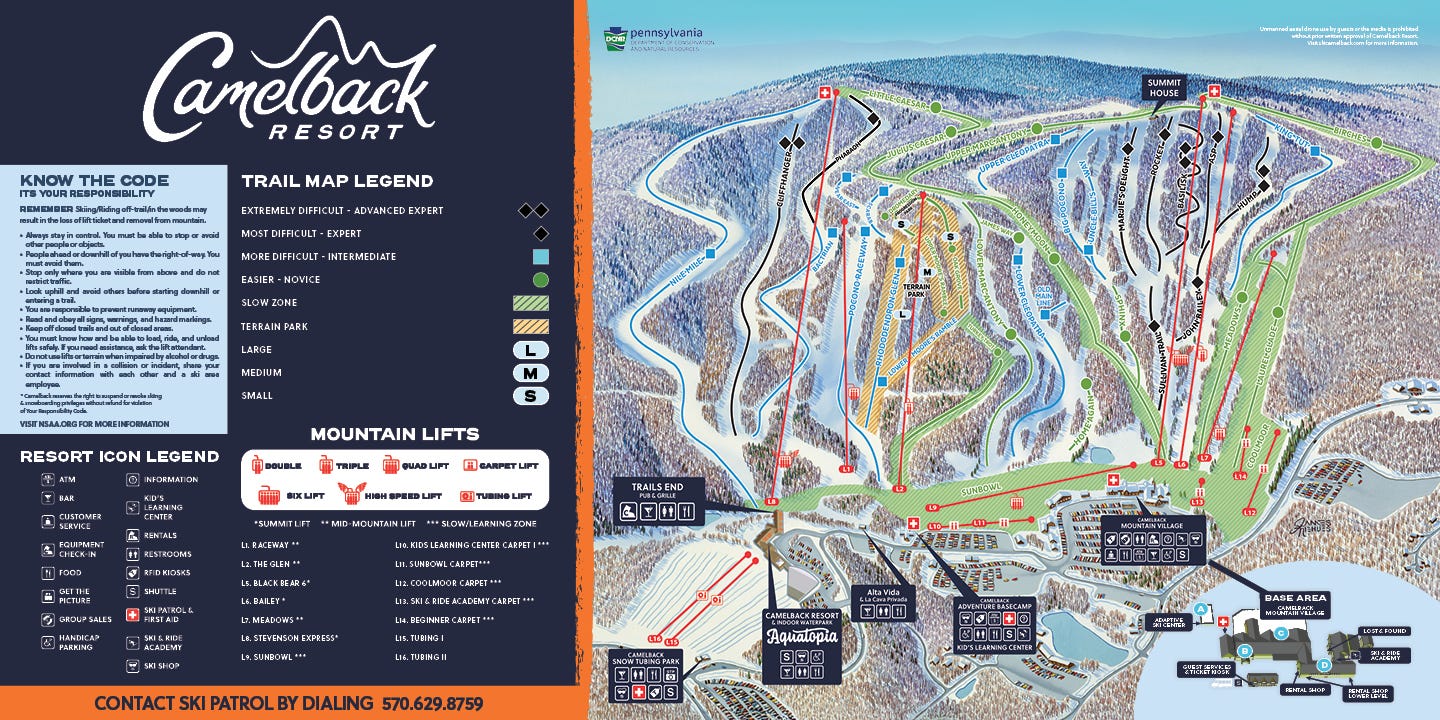
For reference:

The Zoom transcript (click “transcript” above for the Substack transcript, then click on any text block to teleport to the associated point in the video; timestamps below DO NOT MATCH THE VIDEO)
00:03:25.000 --> 00:03:37.000
Stuart Winchester: Welcome to The Storm! I’m your host, Stuart Winchester. Today is Wednesday, September 16th, 2026, and I’ve got a really good show for you today.
00:03:37.000 --> 00:03:45.000
Stuart Winchester: we’re going to talk some Pennsylvania skiing. And Pennsylvania skiing is a really interesting thing. As I travel around the country.
00:03:45.000 --> 00:03:56.000
Stuart Winchester: and ski at all these different places in the Midwest, and out West, and in New England, and in the Mid-Atlantic. Uh, and as I talk to folks who… who don’t ski that much, or only ski at the big mountains.
00:03:56.000 --> 00:04:05.000
Stuart Winchester: I’ll often bring up some experience I had at a Pennsylvania ski area. Pennsylvania has quite a few ski areas as 21.
00:04:05.000 --> 00:04:20.000
Stuart Winchester: public chairlift-served ski areas, and it does 2.6 million skier visits on average per year. That is more than any state except for Colorado, California, Utah, Vermont, and New York.
00:04:20.000 --> 00:04:26.000
Stuart Winchester: It’s more than Washington, it’s more than Oregon, it’s more than Montana, it’s more than New.
00:04:26.000 --> 00:04:39.000
Stuart Winchester: So, Pennsylvania is a really important ski state, which is probably why Vail Resorts owns 8 ski areas there, because it is really close to a lot of population centers. In western PA, you have Pittsburgh.
00:04:39.000 --> 00:04:54.000
Stuart Winchester: and Seven Springs, and Laurel, and Hidden Valley, and then you have Philadelphia on the east side, and you can also draw up from Baltimore and D.C. for Round Top and Whitetail. And uh…
00:04:54.000 --> 00:04:57.000
Stuart Winchester: And Jack Frost’s Big Boulder up in the Poconos. So…
00:04:58.000 --> 00:05:00.000
Stuart Winchester: Vail has a big presence there.
00:05:00.000 --> 00:05:15.000
Stuart Winchester: Icon has a presence there with Camelback and Blue Mountain. Uh, and then Indy Pass just signed their 8th ski area in Pennsylvania with Spring Mountain, uh, down near Philadelphia. So, so it’s, it’s a place where a lot of skiers start.
00:05:15.000 --> 00:05:19.000
Stuart Winchester: And it’s a little bit of a funny place to ski, because…
00:05:19.000 --> 00:05:29.000
Stuart Winchester: it tends to have an outsized number of novice skiers, which is great. They’re very good at doing that. Uh, but it can make it a little chaotic.
00:05:29.000 --> 00:05:38.000
Stuart Winchester: And the lift lines can get a little crazy, and people are all over the hill, and sometimes they’re walking down the hill because they’re frustrated and they’re giving up.
00:05:38.000 --> 00:05:40.000
Stuart Winchester: Uh, and…
00:05:40.000 --> 00:05:44.000
Stuart Winchester: You take that as your baseline in Pennsylvania.
00:05:44.000 --> 00:05:49.000
Stuart Winchester: And you had any sort of complications.
00:05:49.000 --> 00:05:54.000
Stuart Winchester: And things get out of hand really quickly. And in general.
00:05:55.000 --> 00:06:00.000
Stuart Winchester: For that reason, the ski areas that have survived in Pennsylvania.
00:06:00.000 --> 00:06:07.000
Stuart Winchester: are among the best operators in the world, and I would put that up against anyone.
00:06:07.000 --> 00:06:14.000
Stuart Winchester: It’s a very, very challenging environment, not only because you have a high number of novice skiers.
00:06:14.000 --> 00:06:17.000
Stuart Winchester: Uh, but also because you have…
00:06:17.000 --> 00:06:31.000
Stuart Winchester: not a ton of snow, sometimes in the west part of the state, where there’s higher elevation, they do get a lot of snow, but… but not as a rule, you couldn’t count on it for natural snow. Uh, you get a lot of rain, you get a lot of warm-ups.
00:06:31.000 --> 00:06:35.000
Stuart Winchester: Uh, and… and you, in general, have to rely on…
00:06:35.000 --> 00:06:42.000
Stuart Winchester: a very short season, generally mid-December-ish to mid-March-ish.
00:06:42.000 --> 00:06:45.000
Stuart Winchester: And the skiers there…
00:06:47.000 --> 00:06:52.000
Stuart Winchester: They’re they’re accustomed to a pretty high standard, so.
00:06:52.000 --> 00:06:57.000
Stuart Winchester: So when things do get out of control, uh…
00:06:57.000 --> 00:07:04.000
Stuart Winchester: They really rebelled, and they really noticed. So, a couple years ago, this is what happened at Camelback. So, Camelback…
00:07:05.000 --> 00:07:09.000
Stuart Winchester: You know, I don’t generally do ops stories, uh…
00:07:09.000 --> 00:07:10.000
Stuart Winchester: You know.
00:07:10.000 --> 00:07:19.000
Stuart Winchester: ski area didn’t groom this run, or they haven’t opened this lift, or, uh, you know, they usually let this bump up, but they don’t, or, or…
00:07:19.000 --> 00:07:27.000
Stuart Winchester: you know, they… they are trying to save money, or they’re being cheap. I generally don’t bother with those, even though I get a lot of messages.
00:07:27.000 --> 00:07:32.000
Stuart Winchester: Complaining about things like that, because there’s almost always a pretty good reason.
00:07:32.000 --> 00:07:38.000
Stuart Winchester: Uh, and it’s almost always temporary, and it’s really not worth the effort.
00:07:38.000 --> 00:07:48.000
Stuart Winchester: to write the story if I’m just writing about, you know, why Stratton or Mount Snow or Magic Mountain didn’t open a certain lift on a certain day.
00:07:48.000 --> 00:08:04.000
Stuart Winchester: Uh, it’s, it’s a lot to track down and it’s a lot of, uh, this person said this and the other person said that. It’s just not the kind of thing that I’m want to cover with the storm, right? I want to do bigger stories. I want to do trend stories. I want to look at the culture and evolution of skiing.
00:08:04.000 --> 00:08:11.000
Stuart Winchester: And the passes, and all the infrastructure, and all the fun stuff. So I don’t generally cover the day-to-day stuff, just because…
00:08:12.000 --> 00:08:18.000
Stuart Winchester: The ski areas that remain in 2026 are, for the most part, run by really good operators.
00:08:18.000 --> 00:08:32.000
Stuart Winchester: Uh, it… because… and they’ve survived. Most of the bad ski areas that were either mismanaged or were in the wrong places, they went out of business a long time ago, which is why the number of ski areas has been stable for around 25 years now in America.
00:08:32.000 --> 00:08:35.000
Stuart Winchester: So I but I started to notice.
00:08:35.000 --> 00:08:45.000
Stuart Winchester: several years ago that I was getting an outsized number of complaints around one ski area in particular in the Poconos.
00:08:45.000 --> 00:08:47.000
Stuart Winchester: And it was Camelback.
00:08:47.000 --> 00:08:51.000
Stuart Winchester: And Camelback had a long history of being an independent.
00:08:51.000 --> 00:08:52.000
Stuart Winchester: And…
00:08:52.000 --> 00:08:54.000
Stuart Winchester: Really…
00:08:54.000 --> 00:08:59.000
Stuart Winchester: the way it’s been described to me by… by season pass holders, and I’ve skied…
00:08:59.000 --> 00:09:04.000
Stuart Winchester: some at Camelback, but I don’t have that depth of knowledge of having grown up there.
00:09:04.000 --> 00:09:20.000
Stuart Winchester: That Camelback for a long time, for decades, set the standard on snowmaking, on grooming, on just general maintenance of lifts in the ski area in the Poconos. And that was why they had chosen to ski there all those years.
00:09:20.000 --> 00:09:30.000
Stuart Winchester: But things had started to fall apart when a new owner showed up in 2019. It was at the time KSL Capital, who was.
00:09:30.000 --> 00:09:43.000
Stuart Winchester: was managing it for EPR Properties, which is the entity that bought it, and they own a bunch of ski areas, EPR Properties, including a bunch owned by Vail, including North Star, and a lot of the old Peak Resorts in Ohio and such.
00:09:43.000 --> 00:09:50.000
Stuart Winchester: And KSL Resorts was a division of KSL Capital.
00:09:50.000 --> 00:09:53.000
Stuart Winchester: which is a part owner of Altera.
00:09:53.000 --> 00:09:58.000
Stuart Winchester: But for some reason, Altera, which is very good at running ski resorts.
00:09:58.000 --> 00:10:00.000
Stuart Winchester: did not…
00:10:00.000 --> 00:10:15.000
Stuart Winchester: get assigned as the… as the owner of Camelback. And when KSL Resorts purchased Blue Mountain, not in Ontario, the Blue Mountain in Pennsylvania, that’s about 45 minutes from Camelback, two years later, in 2021.
00:10:15.000 --> 00:10:26.000
Stuart Winchester: That ski area also did not fall under Altera’s ownership. And it was an odd choice to make, because Altera’s really good at running ski areas, and they run…
00:10:26.000 --> 00:10:35.000
Stuart Winchester: Mammoth, and Deer Valley, and Steamboat, and Solitude, and Palisades Tahoe, and Stratton, and Sugarbush, and they definitely have.
00:10:35.000 --> 00:10:41.000
Stuart Winchester: the institutional knowledge and internal firepower to be able to run these ski areas in the Poconos.
00:10:41.000 --> 00:10:43.000
Stuart Winchester: Uh, Blue Mountain…
00:10:43.000 --> 00:10:47.000
Stuart Winchester: Had the benefit of a long time tenured management team.
00:10:47.000 --> 00:11:02.000
Stuart Winchester: That kept the place, by all accounts, running pretty well. Camelback, on the other hand, seemed to be falling apart before our eyes, and before the eyes of the loyalist skiers who loved the place so much. And they were really, really concerned, and I started to…
00:11:02.000 --> 00:11:08.000
Stuart Winchester: Because they had put, uh, a management team in place, it seemed.
00:11:08.000 --> 00:11:10.000
Stuart Winchester: that…
00:11:11.000 --> 00:11:22.000
Stuart Winchester: was not familiar with the… with the inner workings of a ski area. Uh, I… I hosted Dave Makarski, the former general manager of Kalenbach, on this podcast.
00:11:22.000 --> 00:11:33.000
Stuart Winchester: and very nice guy. We had a great conversation. Uh, he’s not a skier. And, and, you know, sometimes you can be not a skier and run a great ski resort. Uh, look at Bill Stritzler up at Smuggler’s Notch.
00:11:33.000 --> 00:11:43.000
Stuart Winchester: Bill hasn’t skied in years, and he snowboarded for a little bit, but he’s not a daily skier. Look at Shawnee.
00:11:43.000 --> 00:11:54.000
Stuart Winchester: that where the owner… that’s one of the most modern, nice ski areas in the Poconos, uh, and the owner has not skied in decades. So, so it’s not always necessary, uh, but…
00:11:55.000 --> 00:12:10.000
Stuart Winchester: It does help and it’s certainly a benefit. So everyone I talked to, I was, I was gathering all this stuff for a story and I was gonna write about Camelback and, and it, it really seemed like it was the worst run ski area anywhere that I could find based on the amount of feedback I was getting.
00:12:10.000 --> 00:12:25.000
Stuart Winchester: I was gathering all this feedback from all these long-time pass holders, and then they hired a new general manager, and so I scrapped the story, but I still wanted to get it, and by all accounts, Jason Bays, who I’ll bring on the podcast in a moment.
00:12:25.000 --> 00:12:34.000
Stuart Winchester: has really done a nice job of turning CamelBak around. So, so let’s go to Jason now.
00:14:09.000 --> 00:14:16.000
Stuart Winchester: My guest today is the Vice President and General Manager of Camelback Ski Area in Pennsylvania.
00:14:16.000 --> 00:14:26.000
Stuart Winchester: Camelback runs six chairlifts, or maybe seven. I might have had a typo there. Serving 45 trails on an 827-foot vertical drop.
00:14:26.000 --> 00:14:41.000
Stuart Winchester: Prior to taking the top job at Camelback, he was general manager for Great Wolf Resorts around the United States. He also spent time as chief operating officer and general manager of Mountain Creek Ski Area in New Jersey and director of operations.
00:14:41.000 --> 00:14:54.000
Stuart Winchester: for Jay Peak, Vermont. His very first jobs as a teenager were as a lifeguard and ski instructor at Camelback. Jason Bay is my guest. Jason, welcome to the Storm. Awesome to have you. How you doing today?
00:14:53.000 --> 00:15:00.000
Jason Bays: Thank you, Stuart. Great to be here. I’ve been a listener from day one, so excited to join you.
00:14:59.000 --> 00:15:14.000
Stuart Winchester: I love that. I’m so hyped to hear that. I know I started with a little Northeast focus. You know, you’re the… you probably know this already, but you’re the second straight guest I’ve had on. There was a Mountain Creek alum, Chris Haggerty, on yesterday. Are you acquainted with Chris?
00:15:13.000 --> 00:15:18.000
Jason Bays: Yeah, Chris and I worked together, um, back in our days at Mountain Creek, great guy.
00:15:17.000 --> 00:15:33.000
Stuart Winchester: Yeah, yeah, I’m, uh, I’m not sure, I’m sure you’re aware I’m based in New York City and Mountain Creek is one of my go-tos and, and was my home mountain before I started traveling all over the place for the storm. So, so, you know, Jason, I, I think it’s awesome that you grew up at Camelback. Tal.
00:15:34.000 --> 00:15:41.000
Stuart Winchester: your childhood Camelback. What was the kingdom of Camelback like to you, uh, when you were growing up skiing there?
00:15:40.000 --> 00:16:03.000
Jason Bays: Yeah, look, I, you know, took, I grew up in Pocono Kid, born and raised 10 minutes from the resort. After school ski program was the first, you know, first sort of foray into life at Camelback and was immediately hooked in the summer as a swimming pool and two water slides. I thought that was the most awesome place in the world too.
00:15:44.000 --> 00:15:45.000
Stuart Winchester: Yeah.
00:15:54.000 --> 00:15:55.000
Stuart Winchester: Mmhm.
00:16:03.000 --> 00:16:04.000
Stuart Winchester: Mmhm.
00:16:03.000 --> 00:16:21.000
Jason Bays: And my parents thought it was a great babysitting service, you know, relative to that. So it was just an awesome, awesome place to grow up and, you know, be part of the small but mighty ski community that is Tannersville, Pennsylvania, in this area, in the Poconos.
00:16:21.000 --> 00:16:39.000
Jason Bays: um, you know, when it came to get a first job, uh, there’s no place I was, uh, gonna consider other than Camelback. It’s where all my friends were, it’s where we all hung out all the time, and, um, you know, really just got introduced to, uh, to the sport, and, um, had some freedom. It was the first time I had some freedom, and it was to be at Camelback, so that’s.
00:16:27.000 --> 00:16:29.000
Stuart Winchester: Mmhm.
00:16:39.000 --> 00:16:56.000
Stuart Winchester: So you worked there, and you were part of the machine, so to speak, and I realized you were sort of on the peripheral of the machine, as opposed to in the center of it, as you are now. But, you know, you grew up in the Poconos, and had that experience, and you had this vision of Camelback in your head, right? Then you went off and had a big life, as…
00:16:56.000 --> 00:16:57.000
Jason Bays: Yes.
00:16:56.000 --> 00:17:00.000
Stuart Winchester: as people do, and you went and worked at all these places that I just mentioned.
00:17:00.000 --> 00:17:03.000
Stuart Winchester: And then you came back to Camelback.
00:17:03.000 --> 00:17:06.000
Stuart Winchester: When you, when you arrived.
00:17:06.000 --> 00:17:10.000
Stuart Winchester: How had the place changed? And I just want to tee this up. I, you know.
00:17:10.000 --> 00:17:19.000
Stuart Winchester: before you came on, I was talking about how I don’t generally write operations stories, right? Because it… there’s usually a good reason for why a trail is closed, a lift’s not running.
00:17:19.000 --> 00:17:26.000
Stuart Winchester: Uh, but a few years ago, I started to get an outsized number of complaints about Camelback.
00:17:26.000 --> 00:17:38.000
Stuart Winchester: And so I started to write a story about it, and then when you came along, I shelved it, because honestly, everyone immediately was like, oh, this is so much better. So, you know, how had…
00:17:38.000 --> 00:17:41.000
Stuart Winchester: Camelback changed.
00:17:41.000 --> 00:17:42.000
Stuart Winchester: when you…
00:17:42.000 --> 00:17:44.000
Stuart Winchester: Came back to work there.
00:17:44.000 --> 00:17:51.000
Stuart Winchester: And what were the challenges facing the resort? What did you focus on immediately?
00:17:50.000 --> 00:18:08.000
Jason Bays: Yeah, I’ll just back up to say, you know, just to contextualize, um, from when I was there as a teenager and, um, through college on the ski team, too, I would say that community was a really big word, um, that was used all the time. You, you felt like it was, it was the Camelback community, and there’s a really big emphasis on the ski product.
00:18:08.000 --> 00:18:28.000
Jason Bays: Um, as a ski instructor, like, what we were putting out, how we were doing lessons, how many lessons we could do, and the experience that was surrounding that. And same thing on the water park side. And, you know, I think the, um, you know, some of the observations, um, coming back to Camelback was, um, I think there’s a little bit of focus, um, focus direction for, for, like, to focus on the ski product.
00:18:28.000 --> 00:18:44.000
Jason Bays: and focusing on the water park product, and I sort of look at it as, like, a… as Disney World, right? Whereas we fill out… if we do the ski part well, we do the snow tubing part well, we do the water park well, that puts heads in beds, um, versus trying to put heads in beds.
00:18:44.000 --> 00:19:01.000
Jason Bays: And then have them do the activities. We’re leading with an activity front and centered focus. And that means making the strategic investments in the ski product, in our recreational product, and making that the very best that it can be.
00:19:01.000 --> 00:19:23.000
Jason Bays: back in 2008 when I was here as a teenager, that was all there was. There was no hotel product, right? So the ski product got outsized attention just naturally because it was a 560-acre resort that identified as a ski area and a water park. And I think some of the context that was missing was that while there’s been a great evolution of Camelback as a four-season resort.
00:19:15.000 --> 00:19:16.000
Stuart Winchester: Mmhm.
00:19:23.000 --> 00:19:40.000
Jason Bays: It’s really important that, to me, that each of those business units gets the time and attention that they would deserve if they were stand-alone units, particularly because a cog… it’s a cog in the wheel, and that wheel is… it’s a flywheel. It needs to… it all needs to turn at once, and so we lead with.
00:19:40.000 --> 00:19:43.000
Jason Bays: the recreational offerings first.
00:19:43.000 --> 00:19:48.000
Stuart Winchester: You know, you mentioned the community, and I wasn’t aware…
00:19:48.000 --> 00:19:59.000
Stuart Winchester: that there was such a strong community around Camelback, and I’m not surprised, because most ski areas have that group of folks who, you know, they’re retirees, and they boot up at 8am, and they take runs together.
00:19:59.000 --> 00:20:14.000
Stuart Winchester: But they were really passionate, and the running theme, Jason, in the emails and messages that I got from Camelback locals was that they loved Camelback. It wasn’t that they hated Camelback, they hated to complain about Camelback.
00:20:14.000 --> 00:20:18.000
Stuart Winchester: They wanted to love it, but they couldn’t. There was there was.
00:20:18.000 --> 00:20:34.000
Stuart Winchester: a lot of things they cited, uh, not making snowmaking when it’s cold, understaffed grooming, uh, missed lift inspections. I don’t know if this is true. This is what people were… they were reaching, I think, for answers. Uh, put it all together, and there was… it was definitely…
00:20:34.000 --> 00:20:47.000
Stuart Winchester: seemed as though the ski product was not the focus. So when you came in, what did you focus on right away and say, okay, this is what we gotta change, you know, we have to cover every trail 100% right away, or whatever it was?
00:20:47.000 --> 00:21:09.000
Jason Bays: Yeah, I think that’s, look, I would start, you hit the nail on the head that there’s a very passionate skiing community here at Camelback and in the Poconos and it means a lot to people. This is second, third generations that are learning to ski here, bring their families here and be part of this. And to your point, everyone wants to be prideful of Camelback, right?
00:21:09.000 --> 00:21:24.000
Jason Bays: This was the, this was family run for a really long time and, you know, very focused on sort of the, you know, season pass holders renewing year after year.
00:21:24.000 --> 00:21:40.000
Jason Bays: You know, a couple of things. One is I think that how we authentically tell our story isn’t done in a way that is, you know, is done in a way that’s authentic. A, bringing back the Camelback Mountain Facebook page that communicated ski related content.
00:21:38.000 --> 00:21:39.000
Stuart Winchester: Yeah.
00:21:40.000 --> 00:22:06.000
Jason Bays: Right? I think that, you know, there’s only so many things you can say about a hotel room and how exciting it is. Like, we really lead now first with authentically telling the story. Our snow report got a lot more detailed, gave granular information as to what was going on. So, you know, did we have a perfect winter last winter? By all means, no, but we communicated that authentically. And where we messed up, we took.
00:22:06.000 --> 00:22:23.000
Jason Bays: the blame for it, and said, hey, we didn’t get this right, and where we were working to improve the experience, we communicated that… communicated that story. So, to me, it started from a communication standpoint, that we were authentic, that we were honest, that we were truthful, and that we were communicating on a medium that.
00:22:23.000 --> 00:22:31.000
Jason Bays: our guests would see, um, and relate to. So I think a big miss was, I think, admittedly, a big miss was removing the, um, Camelback Mountain.
00:22:31.000 --> 00:22:53.000
Jason Bays: social media pages, um, and bringing those back were really important so that, um, we could tell the story authentically. I think SKUs really appreciate, um, knowing what’s going on, and to your point on, hey, there’s sort of this rumor flying or that rumor flying, um, you know, we were able to, uh, sort of hone in and, and tell, tell that story. Secondarily, I think from an infrastructure standpoint.
00:22:53.000 --> 00:23:09.000
Jason Bays: um, we really needed to make sure that we had, um, the right team in place. And we have an amazingly talented team at Camelback, um, but we did not have key positions filled, um, in certain areas. Um, and so, we bolstered up the snowmaking. Snowmaking team went from.
00:23:04.000 --> 00:23:05.000
Stuart Winchester: Mmhm.
00:23:06.000 --> 00:23:08.000
Stuart Winchester: Like, what areas?
00:23:09.000 --> 00:23:30.000
Jason Bays: you know, 3 to 4 to 30, um, this past winter, um, that makes a big difference, right? Our trail rollout was, um, you know, first to open in the East, uh, for Pennsylvania, um, and, uh, um, and, and focus on the core products. Um, same thing with lift operations. We brought in a really experienced lift, uh, maintenance manager.
00:23:12.000 --> 00:23:13.000
Stuart Winchester: Hey!
00:23:13.000 --> 00:23:14.000
Stuart Winchester: Wow.
00:23:14.000 --> 00:23:16.000
Stuart Winchester: Yeah.
00:23:20.000 --> 00:23:21.000
Stuart Winchester: Yep.
00:23:30.000 --> 00:23:46.000
Jason Bays: Um, to our team that really helped, um, support our Lyft, um, uh, operation. Um, decisions on when Lyfts ran and what time they ran, uh, you know, our thought was, let’s, um, be more… like, you have to run the Terrain Park Lyft every day.
00:23:46.000 --> 00:23:47.000
Stuart Winchester: Mmhm.
00:23:46.000 --> 00:24:06.000
Jason Bays: to me, that’s a commitment. We make that every day. We say we’re running the Glen Lift every day. It services great novice terrain. It services the train park. And so, looking at the operational plan and saying, okay, what are ways that we can give back, you know, and make deposits back to our skiers? And in turn.
00:24:06.000 --> 00:24:24.000
Jason Bays: that builds momentum, right? People talk, and, like, the ski community is so connected, right? It’s like, if you do something, like, people find out about it, because they’re really, you know, they hear about it. And so, for us, focus on the core business was, um, you know, from a ski standpoint, was really important, and the infrastructure.
00:24:12.000 --> 00:24:13.000
Stuart Winchester: Right.
00:24:17.000 --> 00:24:19.000
Stuart Winchester: Mmhm.
00:24:24.000 --> 00:24:41.000
Jason Bays: to be able to do it. And I would just, lastly, just say I go back to making sure that our team had the resources to do their job. We’re supported, we’re empowered, collaborative leadership, you know, we sat around the table and said, this is the operating plan, this is what we’re going to do for our guests.
00:24:41.000 --> 00:24:46.000
Jason Bays: And then go out and execute it to the best we can.
00:24:45.000 --> 00:25:03.000
Stuart Winchester: You know, Jason, I, I, I think you could have run for governor with one of the first things that you did, which was get rid of paid parking. I, I, I don’t think that I’ve ever, uh, heard people happier about anything. Now, now, and let me, let me qualify this, right? I think in, in some instances, paid parking and parking reservations.
00:25:03.000 --> 00:25:05.000
Stuart Winchester: make sense.
00:25:05.000 --> 00:25:18.000
Stuart Winchester: you know, super high volume days. Arapahoe Basin, I think, is a model in Colorado where they only charge for certain days and certain times, and they keep backing off which days as they learn when they really need it. Camelback was charging every day.
00:25:18.000 --> 00:25:36.000
Stuart Winchester: All day, you know, a Monday with, you know, 10 people on the mountain, they were charging for it. And, you know, acknowledging that sometimes it’s appropriate, I think Camelback got pretty out of hand with it, and when I had Mr. Markowski on the podcast, great guy, we had a great conversation, but he was not backing off that. He said, nope, paid parking.
00:25:36.000 --> 00:25:51.000
Stuart Winchester: we’re all in. You said no. So talk about that and how you sold. I’d imagine it was a revenue stream, right? And you had to sell management on that, and I don’t know if I’m giving you credit for something someone else did, but talk to us about parking and the evolution there.
00:25:51.000 --> 00:26:12.000
Jason Bays: Yeah, that was a week one decision from the Camelback team when I got here made from our leadership team at Camelback that everyone was in alignment on our senior leadership team here at the property and myself to remove the paid parking. And I think definitely there’s actually you have so many nice pictures behind you.
00:26:12.000 --> 00:26:30.000
Jason Bays: I have a picture of the old paid parking sign behind me there, if you can see it on the corner, and it actually serves to me as a reminder of the guest experience, because someone’s put a sticker on that paid parking sign that you probably can’t see there, but it says, Ski Camelback, we’re not happy until you’re not happy.
00:26:15.000 --> 00:26:19.000
Stuart Winchester: Yeah.
00:26:30.000 --> 00:26:48.000
Jason Bays: Um, and it’s a reminder to, to me and our team, um, that we’re here to have fun, and we’re here for the guest experience, and we’re here to live, live and breathe fun Camelback style. This is not a, um, you know, we want guests to look forward to, to being here. And I think, you know, yes, there was.
00:26:37.000 --> 00:26:38.000
Stuart Winchester: Mmhm.
00:26:48.000 --> 00:27:05.000
Jason Bays: So obviously we ran a financial model. We didn’t just, you know, get rid of paid parking and not assume, you know, that there wasn’t some revenue to be recaptured elsewhere with a strategy to do it. But I think more importantly, you know, think about it.
00:27:05.000 --> 00:27:22.000
Jason Bays: a non-busy day, it might even be raining, it’s 40 degrees, the last thing you want is someone running around a parking lot telling you, like, hey, I need you to hand over $15, and by the way, then you’re gonna schlep your stuff up two different levels of parking, um, you know, that might be even charged higher, and then get to.
00:27:18.000 --> 00:27:19.000
Stuart Winchester: Mmhm.
00:27:22.000 --> 00:27:38.000
Jason Bays: uh, the mountain and go to guest services. You know, I have a 3-year-old. If my wife and I went skiing, that would be an incredible amount of friction, um, just to get to, uh, the front of the mountain. And so I think putting ourselves in the guest lens of saying, is that really what we want the guests to experience?
00:27:29.000 --> 00:27:30.000
Stuart Winchester: Mmhm.
00:27:38.000 --> 00:27:53.000
Jason Bays: Um, it’s not, and, and it was a burden to everyone at this, you know, you think I’m talking about, we talked to frontline associates too, like, the first thing that they had to tell people was that they had to pay for parking. You just imagine, sort of, the cascading effect that, that, that, uh, that that had, and we said, look, is there.
00:27:53.000 --> 00:28:09.000
Jason Bays: Um, is there a better way? Um, can we run shuttles to these lots and pick people up and bring them to the mountain and make them feel, um, you know, like our valued… like our valued guests? What does that arrival experience look like? Um, you know, that’s really what we… what we looked at, and then said, okay.
00:28:09.000 --> 00:28:25.000
Jason Bays: can we… ultimately, will we drive more volume here? Will more people come because of a better guest experience? And I’ll say that I would rather grow the sport, grow the industry. Our team would rather grow the sport and grow the industry than figuring out how to.
00:28:25.000 --> 00:28:35.000
Jason Bays: You know, sort of, you know, run a secondary ancillary business that’s not to our core product and what we want our guests to experience here.
00:28:34.000 --> 00:28:48.000
Stuart Winchester: You know, it’s a little counterintuitive, but sometimes, by removing a revenue stream, you get that less-is-more effect. Another example, your season pass, you know, according to my records.
00:28:48.000 --> 00:29:04.000
Stuart Winchester: Starting in 2020 to ‘21, the season pass was $599 at its early bird price, and it hovered between that and $649 for the next five years. This year, you put it on sale for $399. It’s still at that price for unlimited Camelback.
00:29:04.000 --> 00:29:20.000
Stuart Winchester: That’s a great bargain for, uh, for a season pass on the East Coast, and, you know, for the listeners, you are competing with the Epic Pass, which has Jack Frost, Big Boulder, right down the road, a couple exits down I-80, and their Northeast season pass is pretty affordable, and it’s a pretty good deal.
00:29:20.000 --> 00:29:33.000
Stuart Winchester: So… so talk to us about that decision and… and… and how… how that $399 is worth it. You also wrote back, if you want to talk about, uh, the… the triple pack. I thought that was great, and I don’t have the price right in front of me, but… but you’ve really done a lot to… to…
00:29:33.000 --> 00:29:39.000
Stuart Winchester: create more of a value experience for that loyal Camelback skier, from my point of view.
00:29:39.000 --> 00:29:55.000
Jason Bays: Yeah, thank you, and that’s definitely the goal. Um, you know, I think our thought process here is let’s get more people on Snow, um, and have them have a great experience while they’re here. Um, I would love to tell you that there’s some master business plan behind this.
00:29:50.000 --> 00:29:52.000
Stuart Winchester: Mmhm.
00:29:55.000 --> 00:30:10.000
Jason Bays: But, you know, truly, at the heart of what we do is, let’s figure out how to get more people on snow, get them to a spot where they want to come back and learn and be part of it. And guess what I would just share to that is.
00:30:10.000 --> 00:30:24.000
Jason Bays: you know, we were charging a day ticket in 2025 of $169, um, at its highest point, right? And I would rather have a lifelong… I would rather have one per… I would much rather, I think from business proposition, we would rather have.
00:30:16.000 --> 00:30:17.000
Stuart Winchester: Mmhm.
00:30:24.000 --> 00:30:39.000
Jason Bays: one person definitely not come and spend $15 to $40 to park and $169 and say, I’m never coming back, versus $399, now they’re like, wow, this place is awesome, I’m getting a great value, I bring my family.
00:30:32.000 --> 00:30:33.000
Stuart Winchester: Damn.
00:30:39.000 --> 00:31:01.000
Jason Bays: I want to come enjoy food and beverage. And hey, by the way, we also have this great snow tubing park and this great water park. And would you like to stay at our hotel when you come with your season pass and enjoy Aquatopia? And we’re debuting The Curse of Camelback this fall, right? Which is the Halloween, if you haven’t heard, it’s a Halloween 13 scare zones. Take a chair, lift up to it.
00:31:01.000 --> 00:31:03.000
Stuart Winchester: Mmhm.
00:31:01.000 --> 00:31:24.000
Jason Bays: But I say all that to say we’ve got so many great cross marketing promotional opportunities at Camelback that that really becomes a super compelling business case for us. And I think it’s the right thing to do for the sport is grow it, make it more accessible, allow more people to come here and see what we have to offer. I can’t tell you how many people I meet, whether it’s snow tubing, skiing.
00:31:24.000 --> 00:31:41.000
Jason Bays: water park, the hotel, whatever they’re here for, CBKMA or Adventure Park, they have no idea that the other part exists to, um, the resort. And I’ll share that that’s been the case even in, like, when I was, uh, at Jay Peak running the water park.
00:31:32.000 --> 00:31:34.000
Stuart Winchester: Hmm. Okay.
00:31:41.000 --> 00:31:43.000
Jason Bays: People would come there, and they’d be like.
00:31:43.000 --> 00:32:02.000
Jason Bays: what is this mountain that is here? And it’s Jay Peak, like, one of the most hardcore ski resorts in the world. And there were people that were coming there and were like, I had no idea there was a ski resort here. So, if it’s true at Jay Peak, it certainly is true at Camelback, where.
00:31:48.000 --> 00:31:49.000
Stuart Winchester: Right.
00:31:49.000 --> 00:31:52.000
Stuart Winchester: Yeah.
00:31:52.000 --> 00:31:53.000
Stuart Winchester: Yeah, thank you.
00:31:59.000 --> 00:32:00.000
Stuart Winchester: Mm-hmm.
00:32:01.000 --> 00:32:02.000
Stuart Winchester: Yeah, okay.
00:32:02.000 --> 00:32:19.000
Jason Bays: we have all these different offerings that people don’t know about, maybe necessarily about all of them, so our fundamental business philosophy is make it accessible, make them lifelong, um, skiers and riders, and introduce them to everything that we have to offer here in the Poconos. And I would just argue, when I say Poconos.
00:32:19.000 --> 00:32:41.000
Jason Bays: Like go, like experience Shawnee and experience Jack Frost Big Boulder and experience, you know, the other great ski areas in this region and Mountain Creek and wherever else and get a flavor for it. I think that’s, we could use more skiers in the industry and to grow the sport. So for us, that’s sort of the long-term business model that we’re using.
00:32:22.000 --> 00:32:23.000
Stuart Winchester: Mmhm.
00:32:41.000 --> 00:32:58.000
Stuart Winchester: So, I just looked at the triple ticket, and it looks like $149, and I think that’s no blackouts. $199 includes rentals. That’s pretty amazing. So, talk about that product, and then you mentioned the $169 peak day ticket. Have you settled on prices yet for 2020?
00:32:58.000 --> 00:33:03.000
Stuart Winchester: 6, 27. I should have checked your site in advance, but I didn’t. So I don’t know if you’ve.
00:33:03.000 --> 00:33:21.000
Jason Bays: Yeah, we have not, uh, posted, uh, day ticket prices for this year. Last year, um, we didn’t exceed around $110, um, on a day ticket. Uh, so we kept it, I think, pretty reasonable for, for, for a, for a Pocono offering. Um, triple tickets, massive, um, success, uh, for us.
00:33:10.000 --> 00:33:12.000
Stuart Winchester: Oh, okay.
00:33:14.000 --> 00:33:15.000
Stuart Winchester: Yeah, yeah.
00:33:21.000 --> 00:33:37.000
Jason Bays: Um, and when we talk about, like, again, getting more people introduced to the sport, you don’t necessarily pick up skiing on the first time. Um, you think about that rental product, which we, um, tremendously… whatever we had on the pro forma for that was, uh, blown by by, like.
00:33:28.000 --> 00:33:30.000
Stuart Winchester: Mmhm.
00:33:37.000 --> 00:33:53.000
Jason Bays: 400% on the triple ticket with rentals. And what I really believe in is that, you know, you become a lifelong skier by getting repetition, not by going once a year. It’s really hard to sustain as a skier going once a year.
00:33:50.000 --> 00:33:52.000
Stuart Winchester: Yeah. Okay.
00:33:53.000 --> 00:34:11.000
Jason Bays: and saying, oh yeah, that was our trip. We’re really trying to create a guest for life and get them to return visit. That’s in many ways more important to us than, again, trying to get, like, the highest yield on that one day that they picked. Like, come back and visit our resort and, um, you know, again, the business side to this is.
00:34:11.000 --> 00:34:28.000
Jason Bays: we’re cross-marketing across all of our other offerings here that we have on this campus to say, come and visit us again. And again, to us, that’s more important than, you know, the highest yield that we can get to. So the triple ticket’s really successful. And I think one last thing I would share.
00:34:28.000 --> 00:34:46.000
Jason Bays: a lot of season passes in the market right now, um, the triple ticket’s a great opportunity for people to get a couple of days at Camelback, even if they’ve committed somewhere else, and particularly, you know, our long season, um, there’s plenty of time to use it, um, as well, uh, from the, uh, long season that we established from last year.
00:34:46.000 --> 00:34:50.000
Stuart Winchester: Jason, I think that’s a really smart way to look at it as…
00:34:50.000 --> 00:34:57.000
Stuart Winchester: a… creating a habit rather than pulling as much yield as possible. And a lot of the larger operators.
00:34:57.000 --> 00:35:11.000
Stuart Winchester: get frustrated with me and the rest of the ski media because they don’t understand why we focus on that peak price, right? Because the peak lift ticket this year at Beaver Creek is $392, set to be. Probably almost no one will pay that price, but…
00:35:11.000 --> 00:35:28.000
Stuart Winchester: What it does is it acts as a, a billboard for the rest of the ski industry and especially so, so Camelback for, for people who don’t know when you’re driving on I 80 I mean, you see it, it looms right over the highway. It is one of the major interstates in America, especially at night. The thing is lit up.
00:35:28.000 --> 00:35:46.000
Stuart Winchester: And so, chances are, if people think about skiing, and they think about where to go, they’re gonna think about the most obvious one, and that’s Camelback, and that’s why, for many years, it was that, or Seven Springs was the busiest ski area in Pennsylvania, traditionally. So I think that’s a really smart way to look at it, because if people show up that one time, and.
00:35:46.000 --> 00:35:59.000
Stuart Winchester: cost them, you know, $500 for 2 people, they’re just not gonna come back, and they’re not gonna try Shawnee, or… or Blue Mountain, or Jack Frost, or Elk Mountain, or Montage. So, um, I wanna talk about… Jason, I wanna talk about Lyft.
00:35:59.000 --> 00:36:16.000
Stuart Winchester: And… can you see this trail map? This is an old trail map. I mentioned that I know this, so for those watching on StormSkiing.com or YouTube, you can see this. So there’s been a ton of changes, and I want to break all these down with you. The first I want to talk about is, over the past couple years.
00:36:16.000 --> 00:36:32.000
Stuart Winchester: Mark Antony and Cleopatra, these two lifts right here, an old triple and an old double, have been removed. Can you talk about why you took those lifts out of service, and if you plan to replace them with anything, or what you planned, or what the rationale was behind it?
00:36:32.000 --> 00:36:49.000
Jason Bays: Yeah, I appreciate that. Uh, that does predate my time here, that they had reached the end of their, um, uh, ability to operate. Um, and so they have, um, both been, um, sort of partially disassembled. Um, there is unfortunately not.
00:36:35.000 --> 00:36:37.000
Stuart Winchester: Mmhm.
00:36:39.000 --> 00:36:41.000
Stuart Winchester: Mmhm.
00:36:46.000 --> 00:36:47.000
Stuart Winchester: Okay.
00:36:49.000 --> 00:37:05.000
Jason Bays: I, by the way, two of my favorite lifts when I was a ski instructor, because you could get right up and not wait in long lines on the weekends, so absolutely realizing and recognizing the capacity that they brought, but no opportunity for us to.
00:37:01.000 --> 00:37:02.000
Stuart Winchester: Mmhm.
00:37:05.000 --> 00:37:23.000
Jason Bays: um, reinstate those lifts as presently, um, as presently, uh, uh, sort of, um, situated, um, and, and not, not, not able to, uh, um, not able to, uh, rerun them. It will require a, um, new, uh, chairlift to, um, to ultimately replace.
00:37:23.000 --> 00:37:37.000
Jason Bays: those two lifts. It saddens me to share that, but that is, in fact, what has happened there, and I’ve been very open with our season pass holders about that messaging and the why behind it.
00:37:38.000 --> 00:37:41.000
Stuart Winchester: So, so in fantasy ski resort world, Jason.
00:37:41.000 --> 00:37:46.000
Stuart Winchester: Would you put a new lift here, and what would you put, if you could?
00:37:45.000 --> 00:38:04.000
Jason Bays: Yeah, absolutely. Um, same thing. We’ve, uh, we’ve made clear, uh, with no time, no official time frame to share, um, but certainly, uh, we’ve, we’ve, um, had, uh, preliminary conversations, um, about a fixed grip, um, quad that would, uh, would be able to take the place of both of those lifts, uh, and create that.
00:38:03.000 --> 00:38:04.000
Stuart Winchester: Mmhm.
00:38:04.000 --> 00:38:10.000
Jason Bays: original redundancy that those two lifts brought to the resort when they were in operation.
00:38:10.000 --> 00:38:27.000
Stuart Winchester: Yeah, that would be really nice. So, so, so these are gone and I, I have a, a current trail map now. So, um, and, and it’s not completely current. We’ll discuss the new trails in a moment, but this is the most current posted on your website. So, uh, we go over, these are the lifts that remain and see, uh, yeah, I, I miscounted in my intro, so sorry about that.
00:38:27.000 --> 00:38:42.000
Stuart Winchester: So this one is Stevenson, and Stevenson was, uh, it’s a high-speed quad, uh, for the listeners, and it… it was a real junker. It was always stop, stop, stop, and, you know, it was… it was really… seemed to be falling apart and have a lot of issues. Now, uh, in 2020…
00:38:42.000 --> 00:38:51.000
Stuart Winchester: 5, this year, or 2024, I believe, Camelback, uh, McCarthy, the GM at the time, sent out a letter saying it was due for a…
00:38:51.000 --> 00:38:53.000
Stuart Winchester: Waltz.
00:38:53.000 --> 00:39:02.000
Stuart Winchester: Uh, let me see what he said… like, a complete modernization of Stevenson. So, so did that happen? And talk to us about Stevenson, and what kind of shape it’s in right now.
00:39:01.000 --> 00:39:20.000
Jason Bays: Yeah, great, um, yes, that was a, uh, look, an amazing, um, project that was completed by, uh, by Dave and team, um, to modernize that lift. Um, it has, essentially, Doppelmayr came in and put in an entire new, uh, minus the, uh, minus the, uh, uh, the terminals and the.
00:39:08.000 --> 00:39:09.000
Stuart Winchester: Mmhm.
00:39:20.000 --> 00:39:35.000
Jason Bays: Um, uh, and the structure itself, um, essentially all new components, all new electrical, um, uh, wiring components to it, a lot of the things that had plagued it. Um, and last year, uh, it operated 138 days.
00:39:34.000 --> 00:39:36.000
Stuart Winchester: Unbelievable.
00:39:35.000 --> 00:39:53.000
Jason Bays: Uh, which for Pennsylvania, uh, that’s pretty darn good. I think we recognize it’s a workhorse, um, it’s key to accessing some really, um, fantastic terrain for us, um, and that modernization project with Doppel… in, um, partnership with Doppelmeyer that was done in the summer and fall of 2025.
00:39:53.000 --> 00:39:54.000
Stuart Winchester: Mmhm.
00:39:53.000 --> 00:40:08.000
Jason Bays: um, was, uh, very, uh, so it’s all immediate impact, um, with, uh, Stevenson Reliability this past year, and we expect that to, uh, you know, knock on wood, to, uh, to continue going forward. We essentially, again, have a brand new lift, minus the, uh.
00:40:08.000 --> 00:40:10.000
Jason Bays: Uh, minus the physical pieces.
00:40:10.000 --> 00:40:26.000
Stuart Winchester: That’s a really smart way to do it because they are tremendously expensive, these new lifts. And for folks who are watching or listening, this Stevenson is really important because you walk out of this giant hotel that’s right here, that’s not on the trail map with 400 and some rooms, and that is how you get up the mountain. Otherwise you got to.
00:40:26.000 --> 00:40:41.000
Stuart Winchester: pull your way over, so when that lift is not running or has problems, it’s a real big issue. So, the alternative was, over here, Black Bear 6, uh, you replaced an old high-speed quad that was there, and… and I love this Black Bear 6 lift. It is…
00:40:41.000 --> 00:41:01.000
Stuart Winchester: Freakin’ Ferrari, man. I think the price they gave me was something like $12 million that they spent, or maybe it was $10 to put that in. So that’s the alternative, right? If you don’t just modernize that current lift, you replace it. So, uh, Black Bear is awesome. I love it. It has bubbles. Is it too much? I mean, I know that KSL Now Peregrine had reasons for.
00:41:01.000 --> 00:41:16.000
Stuart Winchester: for putting it in, but what have you learned from a couple of years of having BlackBerry around, which is, again, probably the nicest lift in the state of Pennsylvania and one of the nicest in the Northeast, but maybe a little heavier than what you need for CamelBak, but I don’t know, you tell me.
00:41:17.000 --> 00:41:41.000
Jason Bays: Yeah, you know, you know what I would share to that, um, you know, we, we brought it back for scenic chairlift rides this summer, and I mean, it’s a massive hit. The summer, summer guests love, uh, the bubbles, they put them down when it’s sunny, they put them down, um, probably gets more use in the summer as a bubble lift than the winter, uh, but look, it’s, it’s nice to, uh, have on the days where, you know, there’s some liquid precipitation out here. It certainly happens in the Poconos.
00:41:22.000 --> 00:41:24.000
Stuart Winchester: Hmm.
00:41:34.000 --> 00:41:35.000
Stuart Winchester: Okay.
00:41:41.000 --> 00:41:58.000
Jason Bays: um, and, uh, and, and or, um, uh, you know, other, other weather events, it’s, it’s, it’s a nice to have, um, and it certainly, it gets you up in, you know, a little bit over two minutes. Um, it’s a smooth ride, it’s a great ride. Um, you are not going to get any complaints from me that we have a, um.
00:41:47.000 --> 00:41:48.000
Stuart Winchester: Mmhm.
00:41:51.000 --> 00:41:52.000
Stuart Winchester: Mm-hmm.
00:41:58.000 --> 00:42:11.000
Jason Bays: bubble, D-line, six-pack, um, in place, uh, and able to operate as our main workhorse lift. Um, and, uh, I think the six-pack versus the quad was absolutely the right, uh, call. Um…
00:42:11.000 --> 00:42:27.000
Jason Bays: from my experience being here before with the Sullivan Express, um, with the four-seater, the six-seater, just the… the added, uh, ability, uh, there is, uh, is… is well worth it. So, uh, we’re happy to have that… happy to have that lift. I… I wouldn’t, uh… I wouldn’t…
00:42:27.000 --> 00:42:31.000
Jason Bays: We won’t be trading it in at this point. Let’s put it that way.
00:42:30.000 --> 00:42:38.000
Stuart Winchester: It is a gorgeous machine, and I have to tell you, I’m that weird person who, if there’s a line on one lift.
00:42:38.000 --> 00:42:56.000
Stuart Winchester: And no line on the lift next to it. Even if it’s a slower lift, I’ll take the slower lift, because I just would rather not deal with the hassle of the line. So right here, for those who are watching, is the Bailey Double, and this is an old chair lift. It’s an old slow double, it runs almost exactly parallel to Black Bear 6, doesn’t land quite as high.
00:42:56.000 --> 00:43:16.000
Stuart Winchester: on the mountain, but functionally, it does about the same thing for you. So I like Bailey, and I was glad to see that not only did you keep it, and it does run, and that was true even under the previous regime, but you got a new gearbox for it, which is a really big deal for a lift like this in several decades. Also, talk about the work you’ve done on Bailey, and how you hope to use that lift.
00:43:16.000 --> 00:43:18.000
Stuart Winchester: this year to complement Black Bear.
00:43:18.000 --> 00:43:21.000
Jason Bays: Yeah, so, um, Bailey Lift…
00:43:21.000 --> 00:43:32.000
Jason Bays: full disclosure, Bailey Lift, Meadows Lift, Raceway Lift, and our season pass holders are very aware of this. Um, unfortunately, uh, we’re not, um…
00:43:32.000 --> 00:43:41.000
Jason Bays: ready for day one of last year, um, or even close. And so, uh, we had to do a lot of, um…
00:43:34.000 --> 00:43:35.000
Stuart Winchester: Mmhm.
00:43:41.000 --> 00:43:57.000
Jason Bays: normal PM maintenance, um, throughout the, um, end of fall and into winter to have all of them operational. Um, what I share to that is, um, we will run, just level set here really quickly, we will run all the lifts that we have on this trail map.
00:43:42.000 --> 00:43:44.000
Stuart Winchester: Okay.
00:43:57.000 --> 00:44:02.000
Jason Bays: Um, and take care of them, maintain them, operate them.
00:44:02.000 --> 00:44:18.000
Jason Bays: Staff them, everything that you would do to run the extra capacity, we certainly need it. We’d like more capacity, actually. So that being said, Bailey Lift is critical. We got it back online.
00:44:08.000 --> 00:44:10.000
Stuart Winchester: Yeah. Okay.
00:44:18.000 --> 00:44:34.000
Jason Bays: End of January, it ran for 2 or 3 weekends, and we had a failed gearbox, um, on it, which is really unfortunate. Um, this off-season, uh, we’ve replaced the gearbox, we’ve done a full PM over the course of the summer on it, which is…
00:44:34.000 --> 00:44:50.000
Jason Bays: the, as you, as everyone knows, the ideal time, uh, to be, um, conducting such work, um, so that it is ready on, uh, day one. Um, it is a critical backup lift. We will run it every weekend.
00:44:50.000 --> 00:45:07.000
Jason Bays: Um, that we’re, you know, in season, I would say in the heart of season, we’re gonna run it. Won’t be shy to not run it. Um, same thing with the Meadows, same thing with the Glen, same thing with the Raceway, which, um, you know, I know that that was, um, certainly chief among the complaints of.
00:45:07.000 --> 00:45:22.000
Jason Bays: locals and guests who were visiting from out of town alike was Lyft availability, Lyft reliability. That was something that we focused as fast as we could on last year, but we’re setting ourselves up this year to be.
00:45:22.000 --> 00:45:39.000
Jason Bays: um, very proactive to that, and recognizing the importance of, of each of, uh, uh, you know, each of these. And look, every once in a while, uh, if the, you always want to have, like, Bailey is critical because it’s the only other, if there’s Black Bear, without Black Bear, it’s the only other thing left, right?
00:45:36.000 --> 00:45:38.000
Stuart Winchester: Yeah.
00:45:39.000 --> 00:45:55.000
Jason Bays: Um, and so, uh, you know, I think the, you know, back in the, when I was here, like, every Lyft ran on the weekends. It was Camelback. Um, it was busy, right? Like, everything was going. That’s, that’s essentially our, our, our philosophy, um, will continue to be our philosophy going forward.
00:45:46.000 --> 00:45:48.000
Stuart Winchester: Mmhm.
00:45:55.000 --> 00:46:11.000
Stuart Winchester: Yeah, Jason, I’ll admit, I didn’t come to Camelback last season, so I wasn’t able to experience it firsthand. I really wanted to come to your May thing, which I’ll talk about, I’ll get to in a minute, but I had a shoulder surgery, so I wasn’t able to do that. But I wasn’t only basing my perceptions of C.
00:46:11.000 --> 00:46:19.000
Stuart Winchester: on locals’ reactions. I had skied there myself in recent years, and the lift line management, I have to say.
00:46:19.000 --> 00:46:21.000
Stuart Winchester: It was…
00:46:21.000 --> 00:46:33.000
Stuart Winchester: really frustrating from a skier point of view, when you’re waiting for the Stevenson lift, and there’s a big line, and every chair is going up with one or two people, and this is not peak COVID or anything else, this is several years later.
00:46:33.000 --> 00:46:50.000
Stuart Winchester: So, you know, and I had a lot of locals tell me, oh, we walk up Sun Bowl because the lift line is just too chaotic. People come from both sides. No, no, again, that was all before. What’s your philosophy of lift line management? How have you tried to tame that? And there’s always, it’s always going to be a little wild and hard in Pennsylvan.
00:46:50.000 --> 00:46:56.000
Stuart Winchester: Uh, but they could definitely have been managed better. Is that something that was important to you, that you focused on?
00:46:56.000 --> 00:47:15.000
Jason Bays: Yeah, we focused on that. We have a new lift operations manager that was hired in November of 2025, who took the bull by the horns. We developed a supervisor team in fairly short order to that as well, to build out a well-rounded team. And then I would just share that our lift attendants.
00:47:15.000 --> 00:47:32.000
Jason Bays: All hired locally within the community. And I think that we were fully staffed in LiftOps this year, which was a big, very big win. It starts there, right? A, the people, and then B, the right people.
00:47:22.000 --> 00:47:23.000
Stuart Winchester: Mmhm.
00:47:32.000 --> 00:47:49.000
Jason Bays: um, on the, uh, on the bus, um, as a catalyst to drive, uh, lift operations forward. Um, and then absolutely, uh, we focused on, uh, line management, queuing, um, we set new, in some cases, new queues. We had, um, uh, supervisors, in many cases, out.
00:47:49.000 --> 00:48:04.000
Jason Bays: um, putting up chairs, um, and, um, and managing the lift line. We added, once we got that right, and we felt like we were in a good spot, and we, you know, look, I think, admittedly, a couple technology hiccups here and there, it was not a perfect, uh.
00:48:04.000 --> 00:48:17.000
Jason Bays: we didn’t, like, on opening day, it wasn’t perfect, but, uh, we improved, it was a big focus for our team, and I think when we talk about fundamental ski operation, um, if we just were a ski area, we would absolutely be focusing on.
00:48:06.000 --> 00:48:08.000
Stuart Winchester: Yeah.
00:48:17.000 --> 00:48:36.000
Jason Bays: lift queuing, but we have to do that, like, we have to execute that every day because we are a ski area, um, and that’s core to our business, and so that’s important. Um, then we added, once we got queuing, uh, uh, correct, we added surprise and delights. Lift, uh, chocolate chip cookies were massively popular.
00:48:36.000 --> 00:49:04.000
Jason Bays: We handed out over 15,000 chocolate chip cookies this winter at the Stevenson lift line. And so, you know, then it becomes fun, right? Then it’s the hospitality side of the business of how do we engage with our guests now that we have full chairs going up for the most part off of the Stevenson and the Black Bear and the Sun Bowl. So we hired extra associates to do that, to surprise and delight, to help our guests.
00:48:40.000 --> 00:48:42.000
Stuart Winchester: Cool.
00:49:04.000 --> 00:49:20.000
Jason Bays: The one other thing I would just share is Sunbowl is a great example. How many people get down to the Sunbowl and have never ridden a lift before? And so you need that extra human touch to be able to help. It’s not even just putting people in groups of four. It’s just helping them with like, here’s where you go to load the lift. Here’s what you do.
00:49:12.000 --> 00:49:14.000
Stuart Winchester: Yeah.
00:49:20.000 --> 00:49:21.000
Stuart Winchester: Yep.
00:49:20.000 --> 00:49:33.000
Jason Bays: Um, I think that that investment in our people to provide that service to our guests is very well worth it, and it’s the difference between someone having a bad experience getting on a lift and never coming back.
00:49:33.000 --> 00:49:43.000
Jason Bays: or having a great experience, feeling well cared for, and wanting to try again. Um, and so that, that, that was, um, you know, I think that’s a core, um, focus for us.
00:49:43.000 --> 00:50:02.000
Stuart Winchester: So, one of the ways that I can tell the resort is being run by a skier, in addition to all the things you just said, and your passion for the minutiae of things like lift lines, which I share, is that you’re cutting 3 new trails in a resort that’s 60 years old, and I love that. So, talk us through these trails, Jason. I’ll do my best to trace them.
00:50:02.000 --> 00:50:08.000
Stuart Winchester: on the trail map. I don’t have the updated trail map, I don’t know if you’ve created it yet, but talk us through these three trails.
00:50:08.000 --> 00:50:25.000
Jason Bays: Yeah, so we’re really excited. Look, this, you know, came after, you know, the so many guests, new guests that visited us at Camelback this past season. We said, you know what, let’s do something fun and exciting. And like, you know, you think about how.
00:50:25.000 --> 00:50:43.000
Jason Bays: Um, yeah, I just, you know, if someone said, anyone puts in a new trail, uh, the skier in me wants to drive to that resort, no matter how big or small, and be like, alright, like, let’s do it. Um, and our team feels, uh, you know, much of the same way. So, um, that being said, uh, we had a lot of natural snowfall this year, so…
00:50:32.000 --> 00:50:33.000
Stuart Winchester: Yeah.
00:50:33.000 --> 00:50:36.000
Stuart Winchester: Yeah.
00:50:36.000 --> 00:50:37.000
Stuart Winchester: Yeah, sure. Yeah.
00:50:43.000 --> 00:50:59.000
Jason Bays: I was acutely paying attention to where people were skiing when we had natural snowfall, where they wanted to go, and then, you know, maybe following those lines, too, and seeing what the fun was about. So, my point to all of that is, we said, let’s create some, and I think for Camelback, too.
00:50:46.000 --> 00:50:48.000
Stuart Winchester: Mm-hmm.
00:50:59.000 --> 00:51:15.000
Jason Bays: it’s very, um, you know, we wanted to create something that was sort of unique. I didn’t want to just put in, like, regular trails that, A, we don’t have a lot of space for regular trails, and B, um, we really wanted to create sort of unique experience. So, right underneath Black Bear, um, in between Sullivan and John Bailey there.
00:51:07.000 --> 00:51:09.000
Stuart Winchester: Mmhm.
00:51:15.000 --> 00:51:30.000
Jason Bays: um, there’s a, um, there’s a chute, um, where the old Alpine Slide used to go. Basculus goes back into Rocket, uh, but underneath there is some really fun rolling terrain. Like, it’s, it’s because the mountain, the, uh, Alpine Slide.
00:51:26.000 --> 00:51:28.000
Stuart Winchester: Yeah, thank you.
00:51:30.000 --> 00:51:54.000
Jason Bays: back in the day did had several dips and curves and so we’re going to lean into those dips and curves and create something sort of fun that you can get some you know launch some airtime off of if you want or carve a turn over it but it’ll have some some really nice terrain variation in a way that most trails at Camelback don’t have and they’re coming off of an expert trail there so.
00:51:54.000 --> 00:52:06.000
Jason Bays: um, gives, uh, you know, anyone skiing Asp, Hump, Rocket, um, or Basilisk would be able to reach that trail, um, and, uh, and be able to, uh, just have a little bit more excitement on the way back down.
00:52:06.000 --> 00:52:08.000
Jason Bays: Um…
00:52:08.000 --> 00:52:20.000
Jason Bays: Upper Cleopatra there, if you go to the, uh, where the U is, uh, or where Upper is, we’re gonna cut a trail through the woods there that’s going to end up on the bottom of Big Pocono.
00:52:19.000 --> 00:52:21.000
Stuart Winchester: Okay.
00:52:20.000 --> 00:52:31.000
Jason Bays: Um, so it’s gonna go down and across. So, um, that… um, and I see where your cursor is. If you go to the… where it says Upper on Upper Cleopatra.
00:52:26.000 --> 00:52:29.000
Stuart Winchester: So, like, here? Or…
00:52:30.000 --> 00:52:32.000
Stuart Winchester: Oh, upper…
00:52:32.000 --> 00:52:54.000
Jason Bays: So, Big Pocono, that’s Uncle B. Yeah, right there. Yep, we’re going through there. Yeah, so that’s gonna be, that’s a narrow blue square. So, you know, I think one of the things that’s fun for us is we’re gonna create a blue square there. That used to be a trail back in the 60s and 70s, fun fact, when Walter Foger was designing Camelback.
00:52:34.000 --> 00:52:37.000
Stuart Winchester: Upper… oh, this one. Okay, so you’re cutting through here?
00:52:37.000 --> 00:52:39.000
Stuart Winchester: Oh, cool. Okay.
00:52:49.000 --> 00:52:51.000
Stuart Winchester: Oh, cool.
00:52:54.000 --> 00:53:09.000
Jason Bays: Um, that being said, um, the… actually, it got filled in with pine trees, so it’s gonna be really cool, because there’s pine trees on both sides. Um, we made it narrow, so we kept the pine trees, um, and so that’s gonna be a really fun, um, sort of narrow… I think about, like, the, um.
00:52:58.000 --> 00:52:59.000
Stuart Winchester: Mmhm.
00:53:01.000 --> 00:53:03.000
Stuart Winchester: That’s cool. It’s pretty.
00:53:09.000 --> 00:53:26.000
Jason Bays: the ending of Jay Peak with some of the blues at the very bottom there by Interstate. We’re trying to sort of have that, obviously in a much smaller zone, have that same effect, though, where you’re feeling like you’re really in the trees, and you’ve got some nice twists and turns to it. It’s not terribly steep.
00:53:12.000 --> 00:53:13.000
Stuart Winchester: Yeah, okay.
00:53:26.000 --> 00:53:44.000
Jason Bays: Um, two things on that trail. One is, it takes traffic off of Honeymoon Lane, which is a main boulevard, it pushes it onto the Sphinx, which has much more trail capacity, which is great, um, comfortable carrying capacity, and secondarily, um, on weekends, we’re gonna have a hot chocolate, um, hut that people can ski up to.
00:53:31.000 --> 00:53:32.000
Stuart Winchester: Mmhm.
00:53:44.000 --> 00:53:52.000
Jason Bays: Um, and get shots of hot chocolate, um, as well, so we’re excited to, um, uh, to offer that to our guests. We think that’ll be really fun.
00:53:46.000 --> 00:53:47.000
Stuart Winchester: That’s cool.
00:53:51.000 --> 00:53:53.000
Stuart Winchester: That was awesome.
00:53:53.000 --> 00:54:17.000
Jason Bays: And then the Stevenson, it’s going to drop on the cliffhanger side and drop down that lift line and go right down into the Faroe there and follow that lift line. Vermont skiing in a very short array but very much Vermont skiing, that’s an intimidating drop. Stevenson for those that may not be familiar has a extremely.
00:53:53.000 --> 00:53:55.000
Stuart Winchester: And it.
00:53:58.000 --> 00:53:59.000
Stuart Winchester: Okay.
00:54:08.000 --> 00:54:09.000
Stuart Winchester: Yeah, I think so.
00:54:17.000 --> 00:54:34.000
Jason Bays: extremely tight, um, and high, uh, crest of the lift, because the mountain crests, um, really steeply. Well, we’re gonna ski that, um, and, uh, and make snow on it, and, uh, and, and, uh, and allow our guests to, uh, um, and allow skiers to, uh, to, to, to test, um, you know, a more narrow.
00:54:34.000 --> 00:54:44.000
Jason Bays: um, uh, trail up there that has a really great expansive view over the Pocono Mountains, too. So, uh, that’s gonna be a really neat, uh, offering for us.
00:54:44.000 --> 00:54:59.000
Stuart Winchester: Those sound really awesome, Jason. And this cliffhanger run, yeah, it’s got a great pitch. And then this little nine mile over here, this is one of my favorite ones to do with kids because it really does feel like it goes on for a long, long time. And it seems to get a nice vert there. So exciting.
00:54:59.000 --> 00:55:05.000
Stuart Winchester: for those new trails. Uh, Jason, I… I already kept you way longer than I said. I want to walk off on this.
00:55:05.000 --> 00:55:12.000
Stuart Winchester: Camelback closed, and I can’t actually believe that I’m saying this, Camelback closed for skiing on May 5th.
00:55:08.000 --> 00:55:09.000
Jason Bays: Okay.
00:55:11.000 --> 00:55:12.000
Jason Bays: Okay.
00:55:12.000 --> 00:55:15.000
Stuart Winchester: How did you do that?
00:55:15.000 --> 00:55:19.000
Stuart Winchester: Why did you do that and are you going to do it again?
00:55:18.000 --> 00:55:30.000
Jason Bays: So, um, you know, in February is when, you know, we said, look, we’re having a really good, we’re having a really good, you know, the North, the Mid-Atlantic had a great season, um, a lot of snowpack, which was great.
00:55:28.000 --> 00:55:29.000
Stuart Winchester: Yeah. Okay.
00:55:30.000 --> 00:55:36.000
Jason Bays: Um, we were eager to… I wanted to test this hypothesis since I was.
00:55:36.000 --> 00:55:44.000
Jason Bays: 9, maybe 8 years old, um, and I first heard about Killington staying open late, I wanted to test this hypothesis at Camelback.
00:55:44.000 --> 00:55:51.000
Jason Bays: Um, unfortunately, when I was a 16-year-old ski instructor, um, no one really wanted to hear my hypothesis or business plan.
00:55:51.000 --> 00:56:12.000
Jason Bays: Um, and, uh, when I came back for a short time, it was to open up Aquatopia, um, and Camelback Lodge. No one wanted to hear it then either. Uh, but, um, there was no, uh, when I was the decision maker, well, then of course we were gonna do it. Um, no, um, our team really, um, I think we were really, um, excited to, um, build on the momentum of the season.
00:55:51.000 --> 00:55:52.000
Stuart Winchester: Thank you.
00:55:55.000 --> 00:55:57.000
Stuart Winchester: Mmhm.
00:56:05.000 --> 00:56:07.000
Stuart Winchester: It’s amazing.
00:56:12.000 --> 00:56:27.000
Jason Bays: Um, and we announced it in February, um, that we were going to stay open as long as we can. We were going to try and make it to May. Um, if you go back to our social posts during that time, uh, you would see that it was actually received really poorly. We kind of all looked at each other in the room and were like.
00:56:27.000 --> 00:56:44.000
Jason Bays: People are like, we’re going to take screenshots of this. Good luck. They have no idea what they’re doing. And the awesome part was we had no idea what we were doing. And so we have this dream.
00:56:32.000 --> 00:56:35.000
Stuart Winchester: Yeah. Okay.
00:56:36.000 --> 00:56:37.000
Stuart Winchester: Yah.
00:56:44.000 --> 00:57:01.000
Jason Bays: Um, let’s do it. But in all seriousness, Cliffhanger’s a really wide trail. We knew that we could get to about a 20-foot to 25-foot base, um, on it. Um, and we did. We got it to about, to average base depth, 25 feet. Um, we did some snow calculations on snowmelt, if we had a normal.
00:57:01.000 --> 00:57:17.000
Jason Bays: normal year, uh, where we could get to, how long we could do it. And, um, we also, um, we actually made so much so on Cliffhanger, and it was successful, that we pulled out this other thought of, well, we’ve got a little bit of extra time, it’s cold, let’s do Nile Mile 2.
00:57:02.000 --> 00:57:03.000
Stuart Winchester: Mmhm.
00:57:17.000 --> 00:57:34.000
Jason Bays: Um, and we actually blew about 10 feet, 10 to 12 feet average depth on Nile Mile, which you pointed out, it’s a long trail, it’s not an easy, easy thing to do. Um, we actually made Nile Mile go until about end of April as, as well. I think it was the second to last week of April that it, um, that it made it to, so…
00:57:20.000 --> 00:57:22.000
Stuart Winchester: Yes.
00:57:23.000 --> 00:57:25.000
Stuart Winchester: Yeah?
00:57:34.000 --> 00:57:51.000
Jason Bays: Uh, but here was the thought. Um, A, um, that we had the longest ski season in Pennsylvania, that we could, um, realistically cross-market everything else that we offer here. I mean, we had people… I didn’t know that this would happen, but we… it’s easy to say now, but.
00:57:51.000 --> 00:58:15.000
Jason Bays: We had people driving from Pittsburgh and from Maryland and Virginia. I met someone from Nashville, Tennessee who drove up for the day. I was like, did you get a hotel room? They’re like, no, I’m driving back. I’m like, all right, well, we didn’t sell a hotel room, but this is great. Like, nice to meet you. Maybe next time we will. But so many people came out and experienced Camelback.
00:58:01.000 --> 00:58:02.000
Stuart Winchester: Wow.
00:58:15.000 --> 00:58:32.000
Jason Bays: um, got to see what we offer, and got to do Aquatopia at the same time, like, and we’re like, oh my gosh, this Flowrider thing is really cool! Um, I got to learn to surf, and I got to learn to, you know, and I got to ski in the same day, this is really neat. Um, and it just became a vibe for our locals and our local community.
00:58:32.000 --> 00:58:48.000
Jason Bays: that they were out there, like, tailgate party, and, like, there’s… and just, like, uh, everyone just sort of came together as a community in the parking lot, and had a lot of fun. Um, so it was a blast, and we were really glad that we didn’t miscalculate.
00:58:48.000 --> 00:59:06.000
Jason Bays: Uh, snowmelt. Because it also is a risk of, you know, could this be pulled off? We are absolutely going to do it again next season. Uh, we’ve got notes on where we need to make more snow, where it melted faster than we thought, where we’ve got to build up higher than what we did.
00:59:06.000 --> 00:59:21.000
Jason Bays: Um, and we’re going to do it again next year and roll it back, and maybe even some more surprises, um, along the way. We wouldn’t miss it. Um, that was, I think, one of the most exciting parts of the season was to have that long season.
00:59:21.000 --> 00:59:28.000
Jason Bays: And we want to be known for that going forward. It’s part of our brand now.
00:59:28.000 --> 00:59:44.000
Stuart Winchester: So let me put all this together. So you roll up in the spring, you’re not paying for parking, so you tailgate for free. Your season pass is going to be $200 cheaper than it was in previous years, and your season is about four to five weeks longer.
00:59:44.000 --> 01:00:01.000
Stuart Winchester: I think that’s gonna be a popular move. Glad to be here. I think you’re doing an awesome job, Jason. Thank you. I know I said this would only be a half hour, but this was a really important one, and one I got a lot of feedback on, so I really appreciate you sticking with me here. And I’m gonna come make some turns with you, because I gotta see this for myself, and I’m right around the corner, so I have no.
01:00:02.000 --> 01:00:05.000
Jason Bays: Yeah, that’d be great, Stuart. Can’t wait to see you out here.
01:00:04.000 --> 01:00:08.000
Stuart Winchester: Alright, sounds good. I’ll talk to you soon. Thanks so much. Alright, bye.
01:00:06.000 --> 01:00:09.000
Jason Bays: Thank you. Take care. Bye.
01:00:13.000 --> 01:00:24.000
Stuart Winchester: All right, that was Jason Bayes, VP and General Manager of Camelback, Pennsylvania. Let’s do some quick reader reaction, and then we will get out of here.
01:00:25.000 --> 01:00:29.000
Stuart Winchester: To the post from yesterday.
01:00:29.000 --> 01:00:31.000
Stuart Winchester: And…
01:00:31.000 --> 01:00:37.000
Stuart Winchester: Get this up here. I had it up, but my window’s getting squeezed shut here.
01:00:37.000 --> 01:00:40.000
Stuart Winchester: I… let me just refresh it, just in case, uh…
01:00:40.000 --> 01:00:43.000
Stuart Winchester: If there’s any new ones…
01:00:43.000 --> 01:00:55.000
Stuart Winchester: So again, I don’t know where people are leaving the comments, but I’m reading the ones from the previous day’s podcast, which was with Monarch General Manager Chris Haggerty.
01:00:55.000 --> 01:01:12.000
Stuart Winchester: Jay Ring says, Hey Stu, love the pod. Just wanted to advise of a new lift install just announced in New York. Holiday Valley will install their fifth high speed lift to replace Cindy’s quad in 2027 to 28, along with a new alignment on Foxfire. Uh, yeah, that’s, that’s awesome. Holiday Valley.
01:01:12.000 --> 01:01:22.000
Stuart Winchester: is the class of ski areas, uh, not just in the East, it’s, I think, one of the best-run ski areas anywhere in the country. So, they aggressively replaced their lifts.
01:01:22.000 --> 01:01:33.000
Stuart Winchester: about once every 20 years, and I’m trying to get Dennis Eshbaugh, the president, over there to come on the pod to talk about the new Cindy’s lift, so thanks for flagging that for us. Steven Rapp, long time…
01:01:33.000 --> 01:01:44.000
Stuart Winchester: subscriber, uh, that I’ve had a dialogue with, says, Hi Stuart, thank you for all you do to cover the lift-served ski industry. I think I have a list a mile long based on your pods of places I want to ski.
01:01:44.000 --> 01:02:00.000
Stuart Winchester: I very much enjoy listening and learning about ski areas in all regions. Yes, even the Midwest as they remind me of the small areas in New Jersey and Pennsylvania. Last thing and most important, I’m enjoying how you are continuing to change and evolve the storm. I very much enjoy this new format and the frequency.
01:02:00.000 --> 01:02:15.000
Stuart Winchester: It’s been fun to ride along with you. Thanks, Snow. Thanks, Steve. I really appreciate that. Very nice sentiments there. Todd Reich says, I will now have to check out Monarch simply for the natural factor. What he’s referring to is Monarch makes no snow. We discussed that yesterday with Chris Haggard.
01:02:15.000 --> 01:02:27.000
Stuart Winchester: listen to that podcast. Uh, while, uh, Todd continues, while snowmaking is important for a lot of resorts to survive, as a Wisconsin skier, I spend much of my time at the Porkies and Mount Bohemia for that reason.
01:02:27.000 --> 01:02:44.000
Stuart Winchester: I hope they hold out as long as possible, relying on Mother Nature’s provisions. There is a difference. Yeah, I totally agree, Todd, and I’m glad we still have some natural snow ski areas. I think if Monarch were to do snowmaking, if you look at their master plan, it’s not terribly extensive. It’s sort of a…
01:02:44.000 --> 01:03:02.000
Stuart Winchester: a backbone move, and… and really, the model for this, I think, would be Alta, which obviously gets tons of snow, and… and more natural than… it gets twice what Monarch gets, uh, and its base is quite high. But they do it just at the base area, they do it just to pad things out, because it’s also a very busy ski area.
01:03:02.000 --> 01:03:12.000
Stuart Winchester: you know, half a million skier visits a year, Alta is. So, you know, as Monarch gets busier and the snow gets tracked down the mountain, I would see them using it as sort of a…
01:03:12.000 --> 01:03:30.000
Stuart Winchester: you know, they’re not gonna blow it in the trees. They’re not gonna blow it, uh, everywhere. It’s gonna be just those main artery runs. Uh, and finally, Joseph Ohl says, you’ve talked about national pass saturation maturation, but both Detroit and Grand Rapids are still severely underserved by national ski passes.
01:03:30.000 --> 01:03:48.000
Stuart Winchester: Although Vail has Mount Brighton that only serves the western suburbs and Ann Arbor, which represent just a tiny portion of the 4.5 million Detroit metro area, throw in the 1.2 million person Greater Grand Rapids area without an affiliated major pass, and it doesn’t take long to recognize that there are a lot of.
01:03:48.000 --> 01:04:03.000
Stuart Winchester: underserved skiers. Making this underrepresentation even more unfortunate is the fact that Wisconsin Resorts LLC sells their astonishingly unreasonable season pass for $750. Please, someone take notice of our plight. Joseph, I am taking notice of your plight.
01:04:03.000 --> 01:04:20.000
Stuart Winchester: So Wisconsin Resorts that Joseph is referring to, uh, owns… it’s called Wisconsin Resorts, but four of their six ski areas are in Michigan. They own Alpine Valley, Michigan, Pine Knob, Michigan, Mount Holly, Michigan, and Bittersweet, Michigan. Those first three serve Metro Detroit on the norther.
01:04:20.000 --> 01:04:32.000
Stuart Winchester: Grand Rapids on the western end. They also own Alpine Valley in Wisconsin, so they own two Alpine Valleys. Uh, and they also own Searchmont, one of my favorite ski areas up in Ontario.
01:04:32.000 --> 01:04:36.000
Stuart Winchester: And Wisconsin resorts, I have to tell you, Joseph, they’re a black hole.
01:04:36.000 --> 01:04:50.000
Stuart Winchester: I have contacts at pretty much every ski area and every ski company across the United States, but Wisconsin resorts, they’re a ghost. They have no presence. I’ve never been able to reach anyone over there. I do talk to people who work there, but not anyone who.
01:04:50.000 --> 01:04:54.000
Stuart Winchester: is in charge of building, which is unfortunate, because.
01:04:54.000 --> 01:05:00.000
Stuart Winchester: while I agree with you that their season pass price is high, and that’s $7.50 for all those… all those 6 mountains, I…
01:05:00.000 --> 01:05:06.000
Stuart Winchester: they do do a really nice job running their mountains. They’ll open in November, early November, when they can.
01:05:06.000 --> 01:05:10.000
Stuart Winchester: Um, they’ve built some of the shortest high-speed quads anywhere.
01:05:10.000 --> 01:05:26.000
Stuart Winchester: and they really invest in, like, bittersweet, they have two high-speed quads there, you know, it’s like 300 and some vertical feet, and they even moved one around that was pretty recently put in just to give folks a better experience. Now, that said, I have often thought.
01:05:26.000 --> 01:05:40.000
Stuart Winchester: that, number one, I’m not really sure how they were allowed to buy three of the four ski areas in Metro Detroit, because Vail owns Mount Brighton, and Wisconsin Resorts owns the other three. I think just no one was really paying attention. I think…
01:05:40.000 --> 01:05:48.000
Stuart Winchester: the Wisconsin Resorts would probably be a pretty good acquisition target for a Boyne or an Alterra.
01:05:48.000 --> 01:05:55.000
Stuart Winchester: who could then add them to the Icon Pass. Uh, you’re right, India is not represented.
01:05:55.000 --> 01:06:09.000
Stuart Winchester: really at all in… in the southern part of the Lower Peninsula of Michigan. Swiss Valley left when… when Perfect North bought them. Uh, Canonsburg was actually on IndyPass for a little bit, and Doug Fish told me they removed Canonsburg for, uh.
01:06:09.000 --> 01:06:22.000
Stuart Winchester: quote, violation of past policy. I don’t really know what that means. But yeah, right now, it’s… it is a multi-mountain past desert. Uh, Mount Brighton is… you know, it’s nice, the Vail has that, and it’s nice if you live around the corner in Brighton, but it’s.
01:06:22.000 --> 01:06:37.000
Stuart Winchester: Uh, it, it’s number four, in my opinion, in quality of the four Metro Detroit ski areas. So look, I hear you. Uh, may, maybe Wisconsin resorts will strike a deal with Indy Pass, uh, or, or maybe Icon Pass with their, with their bonus mountains program.
01:06:37.000 --> 01:06:51.000
Stuart Winchester: Uh, maybe we’ll see the snow pass move in there, but Wisconsin Resorts very much likes to be alone and isolated and by themselves. So, but thank you, Joseph. I always, I always love talking Michigan skiing, and a chance to rant about that a little bit is a lot of fun.
01:06:52.000 --> 01:06:58.000
Stuart Winchester: Alright, this podcast today was brought to you by my friends at Profile Search International.
01:06:58.000 --> 01:07:06.000
Stuart Winchester: A lot of you come to this podcast to hear from the best minds in skiing, folks like Jason Bays, who’s turning around important ski areas like Camelback.
01:07:06.000 --> 01:07:10.000
Stuart Winchester: But, if you want to find one of these great leaders for yourself.
01:07:11.000 --> 01:07:25.000
Stuart Winchester: it’s going to be hard, because they already have a job. So, I want to introduce you to Profile Search International. They are the ski industry talent acquisition experts, and are the only executive search and recruitment firm in the world that is 100% focused on the ski industry.
01:07:25.000 --> 01:07:38.000
Stuart Winchester: Profile Search has used their intimate understanding of skiing and related industries, and of available candidates worldwide, to place hundreds of transformational leaders at the best and most progressive ski areas over the past 30 years.
01:07:38.000 --> 01:07:44.000
Stuart Winchester: Profile searches offices in the US and Canada. They find and negotiate with the right leaders for your team.
01:07:44.000 --> 01:07:56.000
Stuart Winchester: you can reach out to them directly at profilesearch.com, where you can find their email or phone, or send me a message, skiing at substack.com, and I will connect you directly with this expert team.
01:07:57.000 --> 01:08:14.000
Stuart Winchester: Well, that will be our show for today. Please, if you have not already, go to stormskiing.com and subscribe to the Storm Skiing Journal and podcast. That is the way to get not just the podcast content, but all the written content that I produce.
01:08:14.000 --> 01:08:31.000
Stuart Winchester: into your email box or the Substack app the moment I send it out. The best way to support The Storm and my mission of independent ski journalism is to upgrade to a paid subscription at stormskiing.com, which will give you the ability to interact with this podcast via the comments, and also all of the content.
01:08:31.000 --> 01:08:36.000
Stuart Winchester: below the paywall in my written pieces, which is about 80% of what I write.
01:08:36.000 --> 01:08:51.000
Stuart Winchester: Uh, you can also rep the storm with a shirt or other swag by going to stormskiing.myshopify.com. Please follow me on YouTube and Instagram. Until next time, which is scheduled to be tomorrow with the Meyer cousins who run Cabaret Peaks, Michigan.
01:08:51.000 --> 01:08:58.000
Stuart Winchester: Until next time, stay well, stay safe. I’m Stuart Winchester, and I will talk to you again very soon.


