


The Friday before last I saw that another antitrust lawsuit was angling for BigSki. The following week I started to write about it and thought, “Gee let me see if any 2026-27 lift ticket rates are live yet?” And much to my horror and delight they were:
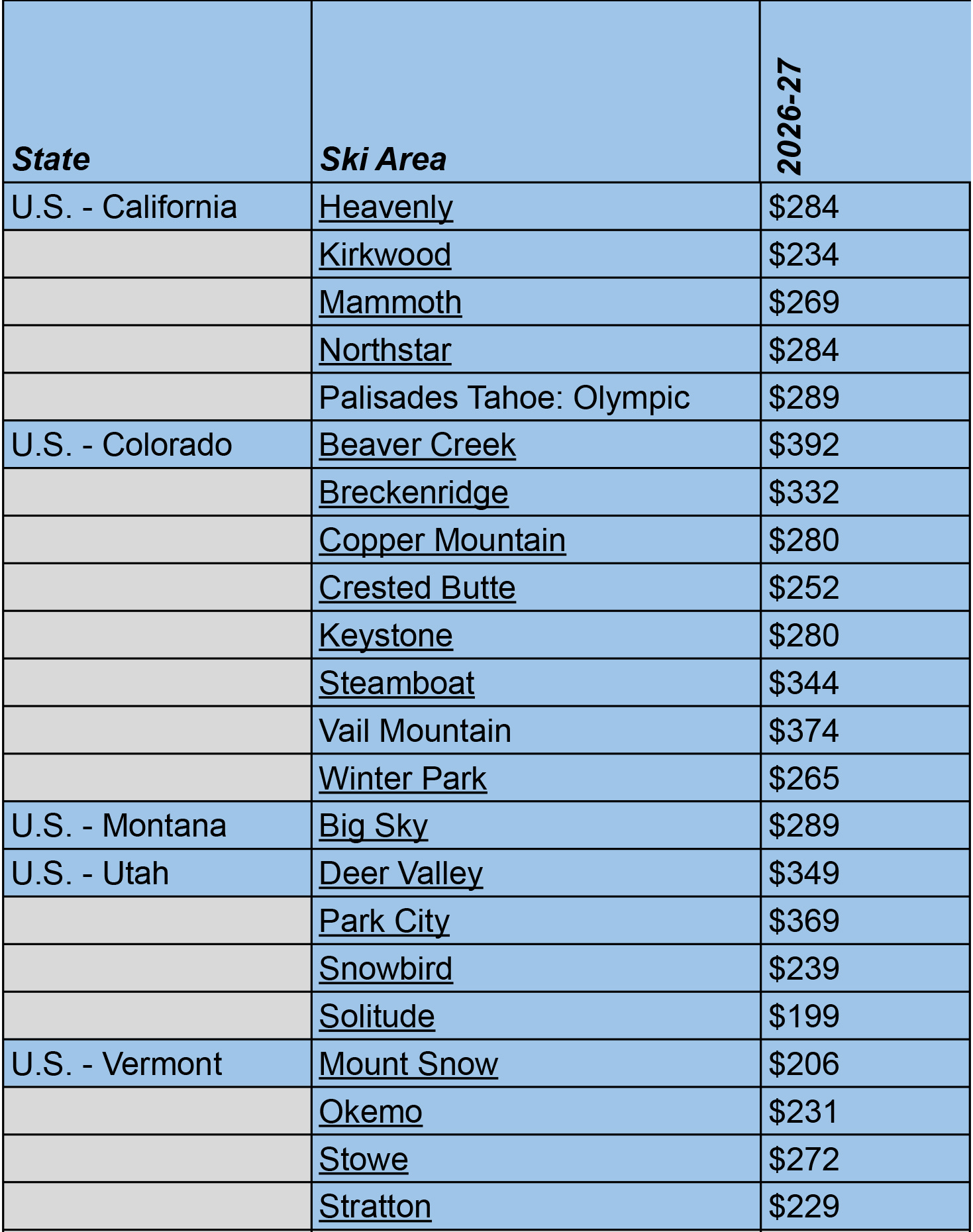
And I looked at these prices and I thought, “You know I’m not a lawyer or a government regulator or a Finance Bro or a marketer or a SnoSportSkiing executive or a Mt. McStudlison townie who skis 400 days per year, or really a person who can offer anything to society other than liking skiing and writing about it, but there is perhaps the tiniest chance that the rapid, simultaneous, and ahistoric surge in peak-day, in-person lift ticket prices across Epic- and Ikon-tied ski resorts tracing to the exact moment of those passes’ launch dates in (respectively) 2008 and 2018, while effective in mainstreaming the formerly niche ski season pass and thereby decoupling a weather-dependent industry from the vagaries of planet Earth’s ever-spinning seasonal schizophrenia, also alienated skiing’s core money-spending demographic, which despite the Instaboost reels of floppy-haired Brahs named Coltyn rocking hoodies in negative-four-degree weather while popping upside-down switch flippity-flops is actually guys named Holten with advanced degrees in biofinance who ski six days per year at Deer Valley usually over Christmas or President’s week or in March. And when Holten, who’s just swamped at the office meaning he spends 90 percent of his working hours monitoring Slack messages and updating his fantasy football roster, emails his wife Jennifer, “Wow look at the prices for our ski week this is kind of getting out of control,” she writes back “yeah no,” and even though between salaries and stock options and bonuses they collectively earn a half million dollars per year she proceeds to Google “Ski in Europe” or “Caribbean resorts” or “civilian Space X flight” and emails back “wow look at this awesome thing we could do instead of skiing at the sixth-best Ikon Pass resort in Utah on the busiest week of the year when the ski area could be like 20 percent open if we get another shitty winter?” And so the Trowleys decide they prefer Boca del Carmen to Park City just a couple years before they move from the Upper West Side to Scarsdale and have Brystoll and Archimedes, who grow up knowing only that vacations are to warm places and that skiing is a pastime reserved for hedgefund owners named Rothstonsully who breed camels as a hobby and message their real-estate broker things like “I didn’t say ‘helipad,’ singular. How else is one to get from the poolhouse to the albino tiger paddock?” And the remaining U.S. American skiers think, “well it seems sort of dumb and stupid that the price of one day of skiing has increased 500 percent this century, leaving us no choice, if we would like to SnoSportSki at the biggest Colorado ski areas, but to buy one of these thousand-plus-dollar passes. Which will then compel us, because of some sort of sunk-cost pyschological-economic principle, to ski at only a defined set of mountains all winter, so that even if we have an Ikon Pass and want to drive 15 minutes from Copper to Vail, it’s really no longer feasible because asking someone who’s already spent a month’s rent on a ski pass to pay $300 for an additional day of skiing is like setting up a cash bar inside of an all-inclusive resort.” And so even if, as I find likely, there never was a nefarious backroom meeting in which the major American ski area operators and their interest groups gathered amidst vats of yak blood and piles of baby seal furs and declared “We The Purveyors of the limited numbers of U.S. American SnoSportSkiing Operations Vast and Varied in terrain but also strangely limited in number, where the monied doth gather with their cublings mostly on weekends and holidays but also for most of March in Colorado, do hereby collectively and forever foreswear to set the price of last-minute walk-up lift tickets at levels more befitting of a Hollywood dark comedy set in an illiberal dystopian 2080s, so that these dumb idiot skiers, feeling great offense and shame but with no option other than to charge $1,400 to their credit card for one day of SkiLift access for their family will, taking responsibility for their dumb stupidity, perchance the following March purchase our Epyk and Eyekon SnoSportSkiing Passes, which are a tremendous bargain if you just do the math, so that they will never again suffer the shame of admitting on the Frat Bros Nintey-Fo’ WhatsApp group that they didn’t know they were supposed to pay for skiing 10 months before they actually planned on skiing, and we doth promise to undertake this pricing scheme even though such a strategy, while economically effective, is also objectively stupid and offensive to the human soul, especially since most of our ski resorts operate on leased public land, a detail we shant’n’t worry over since we have effectively handcuffed, via lobbying and nitpicking, the ever-shrinking and overworked U.S. Forest Service administrators who file our paperwork into allowing us to do basically whatever the hell we want on public land, so long as we, like, draw a checkboard pattern across some cliff-riddled unskiable section of the trailmap and label it Porcupine Habitat or whatever Bwah-hah-hah-hah-hah” and instead of this Doom Summit just sort of copied each other because “why the hell not it seems to be working and damn these Epic/Ikon checks are sick Bruh, and you know no one really pays that price anyway, except for the few idiots who do because if skiers spend even like five minutes on our website or scrolling through discussion boards populated by the socially inept dorklings on Reddit they will see that between use-them-any-day pre-purchased day-pass products, ticket packs, multi-mountain passes, or even super-duper early-bird lift tickets there are plenty of options to ski for less than the cost of a surprise brain transplant after forgetting to renew your health insurance.” But maybe just maybe when every single pass-affiliated operator so inflates lift ticket rates beyond historical norms all at once it makes those operators vulnerable to opportunistic lawsuits claiming that this is not simply a market evolution like the shift from horses to cars but is in fact a coordinated, industry-wide effort to fence off the American destination ski market from poor people occasional skiers anyone unwilling or unable to buy a thousand-plus dollar pass in the spring to ski the following February, thereby locking those skiers into a vertically integrated destination resort ecosystem, meaning that while sure the pass covers lift tickets it does not cover lodging and lessons and food, all of which each mountain nearly always exclusively controls within its permit area.
But what the hell do I know?
Without dissecting the particulars of this lawsuit – in which several put-upon skiers claim antitrust violations in the form of collusion by Vail, Alterra, Boyne, and Powdr, along with the National Ski Areas Association and their research consultants, RRC Associates – we can speculate that SkiBros v. SkiCos (Green v. Vail et al, if you prefer official names or whatever), is a product of several historic, cultural, and market ingredients, nurtured and cured and combined into the sort of Crap Stew that is U.S. American Skiing 2026. No one likes Crap Stew, but everyone helped make it. The ski area operators, who trashed traditional pricing structures with an arrogance that ignored socio-cultural and -economic fallout, are the natural and obvious villains here. But American skiers, who for decades have embraced a group identity defined by the irreconcilable beliefs that wilderness recreation ought to be easily accessible but remain as undeveloped as possible, are also to blame for creating, with destination ski resorts, a product scarcity that a handful of opportunistic operators could easily consolidate and control. Abetting and connecting these codependent antagonists is an administrative state that, especially in the West, has been steadily neutered and politicized, its powers defined down to give operators the broadest possible economic freedom at the expense of the consumer, whom the agencies placate with a regime of environmental stridency that over-protects the vanishingly small tracts of America’s 640 million public acres that we’ve set aside for intensive use.
American skiing works well in many ways. Despite ill-informed headlines fixated on the declining number of ski areas from historic highs, the industry, as a whole, has proven itself to be a climate-change super-adapter that offers rich consumer choice in nearly every U.S. market and at nearly every price tier. In 2026, there is more skiable terrain, more skiers, and more average annual skier visits than there was in 1976 or 1986 or 1996 or 2006 (well, 2026 kinda tanked, but 10-year participation trends are solidly higher than historical averages). But American skiing is broken in important ways, too. These are many and varied, and SkiBros v. SkiCos articulates – or at least infers – many of these anxieties. The most important of which is this: an antagonistic day-ticket pricing structure that ski area operators are aware of but refuse to acknowledge is undercutting the advent of dynamic and inventive products that have made skiing cheaper than ever for consumers who pay attention and shop in advance. As a result – and this is perhaps the most important point – the narrative power of the peak-day lift ticket cost, amplified via social media, has overwhelmed any ski industry efforts to keep skiers focused on the fact that skiing is fun and awesome.
There is a lot more to explore here. But I’m on a family vacation until next week, and I’m in the process of a major podcast revamp that will make Storm content more timely, consistent, and frequent. So before getting too deep into Captain Analysis mode and ruining the trip and dismissing my children to the care of the internet where embittered and vengeful they will eventually cast me as the main character in a 2038 Cats In The Cradle punk-country-sci-fi reboot or perhaps just convince the robots to kill me to loot their inheritance which surprise kids is a 2020 Pacifica overdue for an oil change and a bunch of left-over wicket-tickets from the 1990s, I’ll publish a historical series I’ve assembled over the past few months analyzing American lift-served skiing’s modern evolution.
Stand by.
Great writing as usual Stuart. Is that one sentence the longest in the history of the written word?
SkiWriterBro, may your ski runs be as long as your run on sentences. Looking forward to your take on Felon J. opening up roadless areas. Which you probably missed because obviously Guiness causes your pinky finger to forget where the period key is located.