


Four skiers filed a class-action lawsuit against Vail and Alterra in U.S. District Court in Colorado [Goloja v. Vail Resorts Inc. et al] last week, alleging that the companies’ Epic and Ikon pass sales tactics violated state and federal antitrust laws.
The lawsuit taps long-simmering consumer anger over escalating destination resort lift ticket prices:
“Following the introduction of Defendants’ Mega Passes, the prices of daily or short term (e.g. weekend) lift tickets purchased during the ski season (“Lift Tickets”) have climbed sharply. But this is no accident, or the result of competitive market forces. Pursuant to Defendants’ identical anticompetitive schemes, Lift Tickets for ski areas within the Epic and Ikon ecosystems are priced in a way to induce (or coerce) customers into buying the Mega Pass bundles.
“The primary (and unlawful) way that both Vail Resorts and Alterra drive skiers and snowboarders to purchase Mega Passes is to charge exorbitantly high prices for Lift Tickets. This coerces customers into buying their multi-mountain season pass offerings (the Epic and Ikon Mega Passes) which they then view as more cost effective as compared to a Lift Ticket. …
So framed, on page six of the 74-page lawsuit, the case appears to be built around the notion that ski area operators drove up lift ticket prices to coerce skiers into purchasing season passes (boldface mine):
“Skiers and snowboarders are led to believe they are making a cost-conscious decision in buying the Epic or Ikon Mega Pass, but in reality, and as a result of Vail Resorts’ and Alterra’s respective anticompetitive schemes involving bundling, they are in fact being forced into buying a Mega Pass, which is itself maximally (over)-priced up to the point where it looks like a good deal when compared to the over-priced Lift Ticket. In short, both the Lift Ticket and the Mega Pass are over-priced.”
But the plaintiffs do not build their legal case around pricing, as the “bundling” at the center of the lawsuit is not about lift tickets and season passes. It is, rather, the bundling of “lift access to destination ski resorts” and “lift access to regional ski areas”:
The Mega Passes offered by Vail Resorts and Alterra function as an anticompetitive tie-in, or bundle, under the antitrust laws.
A tying arrangement is an agreement by a party to sell one product but only on the condition that the buyer also purchases a different (or tied) product. Tying arrangements include instances of discount bundling, such as when a seller does not literally require the customer to buy two or more products together, but economically coerces that result by (for instance) charging a supracompetitive penalty price for the individual products compared to the price of the bundle.
With bundling schemes, as a subset or alternate form of an anticompetitive tying arrangement, there must be both a “tying product market” and a “tied product market.”
Here, (1) the tying product market is the market for lift access to Destination Ski Resorts; and (2) the tied product market is the market for lift access to Regional Ski Areas.
This is a novel argument, and one that I’ve never seen articulated in any ski community, online or otherwise. More on this:
Both Mega Passes can be viewed as bundles of individual, day-access lift tickets. But more important with respect to the allegations herein, the Mega Passes also combine lift access to Destination Ski Resorts with lift access to Regional Ski Areas. Consumers cannot purchase the core value proposition of these products—reasonable access to highly desirable Destination Ski Resorts—without also purchasing bundled access to many Regional Ski Areas included in the same Mega Pass ecosystem, even if they do not live anywhere close to these Regional Ski Areas. …
In other words, the lawsuit is claiming that skiers cannot purchase access to destination resorts such as Vail Mountain or Steamboat without also purchasing access to, respectively, Mt. Brighton in Michigan or Snowshoe in West Virginia. By providing more access than is strictly necessary, the Epic and Ikon passes, the plaintiffs argue, are overpriced (boldface mine):
Competition between two functionally identical (anticompetitive) bundles does not cure the coercion inherent in the tying arrangement, because consumers are still forced to accept the tied product to obtain the tying product. Critically, Vail Resorts and Alterra do not compete on the structure of their Mega Pass products. Instead, both Defendants employ the same exclusionary tying and bundling model: conditioning reasonably priced access to must-have Destination Ski Resorts on the purchase of all-or-nothing season passes that also bundle lift access to numerous Regional Ski Areas. At no point have Defendants meaningfully diverged from this model by offering unbundled destination access, modular pricing, or destination-only passes that would permit consumers to avoid the tied products. Thus, whatever putative competition exists between Defendants does not operate to constrain the tying arrangement itself, which is the source of the anticompetitive harm.
I don’t even know if Vail or Alterra has to assign a real lawyer to this case: I can shut it down with three charts. The argument that megapasses are overpriced because they tie destination resort access to regional ski area access is flimsy for two reasons:
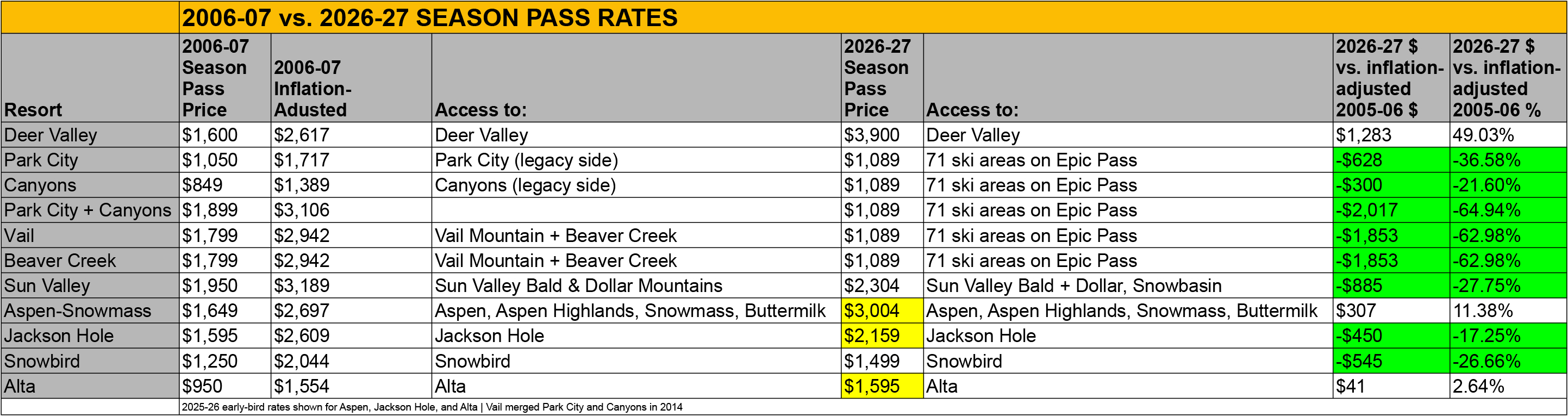
1) the Epic and Ikon Passes, where they function as the sole unlimited season pass product for destination ski areas, are in most cases substantially less expensive in both real dollars and inflation-adjusted dollars than their pre-megapass, single-mountain counterparts. Check out select season pass prices, in real and inflation-adjusted dollars, from pre-Epic, pre-Ikon 2006 to 2026 - season pass prices have fallen substantially even as those passes, in general, covered more mountains:
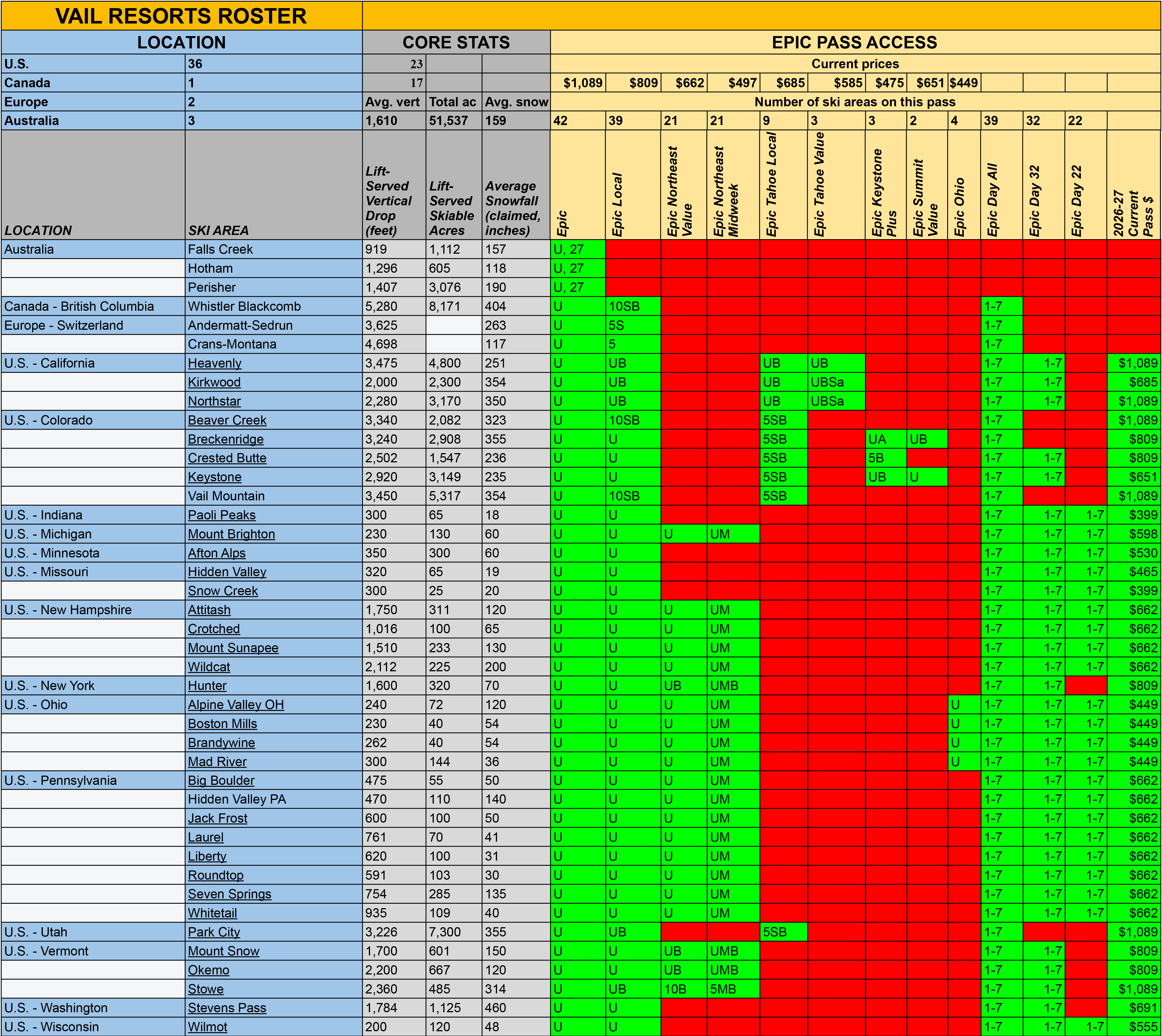
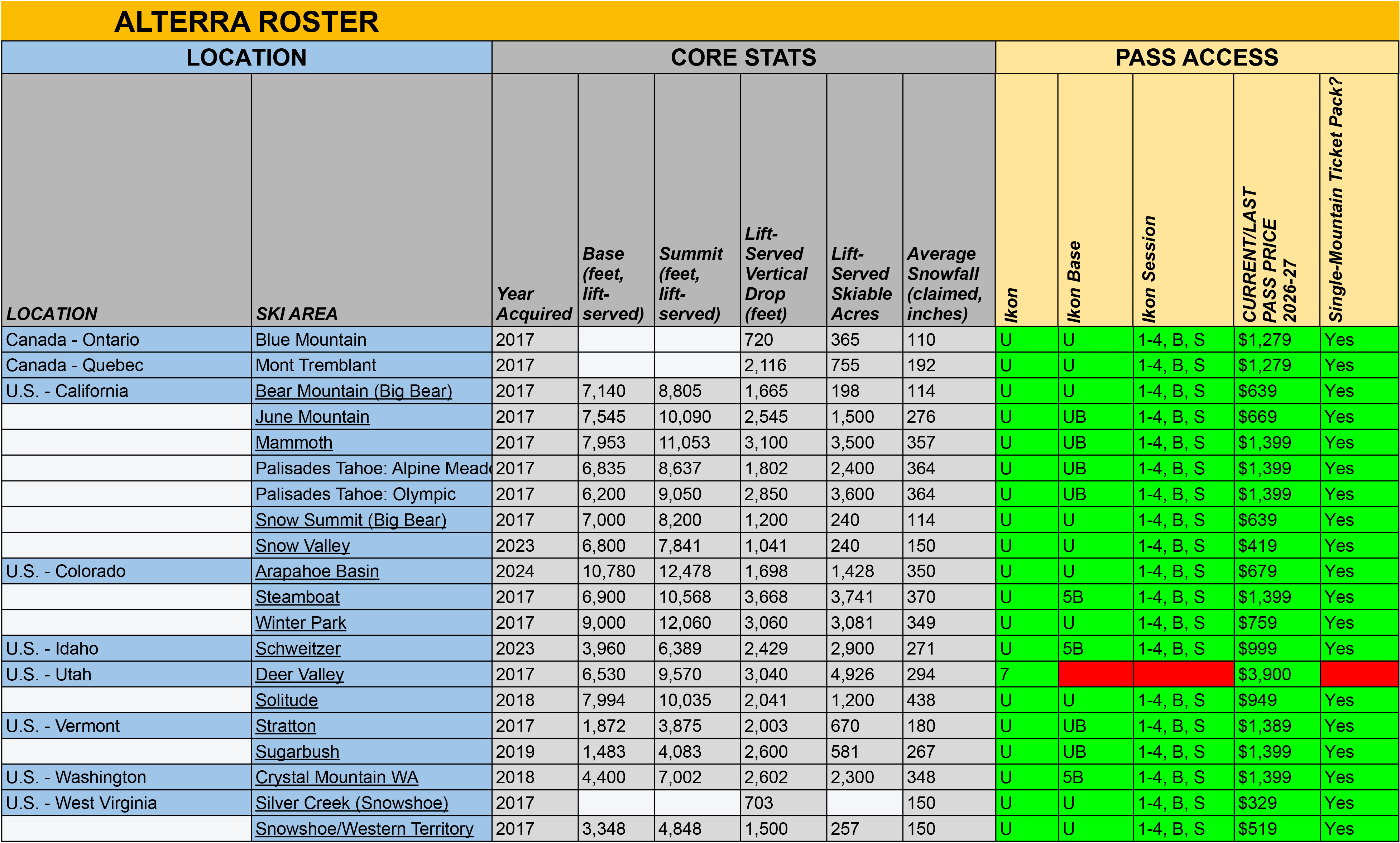
2) Vail and Alterra do in fact offer single-mountain season passes to the majority of their ski areas, as well as a variety of ticket-pack products that exclude smaller ski areas.
We could turn this lawsuit and its many sub-plot arguments inside-out, and analyze whether Vail and Alterra constitute a true duopoly (I don’t think they do), whether skiers and independent ski areas have benefitted from or been harmed by the advent of Epic and Ikon (I believe it’s mostly been for the better), or whether the “quality” of skiing has declined in recent years (again, I don’t think it has, holistically). I’ll analyze these particulars more as the legal process unfolds. And though I don’t believe any judge or jury will find the plaintiffs’ arguments compelling, I do believe this lawsuit should function as an alarm bell for both skiers and ski area operators.
Ski area operators – especially but not exclusively Vail and Alterra – have massively underestimated the raw anger stoked by the quadrupling of lift ticket prices since 2000. While affordable season passes are novel and cool, it’s a product that no one was really asking for. Most skiers looked at season passes like they looked at their uncle’s boat: wow, that’s an expensive cool thing that you probably only want if you live on a lake. But no one was arguing that boats should be less expensive so that everyone can have a boat, so long as boat rides stayed cheap. Vail has started to soften lift-ticket pricing, but both operators could make this price-gouging narrative disappear instantly by dropping lift tickets back to inflation-adjusted historic rates.
Skiers, watch what you ask for. At early-bird prices, purchasing a $369 Indy Base Pass, $809 Epic Local Pass, and $949 Ikon Base Pass gets you access to 217 U.S. ski areas for $2,127. Remember when we were all pissed off about the cost of cable, and so we said “fuck cable” and let the streamers destroy it, and now we have to subscribe to 18 different services for $17.99 per month just to watch college basketball? The megapass has given us an incredible gift in the form of passports that move us seamlessly across skiing’s formerly balkanized borders. Do we really want to return to the days of the $3,000 season pass just because someone who lives in Park City thinks they’re also paying for access to Wilmot, Wisconsin? Because right now, it kind of seems like we do.
To me, this appears to me no more than a fishing expedition by a group seeking a settlement payment to have them go away.
The mega passes are a great benefit to anyone planning to ski more than seven or so days a season. As you document, this results in season pass prices declining at all but a few areas. This reminds me of frivolous government regulation of big tech because they effectively reduced their costs of services to consumers to zero, thwarting competition. Only in America are lower prices anti-competitive. As Frederic Bastiat famously opined “the interests of the consumers are the interests of the human race.”
Thanks for the analysis - I think the lawyers who filed this should have retained you first!!