


Who
Jasen Bellomy, General Manager of Pajarito, New Mexico
Date Recorded
September 28, 2026
Also discussed
Upgrades across Mountain Capital Partners’ portfolio (see chart below), and reader reaction to last week’s pods - especially the EuroSki ep with Iain Martin.
About Pajarito
Owned by: Mountain Capital Partners, since 2014; company also owns:
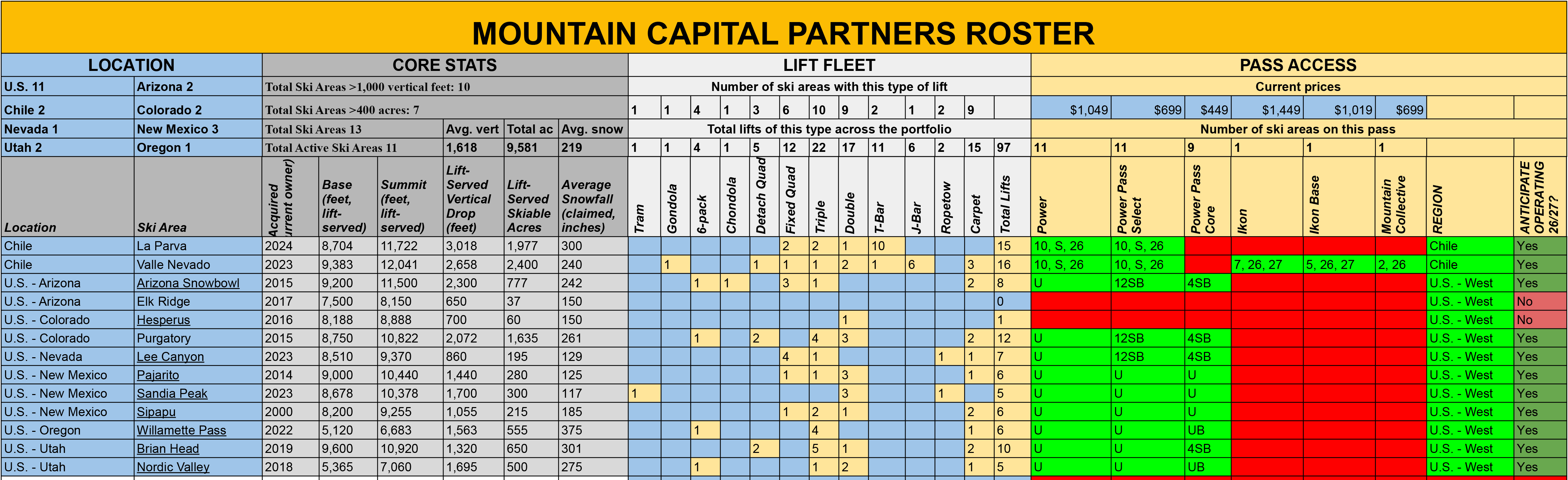
Year founded: 1957 - predecessor ski area, Sawyers Hill, founded nearby by the same ski club in 1944
Pass affiliations: Power Pass, Power Pass Select, Power Pass Core - unlimited
Base elevation: 9,000 feet
Summit elevation: 10,440 feet
Vertical drop: 1,440 feet
Skiable acres: 280 trail acres + unspecified glade acreage (though Bellomy urges caution in the glades)
Average annual snowfall: 125 inches
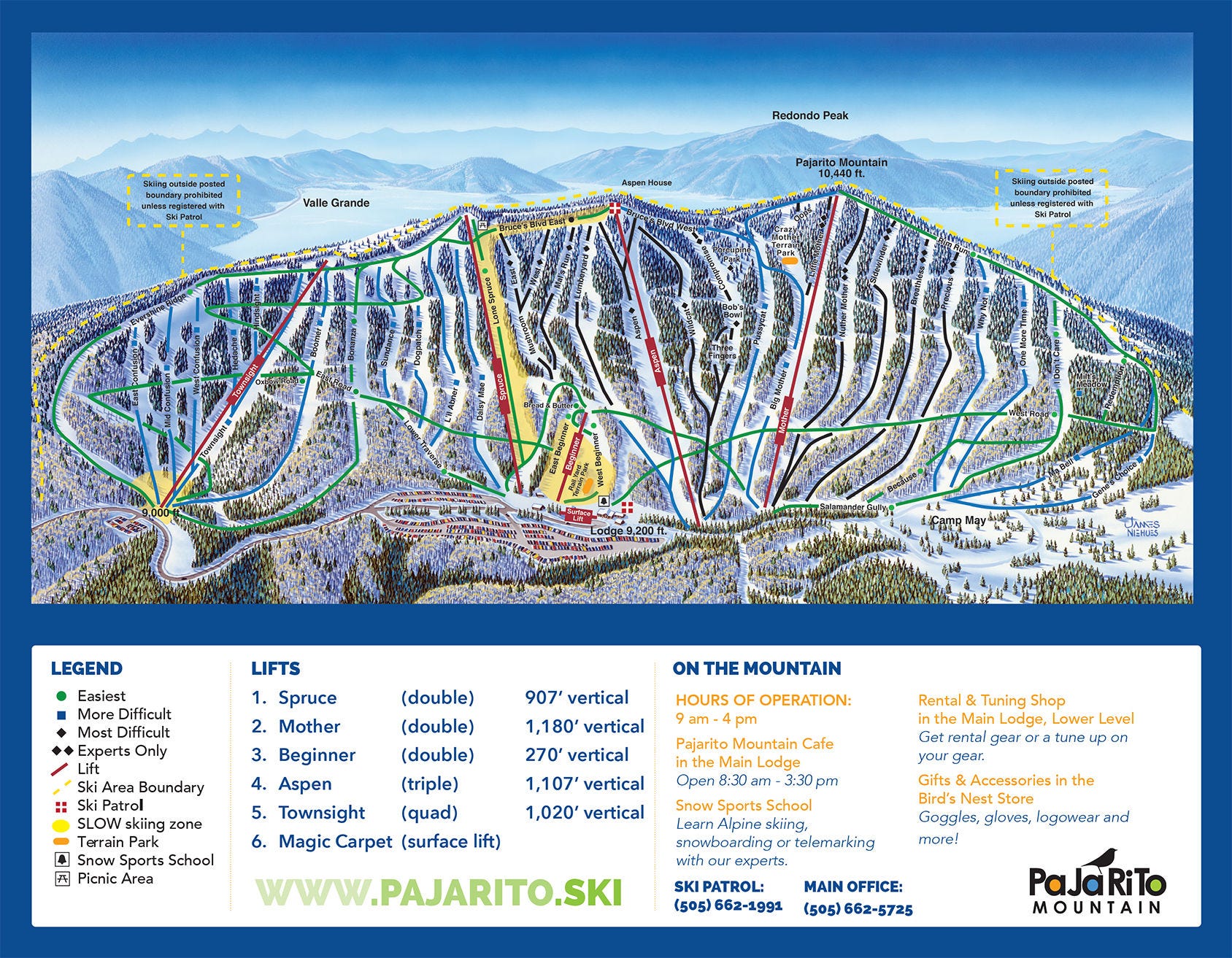
Lift count: 6 (1 fixed quad, 1 triple, 3 doubles, 1 carpet) - view Lift Blog’s inventory of Pajarito’s lift fleet.
Why I interviewed him
“Ski New Mexico,” you say?
Those three words underwhelm, but the stat sheet suggests that skiers miss out by dismissing New Mexico:
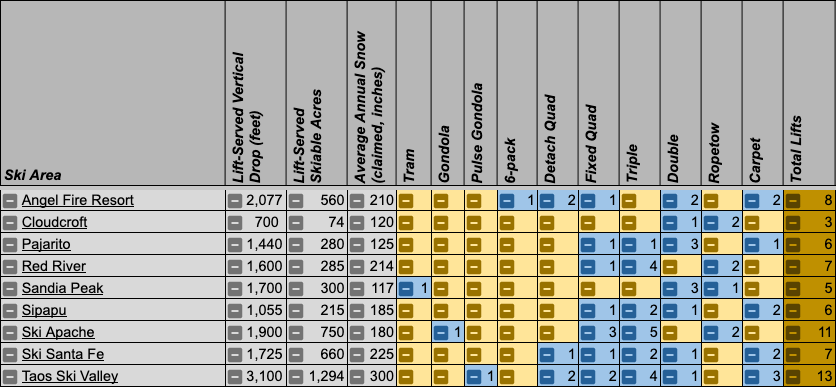
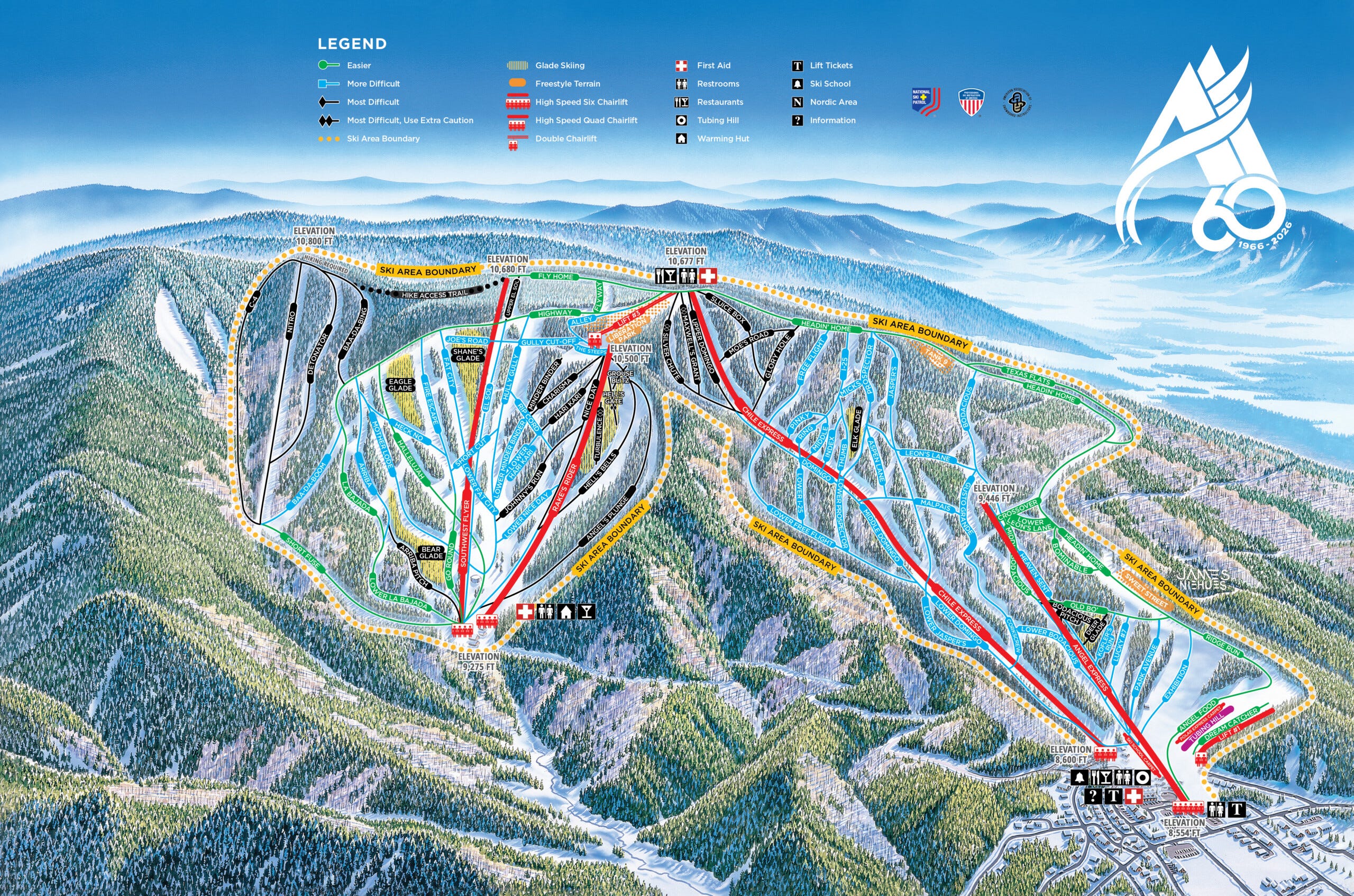
Those are respectable vertical drops, and some nice acreage with modernizing lift fleets. Taos gets all the Ikon/Mountain Collective destination attention, and deserves it, after building seven new aerial lifts and otherwise sweeping the place clean over the past dozen years. But just about every New Mexico ski area is investing: Angel Fire props up the state’s first sixer for winter 2026-27, just a year after dropping a second quad, Rake’s Rider, onto its east side to spread skiers out between blues and blacks:
Ski Santa Fe, Ski Apache, and Red River have collectively built or relocated another five lifts in the past decade. Tiny, super-south Cloudcroft seems like a mess, with little online presence and minimal operations (the bump lacks snowmaking). But overall, New Mexico is a bit of a big-mountain secret, with dry desert snow when it comes.
The key to this improbable kingdom is base elevations among the highest in America:
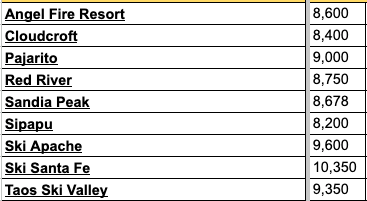
It’s not quite Colorado, but they’re high:
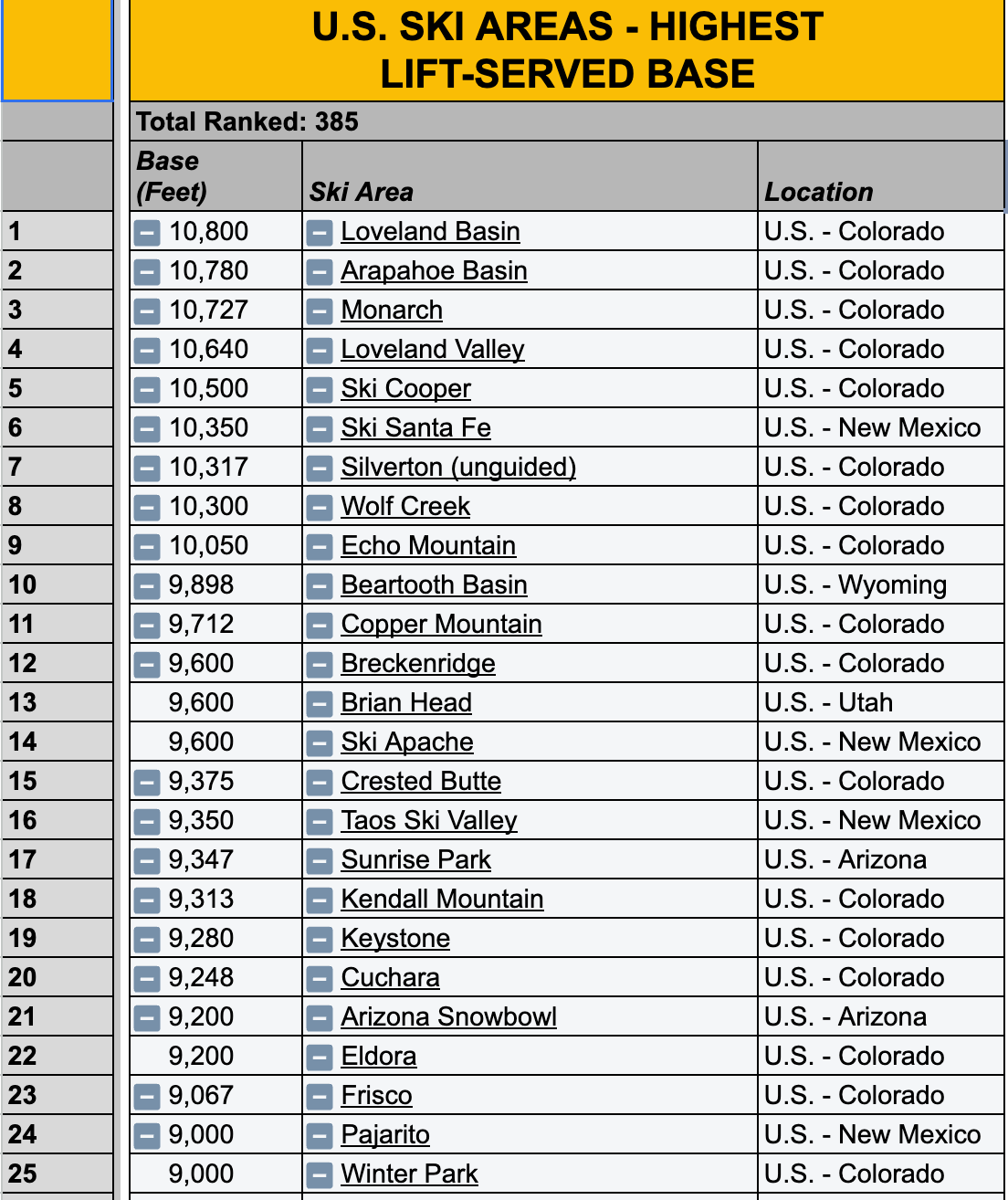
And it’s high enough to get us to nine active New Mexico ski areas in 2026, which is probably nine more than most people think the state has. But even cloud addresses are not enough to keep these survivors around forever. They need snowmaking. Taos’ system - a big part of the mountain’s modernization under billionaire Louis Bacon, who bought the ski area in 2013 - runs to nearly 11,000 feet. But the smaller areas are building more firepower too. MCP, which operates one-third of those ski areas, stapled together a nice system at Sipapu, the company’s first acquisition, in 2000. Now, after years of negotiations, MCP is working with state and Los Alamos County officials on an $18 million snowmaking modernization plan for Pajarito:
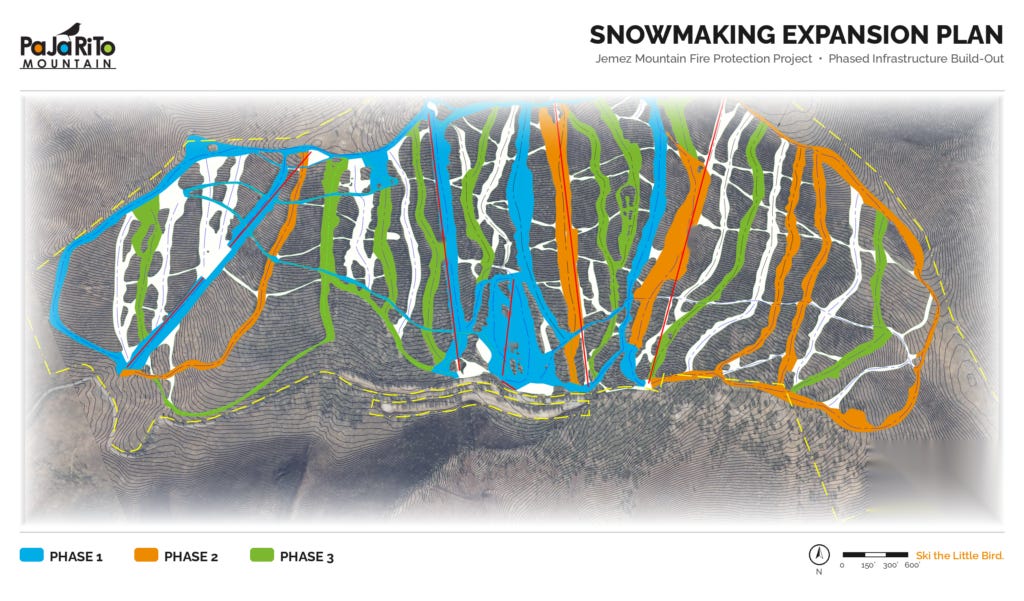
A five-mile pipe will shuttle water approximately 2,000 vertical feet up from Los Alamos to Pajarito’s summit reservoir. But this is not just a snowmaking project: firefighters will be able to tap hydrants along the five-mile route or dip the 10-million gallon reservoir with helicopters.
The impact, MCP officials believe, will be substantial, and could mirror the turnaround of the company’s Arizona Snowbowl ski area. Prior to running a 15-mile-long snowmaking pipe 3,000 feet up from Flagstaff, Snowbowl’s seasons swung wildly, from 162,000 visits in winter 2000-01 to just four operating days the following season. Now, Snowbowl is consistently one of the last ski areas in the nation to close, with a 185-day 2024-25 season that ended on June 1. Repeating that success at Pajarito would, according to officials, give skiers seasons up to 140 days long - more than double the ski area’s traditional 60-day winter.
So yeah, ski New Mexico, Man. It’s weird, I know. Down there in the desert. But there’s water if you get creative and work together. (Now we just need to see if MCP can repeat some version of this deal at snow-starved Sandia Peak.)
Additional reading
A Ski profile of Pajarito by Nick Heil, 2016
Pajarito’s blog tracking the snowmaking project
Transcripts
There are two transcripts. Both are generated by robots. Both are helpful and defective in their own unique ways. I do not proofread either of them.
Transcript 1: Click the “transcript” button at the top of this article. You can only see this transcript on a computer. Because I don’t know why exactly but everything is getting better and dumber all at once it seems. Anyway, this is the transcript that the robots create when I upload the podcast to the internet. The cool thing about it is that you can click on any block of text and the audio will teleport there instantly. The uncool thing about this transcript is that it does not indicate who is talking at any given moment.
Transcript 2: You can read this below. This is the transcript that Zoom creates as we record the podcast. The cool thing about this transcript is that it indicates who is talking at any given moment. The uncool thing about this transcript is that the timestamps do not match the audio. Also, you cannot click on this text to move to the associated point in the audio. I only included my conversation with Jasen in this transcript - you can read my editorial on MCP or my reaction to reader’s comments in the other transcript, but frankly I’d either listen to them or skip those sections.
Zoom
Stuart Winchester: My guest today has been the general manager of Powerito New Mexico since 2023.
00:35:14.000 --> 00:35:26.000
Stuart Winchester: Bajarito’s predecessor ski area, Sawyers Hill, was founded by top American scientists and soldiers working on top secret research, including the Manhattan Project in Los Alamos during World War II.
00:35:26.000 --> 00:35:46.000
Stuart Winchester: In 1957, the Los Alamos Ski Club moved the facility up to Pareto, where today, 5 chairlifts serve 1,440 vertical feet on 280 skiable trail acres, plus glades. Pareto is one of 13 ski areas operated by Durango, Colorado-based Mountain Capital Partners.
00:35:46.000 --> 00:35:52.000
Stuart Winchester: and one of three that the company operates in New Mexico, including Sipapu and Sandia Peak.
00:35:52.000 --> 00:36:09.000
Stuart Winchester: Prior to joining the team at Power Reno, he worked at Saddleback, Maine, Sugarbush, Vermont, Pratchett, New Hampshire, and all the way back at the start of his career as a lifty at Waterville Valley, New Hampshire. He served a tour in the Marine Corps and spent several years working in air traffic management technologies.
00:36:09.000 --> 00:36:16.000
Stuart Winchester: Jason Bellamy is my guest. Jason, welcome to The Storm. So good to have you. How is life in the mountains of New Mexico today?
00:36:16.000 --> 00:36:24.000
Jasen: Oh, man, thanks for having me. Super excited. Uh, busy. And wet, currently.
00:36:23.000 --> 00:36:38.000
Stuart Winchester: Oh, yeah, yeah, it’s… I’m out on the East Coast, it’s been raining all weekend, so… so I… look, I know you got a ton going on, so let’s jump right into it. The headline, if you go to Powerito’s website right now, which, by the way, if I’m saying the name of the scary wrong, you.
00:36:38.000 --> 00:36:48.000
Stuart Winchester: 2700% more water for snowmaking, so lay this out for us, Jason. What did Powerito’s snowmaking system look like before, and what are you…
00:36:48.000 --> 00:36:50.000
Stuart Winchester: Building up.
00:36:51.000 --> 00:36:57.000
Jasen: So, historically, it was about 2010 that we were able to.
00:36:57.000 --> 00:37:04.000
Jasen: while it was still operated by the Los Alamos Ski Club, they put in a very bare-bones snowmaking system.
00:37:04.000 --> 00:37:10.000
Jasen: and captured surface runoff in the springtime to fill a 10 million gallon pond at the top of the mountain.
00:37:10.000 --> 00:37:11.000
Stuart Winchester: Mmhm.
00:37:11.000 --> 00:37:17.000
Jasen: The runoff did not yield enough water to fill that pond.
00:37:17.000 --> 00:37:18.000
Jasen: So for…
00:37:18.000 --> 00:37:35.000
Jasen: pretty near a decade, there’s been this effort to get a pipeline connecting the county to the Ski Hill for both wildfire suppression and firefighting capabilities, as well as solidifying the future for the Ski Hill.
00:37:36.000 --> 00:37:43.000
Jasen: That pipeline is going to provide us with about, we’ll be able to cycle that pond about six times a winter.
00:37:43.000 --> 00:37:55.000
Jasen: Um, which, with 60 million gallons, we should be able to make about 300 acre-feet of snow. So, theoretically, when we’re done with this, we could cover the entire mountain with 12 inches of man-made snow.
00:37:56.000 --> 00:38:13.000
Stuart Winchester: So talk about, I guess, to start with, just that pipeline. I mean, there’s echoes here of Arizona Snowbowl, your sister mountain, which ran a pipeline all the way down to Flagstaff from its mountain. And from the press materials, it looks like this is being run up.
00:38:13.000 --> 00:38:20.000
Stuart Winchester: from Los Alamos. So how long is that pipeline? Where does it start? And what does the effort look like to put that in?
00:38:20.000 --> 00:38:23.000
Jasen: Yeah, great question. Um…
00:38:23.000 --> 00:38:39.000
Jasen: The project started over half a decade ago, the real nuts and bolts of it. It’s a really complex project. It involves running that pipeline across DOE land, Llano property, Santa Fe National Forest. We had to get the county, the state, and the federal government.
00:38:39.000 --> 00:39:01.000
Jasen: behind it, and it’s amazing how everyone’s come together. So, after about five or six years of negotiating and all the legal work required, we were able to break ground. The pipeline’s about five miles long, and as a result of previous wildfires that have sparked up from the overhead power lines, we decided to go ahead and put the power underground as well.
00:38:40.000 --> 00:38:41.000
Stuart Winchester: Mmhm.
00:39:01.000 --> 00:39:03.000
Stuart Winchester: Mmhm.
00:39:02.000 --> 00:39:03.000
Jasen: Um, so…
00:39:03.000 --> 00:39:16.000
Jasen: The… we’re also running fiber infrastructure in the road associated with the project so that we can create backhaul to Albuquerque to solidify our communications for the community as well.
00:39:16.000 --> 00:39:20.000
Jasen: There’s a lot more going on with this project than just water.
00:39:20.000 --> 00:39:22.000
Jasen: Oh.
00:39:22.000 --> 00:39:23.000
Jasen: The…
00:39:24.000 --> 00:39:36.000
Jasen: there’ll be 4 booster stations to push the elevation to get it to the mountain, and then it’ll tie into a 250,000 gallon tank, which will energize all the fire hydrants along Camp May Road.
00:39:36.000 --> 00:39:42.000
Jasen: And then from there, we push it to the summit pond out of a pump station.
00:39:43.000 --> 00:39:52.000
Stuart Winchester: So, so we’re looking here at the, at the map of, uh, here’s Puerto Rico and then here’s Los Alamos. Does the, does the pipeline come from up from the.
00:39:52.000 --> 00:39:59.000
Jasen: It does. It starts down just on the corner of the DOE property at the bottom of Camp May Road.
00:39:59.000 --> 00:40:03.000
Jasen: It’s a few thousand feet down, um…
00:40:04.000 --> 00:40:05.000
Jasen: Once you get…
00:40:05.000 --> 00:40:07.000
Jasen: Yes.
00:40:07.000 --> 00:40:10.000
Stuart Winchester: Click around, here’s Camp May Road, where it meets up with West Road.
00:40:07.000 --> 00:40:10.000
Jasen: So, on… on…
00:40:10.000 --> 00:40:21.000
Jasen: Yes, uh, just to the, uh, I guess that would be east on West Road. If you scroll your mouse to the corner there, you can see there’s a tank right there.
00:40:15.000 --> 00:40:16.000
Stuart Winchester: Okay.
00:40:18.000 --> 00:40:19.000
Stuart Winchester: Mmhm.
00:40:20.000 --> 00:40:21.000
Stuart Winchester: Okay.
00:40:21.000 --> 00:40:29.000
Jasen: We built another half million gallon tank there, and then that’s where the first booster pump will reside.
00:40:28.000 --> 00:40:45.000
Stuart Winchester: Okay. Well, that is a major project. I mean, just talk about the effort of that. I, you know, I guess it’s a partnership. Did you share in the cost of construction of all this? And what did it take to run a pipeline five miles?
00:40:45.000 --> 00:40:50.000
Stuart Winchester: And I’m not sure what the elevation is it starts at, but I imagine you have to also push that water up.
00:40:50.000 --> 00:41:06.000
Jasen: It’s close to 2,000 feet of elevation gain, and it is a financial partnership. It’s probably one of the first of its kind where we’ve got federal, state, local, and private dollars to accomplish the mission.
00:40:54.000 --> 00:40:55.000
Stuart Winchester: Wow.
00:41:04.000 --> 00:41:06.000
Stuart Winchester: Mmhm.
00:41:06.000 --> 00:41:10.000
Jasen: It’s really just amazing to see the support.
00:41:10.000 --> 00:41:17.000
Jasen: And everything come together. Los Alamos and Mountain Capital Partner developed a.
00:41:17.000 --> 00:41:22.000
Jasen: an agreement. So, the state was, uh…
00:41:22.000 --> 00:41:29.000
Jasen: basically funded with a grant, the project, um, for $8 million, and then FEMA’s kicking in.
00:41:29.000 --> 00:41:30.000
Jasen: Um, so…
00:41:30.000 --> 00:41:40.000
Jasen: an amount to be determined to bury those power lines. Historically, Los Alamos has been very affected by two, um, huge wildfires.
00:41:40.000 --> 00:41:53.000
Jasen: With hundreds of millions of dollars in, um, asset loss. So, the water getting up there, and Parito, the way it sits, is kind of like a frontline defense to protect the town and the lab.
00:41:53.000 --> 00:41:54.000
Jasen: Oh.
00:41:54.000 --> 00:41:59.000
Jasen: So, it’s amazing that everything’s come together the way it has.
00:41:59.000 --> 00:42:10.000
Stuart Winchester: Yeah, I want to linger on that water point for a moment here, Jason. You know, I never really appreciated this until I was talking to some of the guys who run ski areas in Southern California, and I believe this is your pond right here.
00:42:10.000 --> 00:42:15.000
Stuart Winchester: Uh, which you anticipate being full, and I’m not sure if there’s an older picture, if that’s what.
00:42:11.000 --> 00:42:12.000
Jasen: Yes, it is.
00:42:16.000 --> 00:42:18.000
Stuart Winchester: So so.
00:42:16.000 --> 00:42:19.000
Jasen: That’s pretty current.
00:42:18.000 --> 00:42:35.000
Stuart Winchester: Okay, yeah, so this is Google Earth. So I was speaking with Robbie Ellingson, who runs Mount Baldy, right above Los Angeles, and Carl Kabasinski, who runs Mountain High, just there, I guess, a little bit east of the city. And the way they explained it to me, I never thought about this, was…
00:42:35.000 --> 00:42:41.000
Stuart Winchester: When they have these full ponds in the summer, the helicopters can just come and dip the pond.
00:42:41.000 --> 00:42:57.000
Stuart Winchester: ponds for fire suppression. And so I, I guess that would help answer the question of, you know, we always hear about water shortages in the, in the West, right? So, so how is the ski area building, you know, all this snow making, don’t we have better things to use water for? So, so just talk about that relationship.
00:42:57.000 --> 00:43:05.000
Stuart Winchester: Uh, with… with the, uh, firefighters and… and the firefighting infrastructure this is creating, as well as being useful for snowmaking.
00:43:06.000 --> 00:43:18.000
Jasen: But yeah, you brought up two interesting points there, sir. First and foremost, yes, they will be able to dip out of the pond. We’re also putting in a dry hydrant so that we can hook pump vehicles up to it.
00:43:18.000 --> 00:43:20.000
Jasen: Um…
00:43:18.000 --> 00:43:20.000
Stuart Winchester: Mmhm.
00:43:20.000 --> 00:43:32.000
Jasen: The other thing, I think Mountain High in California, one of the things they did when that fire came through there was they energized their snowmaking system in the summer and just turned on all the snow guns.
00:43:32.000 --> 00:43:33.000
Stuart Winchester: Mmhm.
00:43:32.000 --> 00:43:37.000
Jasen: And from what I understand, that that had a beneficial…
00:43:37.000 --> 00:43:50.000
Jasen: outcome. Um, it could have been a lot worse, apparently. So, there’s a bunch of different things, and we’ve got water now that we can push, you know, multiple locations across the mountain as we build out our pipelines.
00:43:50.000 --> 00:44:01.000
Jasen: in our snowmaking infrastructure. So we’re gonna put water across this 750-acre piece of land that is pretty critical in the defense of Los Alamos.
00:44:01.000 --> 00:44:08.000
Jasen: And then the other thing you mentioned, which I hear a lot, is how can we waste all this water for skiing?
00:44:08.000 --> 00:44:21.000
Jasen: But fundamentally, if you consider what mountains are, they’re a storage device for water during the wintertime. We take the water from the earth, we pump it up the hill, yeah, we’re using energy, but we’re conserving the water on the hill.
00:44:21.000 --> 00:44:36.000
Jasen: as stored water, and in the springtime it melts and goes back into the aquifer. So 80 to 90 percent of the water that we use is going to go directly back into the land. I mean, what we’re losing is what we lose to sublimation through evaporation into the atmosphere.
00:44:37.000 --> 00:44:54.000
Stuart Winchester: Yeah, and in the fires in the past where a couple of Poweritos lifts were damaged, having this on site would theoretically have at least mitigated the damage to some point. So what I have up on the screen here, Jason, as you know, but for the folks watching on stormskiing.com or YouTube.
00:44:54.000 --> 00:45:09.000
Stuart Winchester: is, uh, your phased snowmaking plan. So just talk us through this. Is this year one, year two, year three, or… or how do you… how do you envision or plan for this to play out in real life? And then, you know, here’s…
00:45:09.000 --> 00:45:14.000
Stuart Winchester: Pario’s trail map for reference, but just to see the snowmaking plan.
00:45:15.000 --> 00:45:24.000
Jasen: This was originally the concept that we were going to roll with. Like any major project, there’s speed bumps in the road.
00:45:19.000 --> 00:45:20.000
Stuart Winchester: Mm-hmm.
00:45:23.000 --> 00:45:25.000
Stuart Winchester: Mmhm.
00:45:24.000 --> 00:45:35.000
Jasen: So we’ve had to pivot a little bit. Um, we’re putting a lot more resource into the actual delivery of water in year one, so we had to scale back a little bit of the on-hill distribution.
00:45:35.000 --> 00:45:36.000
Stuart Winchester: Mmhm.
00:45:35.000 --> 00:45:43.000
Jasen: For this winter, we’re gonna add about 50% in snowmaking coverage, acreage wise.
00:45:43.000 --> 00:45:50.000
Jasen: Uh, we did not get into the pump stations. We’re working on engineering and design of, um, future pump stations.
00:45:50.000 --> 00:45:52.000
Jasen: Right now…
00:45:52.000 --> 00:46:02.000
Jasen: We’re at about 1,000 GPM, gallons per minute, for production pumping capacity, and next year we plan to increase that by 400%.
00:46:02.000 --> 00:46:07.000
Jasen: Um, final design build out of 4,000 gallons per minute.
00:46:07.000 --> 00:46:09.000
Jasen: which…
00:46:07.000 --> 00:46:09.000
Stuart Winchester: And yeah.
00:46:09.000 --> 00:46:11.000
Jasen: Oh, I’m sorry, go ahead.
00:46:11.000 --> 00:46:29.000
Stuart Winchester: So, final of 4,000 gallons per minute. You have some trails in white here that are not phased. Do those already have snowmaking, or do you want to keep some stuff natural? I see your famous kind of front four steepies here. A couple of those are white. So, talk to us about the white trails and what’s planned for those.
00:46:30.000 --> 00:46:34.000
Jasen: So, those will just be… those will be El Natural?
00:46:34.000 --> 00:46:41.000
Jasen: Classic, you know, old school bump runs and let Mother Nature take care of those.
00:46:43.000 --> 00:46:49.000
Stuart Winchester: All right, so another interesting thing about Pyroido, Jason, is…
00:46:49.000 --> 00:46:57.000
Stuart Winchester: It’s the only major New Mexico skier area, other than Angel Fire, that does not operate, as far as I understand it, on U.S. Forest Service land.
00:46:57.000 --> 00:47:12.000
Stuart Winchester: So who does own the land? You referenced a lot of different entities here. I know there’s a partnership with the county. Does MCP own the land? Was that given to the county? Take us through the land ownership and the sort of different parties that are involved here and have an interest.
00:47:13.000 --> 00:47:17.000
Jasen: So, the land historically was…
00:47:18.000 --> 00:47:22.000
Jasen: Um, owned by the Los Alamos Ski Club.
00:47:21.000 --> 00:47:23.000
Stuart Winchester: Mmhm.
00:47:22.000 --> 00:47:28.000
Jasen: Through over the course of time, they did some land exchanges with DOE.
00:47:28.000 --> 00:47:32.000
Jasen: So back in 14 when the ski club needed support.
00:47:32.000 --> 00:47:49.000
Jasen: Um, James and Mountain Capital got involved, and originally, MCP was going to assume the liabilities of the ski area and operate the ski area. The bank didn’t like that arrangement, so it took about 3 or 4 years to get through the legal work.
00:47:49.000 --> 00:47:58.000
Jasen: And currently, the majority of the land is owned by MCP. That was a requirement from the bank to transfer the liabilities against the assets.
00:47:58.000 --> 00:48:05.000
Jasen: And then there’s one shoulder over on the west side that was originally part of, um…
00:48:05.000 --> 00:48:09.000
Jasen: I believe it was the Dunnigan family owned it.
00:48:09.000 --> 00:48:17.000
Jasen: And they gave it to the ski club, and there was a first right of refusal on any future transfer of the west side.
00:48:17.000 --> 00:48:32.000
Jasen: So currently, we’re still working through the legal details on that. And in the transfer of the land, the ski club said once the pipeline was established and operational, that they would be willing to transfer the remaining land to MCP.
00:48:32.000 --> 00:48:39.000
Jasen: So that’s happening here pretty quickly, and there’s still… there’s a bunch of legal work to satisfy the first right of refusal.
00:48:39.000 --> 00:48:40.000
Stuart Winchester: Mmhm.
00:48:39.000 --> 00:48:46.000
Jasen: Um, but essentially, Parrito, the 750-acre parcel, is completely privately owned.
00:48:46.000 --> 00:48:48.000
Jasen: Oh.
00:48:48.000 --> 00:48:50.000
Jasen: Which is pretty rare in the West.
00:48:50.000 --> 00:48:57.000
Stuart Winchester: Yeah. So you’re a little late to snowmaking, but it’s… in some ways, I would think…
00:48:57.000 --> 00:49:01.000
Stuart Winchester: an advantage to install a snowmaking system, kind of…
00:49:01.000 --> 00:49:17.000
Stuart Winchester: from whole right now, because the technology’s gotten so good, right? You can start low energy, you can start with automation, if you want. Talk to us about who you worked with, whether it’s SMI or HKD or whoever, uh, to plan out your snowmaking system, and what sort of technology.
00:49:17.000 --> 00:49:21.000
Stuart Winchester: you’re able to deploy to make sure you get the most snow out the most efficiently.
00:49:22.000 --> 00:49:27.000
Jasen: Yeah, great question. So, the partners that we’ve most…
00:49:28.000 --> 00:49:33.000
Jasen: We worked with, uh, Torrent is working with us on some of the pump stations.
00:49:33.000 --> 00:49:34.000
Stuart Winchester: Mmhm.
00:49:33.000 --> 00:49:46.000
Jasen: The pipe design layout, electrical. Brandon, I’m sorry, Jeff and the guys from Slope Works have been here supporting the physical installation.
00:49:46.000 --> 00:49:55.000
Jasen: And because of the history of Puerto Rico, we originally had a — it was a TechnoAlpin system. So we’ve got some legacy TA gear here.
00:49:51.000 --> 00:49:52.000
Stuart Winchester: Mmhm.
00:49:55.000 --> 00:50:04.000
Jasen: And then, we’ve also started working with SMI on some of their equipment. One of the things that, um…
00:50:04.000 --> 00:50:11.000
Jasen: we’re balancing is… there’s so much need in terms of how much infrastructure we have to build and how much equipment we have to purchase.
00:50:11.000 --> 00:50:16.000
Jasen: So we’re kind of balancing the future with today’s needs.
00:50:16.000 --> 00:50:17.000
Stuart Winchester: Mmhm.
00:50:16.000 --> 00:50:22.000
Jasen: Automation is not inexpensive, so we’re doing kind of a semi automation.
00:50:23.000 --> 00:50:34.000
Jasen: where we can run actuators on the hydrants, but it’s not a full-blown system. The original system that was installed back in the early 2010 period, um…
00:50:27.000 --> 00:50:28.000
Stuart Winchester: Mmhm.
00:50:34.000 --> 00:50:41.000
Jasen: That system didn’t work out very well for Power Reno, so we’ve pivoted and moved in a different direction.
00:50:42.000 --> 00:50:58.000
Stuart Winchester: So, you know, you’ve had snowmaking for a while. I’d imagine you got some guys who are pretty good at it. I saw one of your videos, you brought in a fellow from Pennsylvania. I always say that Pennsylvania is home to some of the best skier operators in the world because they have to be masters.
00:50:58.000 --> 00:51:14.000
Stuart Winchester: of snowmaking, because if you don’t have it, you’re just not going to open. I know you’re an East Coast guy yourself, so what have you done as far as, okay, you got this great new system, have you brought in some folks who are more experienced with snowmaking to help out? Are you confident you have the experience yourself?
00:51:14.000 --> 00:51:18.000
Stuart Winchester: What’s your plan to make sure you get the most out of the system right away?
00:51:19.000 --> 00:51:36.000
Jasen: So we got Brandon on board and one of the things that’s challenging at every skier across the country is staffing. So for this winter we really need to nail it and we reached out to Seasonal Labor Solutions.
00:51:27.000 --> 00:51:29.000
Stuart Winchester: Yeah. Okay.
00:51:37.000 --> 00:51:42.000
Jasen: And they have a team of professional snowmakers that basically do the Never Summer.
00:51:42.000 --> 00:51:55.000
Jasen: Um, so after the guys get done making snow for the Birds of Prey up in Colorado, a couple of those guys are gonna come down and support us this winter for the season to make sure that we get it right.
00:51:51.000 --> 00:51:52.000
Stuart Winchester: Oh, wow.
00:51:54.000 --> 00:52:01.000
Stuart Winchester: Awesome, so they’re coming straight to you from Beaver Creek. That’s… that’s impressive. That’s good. And, you know.
00:51:58.000 --> 00:52:00.000
Jasen: Yeah!
00:52:01.000 --> 00:52:09.000
Stuart Winchester: Tell us how much it helps to be part of a larger group like Mountain Capital. I’m particularly interested because this Arizona Snow Bowl.
00:52:09.000 --> 00:52:24.000
Stuart Winchester: story just amazes me, how they… and I realize this was done before MCP arrived, but they ran the pipeline all the way up from Flagstaff, and, you know, Arizona Snowbowl, in the 2001-2 season, was open 4 days, and did 3,000 skier visits.
00:52:24.000 --> 00:52:39.000
Stuart Winchester: Last year, even in a bad winter, it was open 134 days, 185 the season before that. They keep it open until June a lot of years, and that’s a sister mountain of yours. So we’re talking about Arizona, you know, high desert.
00:52:39.000 --> 00:52:51.000
Stuart Winchester: Probably, I would imagine, a pretty similar climate to what you’re dealing with. How much have you learned from talking to them, and how valuable is it to have that support sort of in-house, so to speak?
00:52:52.000 --> 00:52:55.000
Jasen: Oh, yeah, it’s critical.
00:52:55.000 --> 00:53:10.000
Jasen: It’s funny that you picked up on that. The storyline behind Power Rito and Snowball, I mean, you couldn’t draw a more parallel story. It’s the same thing. And realistically, you know.
00:53:05.000 --> 00:53:06.000
Stuart Winchester: Yeah.
00:53:07.000 --> 00:53:08.000
Stuart Winchester: Right.
00:53:11.000 --> 00:53:18.000
Jasen: what they did in Arizona is exactly what we plan on doing in New Mexico. Um, the…
00:53:18.000 --> 00:53:27.000
Jasen: Part of that is, you know, our philosophy is skiing first, and it’s, you know, as soon as we can open, and as long as we have snow, we’re gonna run a chairlift.
00:53:27.000 --> 00:53:28.000
Stuart Winchester: Mmhm.
00:53:27.000 --> 00:53:39.000
Jasen: And I do believe New Mexico is ripe for the picking. I think Puerto Rico is slated to become the king of spring. There’s a lot of great mountains here, but everyone shuts down like the first or second week of April.
00:53:39.000 --> 00:53:40.000
Stuart Winchester: Mmhm.
00:53:39.000 --> 00:53:43.000
Jasen: And that’s not the vision that we have for Power Reno at all.
00:53:43.000 --> 00:53:49.000
Jasen: Well, we plan on having margaritas on the deck, Cinco de Mayo, and hopefully a lot.
00:53:49.000 --> 00:53:51.000
Jasen: Few more weekends after that.
00:53:50.000 --> 00:53:55.000
Stuart Winchester: So, so Pat Ridley, looking back at historical skier visit data was.
00:53:55.000 --> 00:54:10.000
Stuart Winchester: One of the least busy ski areas in New Mexico, you know, Cloudcroft obviously barely operates, but uh someone within MCP whispered to me that they think that Parito within a few years could be the busiest ski area in New Mexico with these upgrades.
00:54:10.000 --> 00:54:12.000
Stuart Winchester: Is that is that the aim?
00:54:12.000 --> 00:54:16.000
Jasen: That’s… that’s kind of the goal, yeah.
00:54:15.000 --> 00:54:31.000
Stuart Winchester: Yeah, so how thorough will the transformation be? Because I saw this in some of your materials. Power Radio averaged 60 days open per season. You want to increase that to 120 to 140. Does that mean… I’m not sure if you go 7 days a week right now, and you have the snow, but…
00:54:31.000 --> 00:54:36.000
Stuart Winchester: But just talk to us about what that could mean for the skier if you’re able to achieve that.
00:54:38.000 --> 00:54:45.000
Jasen: Well, I mean, there’s so much to unpack there. I mean, the economic impact for the community, the labor…
00:54:45.000 --> 00:54:46.000
Jasen: um…
00:54:47.000 --> 00:54:52.000
Jasen: Bottom line is, yes, we are going 7 days a week, effective this winter.
00:54:52.000 --> 00:54:54.000
Jasen: um…
00:54:54.000 --> 00:55:05.000
Jasen: And the plan is, you know, Thanksgiving, as soon as we can get open. Two years ago, we got a monster storm, and I think we were the only skier in the southwest other than Wolf Creek open.
00:55:05.000 --> 00:55:11.000
Jasen: And we were busier that day than we were the previous winter. So there’s the demand.
00:55:08.000 --> 00:55:09.000
Stuart Winchester: Mmhm.
00:55:11.000 --> 00:55:12.000
Stuart Winchester: Yep.
00:55:11.000 --> 00:55:12.000
Jasen: Oh.
00:55:12.000 --> 00:55:22.000
Jasen: So, from the very first cold snap, and we’ve designed and built the new snowmaking system that we put in this year to be able to open it with about 40 hours of snowmaking.
00:55:22.000 --> 00:55:23.000
Stuart Winchester: Wow.
00:55:23.000 --> 00:55:33.000
Jasen: So, we’re looking to do things quite a bit differently, and be super aggressive. Uh, and the plan is, you know, we’ll run 7 days a week into April.
00:55:33.000 --> 00:55:44.000
Jasen: And then as the demand tails off, and the snow starts to melt, we’ll run weekends until we just can’t anymore. So, my goal is Thanksgiving to May every year.
00:55:42.000 --> 00:55:49.000
Stuart Winchester: Okay. Okay. And what’s the, what’s the sort of alpha trail that opens first, closes last? I don’t know, maybe they’re different.
00:55:49.000 --> 00:55:52.000
Jasen: Uh, it would be Pussycat.
00:55:51.000 --> 00:55:53.000
Stuart Winchester: Yeah. Okay.
00:55:52.000 --> 00:55:55.000
Jasen: It’s kind of shaded, it’s in between the two peaks.
00:55:53.000 --> 00:55:54.000
Stuart Winchester: Yeah, yeah.
00:55:55.000 --> 00:56:00.000
Stuart Winchester: Okay, is that one of those, uh, double black bumpers off of the mother lift?
00:56:01.000 --> 00:56:07.000
Jasen: No, it’s off of Aspen. It sits in the saddle between Aspen and Mother. Um, it’s a blue square.
00:56:03.000 --> 00:56:04.000
Stuart Winchester: Okay.
00:56:04.000 --> 00:56:05.000
Stuart Winchester: Okay.
00:56:07.000 --> 00:56:08.000
Stuart Winchester: Okay.
00:56:07.000 --> 00:56:11.000
Jasen: But it’s a really great fall line trail.
00:56:11.000 --> 00:56:26.000
Stuart Winchester: So, so let’s talk about the Aspen lift. So the Aspen lift was one of those ones that was damaged in the 2011 fire. It is, uh, a 1982 SeaTac triple 1,143-foot vertical rise, 3450 length, so a pretty substantial.
00:56:26.000 --> 00:56:36.000
Stuart Winchester: lift, and, and I think your most important lift out of your base. So, so you got a lot, you’re, uh, spiffing that lift up. Take us through Aspen and what you’re doing with it this offseason.
00:56:36.000 --> 00:56:43.000
Jasen: Yeah, so as you pointed out, um, our historical average is about 60 days. Um, that lift.
00:56:43.000 --> 00:56:45.000
Jasen: um…
00:56:45.000 --> 00:56:54.000
Jasen: Because of the limited seasons, we looked at that lift and said, you know, all this snow in the world isn’t going to do us any good if we can’t get the people to it.
00:56:53.000 --> 00:56:55.000
Stuart Winchester: Yeah.
00:56:55.000 --> 00:57:06.000
Jasen: So, we went through… we have major lift projects in the works, but we have to do this piece by piece. The first piece was get the water. Second piece is be able to use the water.
00:57:03.000 --> 00:57:05.000
Stuart Winchester: Yeah.
00:57:06.000 --> 00:57:16.000
Jasen: So as a stopgap for the meantime, we went through and rewired the entire lift, all new controls, new drive.
00:57:16.000 --> 00:57:19.000
Jasen: New hydraulics for the brake systems.
00:57:19.000 --> 00:57:23.000
Jasen: We just did the return bull wheel bearing this summer.
00:57:23.000 --> 00:57:33.000
Jasen: Basically, everything short of the steel and the carrier has been updated, and the goal there was really reliability.
00:57:28.000 --> 00:57:29.000
Stuart Winchester: Mmhm.
00:57:32.000 --> 00:57:33.000
Stuart Winchester: Mmhm.
00:57:33.000 --> 00:57:39.000
Jasen: So when you show up to Puerto Rico this winter, you’re not gonna see a sexy new lift, but you’re gonna have a very reli.
00:57:39.000 --> 00:57:40.000
Stuart Winchester: Yeah.
00:57:40.000 --> 00:57:55.000
Stuart Winchester: So, so Aspen Triple’s getting an upgrade, and then your rest of your lift fleet, you have 3 doubles. Uh, this Beginner is an 81 Seatech. Uh, Mother is a 76 Riblet double. Uh, Spruce…
00:57:55.000 --> 00:58:14.000
Stuart Winchester: is a 69 riblet double, and then Townsite is a 94 quad, so I imagine you’re pretty happy with Townsite, but what are some of those projects that you’re eyeballing? What can you share with us, Jason, about, ultimately, I mean, because once you double the season, the revenue should follow, right? You should be able to make some investments.
00:58:14.000 --> 00:58:18.000
Stuart Winchester: What would you like the Lyft fleet to look like, ultimately, at Pareto?
00:58:19.000 --> 00:58:32.000
Jasen: I think currently we’re looking at, um, the next… the first focus would be updating Motherlift, um, and I do suspect, based on conversations that we had, that that lift, uh, winds up being a detachable.
00:58:33.000 --> 00:58:38.000
Jasen: Townsite, I’m really glad you brought that up. That’s a 1994 Lyft.
00:58:38.000 --> 00:58:39.000
Stuart Winchester: Mmhm.
00:58:38.000 --> 00:58:43.000
Jasen: That exposure got heavy, uh, burn scars during the fires.
00:58:43.000 --> 00:58:48.000
Jasen: And that lift, as a 94, doesn’t even have 4,000 hours on it.
00:58:47.000 --> 00:58:49.000
Stuart Winchester: Wow.
00:58:48.000 --> 00:58:53.000
Jasen: So that lift is in pretty, pretty new shape in terms of wear.
00:58:54.000 --> 00:59:05.000
Jasen: Um, so, the big focus right now, the next piece is, uh, getting the mother lift done, uh, with the new lift, and we’ve got some other things that we’re talking about doing in association with that.
00:59:00.000 --> 00:59:01.000
Stuart Winchester: Mmhm.
00:59:05.000 --> 00:59:15.000
Jasen: That peak overlooks the Valle Caldera, which is an absolutely amazing, breathtaking piece of New Mexico landscape. So there’s a lot of…
00:59:08.000 --> 00:59:09.000
Stuart Winchester: Mm-hmm.
00:59:13.000 --> 00:59:14.000
Stuart Winchester: Yeah. Okay.
00:59:15.000 --> 00:59:33.000
Jasen: a lot of opportunity with the detach. Um, discussions around Chandler have been thrown around. Um, the idea being is, you know, from the top of that peak, having a, um, potentially a banquet, um, event center at the top of the lift, and being able to use that in the off-season for.
00:59:33.000 --> 00:59:38.000
Jasen: Dinners and different type of corporate functions and stuff like that.
00:59:38.000 --> 00:59:54.000
Stuart Winchester: Yeah, everyone I talk to, Jason, just tells me that weddings are going off. They’re so busy, they can’t keep up. It’s just, it’s such a natural thing, and now folks are starting to think about it, especially in the East. It’s really popping. Any thoughts on spruce? I mean, I love an old riblet double.
00:59:54.000 --> 01:00:04.000
Stuart Winchester: you know, they look cool, uh, there’s a couple hundred of them still spinning, but, you know, probably won’t last forever. Any ideas for spruce long-term?
01:00:04.000 --> 01:00:13.000
Jasen: I think, Spruce, that lift, uh, based on the parking lot, there’s a stairwell that goes right up to it. It’s a really popular lift.
01:00:08.000 --> 01:00:10.000
Stuart Winchester: Mm-hmm.
01:00:12.000 --> 01:00:13.000
Stuart Winchester: Mmhm.
01:00:13.000 --> 01:00:27.000
Jasen: It’s a redundant lift. You can ski off at Aspen and get the whole middle of the mountain, but that lift does have tremendous value. That would probably be the second lift that we look at.
01:00:18.000 --> 01:00:20.000
Stuart Winchester: Mm-hmm.
01:00:27.000 --> 01:00:38.000
Jasen: The timing on that, I’m not sure. We haven’t really gotten that far in the master planning. Um, but based on that profile, I would imagine that that becomes a fixed-script quad.
01:00:32.000 --> 01:00:34.000
Stuart Winchester: Mmhm.
01:00:38.000 --> 01:00:48.000
Stuart Winchester: Okay. And, and do you like where the lifts are? You like the layout? They, they did a good job that your predecessors or, or do you wanna move anything around, like as far as where it loads or lands?
01:00:47.000 --> 01:00:58.000
Jasen: I think there might be a slight realignment on the mother lift. That lift doesn’t truly go to the top of the… there’s a few feet of elevation that you can gain.
01:00:51.000 --> 01:00:52.000
Stuart Winchester: Okay.
01:00:58.000 --> 01:01:04.000
Jasen: so that the alignment would kind of come down between, um, Mother… Big Mother Trail and Pussycat.
01:01:02.000 --> 01:01:04.000
Stuart Winchester: Mmhm.
01:01:04.000 --> 01:01:05.000
Stuart Winchester: Mmhm.
01:01:04.000 --> 01:01:11.000
Jasen: And land a little bit closer to the base area, in that triangle of trees at the bottom there.
01:01:08.000 --> 01:01:09.000
Stuart Winchester: Mmhm.
01:01:12.000 --> 01:01:14.000
Jasen: And the…
01:01:12.000 --> 01:01:15.000
Stuart Winchester: Yeah, yeah, go ahead.
01:01:15.000 --> 01:01:26.000
Jasen: But realistically, I mean, the scientists and all the folks that worked on this project back in the day did a really great job of laying out the mountain.
01:01:24.000 --> 01:01:25.000
Stuart Winchester: Yeah. Okay.
01:01:26.000 --> 01:01:29.000
Stuart Winchester: Is there, yeah, go ahead.
01:01:26.000 --> 01:01:28.000
Jasen: And…
01:01:28.000 --> 01:01:38.000
Jasen: Oh, I just… the other thing I think that’s kind of cool to know, I don’t think that there’s a larger ski area in the country that was built by volunteers.
01:01:38.000 --> 01:01:43.000
Stuart Winchester: Yeah, no, I don’t think so either. There’s a lot of, uh…
01:01:43.000 --> 01:01:50.000
Stuart Winchester: of ones that I’m sure you know from your time in the East that were started with Civilian Conservation Corps, but that wasn’t volunteer, those was putting men to.
01:01:50.000 --> 01:01:55.000
Stuart Winchester: Uh, and I… most volunteer-built ski areas are, like.
01:01:55.000 --> 01:02:11.000
Stuart Winchester: A rope tow and a couple of trails like this is, this is impressive. I, I cannot believe what they did here is, you know, looking around and I, and I know you explained the land situation. Is there any potential for expansion in any direction or, or is this the footprint that you’re working with for the foreseeable future?
01:01:57.000 --> 01:01:59.000
Jasen: Yeah, yeah.
01:02:13.000 --> 01:02:15.000
Jasen: There’s…
01:02:15.000 --> 01:02:26.000
Jasen: A couple things. So, Camp May is a campground. The county has approached us about doing a management agreement. With the water line, they’re going to be able to put water in.
01:02:18.000 --> 01:02:20.000
Stuart Winchester: Mmhm.
01:02:25.000 --> 01:02:27.000
Stuart Winchester: Mmhm.
01:02:26.000 --> 01:02:30.000
Jasen: It’s a primitive campground right now. It’s beautiful.
01:02:30.000 --> 01:02:33.000
Jasen: A lot of people come up here to escape the heat.
01:02:32.000 --> 01:02:34.000
Stuart Winchester: Yeah. Okay.
01:02:33.000 --> 01:02:34.000
Jasen: um…
01:02:34.000 --> 01:02:43.000
Jasen: The way this bowl is laid out, it’s amazing. When I first got out here, we had, you know, we were skiing on 60, 70 inches of snowpack, and the mountains…
01:02:43.000 --> 01:02:45.000
Jasen: That we’re looking at.
01:02:45.000 --> 01:02:56.000
Jasen: are completely bare. It’s just the sun angle. Uh, it’s… coming from the east, it’s just… it’s pretty trippy. But, um, I think we’re pretty much…
01:02:46.000 --> 01:02:48.000
Stuart Winchester: Mmhm.
01:02:48.000 --> 01:02:50.000
Stuart Winchester: Yeah. Yeah.
01:02:56.000 --> 01:03:04.000
Jasen: the footprint that we’re in right now is pretty much, I think, about what it’s gonna be, just because of the aspect.
01:03:04.000 --> 01:03:08.000
Jasen: And, you know, where we can hold snow.
01:03:08.000 --> 01:03:23.000
Stuart Winchester: Alright, two more quick things for you, Jason, I’ll let you go. This one’s kind of for your more hardcore. I saw in one of your posts that the Crazy Mother Terrain Park was being, uh, quote, regraded into a regular run. Does that mean you’re not going to have a terrain park at Barrio this season?
01:03:23.000 --> 01:03:32.000
Jasen: No, the exact opposite is true. With snowmaking, it gives us the ability to ensure that we can build quality parks.
01:03:25.000 --> 01:03:27.000
Stuart Winchester: Okay.
01:03:32.000 --> 01:03:48.000
Jasen: One of the things that I am really passionate about, I grew up ski racing, so getting consistent seasons so that we can host USSA races, support USASA, we want to have events and we want to grow.
01:03:37.000 --> 01:03:39.000
Stuart Winchester: Mm-hmm.
01:03:45.000 --> 01:03:47.000
Stuart Winchester: Mmhm.
01:03:48.000 --> 01:03:54.000
Jasen: the foundation for our sport to make sure that it survives for the next several generations, so…
01:03:54.000 --> 01:04:03.000
Jasen: Those pieces, the train parks, the available train for ski racing, and all the ancillary stuff that comes with that, we’re 100% behind.
01:04:03.000 --> 01:04:17.000
Jasen: I’ve got… I saw a lot of pushback, and I’ve heard a lot of pushback about the Crazy Mother Train Park getting bulldozed down. The problem was, is that stuff hasn’t… hadn’t been used in years. Um, they built some really big stuff, and it was too…
01:04:13.000 --> 01:04:14.000
Stuart Winchester: Really?
01:04:17.000 --> 01:04:21.000
Jasen: It was too large. We didn’t have progression to get to that level.
01:04:21.000 --> 01:04:26.000
Jasen: When we need something like that, we’ll build it again.
01:04:25.000 --> 01:04:40.000
Stuart Winchester: I’ve heard the same thing from operators all over the country. Those big ones, they’re impressive and people like to look at them, but in reality, they’re expensive and not a lot of folks use them or have the skill to use them. So that’s a pattern I’ve seen all over the country.
01:04:40.000 --> 01:04:45.000
Stuart Winchester: Uh, so the last thing I wanted to touch on here, Jason, I mean, I…
01:04:45.000 --> 01:04:52.000
Stuart Winchester: I mention this every time I talk about MCP, but I think it’s hard to… I can’t mention it enough. I mean, the PowerPass…
01:04:52.000 --> 01:04:56.000
Stuart Winchester: This thing is unbelievable. Kids 12 and under are free.
01:04:56.000 --> 01:05:12.000
Stuart Winchester: Everyone. No parent purchase required. And right now, the PowerPass Core, which is unlimited at your ski area in Sipapu and Sandia Peak, and has lots of access to the other ski areas in MCP’s portfolio, it’s $449. I mean, it was $299 if you grabbed it early.
01:05:12.000 --> 01:05:21.000
Stuart Winchester: But talk a little bit about that power pass, and do you think people in Los Alamos really get it? Like, kids 12 and under are free, do you hit the schools, do you hit that hard?
01:05:12.000 --> 01:05:14.000
Jasen: Yes.
01:05:22.000 --> 01:05:28.000
Jasen: We do, um, we… it’s amazing how the message just doesn’t resonate loud enough.
01:05:27.000 --> 01:05:28.000
Stuart Winchester: Yeah, okay.
01:05:28.000 --> 01:05:35.000
Jasen: But when you look at our organization, Skiing First, like, that’s real. That’s like the Bible.
01:05:35.000 --> 01:05:39.000
Jasen: And one of the things I think everyone within the organization looks at is.
01:05:39.000 --> 01:05:55.000
Jasen: How do we strip back the barriers to access? Price is number one. So the 12 and under ski free, I mean, that’s just something that the entire organization just firmly believes in. We want to cultivate and grow our sport, and we feel like there’s no better way.
01:05:55.000 --> 01:05:58.000
Jasen: Than to get kids involved at an early age.
01:05:58.000 --> 01:06:01.000
Jasen: And then the pass pricing for, um…
01:06:01.000 --> 01:06:13.000
Jasen: Every year that I’ve been with MCP, springtime comes around and the pass pricing discussion comes up, and it’s not even a discussion because, like, they’re not increasing pricing, and they’re really proud of that.
01:06:13.000 --> 01:06:19.000
Jasen: Another thing that we’re doubling down on this year, which is really cool, is $9 Lyft tickets.
01:06:19.000 --> 01:06:22.000
Jasen: I mean, 9 bucks, with a $10 resort credit.
01:06:23.000 --> 01:06:25.000
Stuart Winchester: We’re basically free.
01:06:25.000 --> 01:06:29.000
Jasen: We’re paying you a dollar, you know?
01:06:27.000 --> 01:06:32.000
Stuart Winchester: That… and is that… that’s not every day, is it?
01:06:32.000 --> 01:06:47.000
Jasen: No, that’s… it’s limited availability, but when we launch, um… I think Purgatory, Snowbowl, and Brian had a launch ticket, so if you hop on the computer right now and you say, I want to go ski on such and such day, you can get a $9 ticket with a $10 resort credit.
01:06:34.000 --> 01:06:35.000
Stuart Winchester: Okay.
01:06:42.000 --> 01:06:43.000
Stuart Winchester: Yes.
01:06:48.000 --> 01:06:50.000
Stuart Winchester: That’s incredible.
01:06:48.000 --> 01:06:53.000
Jasen: It’s not gonna last all winter, but… I mean, the deals are out there.
01:06:50.000 --> 01:06:51.000
Stuart Winchester: Yes.
01:06:51.000 --> 01:06:52.000
Stuart Winchester: Yeah, yeah.
01:06:53.000 --> 01:07:01.000
Stuart Winchester: Yeah, and you have, uh, so is it a… when you have a $9 day, is there a limited number of $9, and it goes up to $10 or $11?
01:07:01.000 --> 01:07:08.000
Jasen: It’s incremental. Yeah, it’s an extremely dynamic pricing system.
01:07:01.000 --> 01:07:03.000
Stuart Winchester: et cetera.
01:07:03.000 --> 01:07:04.000
Stuart Winchester: Okay, okay.
01:07:04.000 --> 01:07:06.000
Stuart Winchester: All right, well…
01:07:07.000 --> 01:07:12.000
Stuart Winchester: That’s… and have you… have you rolled those out yet at Pareto?
01:07:12.000 --> 01:07:15.000
Jasen: We plan to launch our tickets in the next couple weeks.
01:07:15.000 --> 01:07:18.000
Stuart Winchester: Okay, do you know how many days we’ll have that $9 price?
01:07:20.000 --> 01:07:23.000
Stuart Winchester: Is it, like, one or two, or is it, like, dozens.
01:07:23.000 --> 01:07:27.000
Jasen: No, in October, it’ll be, like, 80% of the season.
01:07:24.000 --> 01:07:26.000
Stuart Winchester: Okay.
01:07:26.000 --> 01:07:36.000
Stuart Winchester: Oh my gosh, okay. All right, well, set your timer. All right, I’ll leave us with this, Jason, because I have a lot of listeners on the East Coast.
01:07:28.000 --> 01:07:29.000
Jasen: Yeah.
01:07:36.000 --> 01:07:53.000
Stuart Winchester: And who have never skied Parado. I imagine most people haven’t skied Parado because New Mexico is sort of like the forgotten ski land. Uh, but a lot of my listeners have skied the places that you’ve worked at. So I know you grew up at Hunter Hunter’s Madness. I love Hunter. There’s nothing else like it.
01:07:53.000 --> 01:08:08.000
Stuart Winchester: But it’s just, it’s just New York City sort of transposed onto the ski slope. Uh, Crotchet, more of a college scene, kind of like, you know, they have the high speed quads, a lot of night skiing, you know, a lot of like beer in a lap. Uh, Sugarbush.
01:08:08.000 --> 01:08:25.000
Stuart Winchester: More of a resort, lots of natural snow, great skiing, you know, gets busy, but people get spread out around the base, and it has, obviously, the two mountains. And Saddleback is just, like, this glorious, you know, highest elevation in the east, up there. Uh, it doesn’t get too busy, because it’s far from everything.
01:08:25.000 --> 01:08:27.000
Stuart Winchester: Of those four.
01:08:27.000 --> 01:08:33.000
Stuart Winchester: that my listeners are probably familiar with a couple. What is Powerito? Which one is Powerito most like, and why?
01:08:34.000 --> 01:08:45.000
Jasen: Interesting question. Uh, yeah, New Mexico, the land of enchantment. Um, when I moved out here from the East Coast, everyone asked me why I was leaving the ski industry.
01:08:44.000 --> 01:08:45.000
Stuart Winchester: Yeah.
01:08:45.000 --> 01:08:54.000
Jasen: The lack of awareness… New Mexico’s the best-kept secret. You can fly into Albuquerque, grab a rental car, not hit any traffic, and be a skier in less than 2 hours. It’.
01:08:48.000 --> 01:08:49.000
Stuart Winchester: There.
01:08:52.000 --> 01:08:54.000
Stuart Winchester: Love it.
01:08:54.000 --> 01:08:57.000
Jasen: But Paul Rito, I would say…
01:08:58.000 --> 01:09:09.000
Jasen: I would say it’s very similar in feel to Saddleback. Saddleback is kind of a hidden, quiet gem. It’s just far enough you have to pass everything else.
01:09:03.000 --> 01:09:04.000
Stuart Winchester: Yes.
01:09:09.000 --> 01:09:12.000
Jasen: On a busy day at Parrito.
01:09:12.000 --> 01:09:18.000
Jasen: Because we have 300 acres and we only have fixed scripts getting you up the hill.
01:09:18.000 --> 01:09:31.000
Jasen: the downhill to uphill ratios are a lot different than what most skiers are today. Throughout my life, I’ve seen detaches go up where there used to be a double, especially at… Hunter’s a perfect example, right?
01:09:31.000 --> 01:09:38.000
Jasen: When I started skiing there, there was a summit double chairlift, and now there’s, I think, 3 different detaches that put you at the top of that mountain.
01:09:38.000 --> 01:09:46.000
Jasen: Um, so we’ve increased the uphill capacity and not addressed the downhill capacity, and I think it’s watered down.
01:09:46.000 --> 01:09:57.000
Jasen: the experience a little bit. Powder Retail is the way it used to be. You get to the top of the mountain, and you ski down a trail, and even on a powder day, you have the trail to yourself. It’s amazing.
01:09:57.000 --> 01:10:01.000
Jasen: It’s it’s what I fell in love with as a kid.
01:10:01.000 --> 01:10:04.000
Jasen: And Paul Rito still has that.
01:10:04.000 --> 01:10:13.000
Stuart Winchester: That is an awesome vision. And I read here and there that the Glades are pretty good, and that’s something else Saddleback has. Talk to us about the Glades at Power Reno.
01:10:15.000 --> 01:10:19.000
Jasen: Yeah, the… with some of the, um…
01:10:19.000 --> 01:10:26.000
Jasen: When we get sufficient snowpack, you can go into the trees, but with all the burn scars and stuff.
01:10:26.000 --> 01:10:30.000
Jasen: You really want to be cautious about the woods. Um…
01:10:28.000 --> 01:10:29.000
Stuart Winchester: Mmhm.
01:10:30.000 --> 01:10:35.000
Jasen: I’m actually trying to get the tree message removed from our marketing campaign.
01:10:33.000 --> 01:10:36.000
Stuart Winchester: Oh, I see. Okay. Okay.
01:10:36.000 --> 01:10:48.000
Jasen: So, uh, I would really define Palo Rito more as… there’s certainly trees to get into, I mean, don’t get me wrong, it’s not a J Peak, if you will, um, but…
01:10:48.000 --> 01:10:54.000
Jasen: It’s in-your-face fall line skiing, more so than I think most in New Mexico.
01:10:50.000 --> 01:10:52.000
Stuart Winchester: Yeah, that’s true.
01:10:53.000 --> 01:10:56.000
Stuart Winchester: But you are allowed in the trees when there’s snow?
01:10:56.000 --> 01:10:58.000
Jasen: Oh, yeah.
01:10:57.000 --> 01:11:13.000
Stuart Winchester: Yeah. And, uh, just one last thing, just because I… this popped into my head. Saddleback was doing some really cool things with, like, portable rope tows in their terrain park, their lower level, uh, by, like, the Sandy Lift when they put in the new one. Were you involved with all that before you came out?
01:11:14.000 --> 01:11:16.000
Jasen: I, I was.
01:11:15.000 --> 01:11:26.000
Stuart Winchester: Yeah, and so that’s kind of cool. I really like rope tows for terrain parks because they, you know, you can lap, lap, lap without having to ride a lift. Is that something you’ve thought about for Power Radio at all?
01:11:26.000 --> 01:11:33.000
Jasen: Yeah, as a matter of fact, uh, if you want to pull up the trail map, I’ll show you kind of what I got thinking here.
01:11:29.000 --> 01:11:31.000
Stuart Winchester: Yeah, yeah, yeah.
01:11:31.000 --> 01:11:33.000
Stuart Winchester: All right, let’s do it.
01:11:33.000 --> 01:11:35.000
Jasen: So…
01:11:35.000 --> 01:11:37.000
Stuart Winchester: Here’s a trail map.
01:11:37.000 --> 01:11:41.000
Jasen: Yeah, so the bottom of Lone Spruce…
01:11:42.000 --> 01:11:48.000
Jasen: Right now, we’re having a hard time to really… the beginner lift…
01:11:49.000 --> 01:11:53.000
Jasen: On a busy day, we don’t want to add a lot of traffic on that lift.
01:11:52.000 --> 01:11:53.000
Stuart Winchester: Yeah.
01:11:53.000 --> 01:12:04.000
Jasen: Down here below East Road on the bottom of Daisy May and the bottom of Lone Spruce, there’s a perfect little triangle in there when we’re not running spruce lift.
01:12:04.000 --> 01:12:05.000
Stuart Winchester: Mm-hmm.
01:12:06.000 --> 01:12:16.000
Jasen: The thought process is potentially for next year. We’re on a surface lift up along the looker’s left side of the bottom of Daisy May.
01:12:15.000 --> 01:12:16.000
Stuart Winchester: Okay.
01:12:16.000 --> 01:12:24.000
Jasen: So that if that lift isn’t running, that parking lot is the easiest access to snow, so you could boot up in your car, ride up.
01:12:24.000 --> 01:12:30.000
Jasen: We’ve got snowmaking down in there, and that could be the beginning of our future, um…
01:12:30.000 --> 01:12:35.000
Jasen: uh… beginner level terrain park, and that lift would…
01:12:33.000 --> 01:12:35.000
Stuart Winchester: That’s awesome.
01:12:35.000 --> 01:12:40.000
Jasen: would give you the bottom of Lowen Spruce, the bottom of Daisy May.
01:12:39.000 --> 01:12:40.000
Stuart Winchester: Mmhm.
01:12:40.000 --> 01:12:43.000
Jasen: And also access from that parking lot back to the lodge.
01:12:44.000 --> 01:12:53.000
Jasen: So, exactly, think of what, you know, the lodge is below the train park at Saddleback, but essentially kind of the same thing that we did at Saddleback.
01:12:49.000 --> 01:12:50.000
Stuart Winchester: Yeah, so…
01:12:53.000 --> 01:12:55.000
Stuart Winchester: That’s really cool.
01:12:53.000 --> 01:12:56.000
Jasen: To access that lower section.
01:12:56.000 --> 01:13:00.000
Stuart Winchester: And with a portable rope tower, would you put something more permanent in?
01:13:00.000 --> 01:13:03.000
Jasen: Probably something a little more permanent.
01:13:02.000 --> 01:13:04.000
Stuart Winchester: Yeah.
01:13:04.000 --> 01:13:05.000
Jasen: Um…
01:13:05.000 --> 01:13:09.000
Jasen: Because even when we do replace Sloan’s spruce lift.
01:13:10.000 --> 01:13:17.000
Jasen: You know, do you really want to ride… if you’re just looking to nail a couple features, do you really want to ride a 6 or 7 minute chair?
01:13:16.000 --> 01:13:17.000
Stuart Winchester: Yeah. Okay.
01:13:17.000 --> 01:13:21.000
Jasen: When you can just loop and cycle that lower area.
01:13:23.000 --> 01:13:32.000
Stuart Winchester: Yeah, that’s awesome, Jason, and I imagine being right above a city, you have a good, you know, young skier demographic for that, so…
01:13:32.000 --> 01:13:42.000
Stuart Winchester: All right, Jason, listen, I really appreciate all this. This is, uh, it’s really exciting, and now I’ve skied a little in New Mexico, but I gotta get out there, and I’m always telling people these kind of…
01:13:42.000 --> 01:13:58.000
Stuart Winchester: fringe areas, if you’re coming from the East Coast, they see… they’re as big as an East Coast ski area, and there’s no one there. And they’re wonderful skiing, so this sounds, uh… this first time I focused on Power Reno, it sounds kind of like that if you were an East Coast skier coming out.
01:13:59.000 --> 01:14:08.000
Jasen: Yes, yes. Even on the busiest of days, it’s just… it still amazes me how awesome the terrain is. And you know.
01:14:08.000 --> 01:14:16.000
Jasen: all of the places I’ve worked, we’ve talked about some of the different skiers I’ve worked at, um, in the East. The other thing that I think is important to note.
01:14:16.000 --> 01:14:17.000
Jasen: Because of…
01:14:17.000 --> 01:14:20.000
Jasen: Just the quantity of people.
01:14:21.000 --> 01:14:28.000
Jasen: At 3 or 4 o’clock, the trails get stomped. I mean, you’re down to, like, boilerplate, everything’s scrapped off.
01:14:26.000 --> 01:14:27.000
Stuart Winchester: Yeah, okay.
01:14:28.000 --> 01:14:29.000
Stuart Winchester: Mmhm.
01:14:28.000 --> 01:14:46.000
Jasen: And, uh, that was the other thing that blew my mind when I got out here. The quality of skiing from 8 AM to 4 PM is pretty consistent. Like, you just don’t get that, oh, you know, I’m going to the pub to have a beer because it’s already scraped off at 1 o’clock or 2 o’clock, you know. It’s just, it’s great skiing from first chair to last.
01:14:34.000 --> 01:14:35.000
Stuart Winchester: Yeah.
01:14:36.000 --> 01:14:37.000
Stuart Winchester: Awesome. Yeah.
01:14:41.000 --> 01:14:42.000
Stuart Winchester: Yes.
01:14:47.000 --> 01:15:02.000
Stuart Winchester: Incredible. All right, Jason. Well, I’m going to come test that theory hopefully this winter. If not, I’ll make it out at some point and hope to take a couple turns with you. So thanks so much for all your time, especially I know how busy you are. It’s a huge project. I really appreciate it.
01:15:02.000 --> 01:15:05.000
Jasen: Thanks a lot, Stuart. It was awesome talking to you.


