


Over several months in 2026, The Storm examined hundreds of newspaper articles, ski area master development plans, U.S. Forest Service reports, and other archives documenting the evolution of lift-served skiing across the American West – and, in particular, Colorado – since the end of World War II. This fossil record of a mostly pre-internet culture captures the facts and sentiments of skiing’s past unfiltered by nostalgia or selective memory. This is the fifth in a series of articles summarizing those findings.
In some ways, the U.S. ski industry, particularly in the West, is a case study in successful public-private partnerships. The government, meaning We The People, own the land. Private operators, from publicly traded Colorado conglomerates to dudes names Charles who ride the chairlift with their dog, lease the property and assume all operating costs. A government agency - usually the U.S. Forest Service (USFS) but also sometimes the Bureau of Land Management - reviews proposed lift, snowmaking, building, and other upgrades, and Vail Resorts or George or Robby figure out how to pay for them. The operator then pays the government an annual fee based, at least tangentially, on operating revenue.
Some version of this system, authorized by a 1915 Congressional act and modernized in successive legislation, has worked for at least 102 years, since Alpine Meadows and Mountain High started spinning lifts in California’s high mountains. While the USFS has occasionally sold off or traded properties, the agency remains the largest single stakeholder in the enormous American ski market, overseeing 125 ski areas occupying more than 152,000 acres - 63 percent of the nation’s skiable acreage (the actual percentage of USFS land is marginally smaller than this, as many ski areas operate across patchworks of government and private land).
This is where the peculiarities of the U.S. American political and cultural ecosystem assert themselves. The USFS’ scale translates to to authority in some, but not all, matters. The agency retains considerable veto power over on-mountain upgrades, which are subject to layers of internal, environmental, and public review. For example, a lift upgrade “approved” (“accepted” in USFS parlance) in each ski area’s decennial(-ish) master development plan would undergo an entirely new round of review and approval once the operator decides they actually want to build the machine. The agency scrutinizes the project’s impacts on soil, animals, plants, the viewshed, and the water supply; analyzes how the lift would potentially modify skier traffic and capacity from the parking lots to the day lodges to the rental barn; and ensures compliance with federal disability statutes. When workers building Keystone’s Bergman Bowl six-pack damaged high-alpine vegetation in 2022, the USFS shut the project down and demanded remediation, delaying the 550-acre lift-served expansion for an entire year.
So empowered, the agency is remarkably effective at protecting the environment. But the USFS is completely impotent at protecting a constituency that is at least equally as important: the consumer.
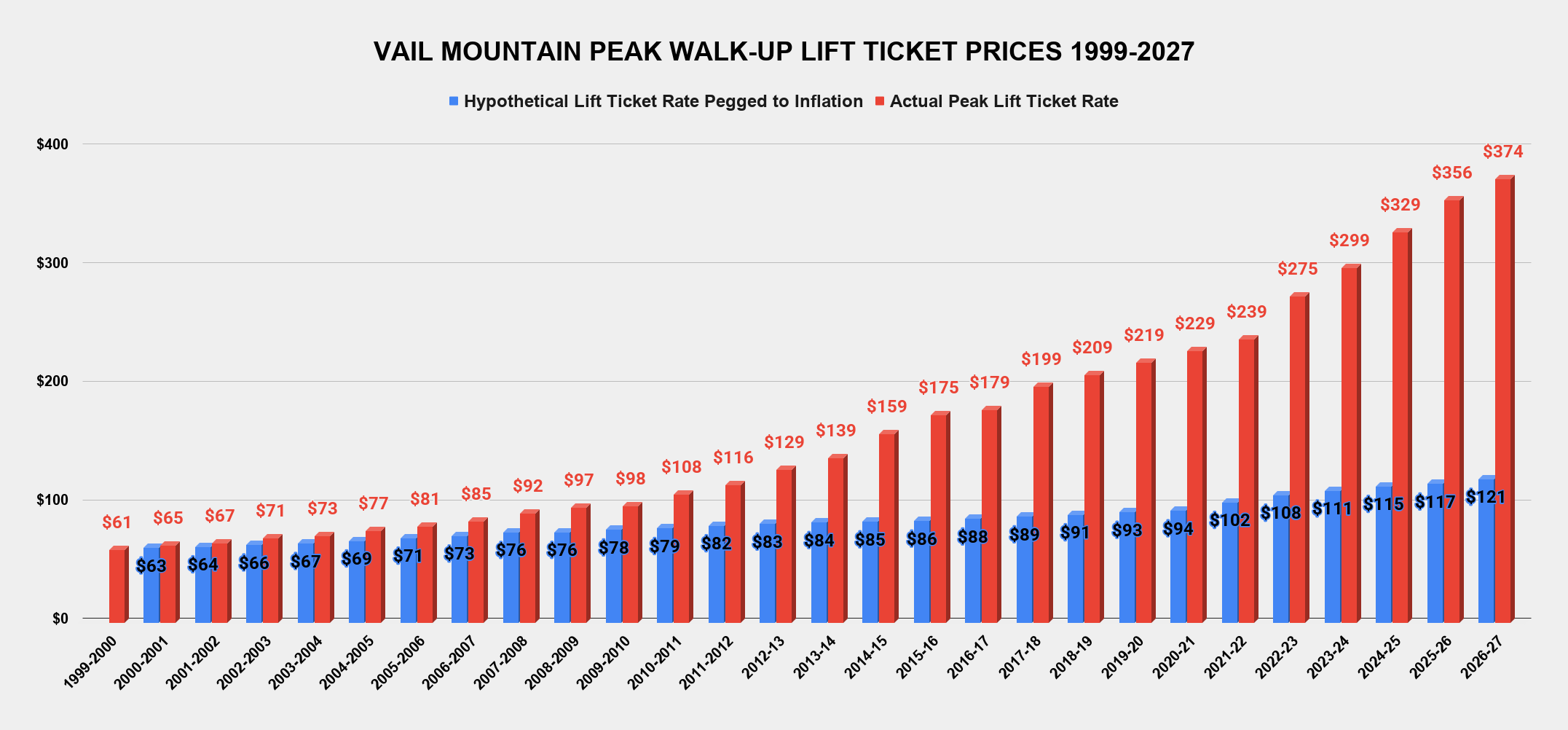
Over the past decade, the agency has watched, inert and silent, as peak lift ticket prices at many ski areas under its supervision have risen well beyond the rate of inflation. Check out Vail Mountain, which accounts for up to three percent of U.S. skier visits annually - had prices risen with inflation since the ski area’s turn-of-the-century $61 peak-day lift ticket rate, they would sit at $121 today, rather than the $374 anticipated top price for winter 2026-27:
This strange dynamic is not so strange for an America en thrall to free-market fundamentalism but held hostage by an environmentalism rooted in an absolutist vision of preventing all development, rather than encouraging responsible development. It’s a ski industry-specific version of What’s The Matter With Kansas (promise action on social issues as a cover for economic stridency) for conservationists: account for every pinecone displaced by a trail widening by promising to plant five times more new trees elsewhere on the mountain, so long as the consumer, once they approach the ticket window, remains at the ski area operator’s whims.
It was not always so. Once upon a time, the USFS held considerable authority to regulate the cost of skiing.