


In what amounts to an act of administrative mercy for ski writers, Berkshire East and Catamount announced this week that they are “joining” Bear Den Partners, the parent company that owns or partly owns or is in transition to express interest in one day hopefully collaborating to discuss potentially owning Burke and Smugglers’ Notch, both in Vermont.
I’m not going to parse the particulars of what it means for the two Massachusetts ski areas, long owned by the Schaefer family, to “join” Bear Den. The press release describes Bear Den Partners as “an independent owner and operator of alpine ski and snowboard resorts including … Berkshire East and Catamount,” but alludes to another entity, the Bear Den Mountain Alliance, which is, “a network of independent mountains that share resources, operational expertise and long-term capital while maintaining local leadership, unique identities and guest experiences.”
If you want to argue about the nuances of who owns what, go join the self-righteous dorks on Reddit. On Planet Storm, this announcement means simply that “Bear Den” will hereby and forever-after be shorthand for all of this:
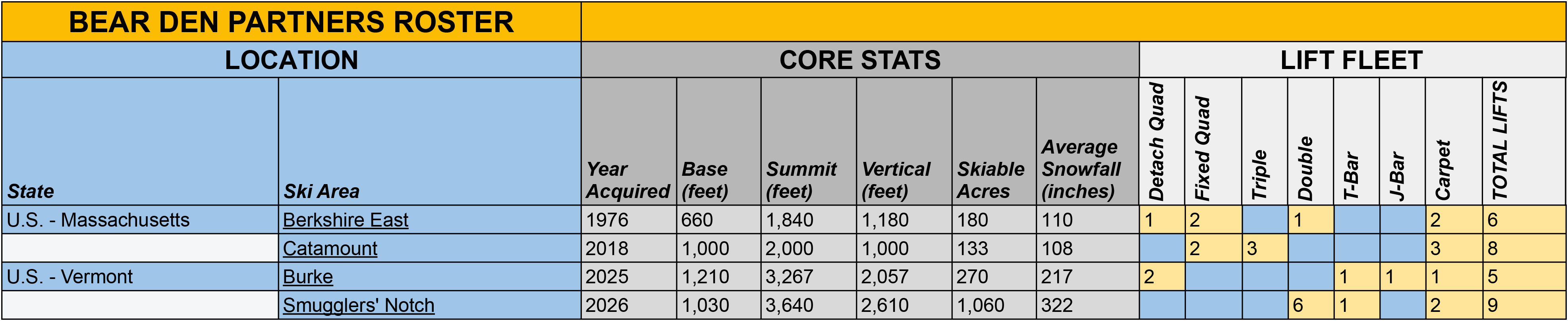
And what that pile of numbers adds up to is perhaps the most complete and complementary single-digit ski area portfolio in the country: a legitimate thousand-footer two hours from New York City (Catamount); the best pure ski terrain in southern New England (Berkshire East); one of the lowest-volume 2,000-vertical-foot ski areas in America that runs top-to-bottom high-speed chairlifts (Burke); and a mountain that ranks in the top four among the East’s 197 active ski areas in vertical drop, skiable acreage, and average annual snowfall (Smuggs).
As a first step toward uniting this portfolio into a unified ski brand, Bear Den reworked the season pass suite for all four mountains:
Smuggs and Burke now share a season pass, with two days each at Berkshire East and Catamount.
Berkshire East and Catamount rebrand their “Berkshire Summit Pass” into the somewhat cheesy AIM High (Authentic Independent Mountains) pass. This is unlimited at both mountains and includes days at Smuggs and Burke. Longtime Berkshire Summit Pass partner Bousquet exits the pass.

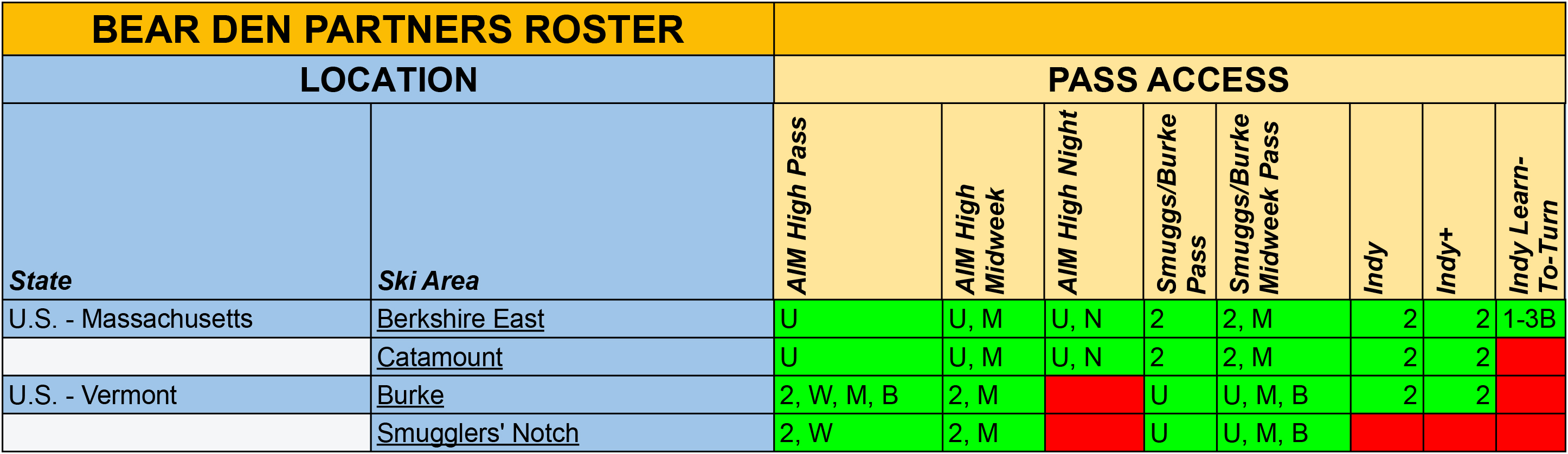
The AIM Pass webpage promises “additional mountain access and partner benefits” to be revealed “later this summer.”
This modest product suite confirms what Bear Den officials have been telling me since announcing the Smuggs’ deal last month: that they intend to move cautiously on pass access so as not to overwhelm two of Vermont’s last remaining uncrowded big mountains.
As for Bousquet, I have this update: “With the changes on the Berkshire East/Catamount side, their business structure has become more complex, and it’s made it difficult for them to continue offering a shared pass product outside of their own network,” Bousquet General Manager Kevin McMillan told The Storm. “We’re still in conversation about whether there’s a way to offer some form of informal reciprocity, as the local market really valued the Summit Pass. With their recent move to join the Bear Den investment group, I’m not sure what — if anything — will be possible for this year, but we remain hopeful.”
New England back in charge of itself
Bear Den’s rollup of four recently independent mountains continues two somewhat contradictory trends: the American ski industry’s decades-long consolidation, and the re-assertion, since 2024, of local ski area control by New England operators following decades of takeovers by extra-regional corporations. In just over 18 months, a group led by Boston investor Phill Gross bought Killington – the largest and busiest ski area in the East – from Utah-based Powdr, Park City-based Pacific Group Resorts ended its long tenure managing Ragged Mountain, and Indy Pass parent company Entabeni announced a move to the base of resurgent Black Mountain in New Hampshire.
Bear Den drops an exclamation point on this narrative. For the first time since American Skiing Company’s parts-and-pieces selloff to operators in Colorado, Utah, Michigan, Missouri, and Canada a generation ago, New England skiing, once proudly local before imploding around its national power ambitions, is returning to a form of self-determination.
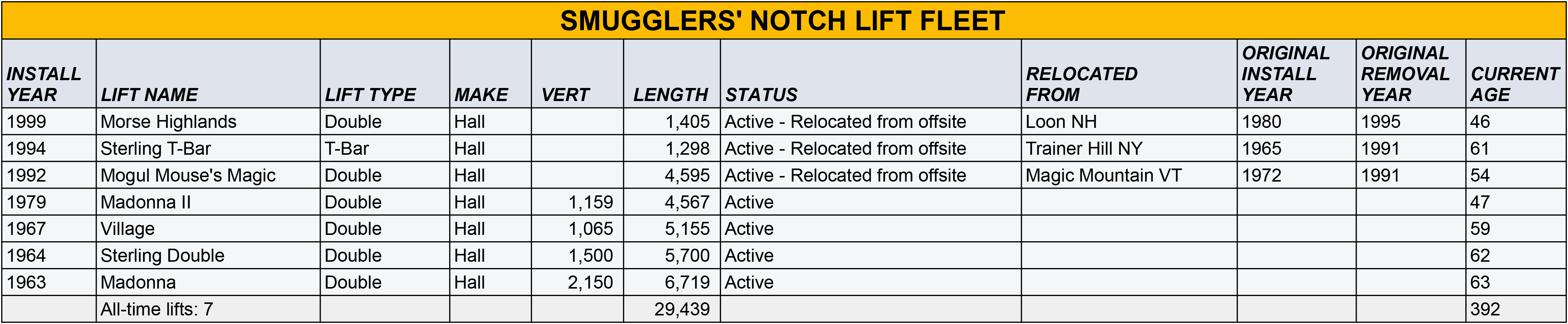
That independence carries its own challenges. The Epic and Ikon passes, non-existent in the ASC days, are entrenched. Companies headquartered in the Midwest and West still control more than a dozen of New England’s largest ski areas. Once-rusty New England mountains now spin many of North America’s most modern chairlifts, while Smugglers’ Notch’s six double chairs and one T-bar are a combined 392 years old.
The good news: I could think of no better general to lead this band of mutants to battle than Bear Den Partners CEO Jon Schaefer. His father Roy purchased bankrupt and backwater Berkshire East in 1976 and brought Jon to Planet Earth in 1980. Like a baby born to a clan of feudal ninjas, skiing was all he ever knew, and all Jon knew about skiing was that Roy papered and patched together his hunk-of-junk ski area by raiding the scrapyards of failed or modernizing mountains all over North America. As established ski areas Berkshire Snow Basin and Brodie and Mt. Tom dropped dead one by one, this remote bump serving Charlemont, population 1,185, somehow fended off aggressively up-to-date Jiminy Peak to its west and Mount Snow to its north. Jon’s brother Jim went off to New York City to make money and Jon took over the ski area around 2007, when the Schaefers used Jim’s money to buy out Roy’s longtime business partners. And Jon, who had grown up on the mountain and was as rooted to it as the trees growing from its soil, looked around and said “Dad I respect the hell out of you but go park cars while I pilot this boat into the 21st century because all those failed ski areas have been stripped clean and we need some new chairlifts and new snowguns and how about a wind turbine on the summit and a bike park for summer and some ziplines and rafting in the nearby river?” And in 2018, with Berkshire East sufficiently renovated, the family purchased Catamount, a ski area that had become a ski area museum straddling the New York-Massachusetts border. And with tremendous speed foiled partly by the societal asteroid that was 2020, Jon built a new lodge and demolished two lifts and installed three new-used lifts and dug enormous ponds and rewired and reworked the whole snowmaking system and maybe cut down more frontside trees than I would have liked but hey what the hell do I know I didn’t grow up in a snowcat shed with skis permanently lashed to me like bison horns. And he led a similar effort at somehow-even-more-brokeass Bousquet that involved a botched chairlift installation made right with the procurement of heavy equipment and all-night floodlit work sessions that likely involved a lot of banging and yelling.
Shortly after the University of Michigan hired Jim Harbaugh as their football coach in 2014, one of his former players described him as “a robot who was programmed as a football coach.” Jon Schaefer is the Jim Harbaugh of skiing, a mountain cyborg with no off-switch. And just as Harbaugh eventually led the stuffy Wolverines to a national championship, Schaefer modernized skiing in western Massachusetts even as Vail and Alterra started buying up competitors and peddling their Epic and Ikon passes.
Now Jon Schaefer will do the same for Vermont. Exactly how he will sync overbuilt and scandal-scarred Burke with under-lifted but beloved Smuggs and his cupboard of Masshills without pissing off the locals or sinking the whole fleet I have no idea, but I’m as confident as I can be about anyone in skiing that he will. Few people on the planet better understand the tensions between a ski area’s entrenched identity and the imperative to modernize, a minefield that he capably navigated at Berkshire East, Catamount, and Bousquet.
Rich guys like to buy ski areas and then buy things for those ski areas like chairlifts and hotels. But that formula only works if the rich guy either is or hires a capable on-the-ground manager. But there are more rich guys in the world than there are competent ski area managers, so it’s harder to find this balance than you may suppose. This was the genius of the group that bought Killington: yes we will take this island back to independence but yes we will also keep the corporate management team groomed out of Powdr’s Park City HQ. Ken Graham, the managing partner behind Bear Den, has fortunately entered his tenure as ski area owner with a similar strategy of Jon-go-run-the-ski-areas.
“Schaefer,” the robots tell me, is a German surname that translates to “shepherd.” Considered as “one who tends flocks,” Schaefer is not a bad last name for a ski area operator. Though the family, had the tradition of commandeering your occupation as last name endured through the 1970s, may have more appropriately become the “Skis.” Though “Schaeferski” doesn’t sound too bad, does it?
So this is still consolidation, but local/regional consolidation as opposed to mega-consolidation. And I think your writing and story telling is frequently at its best when talking about people like the Schaefer family, who are in effect small business owners. Except the small business is not the kind of drywall hanging thing we all need but don’t envy, but ski areas that nobody actually needs but anybody that cares about skiing envies. You cross-appeared on the Ski Podcast, and this is something that’s always a bit lacking about European skiing. What’s going on behind the veil of the 10,000 resorts sprinkled across the Alps?