


Durango, Colorado-based Mountain Capital Partners (MCP) has withdrawn its bid to acquire a controlling interest in El Colorado and three other Chilean ski areas owned by Andacor S.A.
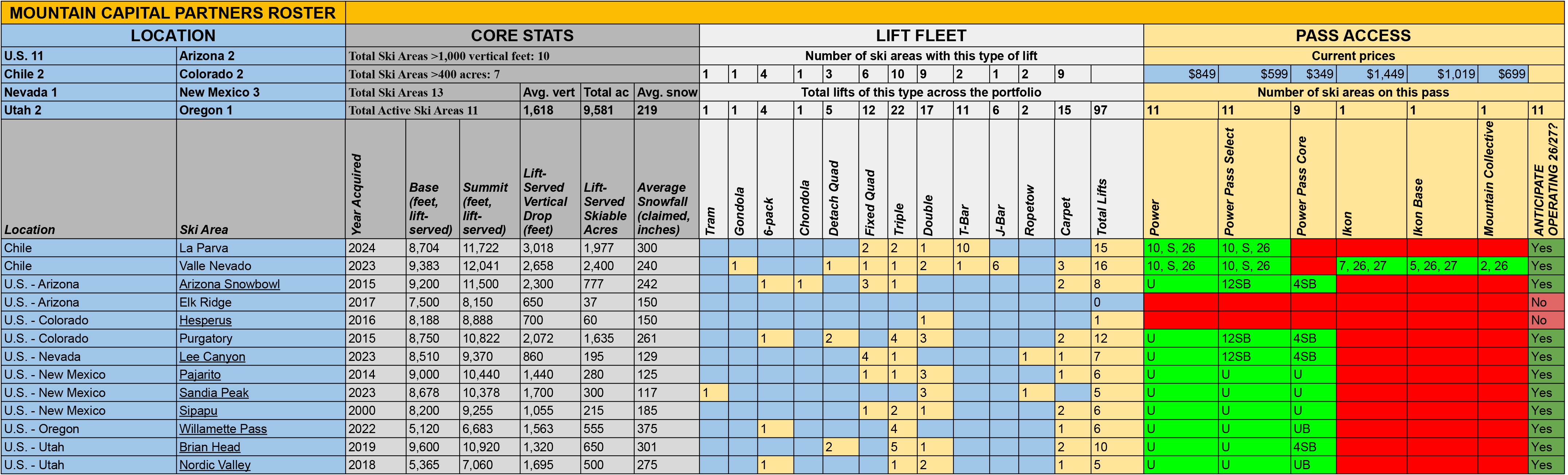
MCP owns nine active and two dormant U.S. ski areas, as well as Valle Nevado and La Parva in Chile. Last summer, the company announced ambitions to interlink El Colorado, along with the smaller Parque Farellones ski area, with its existing Chilean mountains, and to eventually expand the complex into the largest ski center in the western hemisphere. Two mid-sized ski areas included in the deal, Volcán Osorno and Pillán, sit several hours south in the Chilean Andes and would have served as nodes in a hub-and-spoke network that gave local passholders access to one of South America’s premier ski destinations.
Breaking the deal, it appears, was a mandate from Chile’s National Economic Prosecutor’s Office (FNE) – the loose equivalent of the U.S. Justice Department’s Antitrust Division – that one of the so-called Tres Valles ski areas (La Parva, Valle Nevado, El Colorado) be sold to a third-party.
“Naturally, such measures are incompatible with MCP’s investment objectives and the parties’ goal of creating one of the largest and most accessible mountain destinations in the world,” read a joint statement provided to The Storm and credited to MCP and Andacor parent Cururo.
According to the statement, Chile’s FNE rejected “a series of investments and commercial benefits offered by MCP and Cururo as mitigation measures.” MCP provided The Storm with a summary of these “mitigation commitments,” which include:
Broad access products: MCP promised to sell season passes valid at all of its U.S. and Chilean ski areas as well as unlimited, Tres Vallees-specific passes good for unlimited access between El Colorado, Valle Nevado, and La Parva. MCP would continue to offer free passes to the 12-and-under and over-75 age groups.
Infrastructure upgrades: MCP would pledge to at least double the $25 million it has invested in snowmaking expansions, lift upgrades, and other infrastructure improvements at Valle Nevado and La Parva since 2023. Planned projects include a chairlift connecting the small Farellones ski area with the larger El Colorado; a two-stage gondola that would feed a 741-acre “Parva Grande” expansion; a “Santa Teresita” chairlift opening another, 437-acre expansion; another new gondola linking the base of La Parva to mid-mountain terrain; and snowmaking and grooming upgrades. MCP also planned a lift rehab at Pillán and a new “drag lift” at Volcán Osorno.
MCP acquired 2,400-acre Valle Nevado in 2023, and adjacent, 1,977-acre La Parva the following year. Existing ski trails connect both ski areas to one another and to 1,100-acre El Colorado, which links down to microscopic Parque Farellones. The giant ski complex looms in the fortress peaks towering over Santiago, the fifth-largest city in South America and the largest in Chile, with 6.2 million residents.
MCP’s ambitions, driven by this enormous adjacent market and a reliable supply of U.S. skiers holding Ikon (valid at Valle), Mountain Collective (same), or the company’s own Power Pass (La Parva and Valle), was to consolidate operations and expand onto adjacent land. Eventually, MCP Managing Partner James Coleman told me on the podcast in 2024, they could create one of the largest ski areas in the world and eclipse 8,171-acre Whistler as the biggest in the western hemisphere.
Rather than foiling competition, MCP argued, this unified ski kingdom would have benefitted skiers. The statement announcing the deal’s termination – translated from the Spanish, which accounts for some awkward wording below – outlines an extensive case for consolidating Tres Valles:
This submission does not alter the conviction that each of the companies maintains that, in this industry, integration constitutes the most solid path to strengthen the development of mountain sports in Chile and position the country as the leading ski destination in the Southern Hemisphere and the world.
During this process of nearly a year of review by the FNE, the parties maintained that a strategic partnership would allow offering a better experience to visitors, drive new infrastructure investments, enable a broader skiable terrain and new runs, and provide greater sustainability to an industry facing increasingly complex financial challenges. This vision is shared by the vast majority of consumers, who supported the integration of the ski centers.
Our commitment to developing mountain tourism in Chile and the vision that has inspired this initiative remains fully in effect. We are convinced that integration would have represented the best alternative for local consumers, for the national economy, and for the sustainability of ski centers.
MCP signs off with a commitment to “continue working and investing in the development of our mountain centers and promoting initiatives that contribute to the ski industry, so that Chile fully leverages one of its greatest tourism potentials.” In other words, the company doesn’t plan to back out of South America just because it couldn’t secure El Colorado.
While Chile is well-respected in ski circles as a reliable destination for June-through-September turns, the nation’s developed ski footprint is incredibly small, with fewer than 20 active, developed ski centers dotting Chile’s 2,600-mile-long chunk of the Andes.
The notion of consolidating more than one-third of the nation’s ski areas - and one of Chile’s only truly modern ski centers - under one owner appears to have spooked Chilean antitrust regulators. Such concerns have foiled ski operators’ consolidation ambitions in the past. U.S. antitrust regulators required American Skiing Company to sell Cranmore and Waterville Valley when LBO Resorts and S-K-I merged to form the new entity in 1996. The following year, the Justice Department required Vail Resorts to sell Arapahoe Basin after purchasing it, along with Keystone and Breckenridge, from Ralston-Purina. More recently, Justice investigated Alterra’s 2024 bid to buy Arapahoe Basin, ultimately allowing the deal to proceed.
This may be the first instance of regulators outside the United States blocking a ski area sale to a U.S.-based operator, though such deals have been limited. While U.S.-based multimountain passes have grown to include access to 163 ski areas outside of the country, U.S.-based multimountain operators own just 14 ski areas abroad, and half of those are in Canada. MCP is the only U.S.-based operator with an interest in a South American ski area. Chilean authorities’ hesitance to approve such a broad American footprint, and the year-long review process, hints at the bureaucratic complexity U.S. operators may continue to face as they run out of local ski areas to buy.
So now what? For MCP, for Chilean skiing, for consolidation? Now that we know that El Colorado is on the market, could one of the other big U.S. ski companies bid for it? Let’s take a deeper look.