


Vertigo hell is a stalled centerpole Riblet double with no safety bar swaying 50 feet off the snow and claustrophobia hell is an MRI tube. Ski long enough and you’ll probably encounter both. Fortunately scaredy-cat hacks are my specialty and I’ve resolved the dangling-chair dilemma with a ski pole jammed crosswise in the steel carrier and the MRI problem by closing my eyes the entire time.
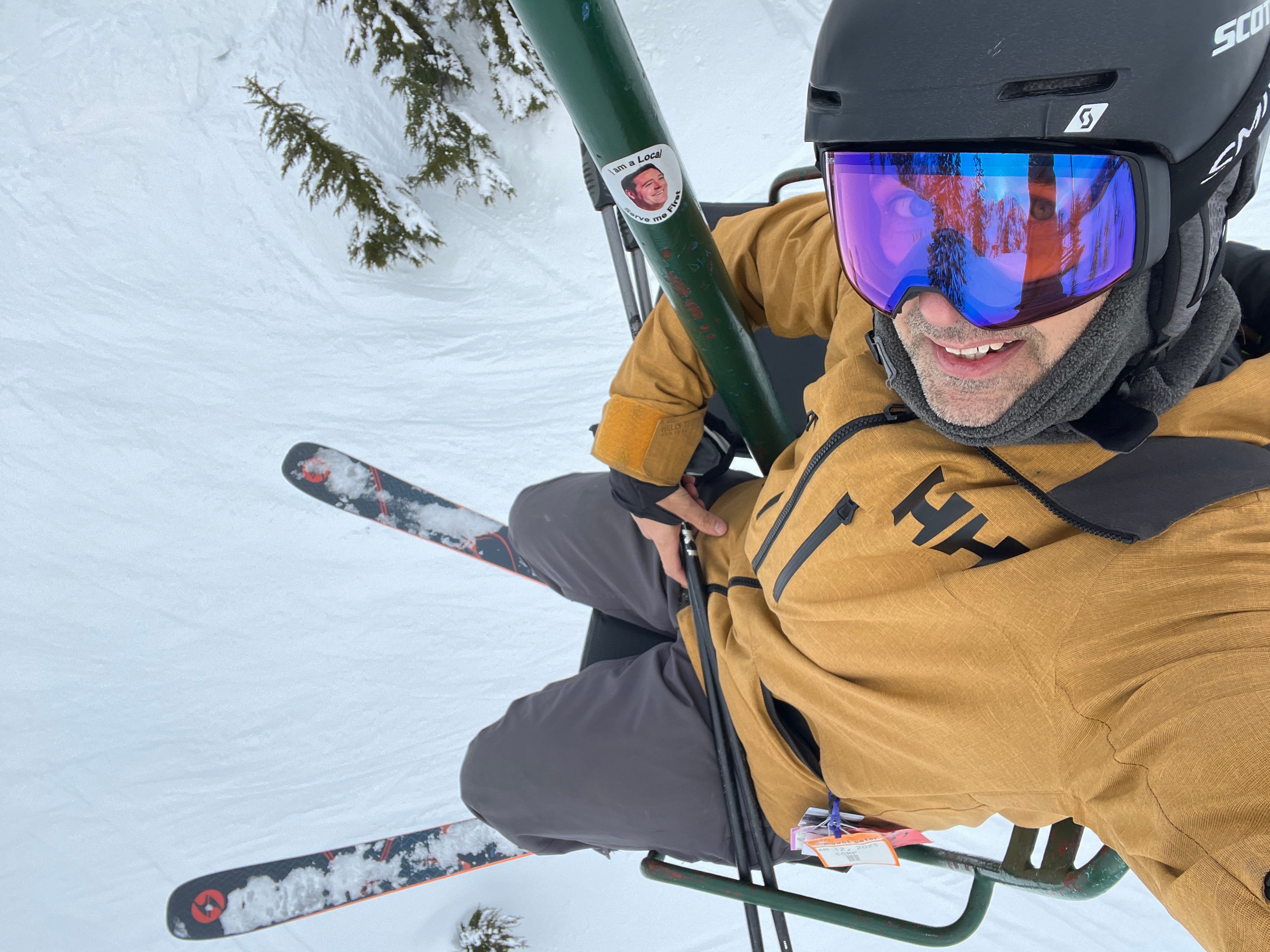
My other hack for coping with these things-that-I-hate is to not do them. The Riblet doubles thank God are one-by-one expiring to the scrapyard and I don’t mine a ride or two for posterity but the MRI is here until the robot killing spree sends all of us to the canning facility. And generally avoidance works great for me but after two years of saying, “I don’t think driving is supposed to hurt” and no apocalypse to bail me out I submitted to a left-shoulder MRI in February. And what that told me was this:
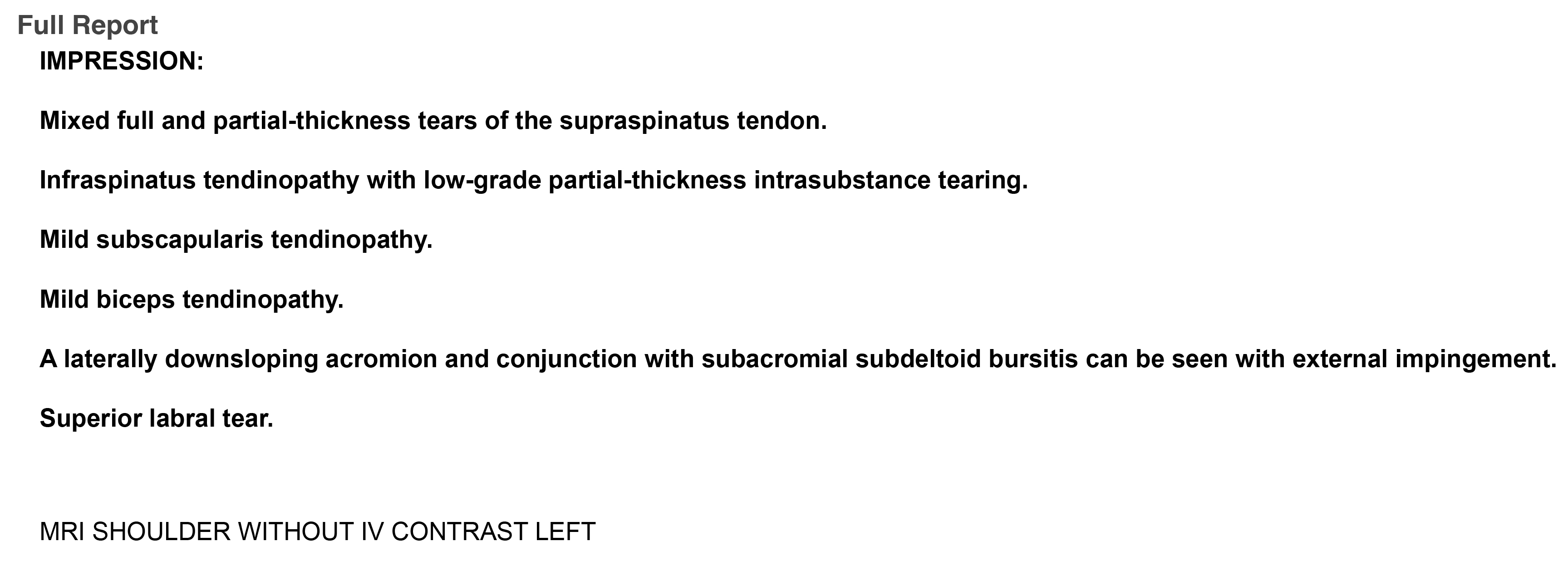
And what that is is a description of a torn rotator cuff. And the doc suggested surgery, which I didn’t mind, and soon, which I did mind because I still had a lot of skiing to do. So from February to April I yo-yoed north-south finally visiting Dartmouth Skiway and taking so many pictures of the Burke Mountain J-bar that the mountain’s head of lift ops asked me if I was Lift Blog and watching Michigan hoops win March Madness games in the Black Mountain baselodge and T-shirt skiing at Killington and minor acts of trespassing to scope the abandoned double chair in the woods off Deer Run at Belleayre and soaking to the skin in an Easter rainstorm at Stowe and two days of nuclear mid-winter Mansfield eversnow after that and a rather hilarious incident in which my son broke his rental ski in half while boarding a chairlift and had to be driven down Snowshed via snowmobile. And after all that when I woke up hazy and high in the Manhattan recovery room on April 15 the doc said, “wow that was a lot worse than it looked on the imaging what have you been doing for the past six weeks?”
After surgery I spent three or four days swimming in an oxy haze and then a week battling an arm rash that resembled a medieval infection brought on by a rat bite or a tick bite or a bite from a rat that had been bitten by a tick or perhaps just a peasant getting too feisty with a barrel of expired mead. And it turns out that a rotator cuff repair that also involves re-attaching a biceps tendon is far more intense than a rotator cuff repair that is just a rotator cuff repair. Meaning that this recovery (for my left shoulder) body-slammed me with an intensity I’d not been expecting after a relatively smooth 2021 recovery from a right-shoulder rotator-cuff repair. Which means I spent three weeks barely sleeping, flailing like an over-boiled pot with the lid left on, jumpy and manic and constantly triggering the smoke alarm.
All of this made writing, um, difficult. So I did what I always do when writing-as-a-mechanism-to-escape-the-tedium-of-existence fails me: I worked on my Big Dumb Charts.
And Man I really went for it this time. I can now tell you that there are 217 active Riblets spread across 109 ski areas in 25 states and that 23 of them are quads and 70 are triples and 124 are doubles and 43 have been relocated to their present line. I don’t know how many have safety bars, but I’m working on that. I can tell you that Arapahoe Basin’s Beavers quad is the sixth-highest chairlift in America at its 12,458-foot apex and the 29th-highest at its 10,948-foot load point, and that the lift’s 1,500-foot vertical rise ties it with chairlifts at Gore and Smuggs and Magic Mountain, Vermont as the nation’s 196th-tallest ski lift. And if you want more useless Beavers lift facts which I know you do it is the 159th-tallest chairlift and the 102nd-tallest quad and the 33rd-tallest fixed-grip lift and the third-tallest fixed-grip quad in America. Beaver quad’s 4,080-foot length fails to impress the ladies, however, ranking 513th-longest on our list of America’s 2,145 non-carpet, non-ropetow active ski lifts, 463rd-longest of 1,922 chairlifts, 251st of 783 quads, 147th among 1,413 fixed-grip chairlifts, and 22nd of 401 fixed-grip quads. I can tell you that the shortest chairlift in America is Montage Mountain, Pennsylvania’s 250-foot-long Short Haul double and that the shortest detachable chairlift is Deer Valley’s 1,020-foot-long Burns Express quad and that the shortest six-pack is Boyne Mountain, Michigan’s 1,941-foot-long Mountain Express, which also happens to be the first sixer ever built in the country. I can tell you that the 4,101-vertical-foot Jackson Hole tram is the tallest ski lift in America and that Park City’s four-vertical-foot Flat Iron double is the shortest. I can tell you that the oldest active ski lift in America is Black Mountain, New Hampshire’s J-bar, built in 1935, and that the oldest active chairlift is Boyne Mountain’s Hemlock double, a Sun Valley original from 1936 that moved to Michigan in 1948 and at some point morphed from a single to a double chair. And I can tell you that the oldest active chairlift that hasn’t been moved is Mad River Glen’s 1948 American Steel-and-Wire single chair and that the oldest active chairlift that does not appear to have undergone a major renovation is Mt. Spokane, Washington’s 1956 Vista Cruiser Riblet double. I can tell you that American ski areas spin 467 double chairs, but that they’ve collectively built just 27 since 2000. I can tell you that 122 lifts built in the 1960s still spin in their original locations and that at least 263 active U.S. lifts have been relocated and that 71 of those just moved to a different part of the same ski area.
I can tell you that the City of Juneau owns Eaglecrest and the U.S. military owns Hillberg ski area on Joint Military Base Elmendorf Richardson in Alaska. I can tell you that if you’re ever quizzed on the founder of such-and-such ski area you’ll probably be right if you just say “Hans” or “Tom.” I can tell you that at least 125 U.S. ski areas once operated under a different name than they use today and that those archival names range from the regrettable (“Satan’s Ridge”; Ski Sundown, Connecticut) to the please come back (“Bear’s Den”; Thrill Hills, South Dakota) to the ridiculous (“Q-Burke”; Burke Mountain, Vermont) to the fleeting (Mt. Hood Skibowl went by “Mirror Mountain” for winter 1985-86). I can tell you that June Mountain sat idle for winter 2012-13 and Frost Fire, North Dakota missed 2022-23 and that Ragged Mountain, New Hampshire missed every winter from 1982-83 to 1987-88. I can tell you that Keystone closed for the season on May 26, 1997 and that Purgatory operated 163 days in winter 1973-74 while under the oversite of general manager Raymond T. Duncan. I can tell you that it snowed 829 inches at Sugar Bowl over the 1982-83 season and 629 inches at Pomerelle, Idaho in 1948-49 and six inches at Ober, Tennessee in 2022-23. I can tell you the cost of a peak-day Vail Mountain walk-up lift ticket in 1969-70 ($8), 2025-26 ($356), and 51 other seasons. I can tell you that Steamboat skier visits collapsed from 630,307 in 1979-80 to 243,000 in 1980-81 and rebounded to 613,354 the following winter. In fact, I can tell you 1,666 years of Colorado skier visit data, which adds up to a 77 percent complete attendance record of active, chairlift-served-ski-areas-that-are-not-Howelsen-Hill dating back to the dawn of the state’s organized ski industry.
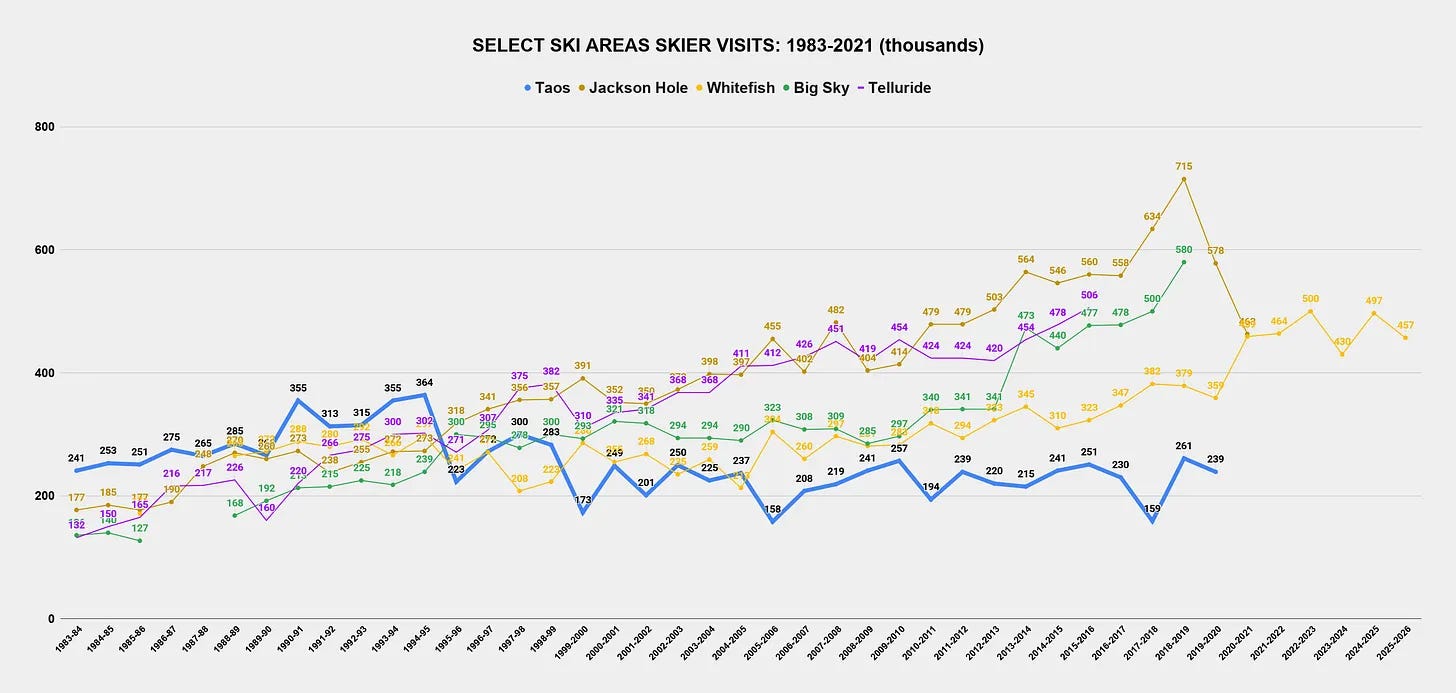
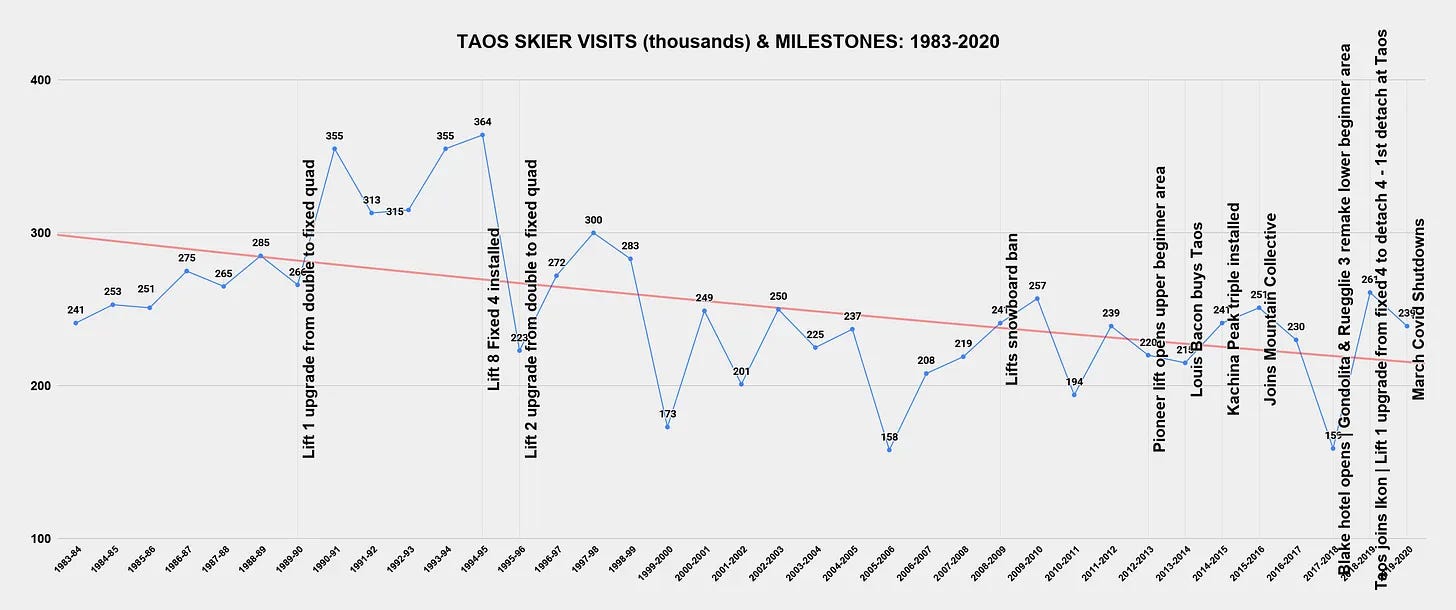
I can also tell you that I’m adding some data, such as skier visits and lift ticket rates, proactively, while I enter other things, like founder and former names, as I find them. And I haven’t quite broken all this down into smaller tables yet, but if you want to subject yourself to this 52,477-cell mastersheet, be my guest. And I can also tell you that if you want to use any of this information for any purpose including pointing out that this chart and its subsidiary charts are proof that I’m somewhere on the toolshed spectrum between nincompoop and Dude-who-wants-to-detail-his-fantasy-football-roster-for-you, knock yourself out. It’s not like I hacked into the Pentagon to find this stuff – I’m just putting it in one place so I can stop having to look up what year American Skiing Company bought Steamboat and how much it snowed in Little Cottonwood Canyon in 2022-23. If this information proves useful to other people, great – maybe we can get back to legible ski journalism as a counterweight to social media hysteria about liftline pictures from seven years ago. And if you want to understand how I intend to use this information, the recent article appended to the Taos podcast is a pretty good showcase, with lots of charts like this showing how Taos skier visits stacked up against similar mountains over time:
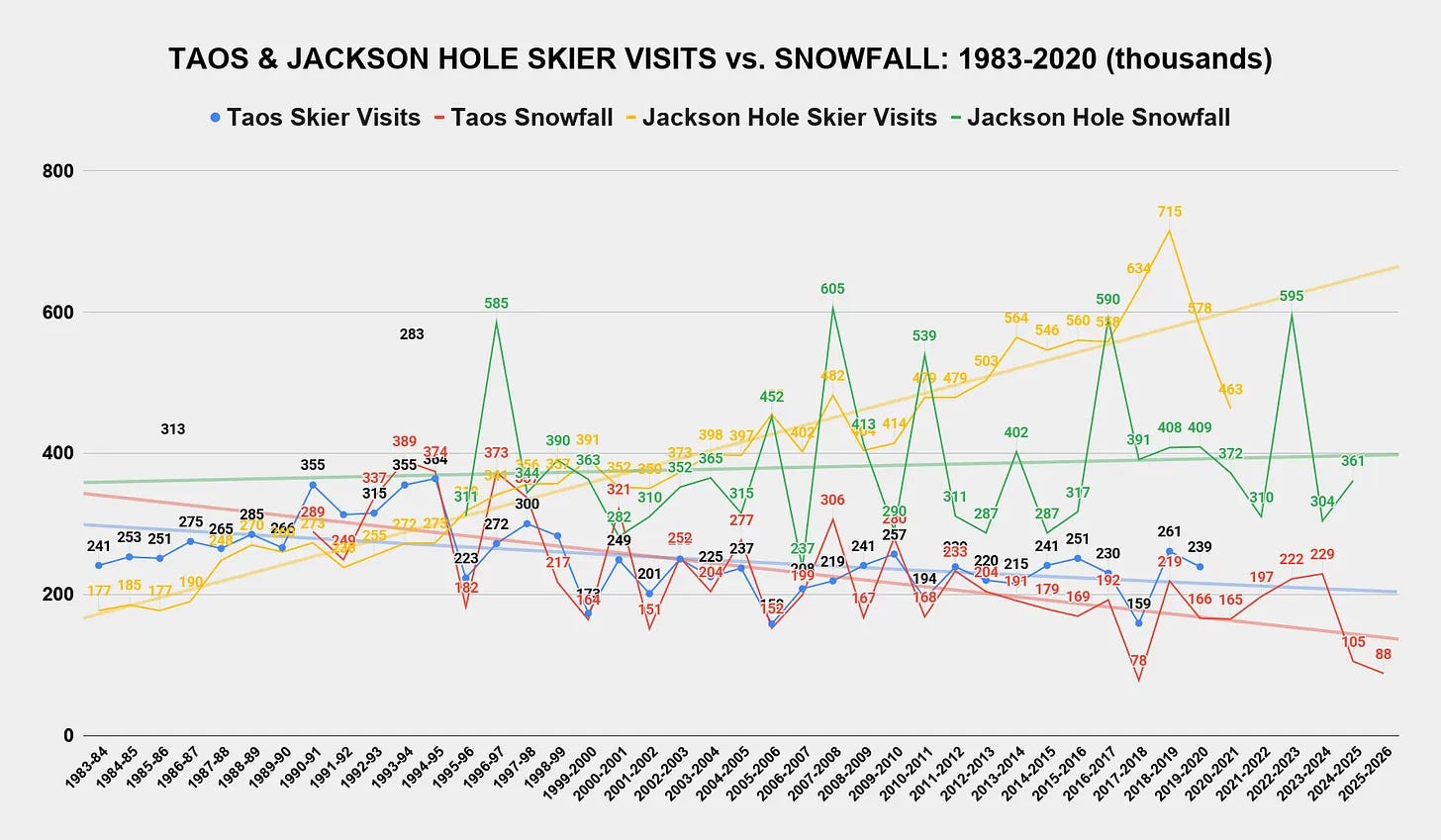
And then zoom-in charts comparing attendance to things like snowfall:
And the mountain’s built evolution:
Speaking of the podcast, I had to take a little rebuilding break. I have a few in the can that I’ve yet to release, and I intend to start cranking episodes out again in the fall, possibly with an additional format (the GM interviews will never go away). In the meantime, you can directly access the 227 archived episodes here.
In the meantime, I’m teaming up with the robots to help me improve the Big Dumb Charts to make them Bigger and Less Dumber. Mostly this means organizing the data in a way that’s faster to manage. The robots are smart and fast and tireless but also earnest and lazy and mistake-prone. But you can tell them “this is not what I want” without fear of an HR writeup for creating a hostile workplace. Long-term, I believe my best energy is spent on The Storm’s core: writing, analysis, Bros, disrespecting the Euros by referring to “centimeters” as “European inches,” and angering Snow Tires Bro with trip reports of driving a rental car through Glenwood Canyon in a snowstorm. But the Big Dumb Charts are my Panama Canal, a pain in the ass to build that will make this whole world spin faster when it’s finished.
I figured you had to be on drugs to compile this info, though I was betting it was meth rather than oxy. Glad to hear you are on the mend, those rotator cuffs take forever to heal. You were a lot more fun before this became a business, throwing bro grenades and skidding off the road causing two hour back ups.
Couple corrections/additions: Bear’s Den/Thrill Hills is in NORTH Dakota, not South Dakota. Detroit Mountain’s two triple chairlifts were rebuilt & relocated from somewhere out East, I believe.