


My son’s half-birthday was last week. Yes I know that’s not actually a thing. I’m not one of these parents who, like, buys him a zebra or rents out Yankee Stadium to mark every made-up milestone. But I’ve Sharpied my now 17-year-old daughter’s height on the wall every six months since she turned 3, and I continue the tradition for my son. The resulting record is a neat physical relic in an increasingly digital world:
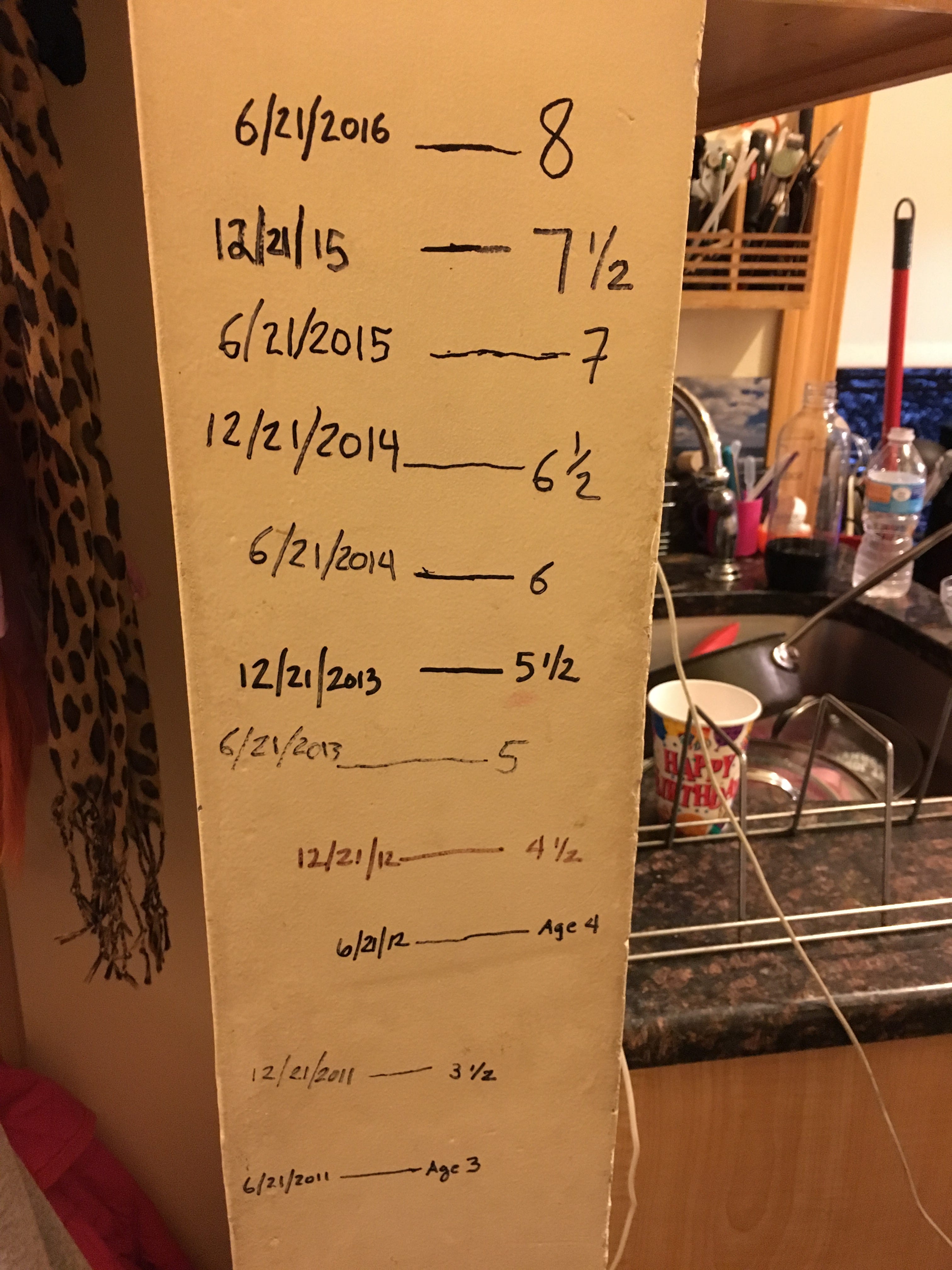
But here’s the funny part: how often I get the measurement wrong. Kids are squirrely, wild-haired, uncertain from day to day how straight they ought to stand up to be standing up straight. It’s tricky to hold a marker exactly level and slide it from the crown of their head to the writing surface. Or at least these are the excuses I make when one of my kids suddenly grows nine inches in six months or, once my daughter maxed out a few years back, seems to occasionally shrink.
Measuring is hard. That’s my point here. Even when the thing you’re measuring is a three-foot-tall human. So I grant resort operators, engineers, maintenance teams, government officials, and media latitude to conjure slightly different measurements for machines that climb a mile or more up steep and unruly mountains. For example: Breckenridge’s trailmap lists its Kensho Superchair six-pack at 1,536 vertical feet, the resort’s 2022 U.S. Forest Service masterplan stakes the lift at 1,540 feet, and the independent Lift Blog lists the machine at 1,502 feet. Lengths diverge by source as well: Lift Blog lists Kensho at 5,902 feet long, while the Forest Service says 5,735 feet.
That’s a 167-foot length difference, which felt significant enough that I asked Lift Blog founder Peter Landsman about the discrepancies. “My info comes from the manufacturers,” he wrote via email. “Sometimes they make mistakes compiling data, particularly when converting meters to feet or they flip length and vertical.”
About length in particular, Landsman added: “There are several different ways to calculate slope length. A fully loaded uphill haul rope is longer than an empty line because of stretch. There is also variation when accounting for tensioning, which can add 6-10 feet. Then there is horizontal length which is distinct from slope length.”
These slight variances probably don’t matter much outside of marketing claims over the longest/tallest/steepest etc., and recitations of such stats have mostly given way to storytelling-style marketing in the social media era. Landsman is probably correct in defaulting to the manufacturers’ records, but I tend to go with the Forest Service numbers when they’re available, mostly because ski area masterplan lift tables tend to include top and bottom elevations. While altitude has nothing to do with length, it’s a (mostly) fair determinate of vertical rise, and for consistency’s sake I’ll use all of the USFS numbers if I use one of them.
Which takes us to today’s exercise: itemizing the tallest ski lifts in the United States. Here are the top 10:
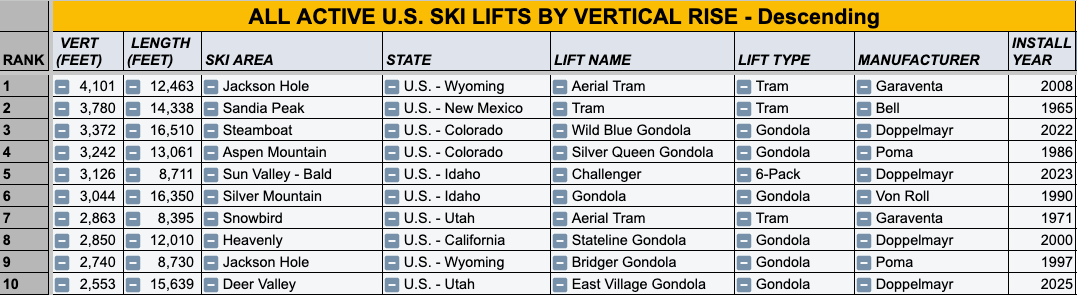
Cool list, Bro. But we run into the same set of problems with this inventory as we did with our longest-ski-lifts list last week: three of the machines listed above are not lappable ski lifts, and one of them is technically two different machines strung together as one lift.
So let’s sort out America’s tallest ski lifts, chairlifts, detachable lifts, fixed-grip lifts, quads, doubles, and triples.
One note before we get to that – I intended to publish this article the day after last week’s lift-length dispatch, but the volume of still-incomplete data was bothering me. Even with the combined references of Lift Blog, New England Ski History, U.S. Forest Service documents, and measurements from ski area websites and trailmaps, I was missing lengths for 279 chairlifts, and verticals for 275. That’s around 15 percent of active ski chairlifts in America, and it included some monsters, such as Lost Trail’s Saddle Mountain double chair (which turned out to be the 13th-tallest and fourth-longest fixed-grip lift in the country).
So I set about filling in the blanks. First, I reached out to my contacts at several dozen ski areas where I was missing lift measurements. Officials from Cascade Mountain, Little Switzerland, Nordic Mountain, and Crystal Ridge, Wisconsin; Mount Brighton, Nub’s Nob, and Crystal Mountain, Michigan; Mad River and Alpine Valley, Ohio; Snow Creek, Missouri; Paoli Peaks, Indiana; Wisp, Maryland; Big Boulder and Seven Springs, Pennsylvania; Mountain Creek, New Jersey; West Mountain, Windham, and Hunter Mountain, New York; Wachusett, Massachusetts; Crotched, New Hampshire; Lost Valley, Maine; Lookout Pass, Idaho/Montana; 49 Degrees North and Summit at Snoqualmie, Washington; Whitefish and Blacktail Montana; Boreal, California; and Solitude, Utah provided updated measurements, and several other operators promised to send measurements soon.
In the meantime, I filled in the blanks using a brand-new site that just debuted this week called “Google Earth.” Most of you have probably not heard of this site, since you do not live on the cutting edge of technology like I do.
OK you got me. Google Earth debuted in like 2001 and has long been an obvious tool that could help fill in missing chairlift dimensions. But I’d failed to click some “allow accelerator” setting on my computer, and thus the site hadn’t loaded properly for me in several years. But then Jon Schaefer said “hey Dumbass just measure on Google Earth because I have no idea how long these lifts are” when I asked if he could fill in some missing info at Berkshire East. Well these were not his exact words, but that was the spirit of it, and so I fixed the stupid setting which took like 15 seconds and three clicks. Then I went around measuring lifts.
This sounds very simple, but it took all week, working (no kidding) 12-hour days. But I filled in the grid. I now have an approximate length and vertical rise for every ski lift in America (excluding ropetows and carpets, which shoot me if I ever go there). On the accuracy continuum, the Google Earth measurements fall somewhere between an educated guess and a fully clothed doctor’s office weigh-in. Meaning they’re close enough. To stress test this, I compared my approximations to published manufacturer, resort, or USFS stats, and the numbers usually landed within 15 feet on vertical rise and within 50 feet on length. So not exactly splitting the atom, but close enough to publish statistical rankings of gigantic machines that scale mountains.
OK anyway here are the stupid lists: