


Earlier this week, I blamed a nearly three-week content absence on a relapse into one of my more regrettable habits: overzealous data accumulation in service of a single article. But I have an even worse habit: overzealous data accumulation that never becomes an article at all.
I spent a considerable amount of time last year assembling an inventory of active American ski lifts, but never made it public. I did this because I needed to know, for a story, how many six-pack chairlifts existed, and it took several hours to compile that inventory. To forestall a repeat of that irritating process, I put together a more complete list of active lifts, which I’ve been using as a personal reference document.
Why have I kept this to myself? Well, like the Encyclopedia Bro-Tannica (formerly My Big Dumb Charts), it’s messy, ever-changing, and inconsistent in places. People looking for a site that is not those things can visit Lift Blog, which is the most complete contemporary resource for North American ski lifts (carpets and ropetows excepted), and indexes a page for every active ski area on the continent (as well as non-ski aerial lifts).
The reason I made my own list is that I needed the ability to sort machines by characteristic - type, age, length, height, make, etc. – and across ski areas, states, regions, and companies without cross-checking dozens of individual resort inventories. What, for example, are the 10 longest active double chairs in America? What is the shortest detachable quad? Which Midwest chairlift claims the tallest vertical rise? What is the longest gondola? How many Riblet and Hall lifts remain in service? What are the steepest lifts? The oldest?
All of the information existed to answer these questions, but aggregating the data proved laborious. So I tapped Lift Blog as a primary source, then supplemented missing or contradictory data with measurements from New England Ski History, ski resort websites, U.S. Forest Service masterplans, historical maps on skimap.org, and other sources (I’m attempting to clarify the measurements discrepancies with Lift Blog).
Once I put all this data onto one sheet, I had the foundation to begin answering additional questions: How many active U.S. lifts have been relocated from their original location? What are America’s highest-altitude lifts? How many of the country’s lifts still lack safety bars? I’ve yet to accumulate sufficient data to answer any of these questions comprehensively (though I’ve made good progress on relocations), but I add data as I find it – often while researching a particular resort for a podcast episode.
I’ll leave most of these questions aside for today to focus on one metric, and to explain why even that simple measurement is more complicated than it at first appears: length.
What exactly counts as a ski lift?
To understand why a metric as simple as how long something is proves to be a puzzle, consider this list of the 10 longest lifts that access ski terrain in the United States:
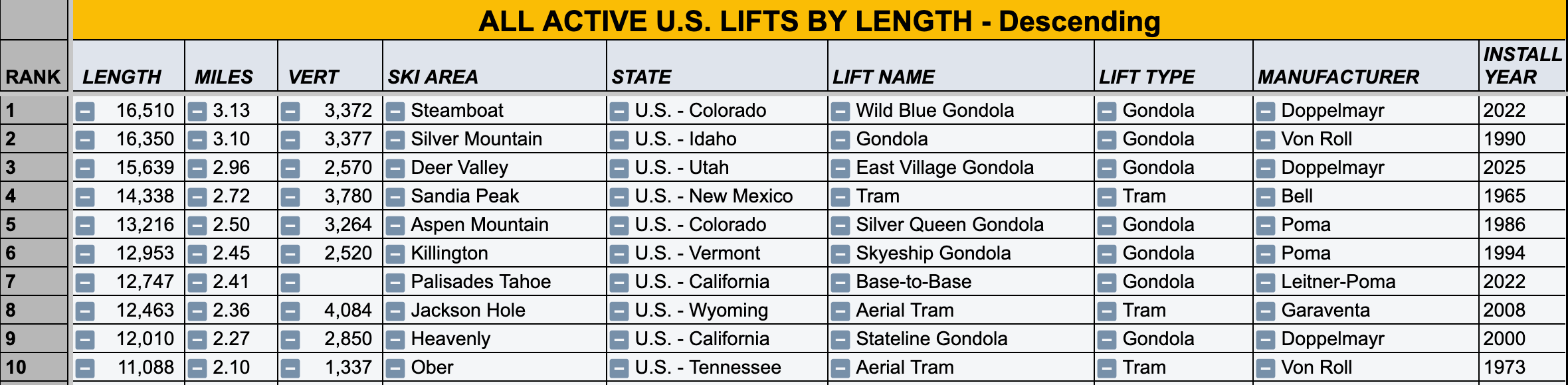
Well that’s pretty straightforward, right? Math is as certain as gravity. But asterisks abound: first, four of these 10 machines are not, technically, lappable ski lifts: the Silver Mountain Gondola, the Sandia Peak tram, Heavenly’s Stateline Gondola, and Ober’s tram. While brave and inventive skiers could perhaps bushwack summit-to-base, skis-on routes in perfect post-storm conditions, these are primarily transit lifts that move skiers to staging areas near lappable ski lifts. Second, four of these lifts are technically two separate machines that riders can exit at an early stage or experience as one continuous machine: Steamboat’s Wild Blue Gondola, Deer Valley’s East Village Gondola, Killington’s Skyeship Gondola, and Palisades Tahoe’s Base-to-Base Gondola. Only Jackson Hole’s tram and Aspen Mountain’s Silver Queen Gondola function as single-machine, lappable ski lifts.
Fortunately, more clarity emerges as we drill deeper into the numbers. So let’s do that.