


The 24-hour clock is one of civilization’s great achievements. Nations don’t share a common language, currency, electrical voltage, or system to measure temperature, size, distance, or weight. We can’t agree on what side of the road to drive on or whether dogs are family members or supper. But we all use the same clock.
This is astonishing. How did it happen? Like how do we not have some block of countries that rejected our hierarchy of 60-second minutes and 60-minute hours and 24-hour days for a metric clock with 100 kiloticks each lasting 1,000 ticks of 1,000 milliticks each? Imagine just trying to organize a conference call. Like “OK I’m free at 3 p.m., which is 43.60 for Jim out in Calgary, but that’s the Hour of the Yak in Shanghai, and they’re generally not free until sometime between tail and horn.”
That’s not to say that the clock doesn’t do its best to ruin us. China, a nation wider than the continental United States, locks the entire country into a single timezone. In what felt like a strange sort of time travel, I once departed Seoul, South Korea around 11 a.m., flew 14 hours, and arrived in New York City a bit before 11:00 a.m. the same day.
In skiing, timezones can be our friends. Direct early-morning flights mean I can wake up in Brooklyn and, picking up two or three hours hauling west, be skiing Vail Mountain or Snowbird or Mount Bachelor or Alpental around lunchtime. Timezones can also baffle us, especially when their borders don’t align with more familiar administrative boundaries. Nearly all of Michigan’s 10.1 million residents live in the eastern timezone, with the odd exception of around 75,000 people and nine ski areas in four counties in the far-western portion of the state’s Upper Peninsula. Snow-socked Idaho sits mostly in the Mountain Timezone, but three of the state’s largest ski areas – Schweitzer, Silver Mountain, and Lookout Pass – live in the state’s northern panhandle, a zone inexplicably slotted into Pacific time. In one of the more bizarre administrative setups in skiing, Lookout Pass straddles the Idaho-Montana border, and thus spins lifts in two timezones (the ski area designates all operations with Pacific time).
If our timekeeping practices sometimes feel arbitrary or ridiculous, it’s because they are. Time – along with universally acknowledged things such as money, religion, and national borders – are what historian Yuval Noah Harari calls “fictions” – things that only exist because humans collectively agree to believe in them. There is only one clock. It is called “the sun.” But the sun is difficult to quantify from the vantage of our rounded, tilting planet. The fact that it appears and disappears each day worked fine until trains - and their habit of moving at consistent speeds between stations - came along. Competing train lines invented their own clocks in the United States and Europe, an idea that worked about as well as their contemporary barter system of otter furs, turpentine, and dugout canoes. So that everyone could agree on when 2 p.m. was when preparing for a 2 p.m. train arrival, England instated the first national clock in 1880. The U.S. followed three years later.
We’ve been tinkering with the clock ever since. Congress adopted American timezones in 1918. The rest of the world more or less agreed on what time it was by World War II. Daylight Savings Time (DST) wedged itself in there somewhere, mostly in North America and Europe. For parts of the World Wars and into the 1960s, U.S. DST became (regionally) year-round, then reverted to an every-six-months national clock-switching exercise in 1966, became “permanent” for 10 months in 1974, converted to a seven-month DST block in 1986, and evolved into the current eight-month, November-to-March window in 2005.
The latest proposed change is the Sunshine Protection Act, which would make DST permanent across the United States. The bill passed the U.S. House of Representatives last month and now sits in Senate committee review. U.S. President Donald J. Trump loves the idea of ditching what he’s called the “ridiculous, twice-yearly production” of springing-forward and falling-back. Most sleep experts oppose the bill, claiming that a one-hour extension of morning wintertime darkness would produce ill health effects. As of Aug. 2, Govtrack.us, an independent website that tracks the status of proposed legislation, gave the bill a 12 percent chance of becoming law.
“Bro I thought this was a newsletter about skiing, not a platform for your pseudo-historical recaps and cracks about otter pelts?”
I am getting to the skiing part, Angry Ski Bro. And the skiing part is this: a shift to permanent DST would push already-late winter sunrises an additional hour into darkness during the peak December-to-February ski season for most North American operators. While this is an extreme example, look at how late the sun would rise at Mount Bohemia, Michigan, which hangs off the far west side of the Eastern Timezone (all sunrise times in this article were sourced from maplogs.com, and do not consider hyper-local impacts to useable light, such as shadows from neighboring mountains or a ski area’s predominant directional aspect):
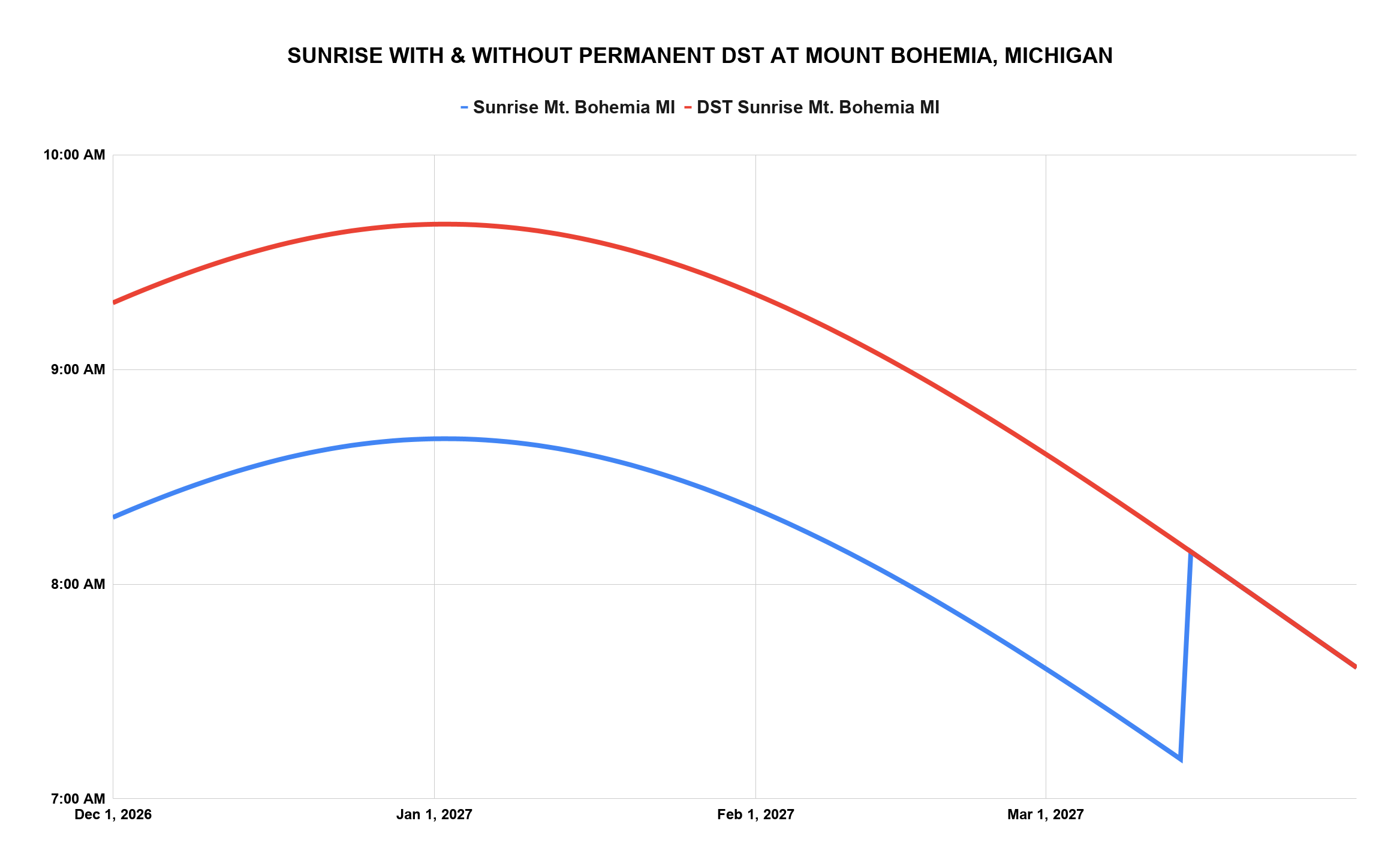
“I can’t imagine a stupider issue to waste time on than changing daylight savings time,” Lonie Glieberman, the outspoken owner of Mount Bohemia, Michigan, wrote to The Storm via text message. “Daylight savings time works.”
Most operators share Glieberman’s concerns. This shift would almost certainly push the traditional ski area opening hour of 9 a.m. later, operators of ski areas across the continent told The Storm. At particular risk are large western resorts that rely on early daylight for avalanche-mitigation measures and patrol sweeps that they cannot conduct in darkness or artificial light.
Ski area operators have been alarmed enough by the momentum behind the Sunshine Protection Act - versions of which have stalled out in past Congressional sessions - to lobby Congress against its passage. Powdr, the Park City-based operator that owns Snowbird, Utah; Copper Mountain, Colorado; Mount Bachelor, Oregon; and several other ski areas, shared with The Storm a letter signed by CEO Justin Sibley addressed to Colorado Congressman Joe Neguse, whose district includes Vail Mountain, Beaver Creek, Breckenridge, Keystone, Copper, Arapahoe Basin, Loveland, Winter Park, Steamboat, and six smaller ski areas (Echo, Eldora, Granby Ranch, Howelsen Hill, Frisco, and Hoedown Hill):
Dear Congressman Neguse,
On behalf of POWDR, one of North America’s largest adventure lifestyle, I am contacting you to share our strong opposition to the Sunshine Protection Act, or any movement towards permanent Daylight Savings Time (DST), and to urge a shift in focus toward permanent Standard Time, if change is necessary.
While the public consensus trends towards eliminating the biannual clock change, forcing the country into permanent DST would deal a severe blow to winter recreation, our workforce, and the 5 million American jobs our broader industry supports.
At our seven ski resorts across the United States, including Copper Mountain and Eldora in Colorado, morning efficiency is everything. Our teams routinely begin on-mountain preparations long before our 9:00 AM openings to maximize daylight for skiers and riders. Under a permanent DST model, winter sunrise would be delayed until after 9:00 AM in many mountain regions. Forcing our essential early-morning operations to take place in pitch darkness would immediately compromise worker and guest safety. While grooming machines can operate at night, critical tasks like lift infrastructure inspections, ski patrol safety sweeps, and avalanche mitigation demand natural sunlight. Attempting this highly technical work in the dark introduces unacceptable hazards.
To guarantee basic safety under late sunrises, resorts would be forced to delay openings until daylight permits. This would shrink the ski day, compress our operational window, and artificially inflate energy costs by requiring extensive floodlighting. Furthermore, because skier satisfaction relies heavily on early-morning conditions, these delayed openings will discourage participation. The resulting drop in visitation will hurt not just our resorts, but the hotels, restaurants, and small businesses in our surrounding gateway communities that depend on robust winter tourism. Finally, if schools and standard business hours do not shift in tandem with our forced operational changes, the resulting scheduling friction will create massive logistical hurdles for our workforce, guests, and skiing families alike.
The outdoor recreation economy thrives when it aligns with the natural rhythm of the day. If a change in our timekeeping is necessary, we strongly recommend moving to permanent Standard Time, which achieves the consistency the public desires while protecting the safety, sustainability, and economic viability of the winter sports industry. As this legislative conversation continues, we urge you to vote against permanent Daylight Time and instead champion permanent Standard Time.
The obvious question is: why not simply shift the standard 9 a.m.-to-4 p.m. western ski area operating day one hour, opening at 10 and closing at 5? The issue, Powdr’s Vice President of Communications and Government Affairs Stacey Hutchinson told me, is that skiing exists in a hardened ecosystem of schools, businesses, and government agencies that are unlikely to alter their own business hours, displacing key skier demographics from timeslots they’ve built ski habits around.
“Visitation in our early hours is important, and unless all the other industries in town shift an hour as well, and schools and businesses start at 10, we would lose the folks who show up at 9 for first tracks and then skate into work,” Hutchinson said in a phone call. “And I don’t think the extra hour in the afternoon will make up for that – that’s when people do afternoon activities, dinner, errands.”
The Canadian Complication
Before I go any further into the hassles of a potential shift to permanent DST for U.S. ski areas, I’ll point out that most of British Columbia already shifted to permanent DST as of this past March. That pushes sunrise in Whistler - by far the busiest ski area on the continent - past 9 a.m. starting Dec. 10. Sunrise would then peak at a high of 9:12 a.m. from Dec. 30 to Jan. 2, and float back below 9 (8:59 a.m.) on Jan. 23.