


On Tuesday, Indy Pass promised 30 new partners over the next week. Yesterday (Wednesday), pass officials dropped the first five: Pyhä, Finland; Kandatsu Snow Resort, Japan; Frost Fire, North Dakota; and Ski Land and Skeetawk in Alaska. Here are core stats for each of these resorts and for the 15 alpine ski area additions that Indy announced earlier this year for winter 2026-27 (the chart does not include Indy’s cross-country roster, including newly added Scotts Cobble/High Peaks XC in New York):
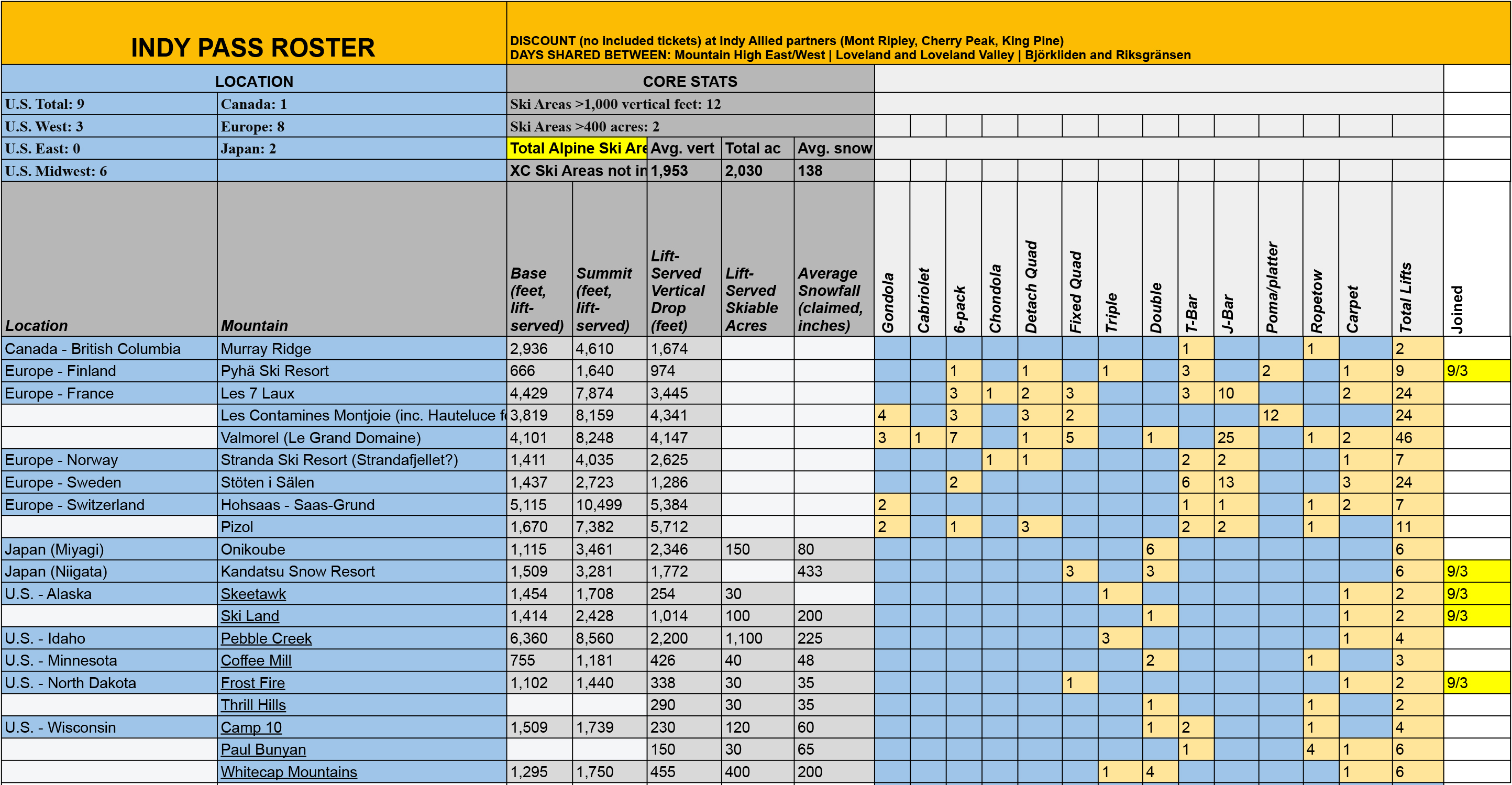
I’m going to save my typical totaling-up across regions and passes until Indy finishes its splurge. For now, let’s examine each of Indy’s latest additions, and how these mostly small and remote ski areas fit into the pass’ broader network.
Skeetawk, Alaska
My Take
Everything in America is either very very old or very very new. Like “Did you know that Pikes Peak is over 1 billion years old? Ben Franklin was just telling me that when I ran into him at the grocery store last week.”
But our ski areas aren’t really old or new. They were all built around the same time, in those few post-World War II decades during which the technology and money to mass-produce mechanized skiing materialized, but before the federal legislation of the late 1960s and ‘70s empowered activist environmentalists to halt a project of nearly any size with a regime of permitting nitpickery and death marches through the legal system. Long live the chipmunks.
But once in a while, someone does figure out how to build a new ski area in America. In the case of Skeetawk, Alaska, which opened in 2020, I guess they did it so far away from everything else or Pinecone Police International was too preoccupied with making sure that salmon weren’t swallowing iron ore tailings that no one noticed until “surprise, we built a triple chair.”
Really, the bump took 40 years to build, and is either on or directly adjacent to the site of the defunct, 500-vertical-foot Independence Mine ski area, which ran a T-bar and at least one ropetow that “incorporated waste straps that were connected to a tow rope holder,” which sounds like a mechanism for the industrial-scale murder of children. “Mike Besh has a childhood memory ‘frozen’ into his mind,” recollects the Alaska Lost Ski Areas Project webpage devoted to the hill. “Near the top he was frantically struggling to get the tow hook off the rope. The metal hook finally popped off the rope, flipped up and hit him in the mouth … where the cold metal hook instantly froze to his tongue!!”
After “many national and international development firms failed to deliver a viable plan for development of a ski area in Hatcher Pass,” reads Skeetawk’s history page, “the grassroots efforts by HAX [Hatcher Alpine Xperience] have taken a dream to a reality in 5 short years by developing a multi phased plan to build a regional alpine recreation facility on land leased from the Matsu [Matanuska Susitna] Borough.” Unfortunately, HAX for inexplicable reasons decided not to name the ski area “Where We Slide Down,” which is the meaning of the Dena’ina word “Shk’ituk’t,” the original name of the village and the etymon for “Skeetawk.”
Anyway, Where We Slide Down Ski Resort Skeetawk’s Phase 1 was, “Let’s A-Team a lift from North America’s ski area boneyards.” If you’re too young or too old to know what the A-Team was, it was this 1980s NBC action series starring four ex-commandoes with a habit of trapping themselves in warehouses or junkyards surrounded by bad guys and then assembling, in the space of about 15 minutes, from like a pile of old vacuum cleaners and coathangers, an improvised tank or helicopter or submarine, which would then erupt from their fortress in a slow-motion salvo of homemade rockets and Gatlin guns, as the crew made their latest daring escape while murdering every sucka in sight. Or sometimes they just accidentally drove their van into a river:
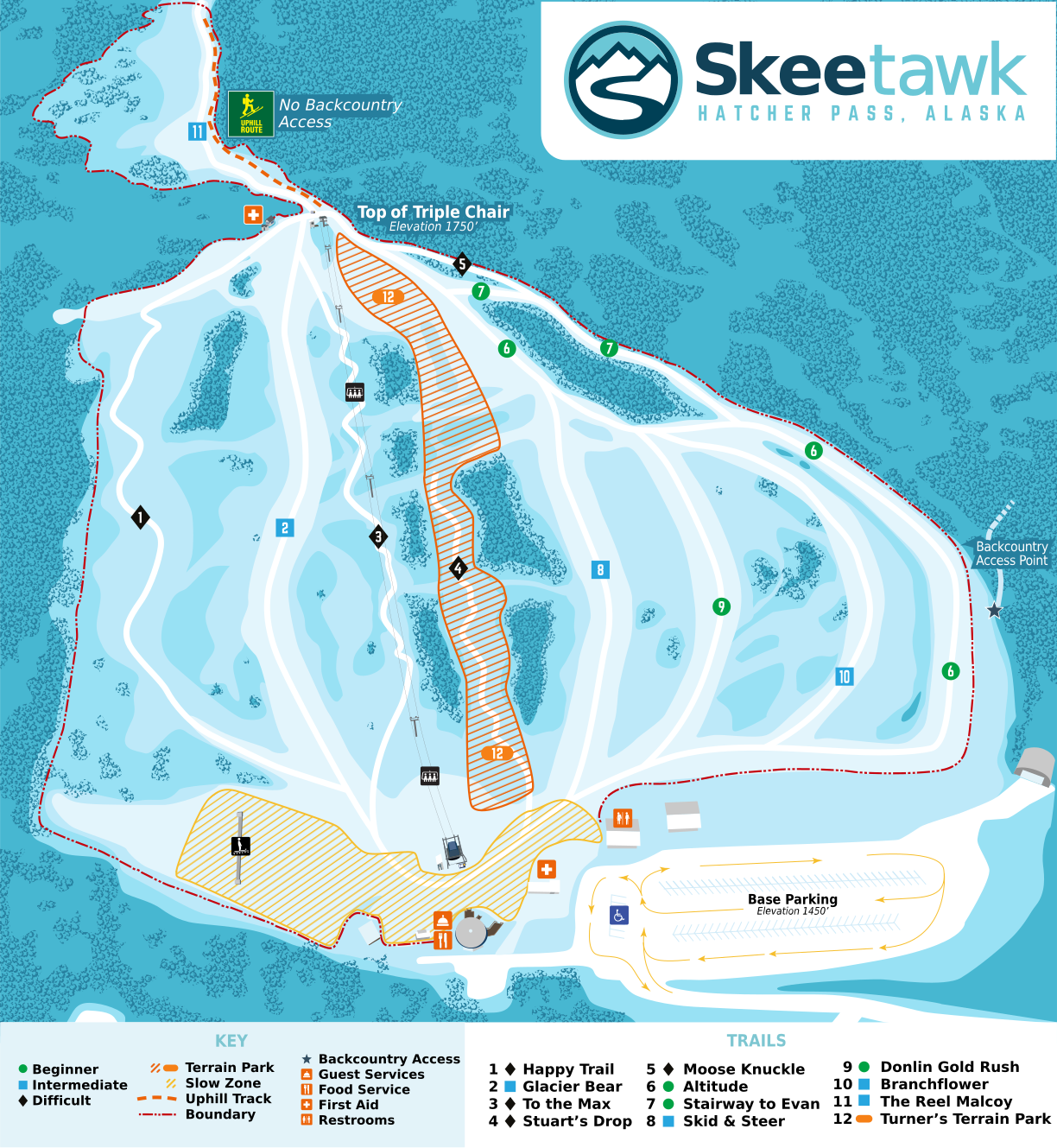
Anyway in Skeetawk’s case the 254-vertical-foot, 1,225-foot-long triple chair is an eclectic Lego kit combining, according to Lift Blog, “tower heads… from a retired lift in Colorado,” Doppelmayr chairs repurposed from another lift, and Poma sheaves.
The comments section attached to each of Lift Blog’s lift profile pages are usually good places to scrounge for additional details on a machine’s backstory. It is also a good place to become extremely confused by conflicting cross-claims. For example, commenter COLLIN PARSONS states that Skeetawk’s triple is “quite the frankenlift. Doppelmayr drive structure, Poma drive bullwheel, Poma towers, Doppelmayr chairs, Hall return structure, Poma return bullwheel.” Commenter LIFTNERD disagrees, writing, “No, it is pure Skytrans. The only components from other manufacturers are the sheave wheels (not the frames) and the chairs, which came from the Summit Triple at Gunstock.”
Anyway there is a triple chair at Skeetawk, which is phase I of a masterplan that could eventually blow the summit up to 4,068 feet, giving the bump a 2,500-ish-foot vertical drop.
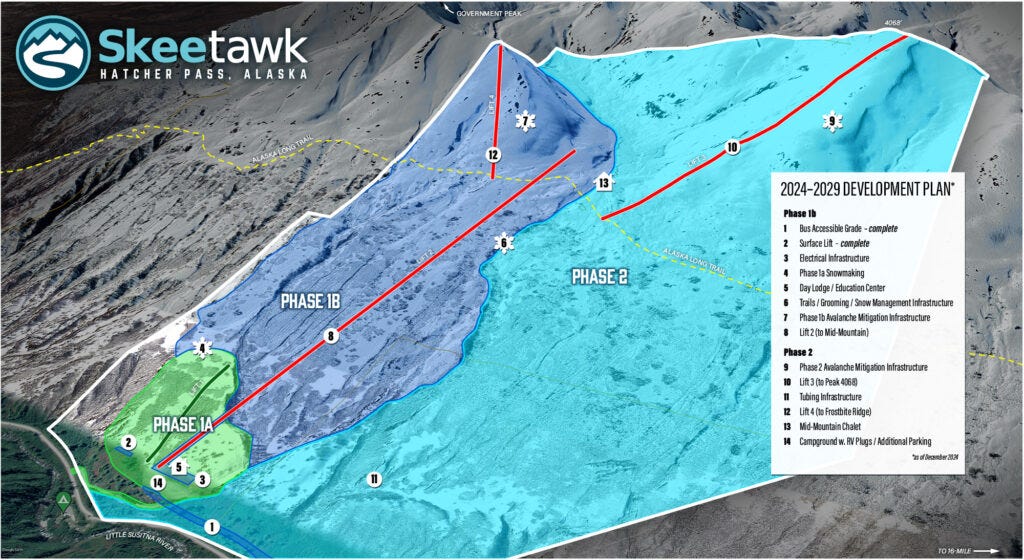
Skeetawk recently began fundraising for phase II, a 1,205-vertical-foot, 4,750-foot-long, eight-passenger Doppelmayr gondola that would rise adjacent to the triple and land at midmountain five-and-a-half minutes later.
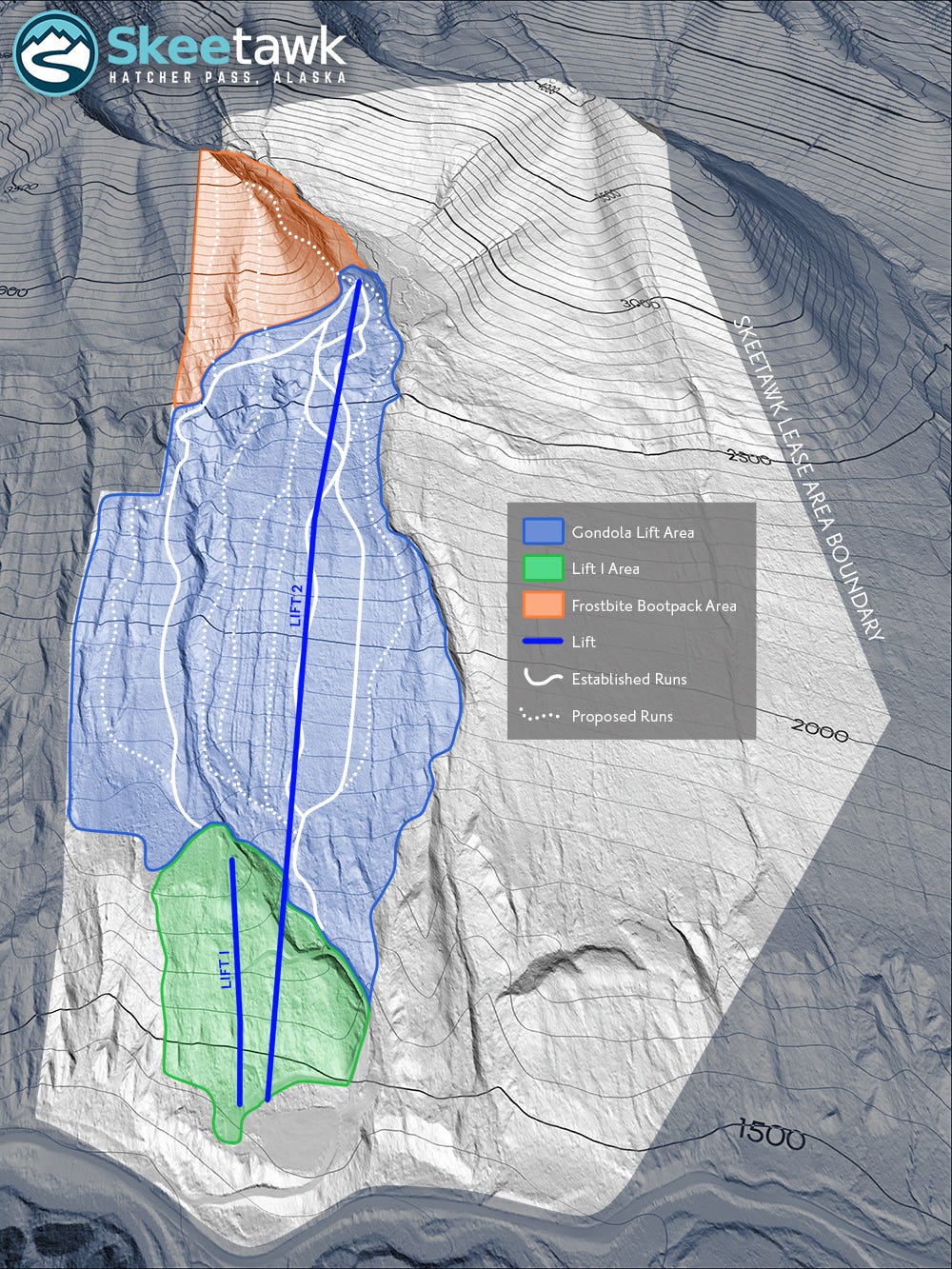
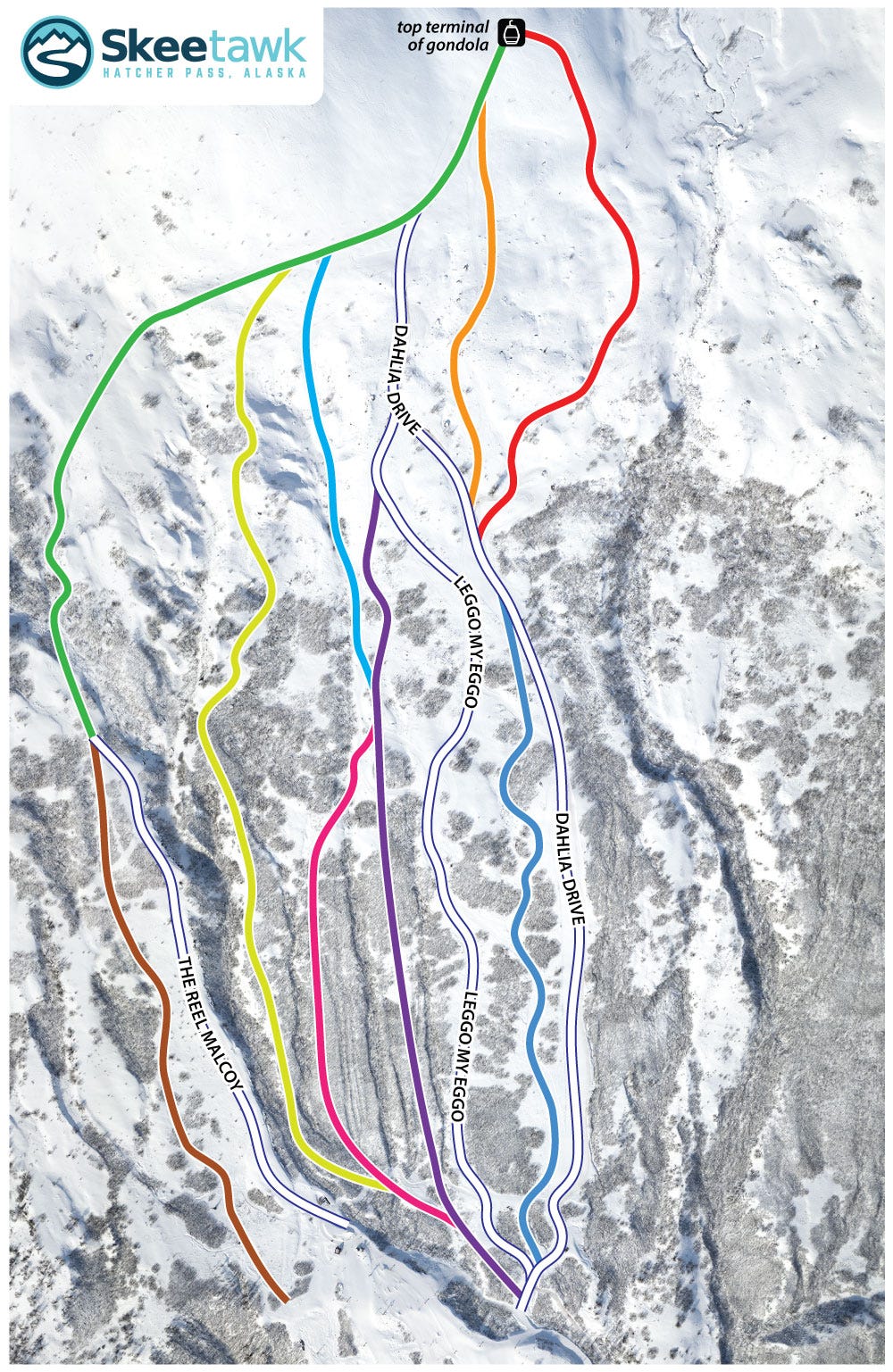
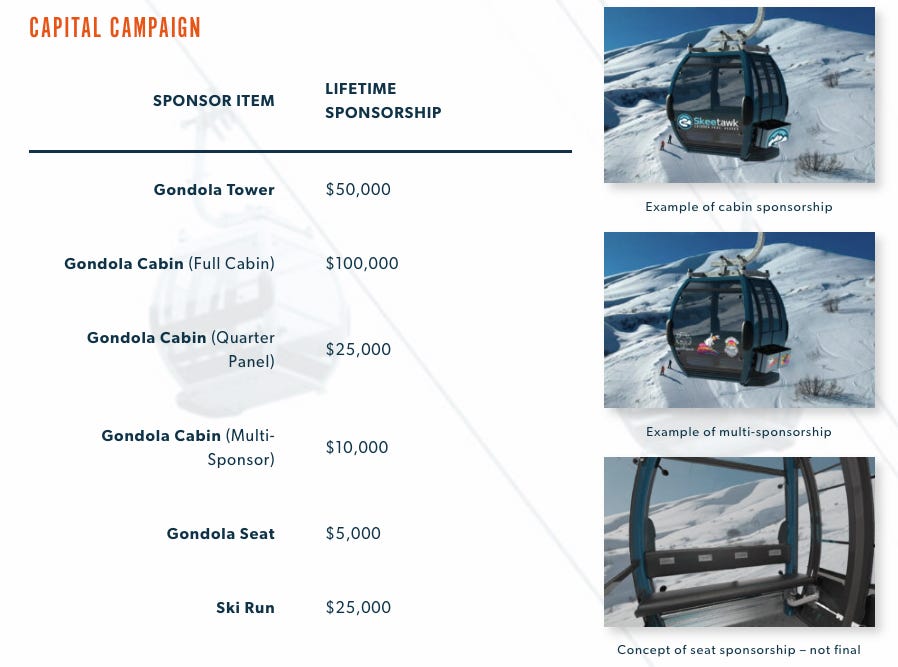
They’ve already began fundraising for the $30 million machine. Who wants to help me raise $25,000 so we can name one of Skeetawk’s new run’s “U.S. America’s Number One Very Best SnoSportSkiing Run Brought to You By The Storm Skiing Journal & Podcast”?
While Skeetawk’s lift-served terrain is perhaps too small in scope to entice Big Mountain Bro up to Alaska, the ski area has been running cat service to mid-mountain as it prepares the mountain for lift two. Treeline in Alaska is amazingly low, and the photos from Skeetawk’s website make it look sort of like skiing in the Andes and sort of like skiing in Switzerland and sort of like skiing in Alaska and sort of like you accidentally got on the snowcat with a group from the Hackensack Ski Club.

Anyway even though Alaska is huge there are only like seven roads in the whole state so most built things are reachable from either Anchorage or Fairbanks. Skeetawk sits an hour-ish north of fellow Indy partners Arctic Valley and Hilltop, though some wintertime road closures or mandatory elk-drawn sledge transfers to ford unnamed seasonal rivers that I’m unaware of may lengthen that commute by several weeks.