


I once read that going back in time was like visiting a different planet. This was around when I was reading a lot of Mark Twain, and I’d fantasize often about the rich but extinct American big-river cultures of the mid-1800s. But damn it if even the lived past doesn’t feel cosmic when viewed from Planet Pet Rectangle. Check out this amazing clip from the Oct. 7, 1985 print edition of the Aspen Daily News:
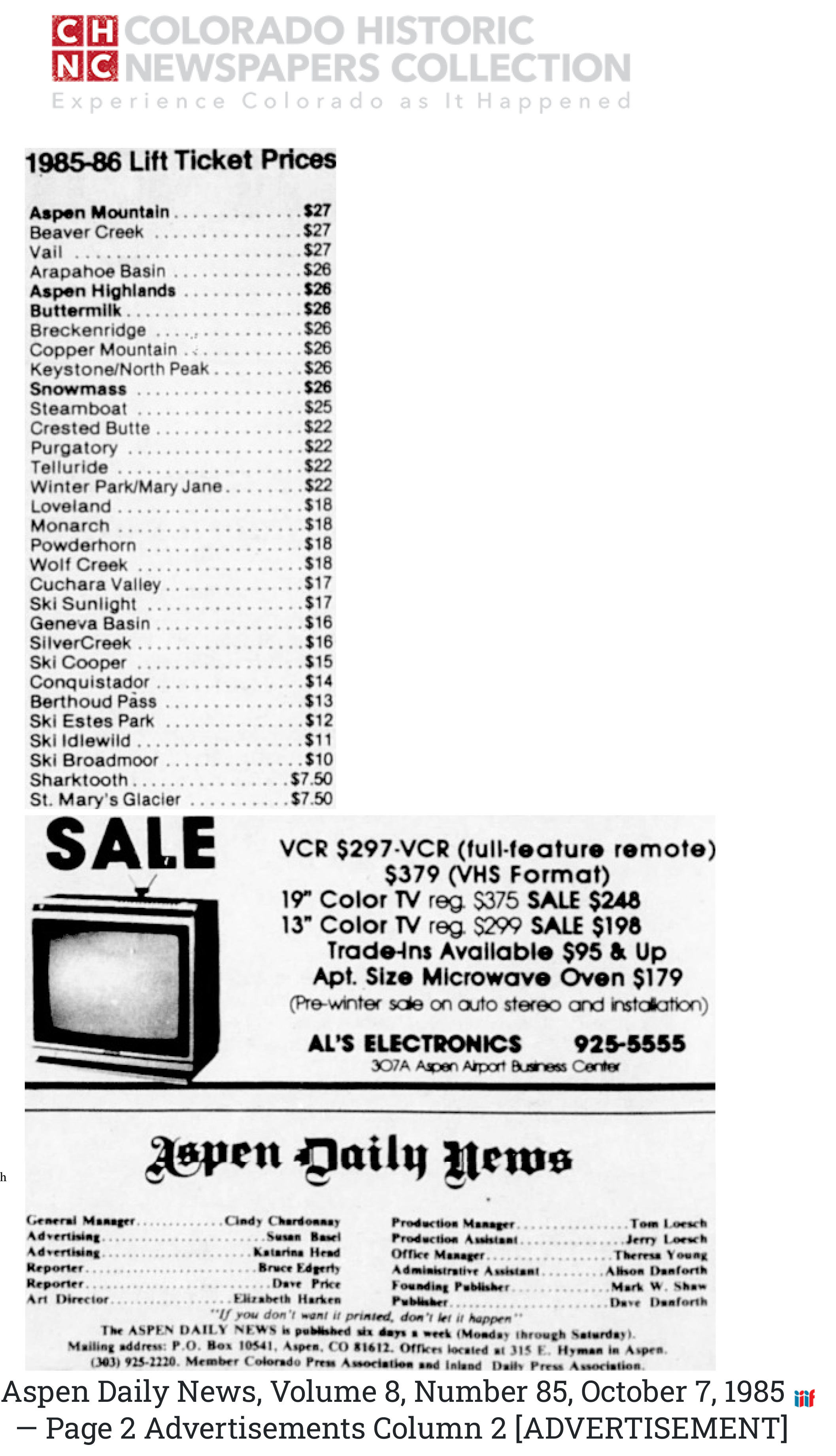
I’m sure the late-night layout editor who smashed a stack of lift ticket prices on top of an ad for televisions on page 2 had no premonitions or intentions that they would be sending a socio-economic cultural freeze-frame four decades into the future, but the juxtaposition of lift ticket prices with technology-of-1985 prices sketches out the stunning trajectory of the consumer economy from that time to this.
Inflation is a tricky monster, so let’s set the raw prices aside for a moment and consider this: in October 1985, a 19-inch TV cost nearly 10 times more ($248) than a one-day Steamboat lift ticket ($25).
In two generations, that economic math flipped: last week, I bought a 55-inch 4K LED internet-connected flatscreen for $179.99 plus tax. That’s $58.38 in 1985 dollars. A peak-day Steamboat lift ticket for the 2025-26 season hit $309, or $100.23 in 1985 dollars.
So in 40 years, the price of televisions has plummeted while the quality of the product and the content available via that medium have improved exponentially, while the price of one day of skiing has skyrocketed as the quality has improved only marginally.
Imagine explaining these strange consumer-price shifts to the newspaper reader of 40 years ago:
Time-Traveling Tim: “My Friend, in the future, television screens are three times larger, the picture quality is 1,000 times better, content options are limitless, and you can watch whatever you want whenever you want.”
1985 Alice: “My Goodness, the TVs of the future must cost more than a house and weigh more than an elephant!”
TTT: “Well you won’t believe it, but these super-advanced TVs cost a fifth of what these dead-weight tube-boxes cost in 1985, and they’re so thin you can hang them on the wall like a painting and so light you can carry them in one hand! And instead of buying it from a guy named Rick wearing a tie decorated in penguins that are also wearing ties you use a computer to order from a place called ‘Amazon’ and an anonymous delivery driver leaves it on your doorstep within 36 hours. And everyone carries a miniature TV around in their pocket, which is also an alarm clock and a camera and a telephone and a computer and a map of every street on earth and your best friend!”
1985A: “Wow! If technology has advanced so much, I can’t wait to hear how much better skiing has gotten in The Year 2026!”
TTT: “Oh skiing is pretty much exactly the same as it is now, just 10 times more expensive.”
Back to 2026, where we know that no one actually buys lift tickets and that phones are also TVs even as we haven’t quite accepted that they are also Pied Pipers leading us to the sea bottom like the Red Bull did with the unicorns. Let’s run that 1985 newspaper clipping through the CPI Inflation Calculator to see what those dollars equal today: