


I just returned from two weeks skiing in Colorado, where every conversation I overheard among locals went something like this:
“Well by gum I’ve never seen such a shitty winter and I’ve lived here for 107 years.”
“Don’t I know it. I got here the day after Lincoln was shot, and these are the worst conditions since the drought of ’84. That’s 1884, you know.”
These patterned chats were at once alarming (I was to understand there’d be Legendary Back Bowls™ if I arrived in February*), comforting (it’s nice to enter one of those rare American bubbles where people actually like snow), and hilarious (the universal habit of American transplants working their I’ve-lived-here-this-long credentials into every conversation is an odd cultural tick that I don’t generally observe among, say, immigrants; admittedly, I do it myself).
*The bowls were partially, minimally open during my stay, from Feb. 8 to 13. Honestly it was impressive how open they were considering the crummy snowpack.
But by the latter half of the trip, it started snowing. And the conversation shifted to “snow is cool” and everyone went skiing. On Friday morning, I drove to the airport in a snow squall, 35-mile-an-hour speed limit in effect through Glenwood Canyon, and arrived back in Brooklyn to traces of January’s snowdump clinging brown and trash-riddled to the sidewalks. This morning, my yard looks like this:
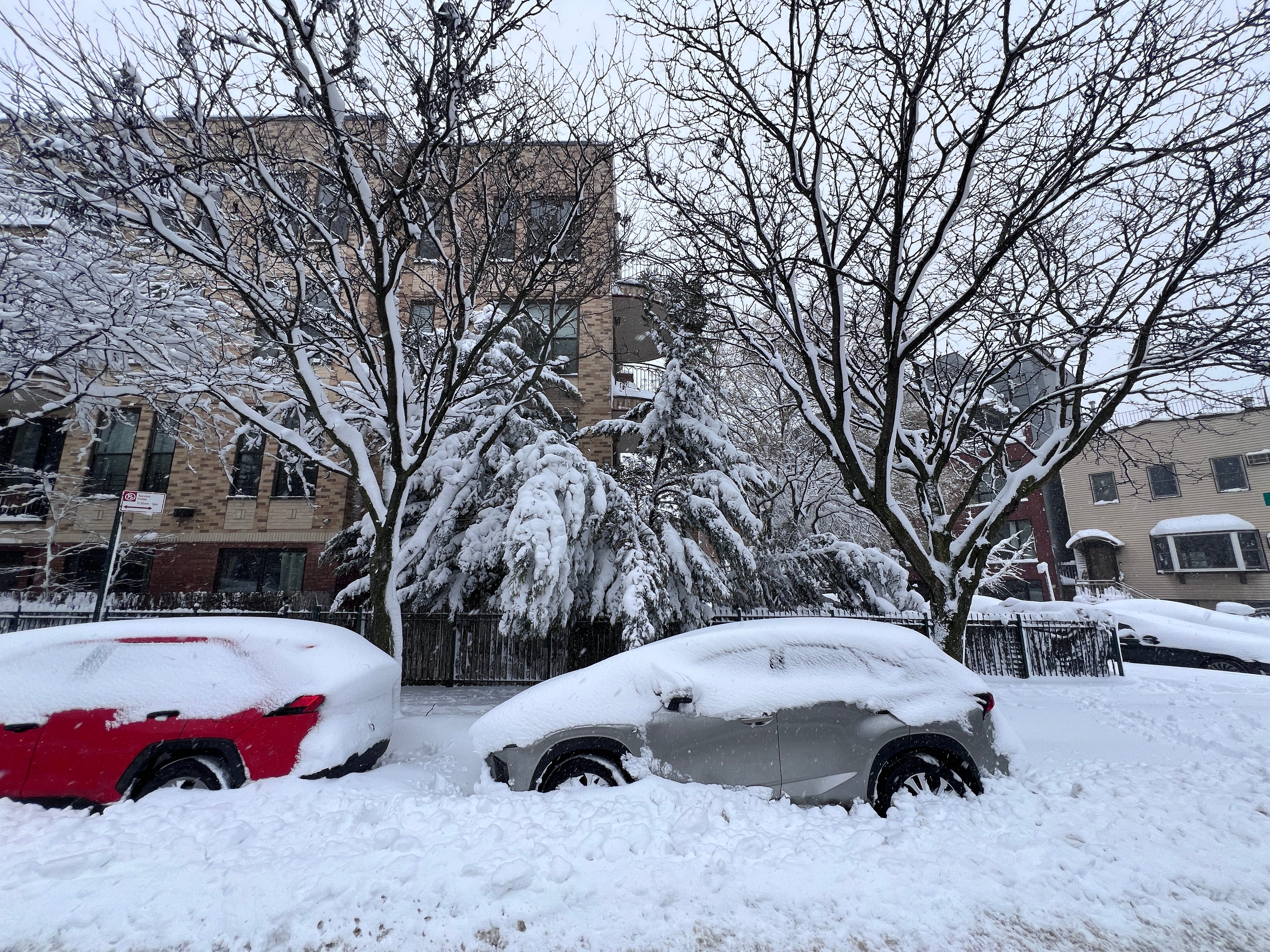
Those pine tree aren’t supposed to go that way. Normally, they point straight up:
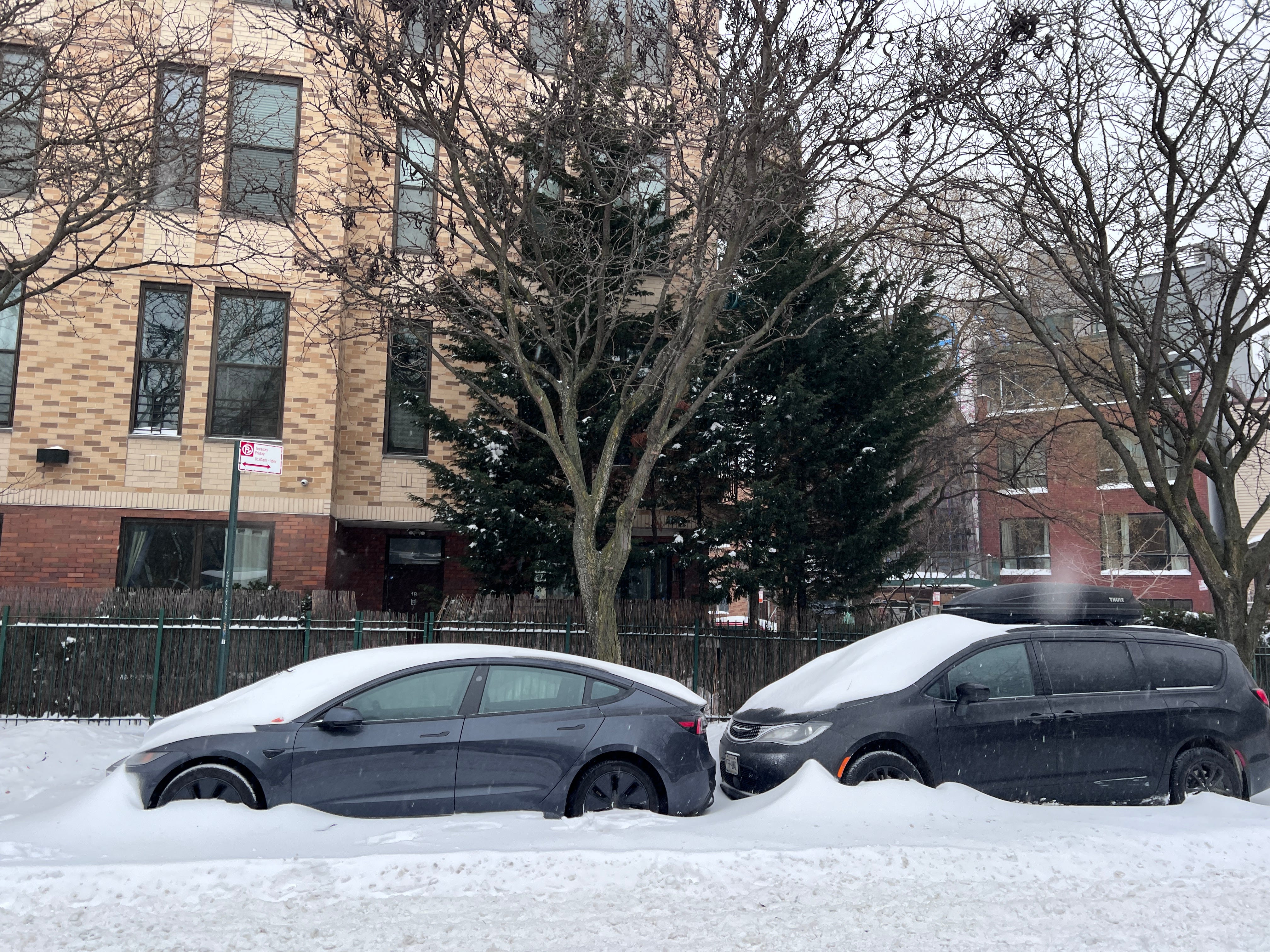
But this is anchor snow, thick and heavy, Cascade Concrete or Sierra Cement, East Coast style, enough to not only cancel school but those obscene remote-learning mandates. Unstamping someone’s one-way ticket to Hell. It doesn’t snow a ton here but it does snow and when that happens we ought to toss the kids outside and say “go do stupid shit” so they remember it always being like that, like we all do. Six of the top 10 snowstorms in NYC history have hit this century and I’ve been here for all of them (see): 27.5 inches in January 2016 (No. 1), 26.9 inches in February 2006 (No. 2), 20.9 inches in February 2010 (No. 5), 20 inches in December 2010 (No. 7), 19.8 inches in February 2003 (No. 8), and 19 inches in January 2011 (No. 9). And since getting out of the city during one of these storms is like escaping Alcatraz I would usually glide around the city on cross-country skis (which tragically broke in the last big snowstorm, sometime around 2022).
January’s blizzard stacked 11 inches in Central Park, NYC’s official snowstake, but the snowbanks stood at least two feet deep for weeks afterward, welded to the sidewalks in a deep-freeze. Today’s edition – a “bomb cyclone,” whatever that means – could stack up to 24 inches. Two big snowstorms in one winter is rare here. Since 1869, only 37 snowstorms have delivered at least a foot of snow to NYC. But long snow droughts, like Manhattan’s 701-day stretch without measurable snow from 2022 to 2024, are also rare.
Which is a long way of saying that weather is weird, inconstant, highly variable, and difficult to categorize and understand. Jay Peak is sitting on 348 inches of snowfall this winter, while Alta has racked 208, Vail is at 119, and Palisades Tahoe is at 278 – 115 inches of which fell over last week’s four-day storm (which kind of appears to have saved the California ski season).
So. This seemed like a good time to check in on our active U.S. ski areas list. My optimistic best-case guess in October was 509 active ski areas. I’ve adjusted that outlook down to 504, with a handful of ski areas officially bailing on the season, offset by a couple of surprise comebacks. Of those 504 potentials, I’ve confirmed operations at 487, including 100 percent of the Midwest’s 124 active ski areas. Here’s what remains:
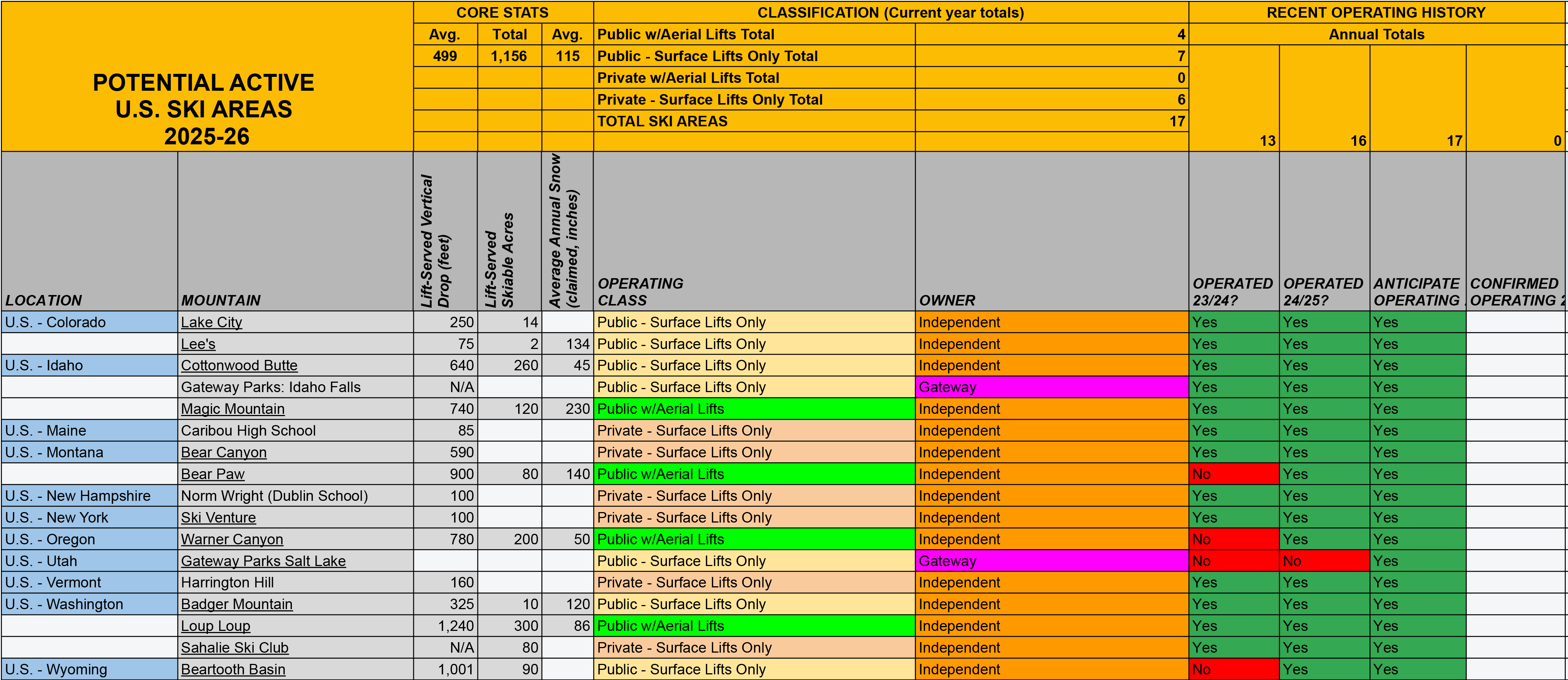
We need 13 of those to activate (or confirm operations), to reach 2024-25’s total of 500 active ski areas, and eight to equal 2023-24’s total of 495. Now, before we start pulling fire alarms with headlines that AMERICA LOSES 13 SKI AREAS IN A SINGLE YEAR, let’s consider some key stats:
Just 4 of these 19 ski areas is a public facility that operates aerial lifts. All five are in the West. None have snowmaking capabilities.
7 of these ski areas are public facilities that run only surface lifts. 6 of these 7 sit at low elevations, and most if not all lack snowmaking. Most are municipally or volunteer operated and do not function as for-profit businesses. All are in the West.
6 of these 19 ski areas are private facilities that operate only surface lifts and are run by a town, school, or ski club. All 6 of these – Caribou High School in Maine, Norm Wright School in New Hampshire, Harrington Hill in Vermont, Ski Venture in New York, Sahalie Ski Club in Washington, and Bear Canyon in Montana - are likely operating, but ski area reps have not responded to The Storm’s requests for confirmation.
1 of these ski areas – Beartooth Basin, Wyoming – is a “summer ski area,” traditionally operating sometime between Memorial Day – when the pass on US 212 between Montana and Wyoming re-opens for spring – and Fourth of July.
In other words, 2025-26 looks like a fairly typical 21st Century American ski season, in which low-volume, low-tech, mostly nonprofit outfits flounder in marginal weather regions, while equivalent operations in hit-or-miss places like Michigan’s Upper Peninsula, New England, and Upstate New York flex like cavemen posing with upthrust spears over a slaughtered woolly mammoth. These are exactly the sorts of operations that have accounted for nearly all annual variation in U.S. ski area counts since 2000.
Which is not to say that this list – and the ski areas I’ve removed as potential operators – isn’t laced with a few bad omens and regional Goddamns. Expect major snowmaking investments as the West grapples with a Pennsylvania winter. Look out for Loup Loup, which was already struggling with a broke-ass summit lift, and Magic Mountain, Idaho, where the owners have kept the lifts spinning more out of a sense of community obligation than because the chairlift was spitting off gold bars (the lift doesn’t even have safety bars, at least for winter operations).
So it’s worth taking a deeper look at these 18 yet-to-activate-maybe-they-will ski areas, along with the five I’ve removed from the list, to diagnose the particular ills of the 2025-26 American winter. And, while we’re there, we’ll examine the ski areas that re-opened after one or several years idle, and a few other positive news points buried in the Year of the Unsnowy Rockies.