

A statement delivered on the subject of ski area lease fees from late congressman Mike Synar to the U.S. House of Representatives Subcommittee on Environment, Energy, and Natural Resources, July 22, 1992 (boldface mine):
As you know, the U.S. Forest Service operates 122 ski areas on National Forest System lands, including 6 of the top 10 concessions operating on federal lands in terms of gross revenues. In recent years, these ski areas generated more than $700 million in gross receipts, but the concession operators paid the taxpayers an average return of only about 2 percent -- a remarkably small return for the exclusive use of taxpayer assets. …
Mr. James Overbay, Deputy Chief of the Forest Service testified on June 25, 1992 before the Senate Subcommittee on Public Lands, National Parks and Forests concerning S. 2606, a measure to revise the system for determining the fees paid for special use permits at ski areas located on National Forest System lands. In that testimony. Mr. Overbay stated that S. 2606 was not revenue neutral and therefore does not comply with the Pay-As-You-Go provisions of the 1990 Omnibus Budget Reconciliation Act. I agree that S. 2606 and its House companion measure, H.R. 4970, appear to reduce the level of federal revenues currently received from ski area permit fees.
Because that testimony and the analytic work which supported it had a direct bearing on my Subcommittee’s ongoing review, I requested that the Forest Service supply all materials including a complete analytic data set supporting the Forest Service’s testimony on S. 2606 and the House companion measure, H.R. 4970.
Mr. Chairman, the Forest Service analysis of these measures raises several serious concerns, especially with respect to what constitutes a fair rate of return to the federal treasury and the taxpayers for the exclusive use of these public lands. Until those questions are addressed, action to change the current system of determining ski area permit fees would, in my view, be premature and imprudent.
That analysis will be ongoing, but in the meantime, there is one Forest Service document specifically relevant to the legislation before, which I would like to provide to you and your Members. This is the Service’s analysis of the impact of the fee structure under H.R.4970 on existing fee levels paid at individual 113 ski areas in short, which would increase and which would decrease and by how much.
I would note that the Forest Service has indicated at the top of the document that it contains proprietary information. I do not believe that is the case. Instead, the financial data which underlies this particular document (such as gross sales for individual ski areas) were undoubtedly designated proprietary by the concessioner, and the designation appears to have been carried forward on this material as well. In fact, I do not believe one is able to determine anything proprietary from this document. For example, while this document contains an average fee paid over the past three years at particular ski areas, that single figure is meaningless unless one also knows what the gross sales figure was for that ski area. That gross sales figure is not on this document. …
I do, though, want to say something about the efforts of some federal recreation concessioners to keep information about their gross sales and rates of return out of the public domain. You may recall that in 1990 a group of National Park concessioners actually brought a law suit against the Inspector General of the Interior Department to suppress publication or release of such information. Mr. Chairman, that any segment of the recreation industry would ever go to such extraordinary lengths to keep the public from knowing how much money they make off these private concessions on public lands—and how little is being returned to the treasury in my view speaks volumes about what that information shows.
I cannot accept an argument that the taxpayers -- who have given concessioners the exclusive right to operate and earn profits off public lands -- have no right to know what those concessioners are making and how much they are returning to the public. I think that is simply outrageous.
Mr. Synar, I agree. And while I am less concerned with financial receipts than I am with skier volume and how record U.S. skier visits since 2018 have impacted communities across the West, our animating belief is the same: ski areas operating on public land should be transparent with the public about what is happening on that land.
For decades, a tacit component of this public-private agreement was the annual release of skier visit data by ski areas operating on Forest Service land. These figures were widely cited by journalists, academics, and government agencies as one way to communicate to the public how weather patterns, demographic shifts, and infrastructure projects within and outside of ski area bounds impacted the communities adjacent to ski areas. With that context, the public could understand what ski area operators were doing well and where they were failing to adapt, and could in turn use that information to guide future development and policy decisions.
Ski area-specific data began drying up around 2010, and more or less evaporated after the 2020 Covid shutdowns. Unlike many things that get blamed on Vail, this was Vail’s fault, though I also fault the rest of the industry for parading after them. How this shift happened, why it was a mistake, and how we’re going to fix it are topics I’ll save for another day.
In the meantime, I’ve been patching together the past. You would not believe how incredibly difficult this is. Ski area operators appear to have not only masked current skier visits, but to obscure – or at least blur – the past, bullying the state ski associations into removing from the public domain archived documents itemizing these statistics.
Last month, I published 2,406 years of skier visit data that I’d scraped from archived newspapers, U.S. Forest Service documents, academic studies, and public records. I kept going. I’m up to 4,213 years across 211 ski areas, and 3,422 years across 128 ski areas for which more than 10 years of records exist. While this is slow, tedious work, it is slow tedious work that no one is ever going to have to do again, because I’m organizing it all in one place. Here is a (nearly) complete record of Colorado skier visits from winter 1976-77 to winter 2009-10 (black means the ski area didn’t operate; red, which is just Eldora 1983-84, means I couldn’t find the data):
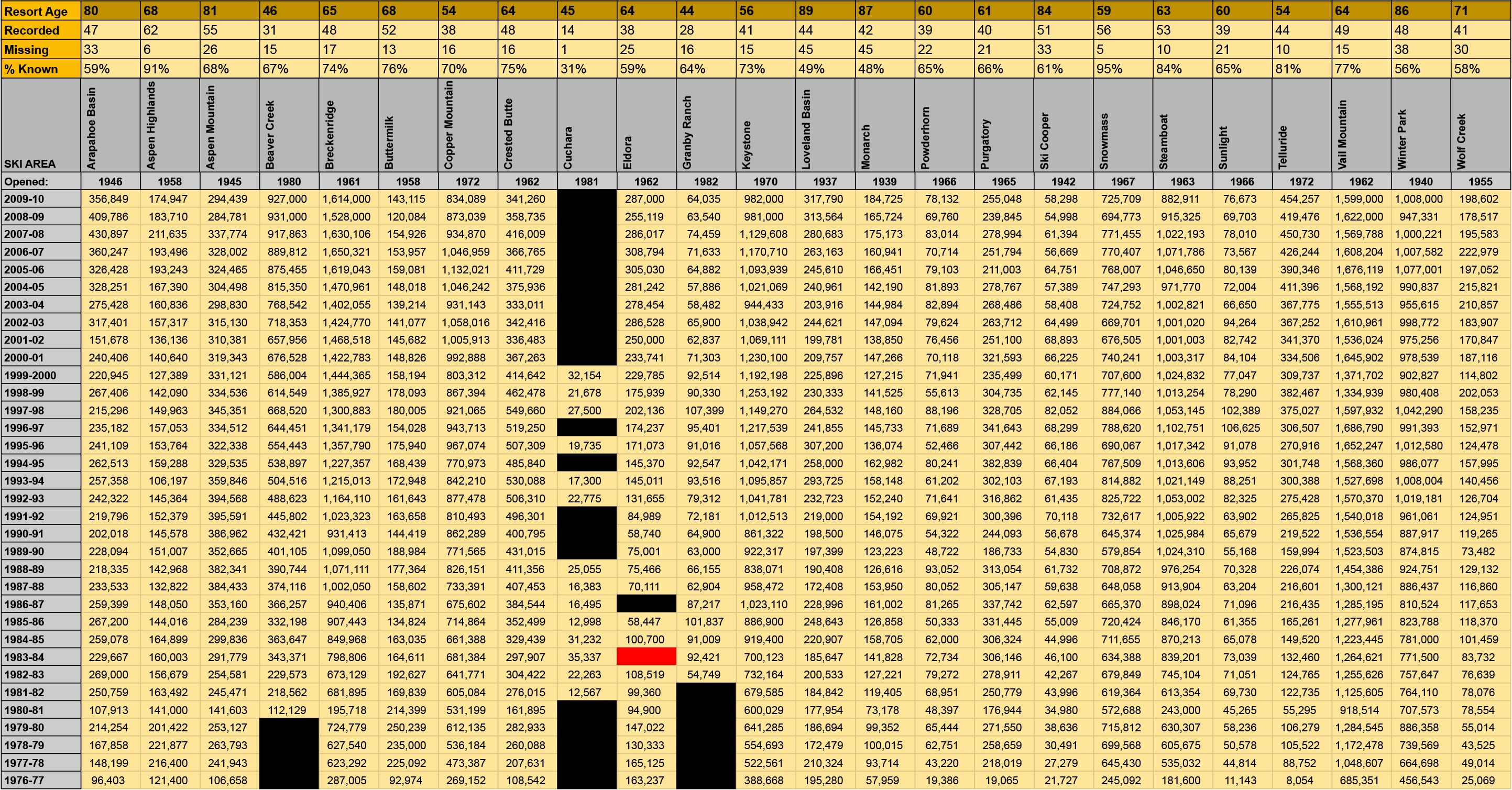
The brickwork falls apart after the 1976-77 season, and more or less disintegrates by the early ‘60s. That’s a hazard of time, but what’s happened since 2010 is a hazard of corporate power forcing bad policymaking. Here is the full Colorado chart stretching backward from this past winter to the beginning of the state’s ski industry:
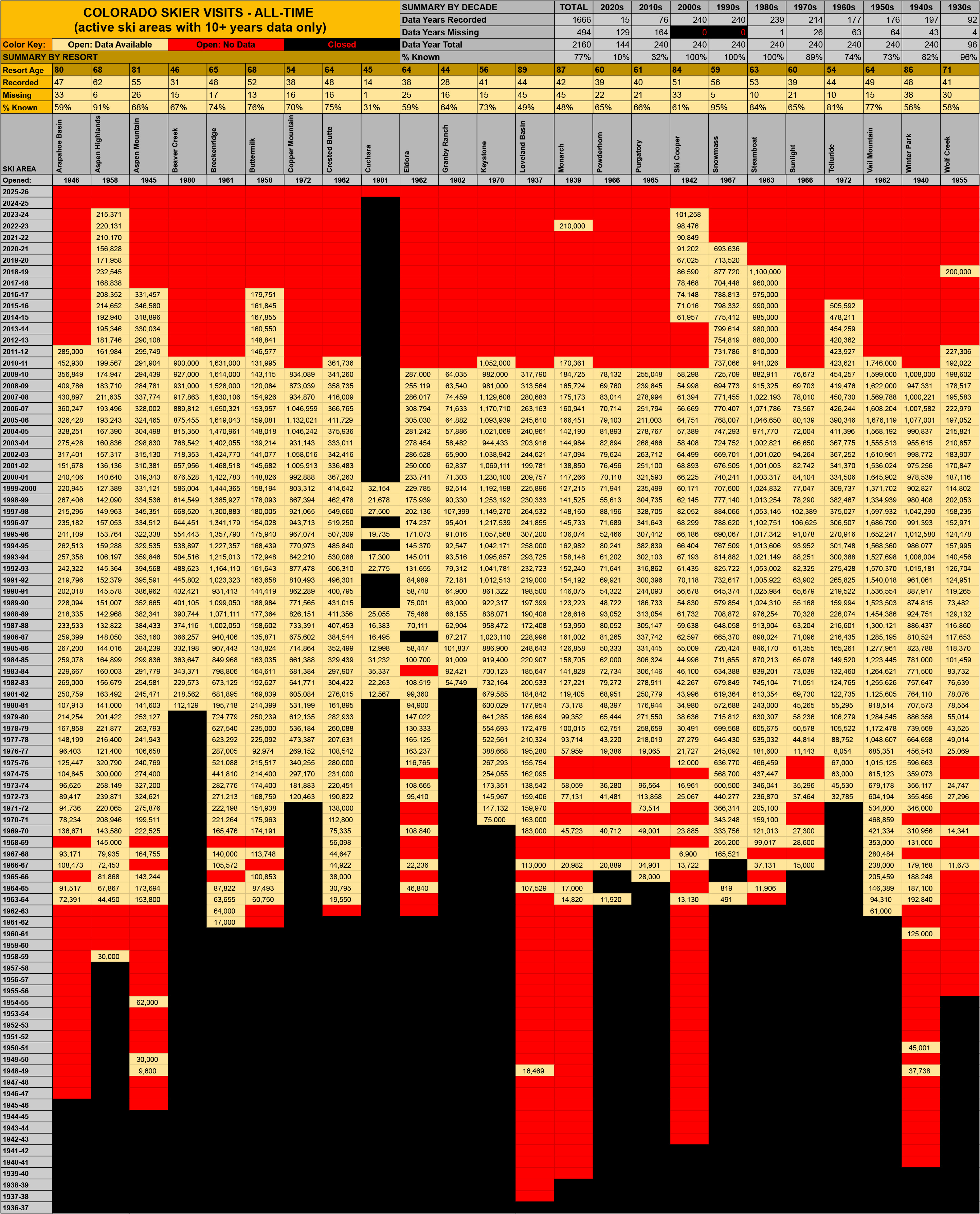
Since 2010, the Epic and Ikon passes, industry consolidation, social media, evolving work and social norms, shifting population and age demographics, short-term rentals, and byzantine regulatory regimes inherited from a different time have, among other factors, dramatically changed the ways in which people access, utilize, live, and work in these mountain communities. State-level metrics are useless in helping us understand these impacts: Southwest Colorado has nothing to do with Summit County, which has nothing to do with Steamboat, which has nothing to do with Eagle County.
Annual skier visit information for ski areas operating on public land should be public. Credit to Aspen Skiing Company and Whitefish for continuing to annually provide these metrics. I will continue to chase this information, which I believe to be foundational to understanding the current state and future trajectory of U.S. skiing. If you’re in possession of ski area-level skier visit data for any ski area, from any era, please share it so that I can add it to the full database. If it is post-2010, all the better. I will protect all sources as anonymous. As Mr. Synar stated so well more than three decades ago, ski area information isn’t proprietary just because ski area operators say so.
Stuart, As we used to say in the 60’s - which were actually the 70’s - Right on! I look forward to seeing you successfully retrieve skier day data -and while you’re at it, ski accident data. I tried to get the data years ago to look at accident rates in areas with Professional Patrols v NSP (Amateur). I wasn’t able to get the data. If I could have accessed the data I could have presented it at an annual conference that year in Val D’Isere. Chris Brown presents there without fail and encouraged me to write a paper do we could enjoy the trip together. Chris is a mechanical engineer and former NCAA champion skier so he is well positioned to help design the binding which purports to protect the anterior cruciate ligament which is not protected by current bindings. It’s called The Knee Binding and in the past they have posted on the internet. Enjoy the Fourth and the coming summer. All the best, Dick
You are a masochist, eh’