


It’s a remarkable tally, a testament to American industrial efficiency and capacity, to the durability of machines well-made and well-maintained: the hundreds of active chairlifts crafted by more than two dozen companies that have shuttered, dissolved, or been ingested by competitors, most of them decades ago.
A handful of one-offs remain, legacies of skiing’s start-up era, when America’s huge World War II industrial capacity pivoted from building death machines to building fun machines. As far as machines go, ski lifts are fairly simple, and dozens of companies strung a bullwheel-and-haulrope-hanging-chair contraption up the nation’s mountainsides. Oddball survivors include the Blue double at Mt. Holiday, Michigan, built by something called St. Lawrence at a long-defunct bump called Carousel Mountain and moved to its present location in 1985; Kelly Canyon’s Lost Treasure double chair, built by Hjorth Brothers at Sundance, Utah in 1965 and moved to Idaho sometime after its 1995 de-commissioning; and the Barnstormer double at Coffee Mill, Minnesota, built by Cosmos for Steamboat’s 1963 opening and moved east in 1983.
Those are curiosities, footnotes. Their most useful contribution to the story of American skiing is to help us understand the breadth of competition in skiing’s lightly regulated early days. What I want to focus on today, however, are the defunct brand names that, despite their shuttering decades ago, still spin more than 100 chairlifts: Riblet, Hall, Yan, and Borvig. These numbers are remarkable:
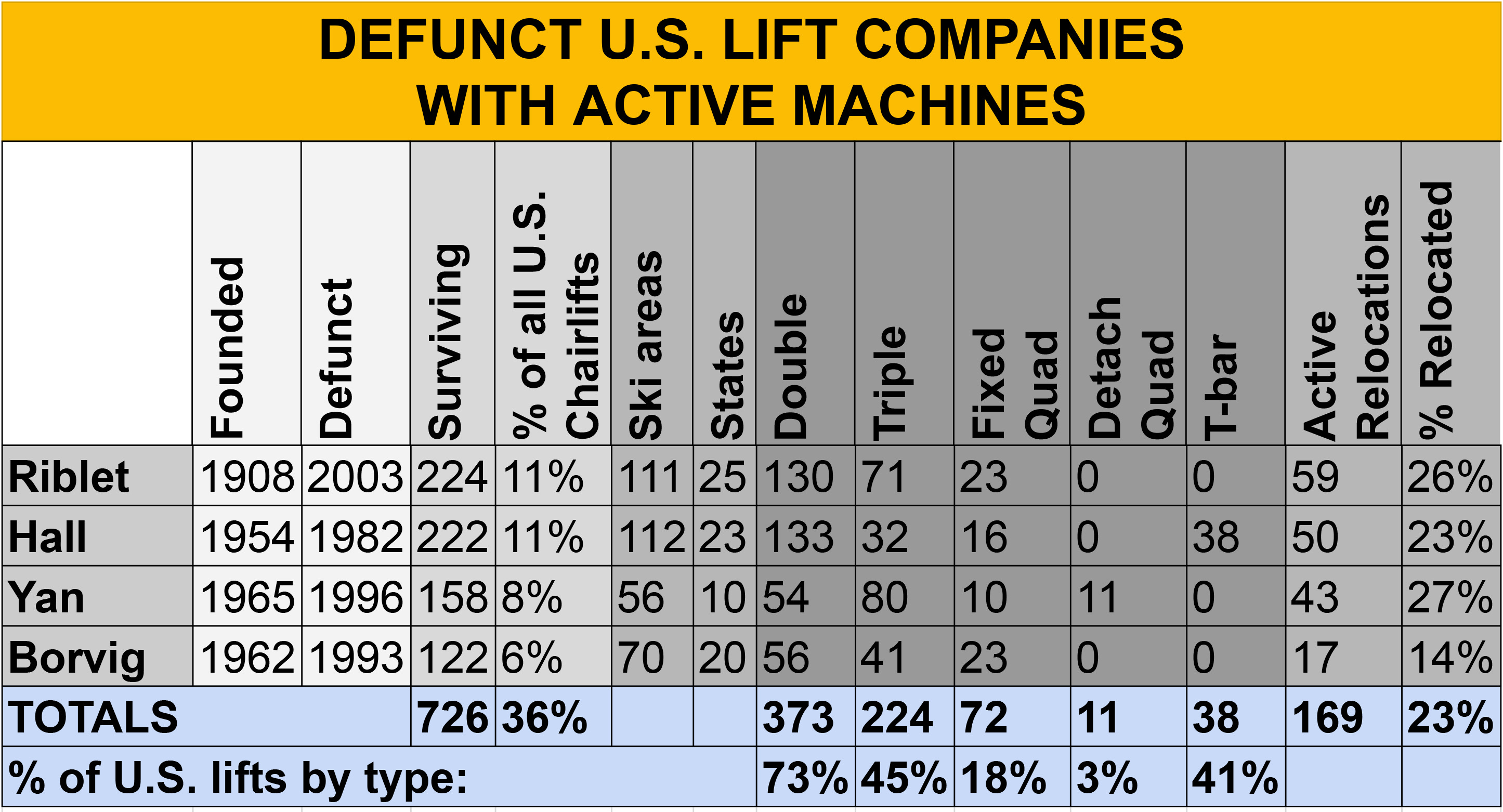
Riblet folded in 2003, Yan in 1996, Borvig in 1993, and Hall in 1982, when the company merged with Von Roll. And yet these orphaned lifts still account for an incredible 36 percent of America’s 2,000 active chairlifts and T-bars, 73 percent of all active double chairs, and 45 percent of active triples.
How impressive is that? Nearly one-quarter of all active U.S. chairlifts are Riblet, Hall, Yan, or Borvig lifts built on their current lines between 1960 and 1989:
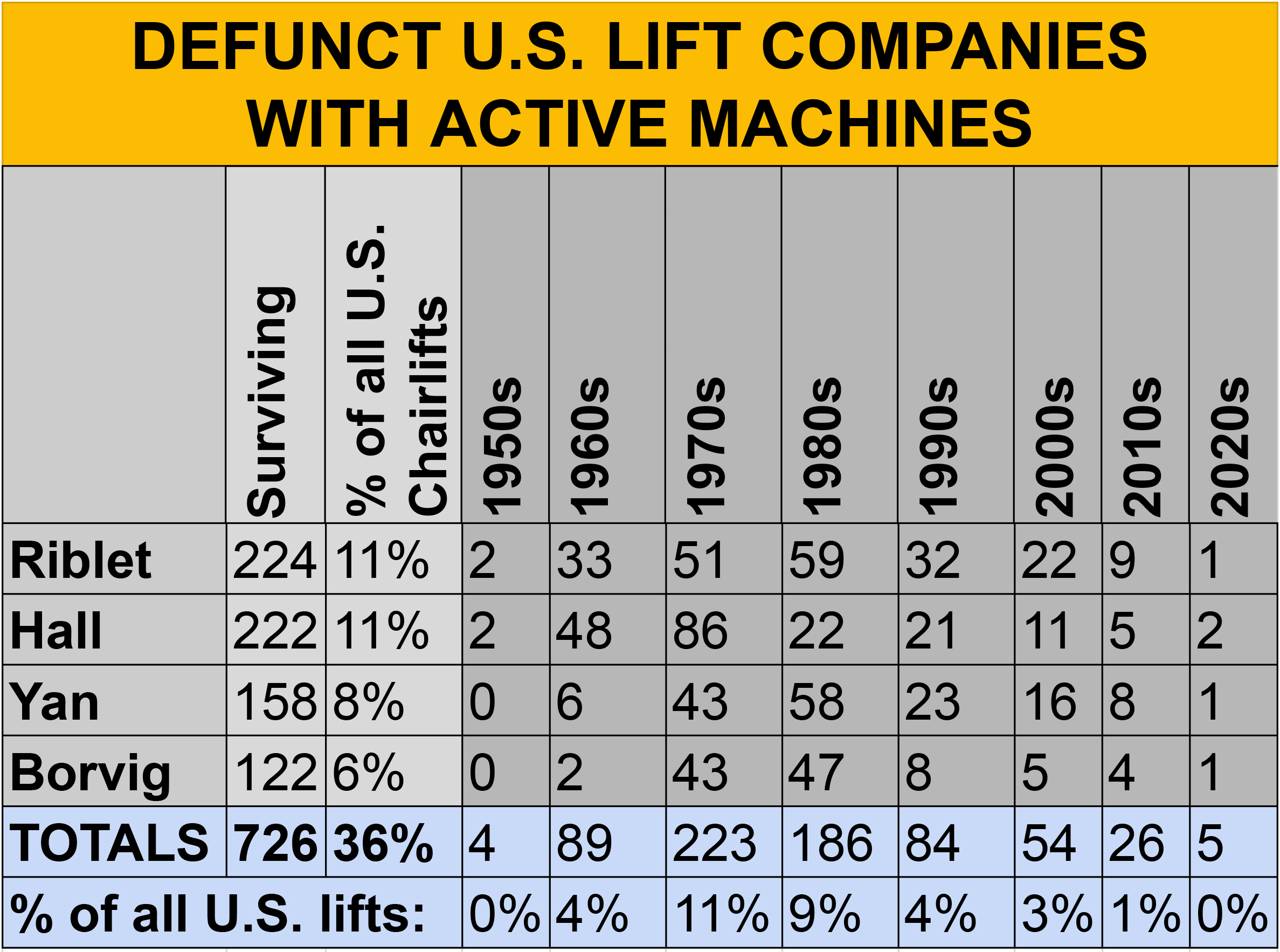
The robots tell me that perhaps two percent of all functioning U.S. vehicles were built before 1990. It’s rare to even see a Pontiac, shuttered in 2010, or Oldsmobile (2004). Machines wear out, making the longevity on display in America’s lift fleet a remarkable display of endurance.
But someday within the lifetime of most people reading this, just about all of these lifts will probably disappear. Several retire each year. Last year, we lost three Riblet doubles: the spectacular Primo and Segundo at Sunlight, Colorado; and the wild Chair 2 at Alpental, Washington. This summer, four more: Angel Fire’s Lift 2 (built in 1966); Rocket at Marquette Mountain, Michigan (1972); and the up-and-over Chair 1/Chair 2 combo at Little Switzerland, Wisconsin.
But, hey, I’ve accepted that. Sunlight and Alpental got modern fixed-grip machines, and Angel Fire skiers are getting the state’s first six-pack. Continual upgrades are a sign of a healthy industry, as I wrote last year:
RIP: Last Original Chairlifts Demolished at Alpental, Big Sky, Sunlight, Meadows

It’s some kind of topographic miracle, this sprawling ski complex an hour east of Seattle: 2,000 acres, 428 inches, 25 lifts, soaring views, door-to-door interstate connection. Michigan-based Boyne Resorts has run The Summit at Snoqualmie since 2007 and itemizes the center as one of the company’s 10 ski areas, its second largest after Big Sky. The on-th…
But the loss is easier to process (at least for me), if I’ve ridden the machine, felt its bumps and burps, marveled at its chug-chug minimalist machinework, stood with skis planted watching 60-year-old chairs in their rhythmic ever-up. I was able to do that with the chairs at Little Switz, Marquette, and Alpental, but I missed my chance for Angel Fire and Sunlight.


So here are checklists of what’s left of our American fleet of Riblets, Halls, Yans, and Borvigs. You can quibble with the details here: is Mount Bohemia’s triple truly still a Riblet now that it’s been retrofit with Skytrac terminals? Are Sun Valley’s modified legacy detachables Yans or Doppelmayrs? Does Borvig really count as extinct when Partek emerged from its ashes and still maintains the old fleet?
But if you’re counting, or you just like old stuff, or you want to pretend its 1965 for five minutes next winter, here’s where to start (or, for many of you, where you’ve already been):